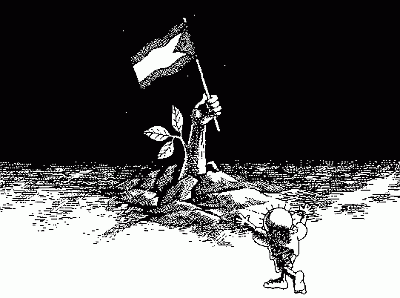
Couple of years ago, I started blogging, and I decided to blog for change. I decided I needed change from face to face politics. I was writing extensively, almost on daily basis, but then... I lacked the time, there is no time to write. Eventually, I started running out of motivation and stamina. Even on the blogosphere I was losing it.
To be honest, ever since 1997 I have been active on the ground. I used to participate in a lot of demonstrations: freedom of speech, civil marriage, and against Israeli atrocities (to name few). I have been active since then, and in those days, me and the fellow "comrades" dreamt of a left-wing Lebanon free of all those corrupt political parties. We had a dream to demolish sectarianism, free ourselves from Syrian chains of thought control, and proceed to continue struggle against Israeli ethnic cleansing against the Palestinians and Lebanese. We had dreams to shatter the borders between Lebanon and Syria, get rid of the Baathi brutal regime, and establish people's republics away from tyranny. We already were dedicated leftists then: each one of us had the experience to be beaten by political party hooligans, the armies (Syrian or Lebanese), and had the guts to go to South Lebanon and stick up our middle fingers in the face of Israeli cowardly soldiers who occupied Lebanon (and still occupy Palestine). Some friends were even more bold, they were students, and they went in a demonstration and throw those chicken Israeli soldiers from Arnon for 24 hours (Israel brutally returned and almost committed a massacre against those brave university students). We were stalked by Syrian second bureau into our houses, and we demanded social justice. In a nutshell, what our non-political activists used to call us: crazy and insane.
One of our aspirations was to dismantle the Lebanese Communist Party and get rid of the Stalinist features. Of course, some broke out and triggered a chain reaction briefly. These people were saluted for their courageous move; nevertheless, they ended up as the founders of another reactionary movement (even though that movement barely has 150 people in it): the Democratic Leftist Movement (as in the Neo-con "Leftists").
We never knew religion, we thought that religion is an invention, and one day we will bury that feature of Lebanon in the graveyard without return. We used to meet up with all types of university students, go and talk to farmers, the proletariat, and anyone. We used to convert party members into free lancing leftists. We thought the whole world was ours. In 1998-1999, we thought that the revolution will begin. Civil marriage was close to be implemented, yet we were far to get that part alive. We retreated with more heat and excitement to change Lebanon, the Middle East, and even the whole blasted entire world. Breaking ethnicity and uniting the workers of the world was easy then. We did believe it, no matter how much the Syrian army tried to shut us up or demoralize us. We were seculars and against Zionism: how could they get their loyalists to accuse us of treason? Beat us instead. Yet, we stayed active. Heck, we had the chance to go to the Lebanese border, after the Israeli army withdrew like cowards, and we had the chance to stick up our middle fingers straight from the borders, with Palestinian grounds for the first time, appeared before our eyes. Yes! As one comrade said in excitement: We are one step closer to our zillion billion goals. Sadly, nothing good lasts for ever.
Then, slap after slap took place. Our different groups of lefties started to crumble down, one after the other. Part of the reason was power struggle and lust for power. Between the Democratic Leftists' bullshit of scaring people away from the left and the Lebanese Communist Party's crappy salutations to "Comrade" Stalin, we were losing grounds. The main reason of our failures were plenty. I demonstrated for Palestine for unaccountable times, yet nothing was done. It was the capitalist powers that decided everything over there. We demonstrated for Iraq in peace demonstrations that aimed against US Imperialism and the dictator Saddam, and the US – UK coalition by-passed the UN and shattered Iraq into a three way ethnic groups. Suddenly, to a lot of people: what is the use to go into demonstrations? We always had those rotten dinosaurs like Elias Atallah or a free lancing leftist suddenly jumping in front a demonstration and then pause to the cameras in order to appear they were demonstrating. Who invited those dorks (prior to the foundation of Democratic Left Movement)?
Then there were the anti-Syrian demonstrations, we took pride in those demonstrations. We succeeded in transforming several demonstrations from Christian versus Syrian to Lebanese versus Syrian hegemony. Walid Junblatt then was defending Syria for the sake of the "Arab Cause" against Israel. We emphasized that solidarity to our brothers and sisters of the Syrian proletariat is a must! That we should together get rid of all our leaderships. Of course, Syria responded with brutality, or get their allies to gather more of their supporters whereby rallies of praising: "Mother Syria". Yet, we stayed active despite the fact our jobs were threatened and everything. We wanted Syria out, but we demonstrated against Aoun's "Syrian Accountability Act" that was launched in DC. Yet, we were little people. The only time anti-Syrian hegemony kicked off in Lebanon is when the late Prime Minister Harriri was assassinated. Hence, mobilization was sectarian in basis, even though Bahiya el Harriri and the late Samir Qassir (the only decent figurehead in the DLM) tried their best to keep it secular (Elias Attallah by then was more Junblatti or Harriri than Junblatt or Harriri themselves, trust me, I know him in person).
Then afterwards, sectarianism entered our private lives. Several comrades started to argue that "we shall demonstrate for civil marriage, but we shall get married in a religious marriage" or "we shall not marry a person non-Christian or non-Muslim". Heck, I was told by several comrades: "if only you were of sect X or Y". Now, tell me dear reader, how does that make you feel?! Nevertheless, I thought we can get it through.
People were involved with jobs, they preferred to stay away from activism instead risking their jobs.
Each 10 lefties built a group, they proclaimed themselves: the real and only leftists fit to "rule" or "guide" other leftists.
Of course, that doesn't exclude other factors as well: the sudden birthrate of NGOs. Those took out a lot of activists from the arena, and suddenly they believe that "lobbying" is the only way to reform the Lebanese government. That is a different topic on its own, as I collected about 90 statements from fellow comrades who were active in NGOs. Nevertheless, these NGOs are business traders, get a part of whatever funding this or that NGO receives. The fact that Ziad Baroud made it as Minister on the behalf of the NGOs, gives them some sense to celebrate; however, Ziad Baroud, is not the NGOs, and Baroud is not involved in the power struggle of these NGOs that scavenge for funds and try to recruit people as "volunteers" (or the NGO term: free labor). Yet so far, these freaks of new capitalism had done better results than others (as much as I hate to admit it), even though at a very very slow pace whereby several top NGOs had scandals being leaked out.
Then 14th of March and 8th of March came out. The remainder of my friends were scattered between those two blocks. My "comrades" of each side accused me of treason for the Lebanese cause because I refused to join them. They accused me of treason for betraying the Palestinian cause. As far as I remembered: Being revolutionary Marxist doesn't mean I was a die-hard nationalist like the latter two. Each of the comrades of each block cut their connections with the other, after they had their blood mixed on the floor from beatings during demonstrations. Of course, they both boycotted the "non-nationalist camp" like me on a social level. By die hard nationalism, this is what I mean: half of the Lebanese are racists to the other half and vice versa (at least party affiliated people). Hence, at a one point, there was no difference between the stands of the Lebanese Communist Party and crazy Aoun's Free Patriotic Movement or the Democratic Left and Saad el Harriri (ultimate symbol of capitalism). That bogged me down.
Then the July war broke out, and I was involved extensively with relief activities in the war. There, I forgot all those lefty bureaucracies, treacheries, and other things. I poured my heart out in activity. I was convinced my activities were breaking the media black-out imposed by Israel on the world. I did great even. I saw the war join some friends, but the great divide remained between the comrades. Heck, some comrades enjoyed how Israel bombed Dahhieh with the hope that Hezbollah learnt a "valuable lesson". Others turned relief work into business (Does Lebanon Aid ring a bell to anyone?). As for our group of relief activists and media warriors, the movement became short-lived as the power-struggle came into existence. At that point, I lost hope, I was shattered.
It was around early 2006 that I started to blog, I decided to start reconstructing the history of Lebanon, Palestine, or anywhere as they happened. I thought that was the way. Then I started to meet other bloggers, some of them to this day do not know who I am. Others were wonderful, and blogging became a means to express my frustration. Yet, even blogging, what can it do on day to day basis except fuel the anger, and feel helpless against everything. I no longer crave for a demonstration. When Nahr el Bared bombardment took place, I spent it quarreling with other friends who were bravely active there (although to do a mini-save, I did announce their campaign). The quarrels were based on the fact I wasn’t participating. To be honest, the 2006 war took out my energy, and the disappointments kept slapping me on the face; work wise or activism wise. I couldn't tolerate another crap from anyone. I was totally drained. By then 11 years of activism was too much for me. We used to take one step forward, and three back.
Then I started to look elsewhere, where in the world the left is doing great? The man we hailed as a hero ended up turning as a dickhead, yes I am referring to Hugo Chavez. Of course, I love it every time he threw the Israeli ambassador out and cut ties with Israel; yet his blind support to anyone that opposes the United States got me punched in the stomach. How could he support Iran then while a lot of comrades were rotting in prison, our feminist sisters' lives are under threat. That didn't click in my head (and not to forget the more recently renewal of his mandate). The Trotskyites of Great Britain are fighting each other, and the only articles I enjoyed to read are the www.marxist.com. To be more exact, I adored their theoretical articles.
Hence, every time I believed we can do change, I was slapped. The unity of the Christians, Muslims, and Jews of Palestine/Israel was shattered as more Jews are becoming zealot fanatics and actually believe that God has chosen them and the great divide is growing as Hamas is gaining more popularity (because Fatah are bunch of sell-outs and leave the Palestinian proletariat with no option).
The Lebanese politicians are still there, and corrupt as ever. Heck we have new ones (in addition to the old) after the Syrians withdrew. Nothing can be done so far, and last year's mini-civil war became part of the amnesia within the people: a new "history" that will be distorted to suit the needs of the Politicians.
Zionist monopoly of the media keeps the US citizens away from knowing the truth in the middle east. Heck, alienation there is worse than here. To my laughter though, a lot of US citizens that I chatted with (or met) actually believe that the BBC is "Pro-Islam" because it reports all events (now how can that be?!)
What ought to be done? I am experiencing what Marx exactly warned... alienation from the cause due to the brutality of capitalism and its offspring (actually this part of the sentence is Lenin's): nationalism/sectarianism.
I still believe in the class struggle and the Marxist doctrines, but currently, the upper class are standing victorious over the divided alienated proletariat.
MFL
PS: Did you know that several "comrades" thing China is the real People's forthcoming Union? (Shoot me please!)
Showing posts with label Anti-Imperialism. Show all posts
Showing posts with label Anti-Imperialism. Show all posts
Monday, November 23, 2009


Friday, January 16, 2009
The Doha Conference, A Great Divide, and A Whirlpool of Ironies
The Doha Conference:
'They come in fancy planes while the people are dying...'
As the number of Palestinian casualties jumps to 1133, those rotten Arab countries so far offered nothing to Palestine. Just as Israel got away in dissecting the West Bank, the massacres of Gaza are exceeding all forms of butcheries. More than 20 Palestinians had been located under the ruins of a building, which means some of them died out of suffocation. Of course, this is dubbed self – defense by Israel.
Conferences and more conferences
The split of the Arab League peaked officially today. Saudi Arabia and Egypt clearly displayed their muscles by blocking the Qataris from having a quorum to meet under the patronage of the Arab League, and take decisions in that regard. This however doesn't mean Qatar is a weakling compared to the former two. Qatar managed to gather 13 voters within the Arab league despite Egypt and Saudi Arabia's obstructions, even though that was not enough to hold a quorum. The Saudi Regime and their allies the Egyptian Regime never forgave how Prince Hamad bin Khalifa al-Thani took the lead in spearheading a Lebanese Dialogue that brought a temporary peace to Lebanon.
Meanwhile, Abbas still argues that the peace treaty is under threat, and still unaware that there never was anything called Peace. The Israeli war-machinery never stopped to do peace. Elsewhere the Doha conference kicked off in order to discuss different means of halting the war. Again, no results, but interesting headlines popped out.
Hamas's Mishaal was present, which is natural. Where there is no Fatah, there is Hamas. Hamas repeated their insistence on halting the butchery of the innocent civilians. He argued that Israeli Forces should withdraw from Gaza, cut their war, end the blockade, open the routes of Gaza, and hold Israel accountable for their war crimes. He insisted on how the Palestinians are practically unarmed. He insisted on the time factor, where as they speak, more citizens are dying. Hamas had secured its representation of the Palestinian resistance and the sufferings of the people of Gaza. He also stressed on how Israel is trying to invent new realities, something that Rice supported. In her own words, the seize fire will not take place or else a temporary peace will take place and a new war. Nevertheless, she failed to mention who is the real aggressor on the issue. Mishaal also described the harsh conditions the people of Gaza are living through, and equated his resistance to that of Hezbollah where he argued that it was the same resistance that expelled Israel from the Southern Lebanese region and Gaza. He also highlighted that the resistance of the Palestinians is capable to achieve victory, mainly because they can remain alive after Israel bombed everything. Nevertheless, as I mentioned earlier, Israel's main purpose is not to dismantle Hamas, rather the Zionist country needs Hamas to gain more funds, arms, and settle internal scores in the elections. For example Ehud Barak jumped 17% in the Israeli opinion when the offensive started, which made him the primary competitor to Levni for the Prime Minister position. Nevertheless, Mishaal's pleas to save the Palestinians was fully felt, but the method he gave his pleas, with a steadfast position, allowed him to divulge the charisma he has. Unlike Abbas who is begging the international community to send an international force, similar to UNIFIL, but to bring Hamas under control so that he can live in peace Israel; hence disregarding all the demonstrations that took place in the West Bank in solidarity with Gaza, to which he barely expressed anything.
I have to admit, what nerves of steel Meshaal displayed, specially in less than 24 hours the Israelis killed his colleague, Hamas's minister of interior Said Siam, along with his brother and son.
The Syrian President
The Syrian President spoke next, as always, he took the leadership of opposing the Israelis and fighting for the Arab cause. He gave credit to the Lebanese resistance for defeating the Israelis in 2000 and 2006, and how both the Lebanese and Palestinians are exporting the spirit of resistance to elsewhere in the Arab world. Indirectly, he separated the Arab world to those who surrender, and those who are resisting. He also argued how those who achieve peace by resisting an occupier, and those who accept peace in seeking their own interests. He also, to give himself credit for the July war, also stressed on the importance of standing next to a country. Although as far as I remember, Syria made money on Lebanon's expense due to the July war, he refused to open a front on his side, denied any Israeli missiles falling on Syrian grounds, and probably the credit he takes is using his land to smuggle weaponry to Hezbollah and their allies.
Nevertheless, the Syrian president, in my personal opinion scored highly in the face of other Arab leaders. While it is true that the majority of the Arab citizens are frustrated by their helplessness, he used the 1970s language of the 'Arab revolutionary' where he summarized that time is not on the Israeli side, but he got philosophical on how each generation becomes more wrathful to Israeli brutality. Throughout his speech, he also hinted to Egypt and Saudi Arabia on their unwillingness to do anything about the on-going massacres. He also expressed the distrust of the Arab world in the International Court to hold Israel accountable.
Finally, his contribution to the summit is by suspending the indirect negotatiations with Israel, spoke in an apocalyptic manner in regards to Gaza and the Golan Heights witnessing a new victory, and the importance of funding the Palestinians with all means possible, ranging from materialistic aid to moral boast.
Lebanese President
The Lebanese President, Michel Suleiman, was next to speak. Unlike the days of Emil Lahoud, for once the Lebanese President's speech was different than what the Syrians wanted him to deliver. The other side of the story, Michel Suleiman's travel to Qatar was dubbed as Hezbollah and Amal imposing their demands on the Lebanese President to travel. Nevertheless, the speech he read in Doha was quiet different. Again, the Suleiman succeeded in copy pasting demands of what was known as the 'Opposition' and 14th of March demands. The Prince of Qatar, Sheikh Hamad bin Khalifa, back in the July war was regarded a 14th of March supporter, now he is regarded as an 8th of March follower.
President Suleiman's speech began with how Lebanon 'victoriously' extracted UN resolution 1701, and insisted on how Israel continued to breach it. He gave credit to the Lebanese citizens, the Lebanese resistance, and the Lebanese army for crushing the Israeli offensive of 2006. Nevertheless, Suleiman's speech rotated around on keeping Lebanon out of war with Israel, and stressed on how Lebanon's role is non-alignment, whereby its role is to tackle those rifts in the Arab World. Of course, he didn't give any hints on Egypt, Saudi Arabia, or any other country, rather projecting on how the Arabs should be united and gave a long-run period for that, which till then probably half of the people of Gaza would be killed.
Nevertheless, being a president of country that defeated Israel on three different eras, he had the aura to escalate, but didn't escalate beyond providing sympathy to the people of Gaza. Prince Hamad bin Khalifa hailed the President as being part of the resistance when he was the head of the Lebanese Army.
It has to be noted, that the Qatari Prince, and the Lebanese & Syrian Presidents, appeared while reading their speeches as if they are in the middle of an Arabic reading test. Other than Meshaal's eloquent Arabic, the others repeated several times Arabic words, and corrected grammar rules as they read.
The Moon Islands , Mauritania, and Iraq
The Moon islands are a couple of small islands that were glued into a republic. While repeating the atrocities of the Israelis, and like the earlier presidents, blamed the Arab leaderships for taking so much time in taking any actions, proposed to form a committee from the attendees, and tour around the major players in the International Community to raise awareness against the Israelis, and properly to unify media efforts in exposing the Israeli brutality, mainly to the Western audience.
Mauritania was probably the most hilarious country of them all. Just recovering from a military coup and preserving a peace treaty with Israel, all eyes went on the speaker. Nobody understood anything what he said, as his Arabic was rather very weak, and he didn't discuss anything about cutting ties with Israel. He did condemn the Israeli brutality, based on what was understood, but that was it. Everyone issued relief sighs of 'Thank Heaven the torture is over' when he finished.
The Iraqi Vice President was next, as much as he condemned the Israeli aggression, he reiterated Iraq's historical role in standing next to Palestine. Nevertheless, he didn't express anything about the US intervention in Iraq, nor whether Iraq as a nation state still exists theoretically with all the cantons present there. But I also realized that their minister of education was targeted in a bomb there, and I wondered for how long this man will stay alive.
Iran's Ahmadinejad
As probably participating as a guest, he expressed his ideas as well. We all know what Iran's role in arming Hezbollah, and giving them the right technology in beating Israel's ass out of Lebanon, then watching how their infantry were sitting ducks to Hezbollah's warriors. Who would thought that those Merkava tanks are destructible? Not complaining on seeing a popped out tank of that caliber. Yet, the Iranian president repeated the same words where Israel's attrocities in Lebanon and Palestine had been repeating themselves for so long, and demanded that the leadership of Israel should be held in a court.
In Parallel...
The Arab League's official meeting of foreign ministers FINALLY agreed for calling the opening of the borders of Gaza. In a nutshell, that is the biggest crap I ever heard for a while. After three weeks of butchery, the Arab League till this day simply issued out such a decision? After what, 1133 (so far), had been killed, and over 5000 wounded? Isn’t it ironical that such decisions come out when Israel is so close to accept a seize fire agreement? That doesn't stop the butchery of the Palestinians...
Collisions also took place in the West Bank between the Palestinian Authority and Hamas. In a large demonstration in solidarity with the people of Gaza, a small group raised the flags of Hamas, where the PA security beat and arrested them. Hence, Abbas reinforces the division between Fatah and Hamas. BBC's article, under the title of Gaza and West Bank: Growing Divide explains it in a nice way.
Bush's final speech:
Bush hailed himself as giving democracy for different countries; some of those he named were Lebanon, Kosovo, and Iraq.
I accuse Bush of being the biggest liar the world has ever seen, and makes Saddam Hussein look like an angel next to him. For starters, Bush didn't do anything to Lebanon, he sold out on his allies (yet again) the 14th of March, leaving them stranded in the middle of nowhere. The expulsion of the Syrian army didn't come from Bush, rather a strong reaction of the Lebanese on the assassination of Harriri and the fact they were fed up from their crap. As a matter of fact, it was his 'Green Card' to the Israelis that allowed all those Lebanese and Palestinian citizens to flourish.
Kosovo was totally irrelevant to Bush's policy, It was Bill Clinton's policy to the Balkans that gave Kosovo its independence, amidst never-ending chaos in the Balkans that secured Kosovo its independence.
Finally, Iraq, Bush gave them no democracy at all. He shattered a country into a three way ethnic divisions, and gave the al-Qaeda the space to crawl into Iraq. His war on terror cost the Iraqis over 650,000 citizens, and that was prior to the execution of the tyrant Saddam. He waged a war on Iraq under the banner of saving the Americans from weapons of mass destruction which were never found, then turned out Jesus inspired him. He also ruined the US economy, which in turn ruined the global economy by spending over 800 billion dollars a year on upgrading weapons, and producing unneeded weapons that no way a group of Qaeda or even the Iraqi regime was able to counter.
Democracy in Bush meant also to support the Moubarak regime, the Saudi regime, and the Jordanian regime. This led the Muslim Brotherhood in specific to grow even stronger in Egypt, while Saudi Arabia's instability is growing even more.
I will tackle his farewell speeches in details. But I would like to add one note: Afghanistan:
His 'War on Drugs' prior to his 'War on Terror' made him a buffoon in protecting his own citizens, when he was warned. Earlier US Administrations funded the Taliban who were actually needed to counter the Soviet invasion of Afghanistan. Actually in a period of four months prior to 9/11, he disregarded the issue of Bin Laden wanting to strike the US, and gave the Taliban government almost 45 million dollars in fighting drugs and opium. Ironic, isn't it?
Bush is responsible for almost every civilian's death that took place, for promoting dictatorships, and even funding terrorists like al-Qaeda. So the hell with you Bush, and I sure wish there is a hell, to see you rotting in it.
'They come in fancy planes while the people are dying...'
As the number of Palestinian casualties jumps to 1133, those rotten Arab countries so far offered nothing to Palestine. Just as Israel got away in dissecting the West Bank, the massacres of Gaza are exceeding all forms of butcheries. More than 20 Palestinians had been located under the ruins of a building, which means some of them died out of suffocation. Of course, this is dubbed self – defense by Israel.
Conferences and more conferences
The split of the Arab League peaked officially today. Saudi Arabia and Egypt clearly displayed their muscles by blocking the Qataris from having a quorum to meet under the patronage of the Arab League, and take decisions in that regard. This however doesn't mean Qatar is a weakling compared to the former two. Qatar managed to gather 13 voters within the Arab league despite Egypt and Saudi Arabia's obstructions, even though that was not enough to hold a quorum. The Saudi Regime and their allies the Egyptian Regime never forgave how Prince Hamad bin Khalifa al-Thani took the lead in spearheading a Lebanese Dialogue that brought a temporary peace to Lebanon.
Meanwhile, Abbas still argues that the peace treaty is under threat, and still unaware that there never was anything called Peace. The Israeli war-machinery never stopped to do peace. Elsewhere the Doha conference kicked off in order to discuss different means of halting the war. Again, no results, but interesting headlines popped out.
Hamas's Mishaal was present, which is natural. Where there is no Fatah, there is Hamas. Hamas repeated their insistence on halting the butchery of the innocent civilians. He argued that Israeli Forces should withdraw from Gaza, cut their war, end the blockade, open the routes of Gaza, and hold Israel accountable for their war crimes. He insisted on how the Palestinians are practically unarmed. He insisted on the time factor, where as they speak, more citizens are dying. Hamas had secured its representation of the Palestinian resistance and the sufferings of the people of Gaza. He also stressed on how Israel is trying to invent new realities, something that Rice supported. In her own words, the seize fire will not take place or else a temporary peace will take place and a new war. Nevertheless, she failed to mention who is the real aggressor on the issue. Mishaal also described the harsh conditions the people of Gaza are living through, and equated his resistance to that of Hezbollah where he argued that it was the same resistance that expelled Israel from the Southern Lebanese region and Gaza. He also highlighted that the resistance of the Palestinians is capable to achieve victory, mainly because they can remain alive after Israel bombed everything. Nevertheless, as I mentioned earlier, Israel's main purpose is not to dismantle Hamas, rather the Zionist country needs Hamas to gain more funds, arms, and settle internal scores in the elections. For example Ehud Barak jumped 17% in the Israeli opinion when the offensive started, which made him the primary competitor to Levni for the Prime Minister position. Nevertheless, Mishaal's pleas to save the Palestinians was fully felt, but the method he gave his pleas, with a steadfast position, allowed him to divulge the charisma he has. Unlike Abbas who is begging the international community to send an international force, similar to UNIFIL, but to bring Hamas under control so that he can live in peace Israel; hence disregarding all the demonstrations that took place in the West Bank in solidarity with Gaza, to which he barely expressed anything.
I have to admit, what nerves of steel Meshaal displayed, specially in less than 24 hours the Israelis killed his colleague, Hamas's minister of interior Said Siam, along with his brother and son.
The Syrian President
The Syrian President spoke next, as always, he took the leadership of opposing the Israelis and fighting for the Arab cause. He gave credit to the Lebanese resistance for defeating the Israelis in 2000 and 2006, and how both the Lebanese and Palestinians are exporting the spirit of resistance to elsewhere in the Arab world. Indirectly, he separated the Arab world to those who surrender, and those who are resisting. He also argued how those who achieve peace by resisting an occupier, and those who accept peace in seeking their own interests. He also, to give himself credit for the July war, also stressed on the importance of standing next to a country. Although as far as I remember, Syria made money on Lebanon's expense due to the July war, he refused to open a front on his side, denied any Israeli missiles falling on Syrian grounds, and probably the credit he takes is using his land to smuggle weaponry to Hezbollah and their allies.
Nevertheless, the Syrian president, in my personal opinion scored highly in the face of other Arab leaders. While it is true that the majority of the Arab citizens are frustrated by their helplessness, he used the 1970s language of the 'Arab revolutionary' where he summarized that time is not on the Israeli side, but he got philosophical on how each generation becomes more wrathful to Israeli brutality. Throughout his speech, he also hinted to Egypt and Saudi Arabia on their unwillingness to do anything about the on-going massacres. He also expressed the distrust of the Arab world in the International Court to hold Israel accountable.
Finally, his contribution to the summit is by suspending the indirect negotatiations with Israel, spoke in an apocalyptic manner in regards to Gaza and the Golan Heights witnessing a new victory, and the importance of funding the Palestinians with all means possible, ranging from materialistic aid to moral boast.
Lebanese President
The Lebanese President, Michel Suleiman, was next to speak. Unlike the days of Emil Lahoud, for once the Lebanese President's speech was different than what the Syrians wanted him to deliver. The other side of the story, Michel Suleiman's travel to Qatar was dubbed as Hezbollah and Amal imposing their demands on the Lebanese President to travel. Nevertheless, the speech he read in Doha was quiet different. Again, the Suleiman succeeded in copy pasting demands of what was known as the 'Opposition' and 14th of March demands. The Prince of Qatar, Sheikh Hamad bin Khalifa, back in the July war was regarded a 14th of March supporter, now he is regarded as an 8th of March follower.
President Suleiman's speech began with how Lebanon 'victoriously' extracted UN resolution 1701, and insisted on how Israel continued to breach it. He gave credit to the Lebanese citizens, the Lebanese resistance, and the Lebanese army for crushing the Israeli offensive of 2006. Nevertheless, Suleiman's speech rotated around on keeping Lebanon out of war with Israel, and stressed on how Lebanon's role is non-alignment, whereby its role is to tackle those rifts in the Arab World. Of course, he didn't give any hints on Egypt, Saudi Arabia, or any other country, rather projecting on how the Arabs should be united and gave a long-run period for that, which till then probably half of the people of Gaza would be killed.
Nevertheless, being a president of country that defeated Israel on three different eras, he had the aura to escalate, but didn't escalate beyond providing sympathy to the people of Gaza. Prince Hamad bin Khalifa hailed the President as being part of the resistance when he was the head of the Lebanese Army.
It has to be noted, that the Qatari Prince, and the Lebanese & Syrian Presidents, appeared while reading their speeches as if they are in the middle of an Arabic reading test. Other than Meshaal's eloquent Arabic, the others repeated several times Arabic words, and corrected grammar rules as they read.
The Moon Islands , Mauritania, and Iraq
The Moon islands are a couple of small islands that were glued into a republic. While repeating the atrocities of the Israelis, and like the earlier presidents, blamed the Arab leaderships for taking so much time in taking any actions, proposed to form a committee from the attendees, and tour around the major players in the International Community to raise awareness against the Israelis, and properly to unify media efforts in exposing the Israeli brutality, mainly to the Western audience.
Mauritania was probably the most hilarious country of them all. Just recovering from a military coup and preserving a peace treaty with Israel, all eyes went on the speaker. Nobody understood anything what he said, as his Arabic was rather very weak, and he didn't discuss anything about cutting ties with Israel. He did condemn the Israeli brutality, based on what was understood, but that was it. Everyone issued relief sighs of 'Thank Heaven the torture is over' when he finished.
The Iraqi Vice President was next, as much as he condemned the Israeli aggression, he reiterated Iraq's historical role in standing next to Palestine. Nevertheless, he didn't express anything about the US intervention in Iraq, nor whether Iraq as a nation state still exists theoretically with all the cantons present there. But I also realized that their minister of education was targeted in a bomb there, and I wondered for how long this man will stay alive.
Iran's Ahmadinejad
As probably participating as a guest, he expressed his ideas as well. We all know what Iran's role in arming Hezbollah, and giving them the right technology in beating Israel's ass out of Lebanon, then watching how their infantry were sitting ducks to Hezbollah's warriors. Who would thought that those Merkava tanks are destructible? Not complaining on seeing a popped out tank of that caliber. Yet, the Iranian president repeated the same words where Israel's attrocities in Lebanon and Palestine had been repeating themselves for so long, and demanded that the leadership of Israel should be held in a court.
In Parallel...
The Arab League's official meeting of foreign ministers FINALLY agreed for calling the opening of the borders of Gaza. In a nutshell, that is the biggest crap I ever heard for a while. After three weeks of butchery, the Arab League till this day simply issued out such a decision? After what, 1133 (so far), had been killed, and over 5000 wounded? Isn’t it ironical that such decisions come out when Israel is so close to accept a seize fire agreement? That doesn't stop the butchery of the Palestinians...
Collisions also took place in the West Bank between the Palestinian Authority and Hamas. In a large demonstration in solidarity with the people of Gaza, a small group raised the flags of Hamas, where the PA security beat and arrested them. Hence, Abbas reinforces the division between Fatah and Hamas. BBC's article, under the title of Gaza and West Bank: Growing Divide explains it in a nice way.
Bush's final speech:
Bush hailed himself as giving democracy for different countries; some of those he named were Lebanon, Kosovo, and Iraq.
I accuse Bush of being the biggest liar the world has ever seen, and makes Saddam Hussein look like an angel next to him. For starters, Bush didn't do anything to Lebanon, he sold out on his allies (yet again) the 14th of March, leaving them stranded in the middle of nowhere. The expulsion of the Syrian army didn't come from Bush, rather a strong reaction of the Lebanese on the assassination of Harriri and the fact they were fed up from their crap. As a matter of fact, it was his 'Green Card' to the Israelis that allowed all those Lebanese and Palestinian citizens to flourish.
Kosovo was totally irrelevant to Bush's policy, It was Bill Clinton's policy to the Balkans that gave Kosovo its independence, amidst never-ending chaos in the Balkans that secured Kosovo its independence.
Finally, Iraq, Bush gave them no democracy at all. He shattered a country into a three way ethnic divisions, and gave the al-Qaeda the space to crawl into Iraq. His war on terror cost the Iraqis over 650,000 citizens, and that was prior to the execution of the tyrant Saddam. He waged a war on Iraq under the banner of saving the Americans from weapons of mass destruction which were never found, then turned out Jesus inspired him. He also ruined the US economy, which in turn ruined the global economy by spending over 800 billion dollars a year on upgrading weapons, and producing unneeded weapons that no way a group of Qaeda or even the Iraqi regime was able to counter.
Democracy in Bush meant also to support the Moubarak regime, the Saudi regime, and the Jordanian regime. This led the Muslim Brotherhood in specific to grow even stronger in Egypt, while Saudi Arabia's instability is growing even more.
I will tackle his farewell speeches in details. But I would like to add one note: Afghanistan:
His 'War on Drugs' prior to his 'War on Terror' made him a buffoon in protecting his own citizens, when he was warned. Earlier US Administrations funded the Taliban who were actually needed to counter the Soviet invasion of Afghanistan. Actually in a period of four months prior to 9/11, he disregarded the issue of Bin Laden wanting to strike the US, and gave the Taliban government almost 45 million dollars in fighting drugs and opium. Ironic, isn't it?
Bush is responsible for almost every civilian's death that took place, for promoting dictatorships, and even funding terrorists like al-Qaeda. So the hell with you Bush, and I sure wish there is a hell, to see you rotting in it.
Tuesday, January 13, 2009
Israeli On-Going Brutality
A new day, and the Palestinian victims are exceeding 900 dead. Last time I checked as a matter of fact, they were more than 930.
Israel improved (being sarcastic) 1% by easing down its brutality (not!). They at least warned on Saturday the Christian Aid Clinic that they have only 15 minutes to evacuate because their building was suspected of hosting 'terrorists'. The UN itself, unless dumb Zionists want to accuse the UN of racism, reported that 40% of these victims are women and children. Valuable medical supplies required to assist the Palestinians were destroyed. Other clinics remain under threat of being bombed... those threats come straight from the Israeli Defense (still wondering about the defense part) Forces. According to the BBC statistics, only 13 Israelis are killed, whereby three of them are citizens. Only three citizens, whereby 3/4 of the killed by the Palestinians were military, now compare that to the 930 killed. Isn't that ethnic cleansing? Or as some naïve Zionists claim: Self-Defense... still wondering what self-defense has to do with the butchery of almost a 1000 citizens...
One of the comrades posted the damage Hamas is inflicting on Israeli targets, this is the damage:

Another comrade at the Further Left Forum, also provided valuable information on boycotting Israeli products.The bar codes on the packages acually expose the country of origin. The first three numbers, circled in green, related to Israel.

Now of course, a dumb-ass Zionist will tell you they are boycotting Israeli products because they are Jews, not at all. Israel has to learn that their self-victimization strategy is running out of fuel.People are fed up of attrocities covered up by the American propaganda media.
Speaking of media, the echoes of the July War 2006 are repeating itself. Israel, like two years ago, have prepared packages for the newspapers and the media to publish. They are limiting access of media, the BBC World Correspondent expressed deep frustration on Israeli monopoly in regards of imposing its own version on the media. In the words of BBC's Paul Reynolds: Israel has been aiming for total air supremacy in more than one way in Gaza - it wants to dominate the airwaves of the news organisations with its own narrative.
A person is wondering why? Because they are worried that the Israeli government is the barbarian and uncivilized rather the Palestinians who are the real victims? Olmert defended his army by stating that Israel is using acceptable war weapons.... he also added that such weapons are used by all Western Democracies. Now, to what extent Olmert expects people to believe that Israel is the beacon of democracy in the Middle East amidst this butchery. Or is a 'civilized country' justified to bombard the hell out of the Palestinians? To those who support such a logic, they are no better than Hitler or Milosevic, who based attoricities based on race and ethnicity.
It is enough that each Palestinian is suffering in his/her home from explosions, food shortages, diseases, but it is not enough to Israel, they are also calling the victims and laughing on them that they will be killed because Hamas. Now correct me, who is driving those aircrafts? Who is doing the killings? Hamas or the IDF? Of course, the IDF. However, the words of my history professor in school still find resonance in my brains: "The Israelis pull all the triggers, kill people, and they are still crying. When they invaded Beirut in 1982, they were crying. When they brutally took Palestine to announce their fake nation, Israel, they were crying that they are victims! Damn it, they are all candidates for the Grammy Awards!" Indeed, the Palestinians of Gaza are treated as if they carry the blood of the Jewish victims of the Holocaust. Oh I forgot, to some, Israel was a nation 2000 years ago and the Palestinians are simply the conquerors... how pethatic! It reminds us of Mussolini restoring the Roman Empire back in World War II.
Well Israel bombed overnight 60 targets tonight. Mr. Ban of the UN decided finally to visit the region for attrocities. After how many days of on-going Palestinian genocide? Oh sorry, the general secretary cannot do anything except equate the butcherer and the victim's violance and call for peace. The same what Mr. Obama, who promised change. It just hurt his heart to see all those victims, "whether Israeli or Palestinian?" Did he really check out the scene over here? Doesn't this remind us of Bosnia's war where the UN called all parties to seize power and called for an Arms Embargo? Leaving an entire ethnic group at the mercy of two fully armed groups? I seriously find no difference between Karadzic and Olmert, or Levni and the notorious Beljana Plavsic, who based everything on genetic differences to justify attrocities.
Finally, Jon Stewart, probably the most followed comedy program, did it again by mocking Bush and the situation of what is going on in there. This doesn't mean Stewart is a pro-Palestinian. Stewart feeds on the contradictions of the leadership in the US, and uses their archives against them:
We have seen Jon Stewart during the July War as well, a video that was very popular in Lebanon two years ago... :
Also, I highly recommend readers to check Marcy Newman's amazing blog for details on the situation of Gaza. That activist is all energy, and a source for inspiration, read for the details of Gaza at Newman's Body on the Line.
Finally, I cannot forget my mother, sticking up her middle finger to the TV, as she watched the Bush family mourn the death of their 'first' pet. The pictures of dead children do not affect Bush, apparently their pet seems more human. I wish I can upload the photo, but that would expose who I am.
MFL
PS: Darko, I will fix everything within the two days...
Israel improved (being sarcastic) 1% by easing down its brutality (not!). They at least warned on Saturday the Christian Aid Clinic that they have only 15 minutes to evacuate because their building was suspected of hosting 'terrorists'. The UN itself, unless dumb Zionists want to accuse the UN of racism, reported that 40% of these victims are women and children. Valuable medical supplies required to assist the Palestinians were destroyed. Other clinics remain under threat of being bombed... those threats come straight from the Israeli Defense (still wondering about the defense part) Forces. According to the BBC statistics, only 13 Israelis are killed, whereby three of them are citizens. Only three citizens, whereby 3/4 of the killed by the Palestinians were military, now compare that to the 930 killed. Isn't that ethnic cleansing? Or as some naïve Zionists claim: Self-Defense... still wondering what self-defense has to do with the butchery of almost a 1000 citizens...
One of the comrades posted the damage Hamas is inflicting on Israeli targets, this is the damage:

Another comrade at the Further Left Forum, also provided valuable information on boycotting Israeli products.The bar codes on the packages acually expose the country of origin. The first three numbers, circled in green, related to Israel.

Now of course, a dumb-ass Zionist will tell you they are boycotting Israeli products because they are Jews, not at all. Israel has to learn that their self-victimization strategy is running out of fuel.People are fed up of attrocities covered up by the American propaganda media.
Speaking of media, the echoes of the July War 2006 are repeating itself. Israel, like two years ago, have prepared packages for the newspapers and the media to publish. They are limiting access of media, the BBC World Correspondent expressed deep frustration on Israeli monopoly in regards of imposing its own version on the media. In the words of BBC's Paul Reynolds: Israel has been aiming for total air supremacy in more than one way in Gaza - it wants to dominate the airwaves of the news organisations with its own narrative.
A person is wondering why? Because they are worried that the Israeli government is the barbarian and uncivilized rather the Palestinians who are the real victims? Olmert defended his army by stating that Israel is using acceptable war weapons.... he also added that such weapons are used by all Western Democracies. Now, to what extent Olmert expects people to believe that Israel is the beacon of democracy in the Middle East amidst this butchery. Or is a 'civilized country' justified to bombard the hell out of the Palestinians? To those who support such a logic, they are no better than Hitler or Milosevic, who based attoricities based on race and ethnicity.
It is enough that each Palestinian is suffering in his/her home from explosions, food shortages, diseases, but it is not enough to Israel, they are also calling the victims and laughing on them that they will be killed because Hamas. Now correct me, who is driving those aircrafts? Who is doing the killings? Hamas or the IDF? Of course, the IDF. However, the words of my history professor in school still find resonance in my brains: "The Israelis pull all the triggers, kill people, and they are still crying. When they invaded Beirut in 1982, they were crying. When they brutally took Palestine to announce their fake nation, Israel, they were crying that they are victims! Damn it, they are all candidates for the Grammy Awards!" Indeed, the Palestinians of Gaza are treated as if they carry the blood of the Jewish victims of the Holocaust. Oh I forgot, to some, Israel was a nation 2000 years ago and the Palestinians are simply the conquerors... how pethatic! It reminds us of Mussolini restoring the Roman Empire back in World War II.
Well Israel bombed overnight 60 targets tonight. Mr. Ban of the UN decided finally to visit the region for attrocities. After how many days of on-going Palestinian genocide? Oh sorry, the general secretary cannot do anything except equate the butcherer and the victim's violance and call for peace. The same what Mr. Obama, who promised change. It just hurt his heart to see all those victims, "whether Israeli or Palestinian?" Did he really check out the scene over here? Doesn't this remind us of Bosnia's war where the UN called all parties to seize power and called for an Arms Embargo? Leaving an entire ethnic group at the mercy of two fully armed groups? I seriously find no difference between Karadzic and Olmert, or Levni and the notorious Beljana Plavsic, who based everything on genetic differences to justify attrocities.
Finally, Jon Stewart, probably the most followed comedy program, did it again by mocking Bush and the situation of what is going on in there. This doesn't mean Stewart is a pro-Palestinian. Stewart feeds on the contradictions of the leadership in the US, and uses their archives against them:
We have seen Jon Stewart during the July War as well, a video that was very popular in Lebanon two years ago... :
Also, I highly recommend readers to check Marcy Newman's amazing blog for details on the situation of Gaza. That activist is all energy, and a source for inspiration, read for the details of Gaza at Newman's Body on the Line.
Finally, I cannot forget my mother, sticking up her middle finger to the TV, as she watched the Bush family mourn the death of their 'first' pet. The pictures of dead children do not affect Bush, apparently their pet seems more human. I wish I can upload the photo, but that would expose who I am.
MFL
PS: Darko, I will fix everything within the two days...
Saturday, January 10, 2009

Friday, June 06, 2008
Angry Anarchist is Back!!!!
Dear readers
The person who motivated me to blog first is back!!! My dearest comrade, (and pain in the neck) is back!!! Angry Anarchist is Back!!!! :)
Hopefully soon that it will be followed by an announcement :)
This is the new Blog of Angry Anarchist... finally all this begging paid off well...
The person who motivated me to blog first is back!!! My dearest comrade, (and pain in the neck) is back!!! Angry Anarchist is Back!!!! :)
Hopefully soon that it will be followed by an announcement :)
This is the new Blog of Angry Anarchist... finally all this begging paid off well...
Friday, January 18, 2008
Revolution of the Snails: Encounters with the Zapatistas by Rebecca Solnit
(Appeared on Jan. 16 on Zmag, Link)
I grew up listening to vinyl records, dense spirals of information that we played at 33-1/3 revolutions per minute. The original use of the word revolution was in this sense -- of something coming round or turning round, the revolution of the heavenly bodies, for example. It's interesting to think that just as the word radical comes from the Latin word for "roots" and meant going to the root of a problem, so revolution originally means to rotate, to return, or to cycle, something those who live according to the agricultural cycles of the year know well.
Only in 1450, says my old Oxford Etymological Dictionary, does it come to mean "an instance of a great change in affairs or in some particular thing." 1450: 42 years before Columbus sailed on his first voyage to the not-so-new world, not long after Gutenberg invented moveable type in Europe, where time itself was coming to seem less cyclical and more linear -- as in the second definition of this new sense of revolution in my dictionary, "a complete overthrow of the established government in any country or state by those who were previously subject to it."
We live in revolutionary times, but the revolution we are living through is a slow turning around from one set of beliefs and practices toward another, a turn so slow that most people fail to observe our society revolving -- or rebelling. The true revolutionary needs to be as patient as a snail.
The revolution is not some sudden change that has yet to come, but the very transformative and questioning atmosphere in which all of us have lived for the past half century, since perhaps the Montgomery Bus Boycott in 1955, or the publication of Rachel Carson's attack on the corporate-industrial-chemical complex, Silent Spring, in 1962; certainly, since the amazing events of 1989, when the peoples of Eastern Europe nonviolently liberated themselves from their Soviet-totalitarian governments; the people of South Africa undermined the white apartheid regime of that country and cleared the way for Nelson Mandela to get out of jail; or, since 1992, when the Native peoples of the Americas upended the celebration of the 500th anniversary of Columbus's arrival in this hemisphere with a radical rewriting of history and an assertion that they are still here; or even 1994, when this radical rewriting wrote a new chapter in southern Mexico called Zapatismo.
Five years ago, the Zapatista revolution took as one of its principal symbols the snail and its spiral shell. Their revolution spirals outward and backward, away from some of the colossal mistakes of capitalism's savage alienation, industrialism's regimentation, and toward old ways and small things; it also spirals inward via new words and new thoughts. The astonishing force of the Zapatistas has come from their being deeply rooted in the ancient past -- "we teach our children our language to keep alive our grandmothers" said one Zapatista woman -- and prophetic of the half-born other world in which, as they say, many worlds are possible. They travel both ways on their spiral.

Revolutionary Landscapes
At the end of 2007, I arrived on their territory for a remarkable meeting between the Zapatista women and the world, the third of their encuentros since the 1994 launch of their revolution. Somehow, among the miracles of Zapatista words and ideas I read at a distance, I lost sight of what a revolution might look like, must look like, on the ground -- until late last year when I arrived on that pale, dusty ground after a long ride in a van on winding, deeply rutted dirt roads through the forested highlands and agricultural clearings of Chiapas, Mexico. The five hours of travel from the big town of San Cristobal de las Casas through that intricate landscape took us past countless small cornfields on slopes, wooden houses, thatched pigsties and henhouses, gaunt horses, a town or two, more forest, and then more forest, even a waterfall.
Everything was green except the dry cornstalks, a lush green in which December flowers grew. There were tree-sized versions of what looked like the common, roadside, yellow black-eyed susans of the American west and a palm-sized, lavender-pink flower on equally tall, airily branching stalks whose breathtaking beauty seemed to come from equal parts vitality, vulnerability, and bravura -- a little like the women I listened to for the next few days.
The van stopped at the junction that led to the center of the community of La Garrucha. There, we checked in with men with bandannas covering the lower halves of their faces, who sent us on to a field of tents further uphill. The big sign behind them read, "You are in Territory of Zapatistas in Rebellion. Here the People Govern and the Government Obeys." Next to it, another sign addressed the political prisoners from last year's remarkable uprising in Oaxaca in which, for four months, the inhabitants held the city and airwaves and kept the government out. It concluded, "You are not alone. You are with us. EZLN."

As many of you may know, EZLN stands for Ejército Zapatista de Liberación Nacional (Zapatista Army for National Liberation), a name akin to those from many earlier Latin American uprisings. The Zapatistas -- mostly Mayan indigenous rebels from remote, rural communities of Chiapas, Mexico's southernmost and poorest state -- had made careful preparations for a decade before their January 1, 1994 uprising.
They began like conventional rebels, arming themselves and seizing six towns. They chose that first day of January because it was the date that the North American Free Trade Agreement went into effect, which meant utter devastation for small farmers in Mexico; but they had also been inspired by the 500th anniversary, 14 months before, of Columbus's arrival in the Americas and the way native groups had reframed that half-millenium as one of endurance and injustice for the indigenous peoples of this hemisphere.
Their rebellion was also meant to take the world at least a step beyond the false dichotomy between capitalism and the official state socialism of the Soviet Union which had collapsed in 1991. It was to be the first realization of what needed to come next: a rebellion, above all, against capitalism and neoliberalism. Fourteen years later, it is a qualified success: many landless campesino families in Zapatista-controlled Chiapas now have land; many who were subjugated now govern themselves; many who were crushed now have a sense of agency and power. Five areas in Chiapas have existed outside the reach of the Mexican government, under their own radically different rules, since that revolution.
Beyond that, the Zapatistas have given the world a model -- and, perhaps even more important, a language -- with which to re-imagine revolution, community, hope, and possibility. Even if, in the near future, they were to be definitively defeated on their own territory, their dreams, powerful as they have been, are not likely to die. And there are clouds on the horizon: the government of President Felipe Calderón may turn what has, for the last 14 years, been a low-intensity conflict in Chiapas into a full-fledged war of extermination. A war on dreams, on hope, on rights, and on the old goals of the hero of the Mexican Revolution a century before, Emiliano Zapata: tierra y libertad, land and liberty.
The Zapatistas emerged from the jungle in 1994, armed with words as well as guns. Their initial proclamation, the First Declaration of the Lacandon Jungle, rang with familiar, outmoded-sounding revolutionary rhetoric, but shortly after the uprising took the world by storm, the Zapatistas' tone shifted. They have been largely nonviolent ever since, except in self-defense, though they are ringed by the Mexican army and local paramilitaries (and maintain their own disciplined army, a long line of whose masked troops patrolled La Garrucha at night, armed with sticks). What shifted most was their language, which metamorphosed into something unprecedented -- a revolutionary poetry full of brilliant analysis as well as of metaphor, imagery, and humor, the fruit of extraordinary imaginations.
Some of their current stickers and t-shirts -- the Zapatistas generate more cool paraphernalia than any rock band -- speak of "el fuego y la palabra," the fire and the word. Many of those words came from the inspired pen of their military commander, the nonindigenous Subcomandante Marcos, but that pen reflected the language of a people whose memory is long and environment is rich -- if not in money and ease, then in animals, images, traditions, and ideas.
Take, for example, the word caracol, which literally means snail or spiral shell. In August 2003, the Zapatistas renamed their five autonomous communities caracoles. The snail then became an important image. I noticed everywhere embroideries, t-shirts, and murals showing that land snail with the spiraling shell. Often the snail wore a black ski mask. The term caracol has the vivid vitality, the groundedness, that often escapes metaphors as they become part of our disembodied language.
When they reorganized as caracoles, the Zapatistas reached back to Mayan myth to explain what the symbol meant to them. Or Subcomandante Marcos did, attributing the story as he does with many stories to "Old Antonio," who may be a fiction, a composite, or a real source of the indigenous lore of the region:
"The wise ones of olden times say that the hearts of men and women are in the shape of a caracol, and that those who have good in their hearts and thoughts walk from one place to the other, awakening gods and men for them to check that the world remains right. They say that they say that they said that the caracol represents entering into the heart, that this is what the very first ones called knowledge. They say that they say that they said that the caracol also represents exiting from the heart to walk the world.... The caracoles will be like doors to enter into the communities and for the communities to come out; like windows to see us inside and also for us to see outside; like loudspeakers in order to send far and wide our word and also to hear the words from the one who is far away."
The caracoles are clusters of villages, but described as spirals they reach out to encompass the whole world and begin from within the heart. And so I arrived in the center of one caracol, a little further up the road from those defiant signs, in the broad, unpaved plaza around which the public buildings of the village of La Garrucha are clustered, including a substantial two-story, half-built clinic. Walking across that clearing were Zapatista women in embroidered blouses or broad collars and aprons stitched of rows of ribbon that looked like inverted rainbows -- and those ever-present ski masks in which all Zapatistas have appeared publicly since their first moment out of the jungles in 1994. (Or almost all, a few wear bandannas instead.)
That first glimpse was breathtaking. Seeing and hearing those women for the three days that followed, living briefly on rebel territory, watching people brave enough to defy an army and the world's reigning ideology, imaginative enough to invent (or reclaim) a viable alternative was one of the great passages of my life. The Zapatistas had been to me a beautiful idea, an inspiration, a new language, a new kind of revolution. When they spoke at this Third Encounter of the Zapatista Peoples with the People of the World, they became a specific group of people grappling with practical problems. I thought of Martin Luther King Jr. when he said he had been to the mountaintop. I have been to the forest.

The Words of the Third Encounter
The encuentro was held in a big shed-like auditorium with a corrugated tin roof and crossbeams so long they could only have been hewn from local trees -- they would never have made it around the bends in the local roads. The wooden walls were hung with banners and painted with murals. (One, of an armed Zapatista woman, said, "cellulite sí, anorexia, no.") An unfinished mural showed a monumental ear of corn whose top half merged into the Zapatista ski mask, the eyes peering out of the corn. Among the embroideries local artisans offered were depictions of cornstalks with Zapatista faces where the ears would be. All of this -- snails and corn-become-Zapatistas alike -- portrayed the rebels as natural, pervasive, and fruitful.
Three or four times a day, a man on a high, roofed-over stage outside the hall would play a jaunty snippet of a tune on an organ and perhaps 250 of the colorfully dressed Zapatista women in balaclavas or bandannas would walk single file into the auditorium and seat themselves onstage on rows of backless benches. The women who had come from around the world to listen would gather on the remaining benches, and men would cluster around the back of the hall. Then, one caracol at a time, they would deliver short statements and take written questions. Over the course of four days, all five caracoles delivered reflections on practical and ideological aspects of their situation. Pithy and direct, they dealt with difficult (sometimes obnoxious) questions with deftness. They spoke of the challenge of living a revolution that meant autonomy from the Mexican government, but also of learning how to govern themselves and determine for themselves what liberty and justice mean.
The Zapatista rebellion has been feminist from its inception: Many of the comandantes are women -- this encuentro was dedicated to the memory of deceased Comandante Ramona, whose image was everywhere -- and the liberation of the women of the Zapatista regions has been a core part of the struggle. The testimonies addressed what this meant -- liberation from forced marriages, illiteracy, domestic violence, and other forms of subjugation. The women read aloud, some of them nervous, their voices strained -- and this reading and writing was itself testimony to the spread both of literacy and of Spanish as part of the revolution. The first language of many Zapatistas is an indigenous one, and so they spoke their Spanish with formal, declarative clarity. They often began with a formal address to the audience that spiraled outward: "hermanos y hermanas, compañeras y compañeros de la selva, pueblos del Mexico, pueblos del mundo, sociedad civile" -- "brothers and sisters, companions of the rainforest, people of Mexico, people of the world, civil society." And then they would speak of what revolution had meant for them.
"We had no rights," one of them said about the era before the rebellion. Another added, "The saddest part is that we couldn't understand our own difficulties, why we were being abused. No one had told us about our rights."
"The struggle is not just for ourselves, it's for everyone," said a third. Another spoke to us directly: "We invite you to organize as women of the world in order to get rid of neoliberalism, which has hurt all of us."
They spoke of how their lives had improved since 1994. On New Year's Eve, one of the masked women declared:
"Who we think is responsible [for the oppressions] is the capitalist system, but now we no longer fear. They humiliated us for too long, but as Zapatistas no one will mistreat us. Even if our husbands still mistreat us, we know we are human beings. Now, women aren't as mistreated by husbands and fathers. Now, some husbands support and help us and don't make all the decisions -- not in all households, but poco a poco. We invite all women to defend our rights and combat machismo."
They spoke of the practical work of remaking the world and setting the future free, of implementing new possibilities for education, healthcare, and community organization, of the everyday workings of a new society. Some of them carried their babies -- and their lives -- onstage and, in one poignant moment, a little girl dashed across that stage to kiss and hug her masked mother. Sometimes the young daughters wore masks too.
A Zapatista named Maribel spoke of how the rebellion started, of the secrecy in which they met and organized before the uprising:
"We learned to advance while still hiding until January 1. This is when the seed grew, when we brought ourselves into the light. On January 1, 1994, we brought our dreams and hopes throughout Mexico and the world -- and we will continue to care for this seed. This seed of ours we are giving for our children. We hope you all will struggle even though it is in a different form. The struggle [is] for everybody..."
The Zapatistas have not won an easy or secure future, but what they have achieved is dignity, a word that cropped up constantly during the encuentro, as in all their earlier statements. And they have created hope. Hope (esperanza) was another inescapable word in Zapatista territory. There was la tienda de esperanza, the unpainted wooden store of hope, that sold tangerines and avacados. A few mornings, I had café con leche and sweet rice cooked with milk and cinnamon at a comedor whose handlettered sign read: "Canteen of autonomous communities in rebellion...dreams of hope." The Zapatista minibus was crowned with the slogan "the collective [which also means bus in Spanish] makes hope."
After midnight, at the very dawn of the New Year, when men were invited to speak again, one mounted the platform from which the New Year's dance music was blasting to say that he and the other men had listened and learned a lot.
This revolution is neither perfect nor complete -- mutterings about its various shortcomings weren't hard to hear from elsewhere in Mexico or the internationals at the encuentro (who asked many testing questions about these campesinas' positions on, say, transgendered identity and abortion) -- but it is an astonishing and fruitful beginning.

The Speed of Snails and Dreams
Many of their hopes have been realized. The testimony of the women dealt with this in specific terms: gains in land, rights, dignity, liberty, autonomy, literacy, a good local government that obeys the people rather than a bad one that tramples them. Under siege, they have created community with each other and reached out to the world.
Emerging from the jungles and from impoverishment, they were one of the first clear voices against corporate globalization -- the neoliberal agenda that looked, in the 1990s, as though it might succeed in taking over the world. That was, of course, before the surprise shutdown of the World Trade Organization in Seattle in 1999 and other innovative, successful global acts of resistance against that agenda and its impact. The Zapatistas articulated just how audacious indigenous rebellion against invisibility, powerlessness, and marginalization could be -- and this was before other indigenous movements from Bolivia to northern Canada took a share of real power in the Americas. Their image of "a world in which many worlds are possible" came to describe the emergence of broad coalitions spanning great differences, of alliances between hunter-gatherers, small-scale farmers, factory workers, human rights activists, and environmentalists in France, India, Korea, Mexico, Bolivia, Kenya, and elsewhere.
Their vision represented the antithesis of the homogenous world envisioned both by the proponents of "globalism" and by the modernist revolutions of the twentieth century. They have gone a long way toward reinventing the language of politics. They have been a beacon for everyone who wants to make a world that is more inventive, more democratic, more decentralized, more grassroots, more playful. Now, they face a threat from the Mexican government that could savage the caracoles of resistance, crush the rights and dignity that the women of the encuentro embodied even as they spoke of them -- and shed much blood.
During the 1980s, when our government was sponsoring the dirty wars in Central America, two U.S. groups in particular countered those politics of repression, torture, and death. One was the Pledge of Resistance, which gathered the signatures of hundreds of thousands who promised to respond with civil disobedience if the U.S. invaded Sandinista-run Nicaragua or otherwise deepened its involvement with the dictatorships and death squads of Central America. Another was Witness for Peace, which placed gringos as observers and unarmed protectors in communities throughout Central America.
While killing or disappearing campesinos could be carried out with ease in countries like El Salvador and Guatemala, doing the same to U.S. citizens, or in front of them, was a riskier proposition. The Yankee witnesses used the privilege of their color and citizenship as a shield for others and then testified to what they saw. We have come to a moment when we need to strengthen the solidarity so many activists around the world have felt for the Zapatistas, strengthen it into something that can protect the sources of "the fire and the word" -- the fire that has warmed so many who have a rebel heart, the word that has taught us to imagine the world anew.
The United States and Mexico both have eagles as their emblems, predators which attack from above. The Zapatistas have chosen a snail in a spiral shell, a small creature, easy to overlook. It speaks of modesty, humility, closeness to the earth, and of the recognition that a revolution may start like lightning but is realized slowly, patiently, steadily. The old idea of revolution was that we would trade one government for another and somehow this new government would set us free and change everything. More and more of us now understand that change is a discipline lived every day, as those women standing before us testified; that revolution only secures the territory in which life can change. Launching a revolution is not easy, as the decade of planning before the 1994 Zapatista uprising demonstrated, and living one is hard too, a faith and discipline that must not falter until the threats and old habits are gone -- if then. True revolution is slow.
There's a wonderful passage in Robert Richardson's biography of Thoreau in which he speaks of the Europe-wide revolution of 1848 and says of the New England milieu and its proliferating cooperative communities at that time, "Most of the founders were more interested in building models, which would be emulated because they succeeded, than in the destruction of the existing order. Still American utopian socialism had much in common with the spirit of 1848."
This says very directly that you can reach out and change the state and its institutions, which we recognize as revolution, or you can make your own institutions beyond the reach of the state, which is also revolutionary. This creating -- rather than simply rebelling -- has been much of the nature of revolution in our time, as people reinvent family, gender, food systems, work, housing, education, economics, medicine and doctor-patient relations, the imagination of the environment, and the language to talk about it, not to speak of more and more of everyday life. The fantasy of a revolution is that it will make everything different, and regime revolutions generally make a difference, sometimes a significantly positive one, but the making of radical differences in everyday life is a more protracted, incremental process. It's where leaders are irrelevant and every life matters.
Give the Zapatistas time -- the slow, unfolding time of the spiral and the journey of the snail -- to keep making their world, the one that illuminates what else our lives and societies could be. Our revolution must be as different as our temperate-zone, post-industrial society is to their subtropical agrarianism, but also guided by the slow forces of dignity, imagination, and hope, as well as the playfulness they display in their imagery and language. The testimony in the auditorium ended late on December 31. At midnight, amid dancing, the revolution turned 14. May it long continue to spiral inward and outward.
The last time Rebecca Solnit camped out on rebel territory, she was an organizer for the Western Shoshone Defense Project that insists -- with good legal grounds -- that the Shoshone in Nevada had never ceded their land to the U.S. government. That story is told in her 1994 book Savage Dreams: A Journey into the Landscape Wars of the American West, but the subsequent inspiration of the Zapatistas is most evident in the book Tom Engelhardt helped her to bring into being, Hope in the Dark: Untold Histories, Wild Possibilities. She is 11 chapters into her next book.
[This article first appeared on Tomdispatch.com, a weblog of the Nation Institute, which offers a steady flow of alternate sources, news, and opinion from Tom Engelhardt, long time editor in publishing, co-founder of the American Empire Project and author of The End of Victory Culture (University of Massachusetts Press), which has just been thoroughly updated in a newly issued edition that deals with victory culture's crash-and-burn sequel in Iraq.]
I grew up listening to vinyl records, dense spirals of information that we played at 33-1/3 revolutions per minute. The original use of the word revolution was in this sense -- of something coming round or turning round, the revolution of the heavenly bodies, for example. It's interesting to think that just as the word radical comes from the Latin word for "roots" and meant going to the root of a problem, so revolution originally means to rotate, to return, or to cycle, something those who live according to the agricultural cycles of the year know well.
Only in 1450, says my old Oxford Etymological Dictionary, does it come to mean "an instance of a great change in affairs or in some particular thing." 1450: 42 years before Columbus sailed on his first voyage to the not-so-new world, not long after Gutenberg invented moveable type in Europe, where time itself was coming to seem less cyclical and more linear -- as in the second definition of this new sense of revolution in my dictionary, "a complete overthrow of the established government in any country or state by those who were previously subject to it."
We live in revolutionary times, but the revolution we are living through is a slow turning around from one set of beliefs and practices toward another, a turn so slow that most people fail to observe our society revolving -- or rebelling. The true revolutionary needs to be as patient as a snail.
The revolution is not some sudden change that has yet to come, but the very transformative and questioning atmosphere in which all of us have lived for the past half century, since perhaps the Montgomery Bus Boycott in 1955, or the publication of Rachel Carson's attack on the corporate-industrial-chemical complex, Silent Spring, in 1962; certainly, since the amazing events of 1989, when the peoples of Eastern Europe nonviolently liberated themselves from their Soviet-totalitarian governments; the people of South Africa undermined the white apartheid regime of that country and cleared the way for Nelson Mandela to get out of jail; or, since 1992, when the Native peoples of the Americas upended the celebration of the 500th anniversary of Columbus's arrival in this hemisphere with a radical rewriting of history and an assertion that they are still here; or even 1994, when this radical rewriting wrote a new chapter in southern Mexico called Zapatismo.
Five years ago, the Zapatista revolution took as one of its principal symbols the snail and its spiral shell. Their revolution spirals outward and backward, away from some of the colossal mistakes of capitalism's savage alienation, industrialism's regimentation, and toward old ways and small things; it also spirals inward via new words and new thoughts. The astonishing force of the Zapatistas has come from their being deeply rooted in the ancient past -- "we teach our children our language to keep alive our grandmothers" said one Zapatista woman -- and prophetic of the half-born other world in which, as they say, many worlds are possible. They travel both ways on their spiral.

Revolutionary Landscapes
At the end of 2007, I arrived on their territory for a remarkable meeting between the Zapatista women and the world, the third of their encuentros since the 1994 launch of their revolution. Somehow, among the miracles of Zapatista words and ideas I read at a distance, I lost sight of what a revolution might look like, must look like, on the ground -- until late last year when I arrived on that pale, dusty ground after a long ride in a van on winding, deeply rutted dirt roads through the forested highlands and agricultural clearings of Chiapas, Mexico. The five hours of travel from the big town of San Cristobal de las Casas through that intricate landscape took us past countless small cornfields on slopes, wooden houses, thatched pigsties and henhouses, gaunt horses, a town or two, more forest, and then more forest, even a waterfall.
Everything was green except the dry cornstalks, a lush green in which December flowers grew. There were tree-sized versions of what looked like the common, roadside, yellow black-eyed susans of the American west and a palm-sized, lavender-pink flower on equally tall, airily branching stalks whose breathtaking beauty seemed to come from equal parts vitality, vulnerability, and bravura -- a little like the women I listened to for the next few days.
The van stopped at the junction that led to the center of the community of La Garrucha. There, we checked in with men with bandannas covering the lower halves of their faces, who sent us on to a field of tents further uphill. The big sign behind them read, "You are in Territory of Zapatistas in Rebellion. Here the People Govern and the Government Obeys." Next to it, another sign addressed the political prisoners from last year's remarkable uprising in Oaxaca in which, for four months, the inhabitants held the city and airwaves and kept the government out. It concluded, "You are not alone. You are with us. EZLN."

As many of you may know, EZLN stands for Ejército Zapatista de Liberación Nacional (Zapatista Army for National Liberation), a name akin to those from many earlier Latin American uprisings. The Zapatistas -- mostly Mayan indigenous rebels from remote, rural communities of Chiapas, Mexico's southernmost and poorest state -- had made careful preparations for a decade before their January 1, 1994 uprising.
They began like conventional rebels, arming themselves and seizing six towns. They chose that first day of January because it was the date that the North American Free Trade Agreement went into effect, which meant utter devastation for small farmers in Mexico; but they had also been inspired by the 500th anniversary, 14 months before, of Columbus's arrival in the Americas and the way native groups had reframed that half-millenium as one of endurance and injustice for the indigenous peoples of this hemisphere.
Their rebellion was also meant to take the world at least a step beyond the false dichotomy between capitalism and the official state socialism of the Soviet Union which had collapsed in 1991. It was to be the first realization of what needed to come next: a rebellion, above all, against capitalism and neoliberalism. Fourteen years later, it is a qualified success: many landless campesino families in Zapatista-controlled Chiapas now have land; many who were subjugated now govern themselves; many who were crushed now have a sense of agency and power. Five areas in Chiapas have existed outside the reach of the Mexican government, under their own radically different rules, since that revolution.
Beyond that, the Zapatistas have given the world a model -- and, perhaps even more important, a language -- with which to re-imagine revolution, community, hope, and possibility. Even if, in the near future, they were to be definitively defeated on their own territory, their dreams, powerful as they have been, are not likely to die. And there are clouds on the horizon: the government of President Felipe Calderón may turn what has, for the last 14 years, been a low-intensity conflict in Chiapas into a full-fledged war of extermination. A war on dreams, on hope, on rights, and on the old goals of the hero of the Mexican Revolution a century before, Emiliano Zapata: tierra y libertad, land and liberty.
The Zapatistas emerged from the jungle in 1994, armed with words as well as guns. Their initial proclamation, the First Declaration of the Lacandon Jungle, rang with familiar, outmoded-sounding revolutionary rhetoric, but shortly after the uprising took the world by storm, the Zapatistas' tone shifted. They have been largely nonviolent ever since, except in self-defense, though they are ringed by the Mexican army and local paramilitaries (and maintain their own disciplined army, a long line of whose masked troops patrolled La Garrucha at night, armed with sticks). What shifted most was their language, which metamorphosed into something unprecedented -- a revolutionary poetry full of brilliant analysis as well as of metaphor, imagery, and humor, the fruit of extraordinary imaginations.
Some of their current stickers and t-shirts -- the Zapatistas generate more cool paraphernalia than any rock band -- speak of "el fuego y la palabra," the fire and the word. Many of those words came from the inspired pen of their military commander, the nonindigenous Subcomandante Marcos, but that pen reflected the language of a people whose memory is long and environment is rich -- if not in money and ease, then in animals, images, traditions, and ideas.
Take, for example, the word caracol, which literally means snail or spiral shell. In August 2003, the Zapatistas renamed their five autonomous communities caracoles. The snail then became an important image. I noticed everywhere embroideries, t-shirts, and murals showing that land snail with the spiraling shell. Often the snail wore a black ski mask. The term caracol has the vivid vitality, the groundedness, that often escapes metaphors as they become part of our disembodied language.
When they reorganized as caracoles, the Zapatistas reached back to Mayan myth to explain what the symbol meant to them. Or Subcomandante Marcos did, attributing the story as he does with many stories to "Old Antonio," who may be a fiction, a composite, or a real source of the indigenous lore of the region:
"The wise ones of olden times say that the hearts of men and women are in the shape of a caracol, and that those who have good in their hearts and thoughts walk from one place to the other, awakening gods and men for them to check that the world remains right. They say that they say that they said that the caracol represents entering into the heart, that this is what the very first ones called knowledge. They say that they say that they said that the caracol also represents exiting from the heart to walk the world.... The caracoles will be like doors to enter into the communities and for the communities to come out; like windows to see us inside and also for us to see outside; like loudspeakers in order to send far and wide our word and also to hear the words from the one who is far away."
The caracoles are clusters of villages, but described as spirals they reach out to encompass the whole world and begin from within the heart. And so I arrived in the center of one caracol, a little further up the road from those defiant signs, in the broad, unpaved plaza around which the public buildings of the village of La Garrucha are clustered, including a substantial two-story, half-built clinic. Walking across that clearing were Zapatista women in embroidered blouses or broad collars and aprons stitched of rows of ribbon that looked like inverted rainbows -- and those ever-present ski masks in which all Zapatistas have appeared publicly since their first moment out of the jungles in 1994. (Or almost all, a few wear bandannas instead.)
That first glimpse was breathtaking. Seeing and hearing those women for the three days that followed, living briefly on rebel territory, watching people brave enough to defy an army and the world's reigning ideology, imaginative enough to invent (or reclaim) a viable alternative was one of the great passages of my life. The Zapatistas had been to me a beautiful idea, an inspiration, a new language, a new kind of revolution. When they spoke at this Third Encounter of the Zapatista Peoples with the People of the World, they became a specific group of people grappling with practical problems. I thought of Martin Luther King Jr. when he said he had been to the mountaintop. I have been to the forest.

The Words of the Third Encounter
The encuentro was held in a big shed-like auditorium with a corrugated tin roof and crossbeams so long they could only have been hewn from local trees -- they would never have made it around the bends in the local roads. The wooden walls were hung with banners and painted with murals. (One, of an armed Zapatista woman, said, "cellulite sí, anorexia, no.") An unfinished mural showed a monumental ear of corn whose top half merged into the Zapatista ski mask, the eyes peering out of the corn. Among the embroideries local artisans offered were depictions of cornstalks with Zapatista faces where the ears would be. All of this -- snails and corn-become-Zapatistas alike -- portrayed the rebels as natural, pervasive, and fruitful.
Three or four times a day, a man on a high, roofed-over stage outside the hall would play a jaunty snippet of a tune on an organ and perhaps 250 of the colorfully dressed Zapatista women in balaclavas or bandannas would walk single file into the auditorium and seat themselves onstage on rows of backless benches. The women who had come from around the world to listen would gather on the remaining benches, and men would cluster around the back of the hall. Then, one caracol at a time, they would deliver short statements and take written questions. Over the course of four days, all five caracoles delivered reflections on practical and ideological aspects of their situation. Pithy and direct, they dealt with difficult (sometimes obnoxious) questions with deftness. They spoke of the challenge of living a revolution that meant autonomy from the Mexican government, but also of learning how to govern themselves and determine for themselves what liberty and justice mean.
The Zapatista rebellion has been feminist from its inception: Many of the comandantes are women -- this encuentro was dedicated to the memory of deceased Comandante Ramona, whose image was everywhere -- and the liberation of the women of the Zapatista regions has been a core part of the struggle. The testimonies addressed what this meant -- liberation from forced marriages, illiteracy, domestic violence, and other forms of subjugation. The women read aloud, some of them nervous, their voices strained -- and this reading and writing was itself testimony to the spread both of literacy and of Spanish as part of the revolution. The first language of many Zapatistas is an indigenous one, and so they spoke their Spanish with formal, declarative clarity. They often began with a formal address to the audience that spiraled outward: "hermanos y hermanas, compañeras y compañeros de la selva, pueblos del Mexico, pueblos del mundo, sociedad civile" -- "brothers and sisters, companions of the rainforest, people of Mexico, people of the world, civil society." And then they would speak of what revolution had meant for them.
"We had no rights," one of them said about the era before the rebellion. Another added, "The saddest part is that we couldn't understand our own difficulties, why we were being abused. No one had told us about our rights."
"The struggle is not just for ourselves, it's for everyone," said a third. Another spoke to us directly: "We invite you to organize as women of the world in order to get rid of neoliberalism, which has hurt all of us."
They spoke of how their lives had improved since 1994. On New Year's Eve, one of the masked women declared:
"Who we think is responsible [for the oppressions] is the capitalist system, but now we no longer fear. They humiliated us for too long, but as Zapatistas no one will mistreat us. Even if our husbands still mistreat us, we know we are human beings. Now, women aren't as mistreated by husbands and fathers. Now, some husbands support and help us and don't make all the decisions -- not in all households, but poco a poco. We invite all women to defend our rights and combat machismo."
They spoke of the practical work of remaking the world and setting the future free, of implementing new possibilities for education, healthcare, and community organization, of the everyday workings of a new society. Some of them carried their babies -- and their lives -- onstage and, in one poignant moment, a little girl dashed across that stage to kiss and hug her masked mother. Sometimes the young daughters wore masks too.
A Zapatista named Maribel spoke of how the rebellion started, of the secrecy in which they met and organized before the uprising:
"We learned to advance while still hiding until January 1. This is when the seed grew, when we brought ourselves into the light. On January 1, 1994, we brought our dreams and hopes throughout Mexico and the world -- and we will continue to care for this seed. This seed of ours we are giving for our children. We hope you all will struggle even though it is in a different form. The struggle [is] for everybody..."
The Zapatistas have not won an easy or secure future, but what they have achieved is dignity, a word that cropped up constantly during the encuentro, as in all their earlier statements. And they have created hope. Hope (esperanza) was another inescapable word in Zapatista territory. There was la tienda de esperanza, the unpainted wooden store of hope, that sold tangerines and avacados. A few mornings, I had café con leche and sweet rice cooked with milk and cinnamon at a comedor whose handlettered sign read: "Canteen of autonomous communities in rebellion...dreams of hope." The Zapatista minibus was crowned with the slogan "the collective [which also means bus in Spanish] makes hope."
After midnight, at the very dawn of the New Year, when men were invited to speak again, one mounted the platform from which the New Year's dance music was blasting to say that he and the other men had listened and learned a lot.
This revolution is neither perfect nor complete -- mutterings about its various shortcomings weren't hard to hear from elsewhere in Mexico or the internationals at the encuentro (who asked many testing questions about these campesinas' positions on, say, transgendered identity and abortion) -- but it is an astonishing and fruitful beginning.

The Speed of Snails and Dreams
Many of their hopes have been realized. The testimony of the women dealt with this in specific terms: gains in land, rights, dignity, liberty, autonomy, literacy, a good local government that obeys the people rather than a bad one that tramples them. Under siege, they have created community with each other and reached out to the world.
Emerging from the jungles and from impoverishment, they were one of the first clear voices against corporate globalization -- the neoliberal agenda that looked, in the 1990s, as though it might succeed in taking over the world. That was, of course, before the surprise shutdown of the World Trade Organization in Seattle in 1999 and other innovative, successful global acts of resistance against that agenda and its impact. The Zapatistas articulated just how audacious indigenous rebellion against invisibility, powerlessness, and marginalization could be -- and this was before other indigenous movements from Bolivia to northern Canada took a share of real power in the Americas. Their image of "a world in which many worlds are possible" came to describe the emergence of broad coalitions spanning great differences, of alliances between hunter-gatherers, small-scale farmers, factory workers, human rights activists, and environmentalists in France, India, Korea, Mexico, Bolivia, Kenya, and elsewhere.
Their vision represented the antithesis of the homogenous world envisioned both by the proponents of "globalism" and by the modernist revolutions of the twentieth century. They have gone a long way toward reinventing the language of politics. They have been a beacon for everyone who wants to make a world that is more inventive, more democratic, more decentralized, more grassroots, more playful. Now, they face a threat from the Mexican government that could savage the caracoles of resistance, crush the rights and dignity that the women of the encuentro embodied even as they spoke of them -- and shed much blood.
During the 1980s, when our government was sponsoring the dirty wars in Central America, two U.S. groups in particular countered those politics of repression, torture, and death. One was the Pledge of Resistance, which gathered the signatures of hundreds of thousands who promised to respond with civil disobedience if the U.S. invaded Sandinista-run Nicaragua or otherwise deepened its involvement with the dictatorships and death squads of Central America. Another was Witness for Peace, which placed gringos as observers and unarmed protectors in communities throughout Central America.
While killing or disappearing campesinos could be carried out with ease in countries like El Salvador and Guatemala, doing the same to U.S. citizens, or in front of them, was a riskier proposition. The Yankee witnesses used the privilege of their color and citizenship as a shield for others and then testified to what they saw. We have come to a moment when we need to strengthen the solidarity so many activists around the world have felt for the Zapatistas, strengthen it into something that can protect the sources of "the fire and the word" -- the fire that has warmed so many who have a rebel heart, the word that has taught us to imagine the world anew.
The United States and Mexico both have eagles as their emblems, predators which attack from above. The Zapatistas have chosen a snail in a spiral shell, a small creature, easy to overlook. It speaks of modesty, humility, closeness to the earth, and of the recognition that a revolution may start like lightning but is realized slowly, patiently, steadily. The old idea of revolution was that we would trade one government for another and somehow this new government would set us free and change everything. More and more of us now understand that change is a discipline lived every day, as those women standing before us testified; that revolution only secures the territory in which life can change. Launching a revolution is not easy, as the decade of planning before the 1994 Zapatista uprising demonstrated, and living one is hard too, a faith and discipline that must not falter until the threats and old habits are gone -- if then. True revolution is slow.
There's a wonderful passage in Robert Richardson's biography of Thoreau in which he speaks of the Europe-wide revolution of 1848 and says of the New England milieu and its proliferating cooperative communities at that time, "Most of the founders were more interested in building models, which would be emulated because they succeeded, than in the destruction of the existing order. Still American utopian socialism had much in common with the spirit of 1848."
This says very directly that you can reach out and change the state and its institutions, which we recognize as revolution, or you can make your own institutions beyond the reach of the state, which is also revolutionary. This creating -- rather than simply rebelling -- has been much of the nature of revolution in our time, as people reinvent family, gender, food systems, work, housing, education, economics, medicine and doctor-patient relations, the imagination of the environment, and the language to talk about it, not to speak of more and more of everyday life. The fantasy of a revolution is that it will make everything different, and regime revolutions generally make a difference, sometimes a significantly positive one, but the making of radical differences in everyday life is a more protracted, incremental process. It's where leaders are irrelevant and every life matters.
Give the Zapatistas time -- the slow, unfolding time of the spiral and the journey of the snail -- to keep making their world, the one that illuminates what else our lives and societies could be. Our revolution must be as different as our temperate-zone, post-industrial society is to their subtropical agrarianism, but also guided by the slow forces of dignity, imagination, and hope, as well as the playfulness they display in their imagery and language. The testimony in the auditorium ended late on December 31. At midnight, amid dancing, the revolution turned 14. May it long continue to spiral inward and outward.
The last time Rebecca Solnit camped out on rebel territory, she was an organizer for the Western Shoshone Defense Project that insists -- with good legal grounds -- that the Shoshone in Nevada had never ceded their land to the U.S. government. That story is told in her 1994 book Savage Dreams: A Journey into the Landscape Wars of the American West, but the subsequent inspiration of the Zapatistas is most evident in the book Tom Engelhardt helped her to bring into being, Hope in the Dark: Untold Histories, Wild Possibilities. She is 11 chapters into her next book.
[This article first appeared on Tomdispatch.com, a weblog of the Nation Institute, which offers a steady flow of alternate sources, news, and opinion from Tom Engelhardt, long time editor in publishing, co-founder of the American Empire Project and author of The End of Victory Culture (University of Massachusetts Press), which has just been thoroughly updated in a newly issued edition that deals with victory culture's crash-and-burn sequel in Iraq.]
Thursday, October 04, 2007
Traboulsi: Was the Iraq War Inevitable?
taken from here
[Translator's Introduction: The article below by Fawwaz Traboulsi first appeared in Arabic in the Beirut daily as-Safir on July 5, 2007.
Was the Iraq war inevitable? The anti-war movement in the West did what it could to prevent it. On February 15, 2003, in hundreds of American, European, and other cities across the globe an estimated ten million people demonstrated against the impending war. Massive demonstrations continued during the weeks preceding the invasion on March 20, 2003. World public opinion notwithstanding, the Bush administration plunged headlong into the war, and eventual catastrophe, with delusional fantasies: they would quickly win in a "shock-and-awe" campaign and the Iraqi people would welcome the invading troops with "rice and flowers" -- so they proclaimed.
What about the anti-war movement in Arab countries? There were demonstrations in Arab cities in the weeks preceding the invasion, to be sure, some turning violent in confrontations with the police (chiefly in Cairo); but these were few and sparse, sometimes organized by the state, and far smaller than anything witnessed in the West. Anecdotal evidence from expatriate Arab groups indicated a far larger turnout of Arabs abroad than in their home countries. No doubt the repressive police states that are the norm in most of the Arab world made it difficult to organize anti-war rallies without government authorization. Perhaps also the masses in Arab countries were weary of marching in demonstrations that would be perceived in support of Saddam Hussein's reviled government. But what about a wider oppositional movement in years preceding the war, if not in Iraq then in neighboring countries, that should have held Saddam Hussein and his government (and other despotic Arab regimes) accountable for their policies and deeds? What about intellectuals and journalists who should have written, and could still write critically, in a press whose freedom in many places (at least in Lebanon and the Gulf states) had not been curtailed? In the article below, Traboulsi addresses an Arab audience that has not always shown a disposition to take to task Saddam Hussein's regime and others like it. A particular target of Traboulsi's criticism are the political commentators that are prone to attribute the Arabs' woes to dark conspiracies or to external forces beyond their control, thus deflecting much of the blame from failed and discredited rulers. In doing so, these political commentators contribute, if not to public apathy and demobilization, then to a feeling of impotence and despair against current conditions.
-- Assaf Kfoury]
For anyone reviewing the record, it is now plain that the president of the United States was lying to the American people, his allies and the world when he was brandishing the specter of "weapons of mass destruction" as justification for the decision to invade Iraq. Not only was George W. Bush lying when he maintained WMD threatened the security of Iraq's neighbors, he managed to push the charade to the point of convincing a large segment of American and world public opinion that these weapons posed a direct threat to the security of the United States itself. His dutiful acolyte Tony Blair elevated the lie to an extra level of demagogy when he declared that Iraq's chemical weapons could be set and launched within 45 minutes!
The lie about WMD was coupled with another lie, this one about a presumed connection between Iraqi intelligence and al-Qaeda, which has since been totally exposed as a fabrication. Osama Bin Laden can now send reams of thanks to the American president for having turned Iraq into a haven for al-Qaeda and other Jihadi organizations. The Mesopotamian lands became a producer and exporter of terrorists within a brief period of importing them during the first few months of the occupation. And Bin Laden can double and redouble his thanks to the American president who has acted, wittingly or not, so as to help make al-Qaeda a truly international terrorist network which now reaches large portions of the planet.
While we recount lies that were used to justify the war, let's not forget that American neo-conservatives had been clamoring for regime change in Iraq since 1995. We now know preparations for regime change by force had been underway before the terrorist operation of September 11, 2001, and the latter provided the perfect excuse to put the plan to invade Iraq into action.
We know all of that, and a lot more, about the background that led to the war from the American side. But what about the background from the Iraqi side? We know very little about the latter and there does not seem to be much interest in finding out more. Nonetheless, during the WMD crisis in the months right before the invasion, there was one person in Iraq who knew with absolute certainty the non-existence of WMD -- this person was of course Saddam Hussein.
So, a question is in order: Why did Saddam Hussein procrastinate for months on end before permitting UN inspectors to proceed with the search for WMD? And why did he put up all sorts of obstacles before finally agreeing to let the inspectors freely pursue their assignment? By the time he agreed it was too late to stop or impede the inexorable drive to war. Many will rush to preempt the question with a flat answer: They were going to attack Iraq regardless!
The same answer came in response to another question several years before: Why didn't Saddam Hussein order his troops to withdraw from Kuwait in 1991 before the UN deadline? Had he done so, he would have invalidated the main and official reason the US and its allies used to attack Iraq in 1991.
In both situations, Saddam Hussein did not undertake to do any of the necessary steps to undercut the plans of the powers arrayed against Iraq. An attempt to do so may or may not have worked, but why refrain from it? There is no need to speculate why Saddam Hussein acted the way he did. He is no longer alive so that we could still hope he would be asked these questions in front of a truly independent Iraqi court -- a court that would judge him for the totality of his crimes and policies, not for only one relatively minor crime which, in the event, led to his execution in an act of tribal vengeance.
Was there a way to prevent the United States from invading Iraq?
Those who maintain the inevitability of the invasion, regardless of the Iraqi regime's conduct, repeat a logic heard before in justification of every war and every Arab defeat. That sort of logic of fated events complements another justificatory logic, this one preoccupied with conspiracies where the idea of a "trap" is central to the plot: After every war and every defeat, it must be that the unsuspecting leader fell into a "trap" set by his enemies. Some have said that Saddam Hussein's invasion of Kuwait and the Second Gulf War in 1991 resulted from his falling into a "trap" set by US Ambassador April Glaspie, who let him understand that her government would not intervene in inter-Arab conflicts, which led him to believe he would have a free hand in acting against Kuwait!
What is truly amazing in the conduct of our Arab rulers is that, while they literally follow the principles of Machiavelli's book "The Prince" when it comes to devising forms of internal repression and tyranny, they invariably fail to pay attention to the Prince's advice in being expert like the fox in uncovering "traps" and avoiding them. If they keep falling into "traps", it then stands to reason our rulers should be made accountable rather than absolved for their failure.
These questions may now seem from a different bygone time, but they haven't lost any of their relevance as we watch the unrelenting horrors in today's Iraq. There may be a lesson in pondering them. May they contribute to put an end to that pernicious habit of elevating defeated leaders to heroes -- these leaders who were often rewarded by promoting them to absolute ruler or by renewing their mandate by acclamation after ... a war they did not know how to avoid or a defeat that brought destruction to their country and their people!
Fawwaz Traboulsi teaches at the Lebanese American University, Beirut-Lebanon. He has written on history, Arab politics, social movements and popular culture and translated works by Karl Marx, John Reed, Antonio Gramsci, Isaac Deutscher, John Berger, Etel Adnan, Sa`di Yusuf and Edward Said. The translator, Assaf Kfoury, teaches computer science at Boston University.
[Translator's Introduction: The article below by Fawwaz Traboulsi first appeared in Arabic in the Beirut daily as-Safir on July 5, 2007.
Was the Iraq war inevitable? The anti-war movement in the West did what it could to prevent it. On February 15, 2003, in hundreds of American, European, and other cities across the globe an estimated ten million people demonstrated against the impending war. Massive demonstrations continued during the weeks preceding the invasion on March 20, 2003. World public opinion notwithstanding, the Bush administration plunged headlong into the war, and eventual catastrophe, with delusional fantasies: they would quickly win in a "shock-and-awe" campaign and the Iraqi people would welcome the invading troops with "rice and flowers" -- so they proclaimed.
What about the anti-war movement in Arab countries? There were demonstrations in Arab cities in the weeks preceding the invasion, to be sure, some turning violent in confrontations with the police (chiefly in Cairo); but these were few and sparse, sometimes organized by the state, and far smaller than anything witnessed in the West. Anecdotal evidence from expatriate Arab groups indicated a far larger turnout of Arabs abroad than in their home countries. No doubt the repressive police states that are the norm in most of the Arab world made it difficult to organize anti-war rallies without government authorization. Perhaps also the masses in Arab countries were weary of marching in demonstrations that would be perceived in support of Saddam Hussein's reviled government. But what about a wider oppositional movement in years preceding the war, if not in Iraq then in neighboring countries, that should have held Saddam Hussein and his government (and other despotic Arab regimes) accountable for their policies and deeds? What about intellectuals and journalists who should have written, and could still write critically, in a press whose freedom in many places (at least in Lebanon and the Gulf states) had not been curtailed? In the article below, Traboulsi addresses an Arab audience that has not always shown a disposition to take to task Saddam Hussein's regime and others like it. A particular target of Traboulsi's criticism are the political commentators that are prone to attribute the Arabs' woes to dark conspiracies or to external forces beyond their control, thus deflecting much of the blame from failed and discredited rulers. In doing so, these political commentators contribute, if not to public apathy and demobilization, then to a feeling of impotence and despair against current conditions.
-- Assaf Kfoury]
For anyone reviewing the record, it is now plain that the president of the United States was lying to the American people, his allies and the world when he was brandishing the specter of "weapons of mass destruction" as justification for the decision to invade Iraq. Not only was George W. Bush lying when he maintained WMD threatened the security of Iraq's neighbors, he managed to push the charade to the point of convincing a large segment of American and world public opinion that these weapons posed a direct threat to the security of the United States itself. His dutiful acolyte Tony Blair elevated the lie to an extra level of demagogy when he declared that Iraq's chemical weapons could be set and launched within 45 minutes!
The lie about WMD was coupled with another lie, this one about a presumed connection between Iraqi intelligence and al-Qaeda, which has since been totally exposed as a fabrication. Osama Bin Laden can now send reams of thanks to the American president for having turned Iraq into a haven for al-Qaeda and other Jihadi organizations. The Mesopotamian lands became a producer and exporter of terrorists within a brief period of importing them during the first few months of the occupation. And Bin Laden can double and redouble his thanks to the American president who has acted, wittingly or not, so as to help make al-Qaeda a truly international terrorist network which now reaches large portions of the planet.
While we recount lies that were used to justify the war, let's not forget that American neo-conservatives had been clamoring for regime change in Iraq since 1995. We now know preparations for regime change by force had been underway before the terrorist operation of September 11, 2001, and the latter provided the perfect excuse to put the plan to invade Iraq into action.
We know all of that, and a lot more, about the background that led to the war from the American side. But what about the background from the Iraqi side? We know very little about the latter and there does not seem to be much interest in finding out more. Nonetheless, during the WMD crisis in the months right before the invasion, there was one person in Iraq who knew with absolute certainty the non-existence of WMD -- this person was of course Saddam Hussein.
So, a question is in order: Why did Saddam Hussein procrastinate for months on end before permitting UN inspectors to proceed with the search for WMD? And why did he put up all sorts of obstacles before finally agreeing to let the inspectors freely pursue their assignment? By the time he agreed it was too late to stop or impede the inexorable drive to war. Many will rush to preempt the question with a flat answer: They were going to attack Iraq regardless!
The same answer came in response to another question several years before: Why didn't Saddam Hussein order his troops to withdraw from Kuwait in 1991 before the UN deadline? Had he done so, he would have invalidated the main and official reason the US and its allies used to attack Iraq in 1991.
In both situations, Saddam Hussein did not undertake to do any of the necessary steps to undercut the plans of the powers arrayed against Iraq. An attempt to do so may or may not have worked, but why refrain from it? There is no need to speculate why Saddam Hussein acted the way he did. He is no longer alive so that we could still hope he would be asked these questions in front of a truly independent Iraqi court -- a court that would judge him for the totality of his crimes and policies, not for only one relatively minor crime which, in the event, led to his execution in an act of tribal vengeance.
Was there a way to prevent the United States from invading Iraq?
Those who maintain the inevitability of the invasion, regardless of the Iraqi regime's conduct, repeat a logic heard before in justification of every war and every Arab defeat. That sort of logic of fated events complements another justificatory logic, this one preoccupied with conspiracies where the idea of a "trap" is central to the plot: After every war and every defeat, it must be that the unsuspecting leader fell into a "trap" set by his enemies. Some have said that Saddam Hussein's invasion of Kuwait and the Second Gulf War in 1991 resulted from his falling into a "trap" set by US Ambassador April Glaspie, who let him understand that her government would not intervene in inter-Arab conflicts, which led him to believe he would have a free hand in acting against Kuwait!
What is truly amazing in the conduct of our Arab rulers is that, while they literally follow the principles of Machiavelli's book "The Prince" when it comes to devising forms of internal repression and tyranny, they invariably fail to pay attention to the Prince's advice in being expert like the fox in uncovering "traps" and avoiding them. If they keep falling into "traps", it then stands to reason our rulers should be made accountable rather than absolved for their failure.
These questions may now seem from a different bygone time, but they haven't lost any of their relevance as we watch the unrelenting horrors in today's Iraq. There may be a lesson in pondering them. May they contribute to put an end to that pernicious habit of elevating defeated leaders to heroes -- these leaders who were often rewarded by promoting them to absolute ruler or by renewing their mandate by acclamation after ... a war they did not know how to avoid or a defeat that brought destruction to their country and their people!
Fawwaz Traboulsi teaches at the Lebanese American University, Beirut-Lebanon. He has written on history, Arab politics, social movements and popular culture and translated works by Karl Marx, John Reed, Antonio Gramsci, Isaac Deutscher, John Berger, Etel Adnan, Sa`di Yusuf and Edward Said. The translator, Assaf Kfoury, teaches computer science at Boston University.
Subscribe to:
Posts (Atom)