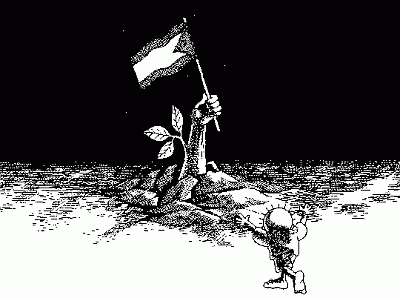
Please Check: Causes of the Lebanese Civil War, Lebanon and Democracy: Doomed to Repeat the Past, Investigating Lebanon: Investigating the Ethnic Dilemma
On the memory of the ignition of the Lebanese Civil War, I decided to write these several series of posts... and hopefully will have the time to finish them.
For a tiny country whose area is 10420 KM2 and a population of 4,000,000, Lebanon sure took the attention of the world, or almost the world. I will not argue what Ghassan Tuieni once described our Civil War as the War of others, rather , I will record each foreign intervention as they occurred. This will give a highlight on Syria, PLO, Israel, USA, among the countries involved.
To be honest if you want to count the number of foreign powers involved in our civil war, they can be counted as follows: Unites States of America, Palestinian Liberation Organization – Egypt – Syria – Jordan – Israel – Saudi Arabia – Libya – Soviet Union – Iran – Iraq – France – Italy – Eastern Europe – Tunis – Cyprus – China – Kuwait – Others. For a tiny country as Lebanon, it sure took a focal point of foreign powers to be interested in this country. Each power had its own foreign cliental, and supplier of funds/arms.
The Case of Lebanon
As I explained in an earlier post "Causes of the Civil War", Lebanon had several situations for having a war. Some were innate due to failed 1943 Pact, and others involved regional interest in the war. The Saddest part of the story, that all the war criminals (ie all the party figureheads) are not locked up in prisons, and their audiences still believe they are fighting for their Lebanon. For me, I think Aoun, Berri, Jaajaa should be locked up in prison and throw the key in a bucket of acid. Actually, I can't exclude anyone. They all deserve to be locked up in prison, they all are well-funded while the victims voices remain screaming from the graves unpunished. This concludes that the ones who inflicted maximum butcheries on the Lebanese were the Israelis, then invited by different Christian powers to come and rid them from the PLO. Now of course, the Israelis killed more Lebanese rather than harming PLO warriors. The Lebanese Front cadres failed to mention that there are also the Lebanese National Movement, which was strictly Lebanese raising arms in front of their "Christian-like" Lebanon.
The war to be clear, didn’t start as several Western (and even local) scholars like to describe between the Muslims and the Christians. As a matter of fact, several Shiite and Sunni leadership supported the Christians, while others supported the Left. Hence on a local level, it will be rather naïve and childish to say that the war broke out between these two religious sects. Other downsized it as the war between the PLO and the Christians, which again suits a lot of Western audience to believe so, but again, that is a bogus 'humbug' truth. The war broke out between the Lebanese among themselves. The Palestinian military became severely involved in post 1975 towards the end of it, when Tel Za'atar Camp was severely surrounded. The combatant coalitions were:
The Lebanese Front (Christian Extreme Parties):
The Phalange Party (Spearheaded by Pierre Gemayel Sr.) – The Partisan Liberation Party (Spear headed by Camille Shamoun) – The Marada (Spearheaded by Suleiman Franjieh Sr.), Guardians of the Cedars (Spearheaded by Etienne Sakr) – The Organization aka Tanzeem (Spearheaded by George Adwan).
The Lebanese National Movement included:
The Progressive Socialist Party (Spearheaded by Kamal Junblatt) - The Lebanese Communist Party (Spearheaded by George Hawi) – The Order for Communist Action (Spearheaded by Mohsen Ibrahim) – Syrian Social Nationalist Party (Spearheaded by Inaam Raad) .
Now both parties had mini-militias supporting them, such as AMAL Movement (which in fact fluctuated between both coalitions). They were part of the Lebanese National Movement, then switched sides when the Christians begged the Syrians to enter Lebanon.
Nature of the Civil War
Now the question to ask: "Was the Lebanese Civil war the same when the War broke out and it ended?" The answer is definitely not. The Progressive Socialist Party for example underwent drastic changes with the assassination of Kamal Junblatt and becoming more Durzi in nature in post 1982 era. There are of course new parties/players that changed the form of the war. The Morabitoun for example became a powerful militia then was destroyed by four parties allying briefly with each other into a single coalition. The fact it took four powerful militias in the 1980s to annihilate them shows their strength: The Lebanese Communist Party – The Progressive Socialist Party – AMAL Movement - Order for Communist Action. New parties/players would include the rise of Nabih Berri on a new more militant AMAL movement, Michel Aoun with the Lebanese Army, Samir Jaajaa for the Lebanese Forces, and Hezbollah as a whole. The war between the Left and the Christians ended up with the Christians battling each other, the Shiites battling each other, and the Left Wing battling the Shiites and Christians alike. Israel and the United States seized to be powerful players in Lebanon after 1985, and loyalties changed. Iraq and Iran became integral players in the war, while Egypt's role got marginalized.
Finally, only the stupid members of the Lebanese Forces would argue that is due to the Palestinians that the war broke out; the Palestinians lost politicially and most of their major powers in 1982 and ended up battling a Muslim Party = AMAL Movement. In fact, AMAL Movement opened fronts on all levels against almost everyone on a separate front. They battled Hezbollah on one wide, they battled the Lebanese Communist Party and the Progressive Party on another, and they battled the PLO on a third front. As for the Sunnis, there were two separate parties that were tagged Sunnis. The first is called "The Mourabitoun" while the other was the Islamist Movement of Unification (in Tripoli). Other than that, they were severely marginalized during the war. The Shiites almost lacked any organization prior to the war, eventually they immerged with two powerful Parties: Hezbollah and AMAL. Someone may ask why I write AMAL Movement in capital letters because AMAL is an abbreviation in Arabic to Affwaj Mouaqawa el Lebanieh (which means Legions of the Lebanese Resistance, which is ironic because they killed more Lebanese and Palestinians than they killed Israelis).
Methodology
To fully comprehed the civil war, the Marxist dialect has to be followed. This includes objectivity. The Sciences of Marxism are based on re-constructing history as it happened. This means as far as trashing the Soviet Union and anything else because they already happened. In the case of Lebanon, we have to document each event as it happened. Understand how we jumped from one phase to another, and of course liberate ourselves from the War mythes we inherited from our parents/friends/relatives. The core of Marxism states that the present cannot be understood unless we understand the past and how we arrived. This means I will mention the Communist parties same as I mention the other. This also means it is not enough to say there was only a Sabra - Chatila Massacre, there were massacres at Saida, Damour, Chicca, Port Beirut, Ba'abda, West Beirut, and several others equally. In the end, to carry arms in the name of the Proletariat is one thing, but shooting innocent citizens and take away 15 years of their lives means that all parties are all accountable in the civil war.
This means that the Phalange or AMAL Movement should come out clean and say: "Yes, we butchered people based on Sect". This means that the supporters of Bashir Gemayel or Camille Shamoun should admit they invited the Israelis to enter, the US archives prove so. This leads me to analyze the sources of information. We are lucky that a lot of key players displayed their information to the public, the most recent would be Joseph Abu Khalil's memoirs. Others would include the CIA archives (we have full knowledge of what happened in 1975-1976 on the party-leadership levels). Other sources would be the Israelis (yes, you read me right, their archives also are important despite the fact several Zionist scholars try to distort history to satisfy their extremist readers). Other information would be the media, documentaries, and first person witnesses. A lot of information might involve deducation, but if deducation can be avoided and reach the truth as it happened from a fixed reference, then by all means that what should happen. Finally the current politicians shouldnt impose a bad case of amnesia on the Lebanese because they shouldnt be selfish to defend their politicial interests and expose for real what they have done to a tiny country called Lebanon.
Conclusion
Now mentioning so many political parties means one thing: so many foreign cliental involved in the Lebanese Civil War, and it would be interesting to investigate (as much as possible) their role in the Lebanese Civil War.
Saturday, April 19, 2008


Tuesday, April 15, 2008
Regarding the Divorce of Aoun and Murr
It is amazing how everything is bi-polar to the extent that 14th of March has a lot of supporters now calling Michel Murr as "The Wiseman" while the Opposition call him "The Traitor". The Opposition seems to have forgotten what he has done to the Syrians.
One of the shakiest alliances that took place between any two individuals was between Aoun and Michel el Murr. During last year elections, 14th of March gambled on the chance that Aoun and Murr will break their alliance, to which the latter two disappointed them when both announced loud and clear that the trilogy alliance between Aoun, Murr, and Tashnag is still alive and kicking. Although it has to be noted, Murr and Aoun forgot to mention the Syrian Social Nationalist Party's votes (estimated at least 4500) that gave Camille Khoury the breaking factor.
Couple of months later, Michel el Murr appeared on Marcel Ghanem's show, and he defended his alliance to Aoun on the basis of paying back an old friend a favor for saving his son during the last couple of years in the civil war. But Michel el Murr was explicit to also state that he doesn’t talk with Aoun's men, and in fact he indirectly slapped their form of talking on TV with the highest pitch (almost every time between Tony Nasrallah, Alain Aoun, Salim Aoun, Nicholas Khoury, Jubran Ba"th"il, and others. Michel el Murr also stated that if he was a Maronite Christian, instead a Greek Orthodox Christian, he would have run on the elections.
To be honest, in my personal opinion, the smartest politician to join then Michel Aoun's coalition "Reform and Change" was el Murr. The man managed since the late sixties to sustain himself in the parliament, knocked out Bshara Merhej to grab hold of the Ministry of Interior, and developed a gigantic empire in Matn whereby he swept over 80% of the municipalities. To be more exact, Murr's empire was gigantic. At a one point, he was the deputy for the Speaker of the Parliament, his son was the Minister of Interior, and his daughter was head of the Upper Matn Municipalities. When Albert Mokhaiber passed away in 2002, he ran his daughter to the Parliamentary elections. The only candidate who was supposed to block his daughter from making it to the Parliament and attain a seat next to her daddy was ironically Gabriel el Murr, his own brother. When Gabriel el Murr, supported by anti-Syrian forces, won, Michel el Murr successfully closed down his channel (and don't laugh it was called MTV, aka Murr TV), and found charges to disqualify his own brother, which ironically made Ghassan Mokhaiber win in default the elections (who was actually Joubran Tuieni's and Walid Junblatt's candidate, eventually the tides changed when MP Ghassan ran against his ex - allies in Matn).
Prior to the divorce between Aoun and Murr, Michel Murr still remained one of the most powerful politicians within the Reform and Change coalition. He emerged victorious from Upper Matn elections, he became a powerful figure head in the Opposition while his son is a powerful figure in the Government. Even strangely, the current government is hanging on the edge, if one more Minister resigns/gets assassinated, the government collapses. Elias Murr remained within the government. Probably what triggered the distrust in the first place between these two figures is the assassination attempt on his son, the current minister of Defense: Elias Murr. Hence, Michel Murr immerged as the most controversial figure of 2005 elections, and of course preserved his title as "King of the Upper Matn Constituency".
So who is Michel Murr?
Michel Murr has been a powerful figure that won elections since the late 1960s in Matn area. In 1979, he was a minister of President Sarkis. It has to be noted that by then Sarkis was a close ally of Bashir Gemayel who didn’t mind bringing Bashir Gemayel's loyalists to the government. Michel el Murr is actually the primary funder of Bashir Gemayel's child "the Lebanese Forces." He was the one responsible to secure that the Lebanese Forces were properly funded. Eventually, he remained a minister till 1982, primarily when Bashir Gemayel was blown to kingdom come due to his alliance with Israel.
Like Michel Aoun, Elie Hobeika, Samir Jaajaa, Karim Bakradouni, Fadi Freim, the Sarkis family, and a lot others: he was one of Bashir Gemayel's powerful figures. His marriage to the Syrians secured Upper Matn as his little kingdom, and of course Murr abused his Ministerial authority and made sure that everyone in that district found work as long as they found work.
Through blackmail, giving the Lebanese nationality to over 10,000 blue collared Syrians (and not to forget the non-Syrians), by "coincidence" they were allocated in Upper Matn. He is associated and accused of the Burj Hammoud cheating when "the electricity went out" in 1996 and of course the expulsion of Nassib Lahoud's "Freedom List" observant in 2000. Murr is also notorious for his generousity in elections during the vote cast.
Personally, I think I am risking my life by talking about this man. I myself fear him more than any other politician. This is also not to forget the speed of securing Elections Voting Cards for his supporters and their relatives while it took almost forever to secure these cards for opposition supporters. Murr's strength grew to give license for arms to all his hooligans (and a shoot-out occurred on Nassib Lahoud without the 'Ministry of Interior' investigating it).
The man, don’t get me wrong on this, has an amazing sense of humor. I think he is really the devil's advocate when it comes to politics.
Murr and Aoun lullaby
Now this is the interesting part. Aoun and Murr knew each other since 1978, when Bashir Gemayel completed his climbing of the ladder of the Phalange Party. Aoun was Bashir's Gemayel's hand inside the army; however, in Bashir's last final days he switched his allegiance to Amin Gemayel, who was then the last person to oppose Bashir politically (since Bashir militarily ended Amin's pocket cell in Bikfaya).
While Michel Murr participated in the Syrian game and the forging of the Ta'ef agreement, Aoun eventually went to exile by living in a "five-stars hotel". Murr's network and Aoun's alliance in 2005 came as a bombshell to everyone. The alliance proved fruitful for both of them, since the government wanted to politically end Michel Murr's winning streak. Even Sarkis Sarkis almost defeated Pierre Gemayel Jr. in the elections.
With Michel Murr's son in the government holding the most powerful ministry, Ministry of Defense, and he is holding a powerful position at the Opposition, specially due to his highly controversial links to Syria, the family seemed to have won the hearts of both coalitions. Probably the only person to hate him till he goes to the grave his Gabriel Murr. It is only a matter of time how long can Murr tolerate Aoun's ego and worse, Aoun's footsoldiers: the figureheads of the Free Patriotic Movement. Despite the fact that Murr tried to end his alliance peacefully with Aoun, again Aoun had to explode on Murr.
Murr argued that it is illogical to keep the nation without a president for so long, and it is insane to keep the parliament closed for that long as well. He was one of the figureheads who supported the closure of the Parliament. Yet, the top of the iceberg was exposed when Murr went to elect a President when his Son supported the election of Michel Suleiman as the President of Lebanon. While Murr said it loud and clear he wants to vote for a president, all the Free Patriotic Movement in December boycotted the Parliamentary Session to occur, and pushed the Opposition to break the quorum of 2/3 to get things rolling within the parliament. (Only AMAL's coalition in a symbolic manner were
What About the 2009 Parliamentary Elections
Well, I know one powerful leader who told me in December 2007: "Be prepared, in six months, the alliances will fluctuate and the borders will change between 14th of March and the Opposition." In fact, he added: "Expect anything!". Seems he is right although I was skeptical at first.
If the 2009 parliamentary elections take place , then where Murr will stand? Will he step down and allow his son lead his tens of thousands of supporters? Technically the primary obstacle for the 14th of March was Rafi Madayan since he is the sworn enemy of the Tashnag. Yet, now Murr fluctuated his alliances currently to neutral grounds. This may lead to a scenario of throwing Nassib Lahoud outside the Matn Formula and forge a strong alliance between 14th of March , Murr, and the Tashnag. After all, Rafi Mayadan switched sides.
Another scenario would be that Murr himself, in a vigorous manner, will go elections again but he will seek to win Matn as a whole. He might be weaker without the SSNP votes and the Free Patriotic Movement's votes (as well as the foreign votes), he still can pull it through. The Opposition and the Government can leave two or three seats for him and vote for him in the face of the others.
Or Aoun and Murr would probably strike a new alliance under different circumstances and run the elections again. This, I have to stress, has lost its cutting edge after Aoun's Tsunami disappeared to only 400 votes against Amin Gemayel. Someone will tell me that it was a nobody (Mr. Camille Khoury) crushing the ex-President, I would like to stress that Camille Khoury was not running but in name, the man who behaved as if he was running was Aoun himself.
The question would have to be asked: What about Murr's allies from the reign of the Syrian Mandate? What about Hezbollah and AMAL movement? Will they in defecto abandon the man who facilitated all black market issues for them and covered them politically? The other question is: Did Michel Murr divorce the Syrian Baathi Regime? Did the attempt on Elias Murr's life break that alliance? Time will tell…
Now isn’t it hilarious how 14th of March and the Opposition automatically switch sides in terms of Opinion?
Update: Seems Murr is heading to an alliance with Gemayel ever since announced publicly that he regrets shooting down Amin Gemayel's parliamentary electoral campaign. Interesting, does this mean that Nassib Lahoud is out of the formula? Is Murr joining 14th of March? Or a powerful coalition of Tashnag - Murr - Lahoud - Lebanese Forces/Phalange is under construction?
As lunatic Aoun, since he is trying to get out of this mess by opening the issue of a mass grave whereby the confronation took place between the Lebanese Army (whatever remained from it then) and the Lebanese Forces. Why doesnt he go to the court since he fully took the credit for the Tel Za'atar massacres on al-Jazeera's War for Lebanon?
What a long road we still have to go through…
MFL
One of the shakiest alliances that took place between any two individuals was between Aoun and Michel el Murr. During last year elections, 14th of March gambled on the chance that Aoun and Murr will break their alliance, to which the latter two disappointed them when both announced loud and clear that the trilogy alliance between Aoun, Murr, and Tashnag is still alive and kicking. Although it has to be noted, Murr and Aoun forgot to mention the Syrian Social Nationalist Party's votes (estimated at least 4500) that gave Camille Khoury the breaking factor.
Couple of months later, Michel el Murr appeared on Marcel Ghanem's show, and he defended his alliance to Aoun on the basis of paying back an old friend a favor for saving his son during the last couple of years in the civil war. But Michel el Murr was explicit to also state that he doesn’t talk with Aoun's men, and in fact he indirectly slapped their form of talking on TV with the highest pitch (almost every time between Tony Nasrallah, Alain Aoun, Salim Aoun, Nicholas Khoury, Jubran Ba"th"il, and others. Michel el Murr also stated that if he was a Maronite Christian, instead a Greek Orthodox Christian, he would have run on the elections.
To be honest, in my personal opinion, the smartest politician to join then Michel Aoun's coalition "Reform and Change" was el Murr. The man managed since the late sixties to sustain himself in the parliament, knocked out Bshara Merhej to grab hold of the Ministry of Interior, and developed a gigantic empire in Matn whereby he swept over 80% of the municipalities. To be more exact, Murr's empire was gigantic. At a one point, he was the deputy for the Speaker of the Parliament, his son was the Minister of Interior, and his daughter was head of the Upper Matn Municipalities. When Albert Mokhaiber passed away in 2002, he ran his daughter to the Parliamentary elections. The only candidate who was supposed to block his daughter from making it to the Parliament and attain a seat next to her daddy was ironically Gabriel el Murr, his own brother. When Gabriel el Murr, supported by anti-Syrian forces, won, Michel el Murr successfully closed down his channel (and don't laugh it was called MTV, aka Murr TV), and found charges to disqualify his own brother, which ironically made Ghassan Mokhaiber win in default the elections (who was actually Joubran Tuieni's and Walid Junblatt's candidate, eventually the tides changed when MP Ghassan ran against his ex - allies in Matn).
Prior to the divorce between Aoun and Murr, Michel Murr still remained one of the most powerful politicians within the Reform and Change coalition. He emerged victorious from Upper Matn elections, he became a powerful figure head in the Opposition while his son is a powerful figure in the Government. Even strangely, the current government is hanging on the edge, if one more Minister resigns/gets assassinated, the government collapses. Elias Murr remained within the government. Probably what triggered the distrust in the first place between these two figures is the assassination attempt on his son, the current minister of Defense: Elias Murr. Hence, Michel Murr immerged as the most controversial figure of 2005 elections, and of course preserved his title as "King of the Upper Matn Constituency".
So who is Michel Murr?
Michel Murr has been a powerful figure that won elections since the late 1960s in Matn area. In 1979, he was a minister of President Sarkis. It has to be noted that by then Sarkis was a close ally of Bashir Gemayel who didn’t mind bringing Bashir Gemayel's loyalists to the government. Michel el Murr is actually the primary funder of Bashir Gemayel's child "the Lebanese Forces." He was the one responsible to secure that the Lebanese Forces were properly funded. Eventually, he remained a minister till 1982, primarily when Bashir Gemayel was blown to kingdom come due to his alliance with Israel.
Like Michel Aoun, Elie Hobeika, Samir Jaajaa, Karim Bakradouni, Fadi Freim, the Sarkis family, and a lot others: he was one of Bashir Gemayel's powerful figures. His marriage to the Syrians secured Upper Matn as his little kingdom, and of course Murr abused his Ministerial authority and made sure that everyone in that district found work as long as they found work.
Through blackmail, giving the Lebanese nationality to over 10,000 blue collared Syrians (and not to forget the non-Syrians), by "coincidence" they were allocated in Upper Matn. He is associated and accused of the Burj Hammoud cheating when "the electricity went out" in 1996 and of course the expulsion of Nassib Lahoud's "Freedom List" observant in 2000. Murr is also notorious for his generousity in elections during the vote cast.
Personally, I think I am risking my life by talking about this man. I myself fear him more than any other politician. This is also not to forget the speed of securing Elections Voting Cards for his supporters and their relatives while it took almost forever to secure these cards for opposition supporters. Murr's strength grew to give license for arms to all his hooligans (and a shoot-out occurred on Nassib Lahoud without the 'Ministry of Interior' investigating it).
The man, don’t get me wrong on this, has an amazing sense of humor. I think he is really the devil's advocate when it comes to politics.
Murr and Aoun lullaby
Now this is the interesting part. Aoun and Murr knew each other since 1978, when Bashir Gemayel completed his climbing of the ladder of the Phalange Party. Aoun was Bashir's Gemayel's hand inside the army; however, in Bashir's last final days he switched his allegiance to Amin Gemayel, who was then the last person to oppose Bashir politically (since Bashir militarily ended Amin's pocket cell in Bikfaya).
While Michel Murr participated in the Syrian game and the forging of the Ta'ef agreement, Aoun eventually went to exile by living in a "five-stars hotel". Murr's network and Aoun's alliance in 2005 came as a bombshell to everyone. The alliance proved fruitful for both of them, since the government wanted to politically end Michel Murr's winning streak. Even Sarkis Sarkis almost defeated Pierre Gemayel Jr. in the elections.
With Michel Murr's son in the government holding the most powerful ministry, Ministry of Defense, and he is holding a powerful position at the Opposition, specially due to his highly controversial links to Syria, the family seemed to have won the hearts of both coalitions. Probably the only person to hate him till he goes to the grave his Gabriel Murr. It is only a matter of time how long can Murr tolerate Aoun's ego and worse, Aoun's footsoldiers: the figureheads of the Free Patriotic Movement. Despite the fact that Murr tried to end his alliance peacefully with Aoun, again Aoun had to explode on Murr.
Murr argued that it is illogical to keep the nation without a president for so long, and it is insane to keep the parliament closed for that long as well. He was one of the figureheads who supported the closure of the Parliament. Yet, the top of the iceberg was exposed when Murr went to elect a President when his Son supported the election of Michel Suleiman as the President of Lebanon. While Murr said it loud and clear he wants to vote for a president, all the Free Patriotic Movement in December boycotted the Parliamentary Session to occur, and pushed the Opposition to break the quorum of 2/3 to get things rolling within the parliament. (Only AMAL's coalition in a symbolic manner were
What About the 2009 Parliamentary Elections
Well, I know one powerful leader who told me in December 2007: "Be prepared, in six months, the alliances will fluctuate and the borders will change between 14th of March and the Opposition." In fact, he added: "Expect anything!". Seems he is right although I was skeptical at first.
If the 2009 parliamentary elections take place , then where Murr will stand? Will he step down and allow his son lead his tens of thousands of supporters? Technically the primary obstacle for the 14th of March was Rafi Madayan since he is the sworn enemy of the Tashnag. Yet, now Murr fluctuated his alliances currently to neutral grounds. This may lead to a scenario of throwing Nassib Lahoud outside the Matn Formula and forge a strong alliance between 14th of March , Murr, and the Tashnag. After all, Rafi Mayadan switched sides.
Another scenario would be that Murr himself, in a vigorous manner, will go elections again but he will seek to win Matn as a whole. He might be weaker without the SSNP votes and the Free Patriotic Movement's votes (as well as the foreign votes), he still can pull it through. The Opposition and the Government can leave two or three seats for him and vote for him in the face of the others.
Or Aoun and Murr would probably strike a new alliance under different circumstances and run the elections again. This, I have to stress, has lost its cutting edge after Aoun's Tsunami disappeared to only 400 votes against Amin Gemayel. Someone will tell me that it was a nobody (Mr. Camille Khoury) crushing the ex-President, I would like to stress that Camille Khoury was not running but in name, the man who behaved as if he was running was Aoun himself.
The question would have to be asked: What about Murr's allies from the reign of the Syrian Mandate? What about Hezbollah and AMAL movement? Will they in defecto abandon the man who facilitated all black market issues for them and covered them politically? The other question is: Did Michel Murr divorce the Syrian Baathi Regime? Did the attempt on Elias Murr's life break that alliance? Time will tell…
Now isn’t it hilarious how 14th of March and the Opposition automatically switch sides in terms of Opinion?
Update: Seems Murr is heading to an alliance with Gemayel ever since announced publicly that he regrets shooting down Amin Gemayel's parliamentary electoral campaign. Interesting, does this mean that Nassib Lahoud is out of the formula? Is Murr joining 14th of March? Or a powerful coalition of Tashnag - Murr - Lahoud - Lebanese Forces/Phalange is under construction?
As lunatic Aoun, since he is trying to get out of this mess by opening the issue of a mass grave whereby the confronation took place between the Lebanese Army (whatever remained from it then) and the Lebanese Forces. Why doesnt he go to the court since he fully took the credit for the Tel Za'atar massacres on al-Jazeera's War for Lebanon?
What a long road we still have to go through…
MFL
Michael A. Lebowitz: Remembering a May Day March
Article taken from here
On May Day 2005, I marched with workers in Caracas. And the slogan workers were chanting at that time was "Without Comanagement, There Is No Revolution." Indeed, the main slogans for that May Day march, organized by the UNT, were "Comanagement Is Revolution" and "Venezuelan Workers Are Building Bolivarian Socialism."
We don't hear much of that anymore. We don't have masses of workers saying, "Without Worker-management, There Is No Socialism." Or, "You Cannot Build Socialism without Worker-management." Nevertheless, I think that we have to recognize the essential truth of this proposition.
Let me stress, though, that I'm not simply talking about worker-management as workers making decisions in individual workplaces. That's a necessary part of it, but it's not enough. When we talk about the goals of production, they should be the goals of workers -- but not in single workplaces. They should be the goals of workers in society, too -- workers in their communities. The goals which guide production should be developed democratically in both communities and workplaces and based on the concept of solidarity. In this respect, it's important to remember the different dimensions of what President Chávez has called the "elementary triangle" of socialism: units of social property, social production organized by workers, and production for the needs of communities. You can't separate those in socialism. As I've written in the new edition of Socialism Doesn't Drop from the Sky, "Without production for social needs, no real social property; without social property, no worker decision-making oriented toward society's needs; without worker decision-making, no transformation of people and their needs." . . .
There is an alternative to capitalism's effects on workers. It is the society that Marx described as characterized not by the capitalist's drive to increase the value of his capital but, rather, by "the inverse situation in which objective wealth is there to satisfy the worker's own need for development." That society oriented to the full development of human beings is socialism. It is the society where, instead of this crippling of body and mind of the worker and the alienation from the worker of all "the intellectual potentialities of the labour process," there is the re-combining of head and hand, the uniting of mental and physical labor. In this way, workers develop their capabilities through their practice. The partially developed individual is "replaced by the totally developed individual, for whom the different social functions are different modes of activity he takes up in turn." The combination of thinking and doing, Marx stressed, is "the only method of producing fully developed human beings."
That can't happen, though, when you work for capital, even if workers have complete control in the workplace. If the interconnection of workers in production "confronts them, in the realm of ideas, as a plan drawn up by the capitalist, and, in practice, as his authority, as the powerful will of a being outside them," how can workers develop all their capabilities? Without "intelligent direction of production" by workers, without production "under their conscious and planned control" --- in other words, without worker management, workers cannot develop their potential as human beings. Clearly, for "the worker's own need for development" to be the goal and to be the result requires an economic system quite different from capitalism, a socialist system which is the inversion of capitalism.
This brings me, though, to the question of worker-management and what we should learn from the efforts to build socialism in the 20th century. . . . What does that experience demonstrate?
1. When workers don't manage, someone else does.
2. When workers don't develop their capabilities through their practice, someone else does.
3. However much you may think you have banished capitalism from the house, when production is not based upon the relation of production of associated producers, sooner or later capitalism comes in -- first, through the backdoor, and then it marches openly through the front door.
Come back to that elementary triangle of socialism: units of social property, social production organized by workers, for satisfaction of communal needs and purposes. Of course, we know that this can't all be put into place at once. Of course, we know that it is a long process of struggle to develop each side of that triangle. But we also know that if we are not actively building each side, we inevitably infect the whole process . . . sooner or later.
How can you build socialism without real workers' management? How can you build fully developed human beings without protagonistic democracy in the workplace and community?
In my book, Build It Now, I quoted a line from an old song by Bob Dylan -- "he not busy being born is busy dying." So, I have to say to you how sad it is to recognize how things have changed since 2005. I look forward to being able to march once again with masses of workers on May Day chanting, "Without Worker Management, There Is No Socialism."
Michael A. Lebowitz is professor emeritus of economics at Simon Fraser University in Vancouver, Canada, and the author of Beyond Capital: Marx's Political Economy of the Working Class, winner of the Isaac Deutscher memorial prize for 2004, and Build It Now: Socialism for the Twenty-First Century, just published by Monthly Review Press. The text above is an excerpt from a talk, "Worker-management and Socialism," given at Centro Internacional Miranda on 26 October 2007 for a Conference "Worker Management: Theory and Experiences."
On May Day 2005, I marched with workers in Caracas. And the slogan workers were chanting at that time was "Without Comanagement, There Is No Revolution." Indeed, the main slogans for that May Day march, organized by the UNT, were "Comanagement Is Revolution" and "Venezuelan Workers Are Building Bolivarian Socialism."
We don't hear much of that anymore. We don't have masses of workers saying, "Without Worker-management, There Is No Socialism." Or, "You Cannot Build Socialism without Worker-management." Nevertheless, I think that we have to recognize the essential truth of this proposition.
Let me stress, though, that I'm not simply talking about worker-management as workers making decisions in individual workplaces. That's a necessary part of it, but it's not enough. When we talk about the goals of production, they should be the goals of workers -- but not in single workplaces. They should be the goals of workers in society, too -- workers in their communities. The goals which guide production should be developed democratically in both communities and workplaces and based on the concept of solidarity. In this respect, it's important to remember the different dimensions of what President Chávez has called the "elementary triangle" of socialism: units of social property, social production organized by workers, and production for the needs of communities. You can't separate those in socialism. As I've written in the new edition of Socialism Doesn't Drop from the Sky, "Without production for social needs, no real social property; without social property, no worker decision-making oriented toward society's needs; without worker decision-making, no transformation of people and their needs." . . .
There is an alternative to capitalism's effects on workers. It is the society that Marx described as characterized not by the capitalist's drive to increase the value of his capital but, rather, by "the inverse situation in which objective wealth is there to satisfy the worker's own need for development." That society oriented to the full development of human beings is socialism. It is the society where, instead of this crippling of body and mind of the worker and the alienation from the worker of all "the intellectual potentialities of the labour process," there is the re-combining of head and hand, the uniting of mental and physical labor. In this way, workers develop their capabilities through their practice. The partially developed individual is "replaced by the totally developed individual, for whom the different social functions are different modes of activity he takes up in turn." The combination of thinking and doing, Marx stressed, is "the only method of producing fully developed human beings."
That can't happen, though, when you work for capital, even if workers have complete control in the workplace. If the interconnection of workers in production "confronts them, in the realm of ideas, as a plan drawn up by the capitalist, and, in practice, as his authority, as the powerful will of a being outside them," how can workers develop all their capabilities? Without "intelligent direction of production" by workers, without production "under their conscious and planned control" --- in other words, without worker management, workers cannot develop their potential as human beings. Clearly, for "the worker's own need for development" to be the goal and to be the result requires an economic system quite different from capitalism, a socialist system which is the inversion of capitalism.
This brings me, though, to the question of worker-management and what we should learn from the efforts to build socialism in the 20th century. . . . What does that experience demonstrate?
1. When workers don't manage, someone else does.
2. When workers don't develop their capabilities through their practice, someone else does.
3. However much you may think you have banished capitalism from the house, when production is not based upon the relation of production of associated producers, sooner or later capitalism comes in -- first, through the backdoor, and then it marches openly through the front door.
Come back to that elementary triangle of socialism: units of social property, social production organized by workers, for satisfaction of communal needs and purposes. Of course, we know that this can't all be put into place at once. Of course, we know that it is a long process of struggle to develop each side of that triangle. But we also know that if we are not actively building each side, we inevitably infect the whole process . . . sooner or later.
How can you build socialism without real workers' management? How can you build fully developed human beings without protagonistic democracy in the workplace and community?
In my book, Build It Now, I quoted a line from an old song by Bob Dylan -- "he not busy being born is busy dying." So, I have to say to you how sad it is to recognize how things have changed since 2005. I look forward to being able to march once again with masses of workers on May Day chanting, "Without Worker Management, There Is No Socialism."
Michael A. Lebowitz is professor emeritus of economics at Simon Fraser University in Vancouver, Canada, and the author of Beyond Capital: Marx's Political Economy of the Working Class, winner of the Isaac Deutscher memorial prize for 2004, and Build It Now: Socialism for the Twenty-First Century, just published by Monthly Review Press. The text above is an excerpt from a talk, "Worker-management and Socialism," given at Centro Internacional Miranda on 26 October 2007 for a Conference "Worker Management: Theory and Experiences."
Monday, April 14, 2008
The Causes of the Lebanese Civil War
An Article I wrote last year for Renegade Eye's Blog
Tomorrow, the painful memory of the beginning of the civil war began. I will try to put a summary of a summary on why the war broke. Someone tell Lahoud to stop thinking he is not legitimate President in a non-technical sense.
There are several factors that tackle the events that led to the break-out of the Lebanese Civil War. Theodor Hanf (in his book Irrevocable Covenant) and others discuss different reasons that become entangled in the end, and trigger the Lebanese Civil war in 1975.
The first reason according to Hanf that the war broke out is due to the nature of Lebanon and its political structure. Lebanon is a state composed of communities whereby one community can never dominate the rest. This balance of power forced into Lebanon democracy as the best solution between the different communities. The second factor would be the class-income distribution between the sects to be involved in the 1975 clash. All the communities got their elites as well as their lower income wage earners. The 1960s witnessed class inequality on the rise among the different communities which made the major Sect leaders aim to mobilize the masses easier against the others. A third factor is the perception of the Muslims and Christians of Lebanese Nationalism. To the Christians, Lebanese Nationalism is strictly Lebanese and nothing else (as long as they were in power) while the Muslims regarded Lebanese Nationalism as complementary to Arab Nationalism and didn’t mind having both. This would play a major role in the different factions who would ally with the Palestinians. These double standards of Nationalism would threaten the Christians’ sense of Lebanese independence.
Another dimension to Theoder Hanf was the Palestinians’ activities in Lebanon starting from the late 1960s and the arrival of large quantity of combatants in 1970 after Black September in Jordan. This tipped the balance of power among the Lebanese communities as the Left-Wing considered that the Lebanese army was already biased for the Lebanese Christian Leaders and the PLO’s mass arrival can balance the power against the “isolationist” Christian Leaders. The Palestinians used Lebanon since the late 1967 as a base to launch operations on Israel. This spread fear among the Christians that Lebanon’s independence was marginalized and they became a minority in Lebanon as the PLO learnt their errors from the Jordan 1970 experience and armed its allied parties in Lebanon. They further established networks, since the PLO got no place else to go and Lebanon was the only country allowing them to launch their military operations. Solidarity to the Palestinians was expressed through the Muslims (mostly the Sunni) but with the aim to change the system in a limited manner while the left-wing Lebanese National Movement aimed to demolish the sect-based system. The PLO eventually transformed the Western Part of Beirut into its stronghold.
A third dimension to several authors is the Army and its incapability to dominate or control the PLO. The Lebanese Army was always a weak army compared to the neighboring armies’ strength of Jordan, Syria, Israel, and Egypt. The purpose of the army, as advocated by head of the Phalange Party, Pierre Gemayel, that the nation’s strength would be its weakness. Having a weaker army means discouragement for other nations to feel threatened. Nevertheless, despite its weakness compared to other institutions, the army has been the core balancer of power between the Christian Militias and the rest of the communities. The Army from 1967 till 1969 entered several confrontations with the Palestinian Commandos in order push away the PLO from the borders, primary allies of Kamal Junblatt and the Left-wing, till the Cairo agreement was signed. After 1970, with the PLO still expanding their networks and continuing with their operations on Israel, the Christian Parties decided to transform their parties into militias. The Left-wing leaders organized mass demonstrations against the Army’s crackdown attempts on the PLO.
The Regional Situation also played a role into contributing factors that would eventually lead to the break out of the Lebanese Civil War. Ever since the end of the Six Days War, the PLO received massive support from the gulf nations in compensation to the great humiliating Arab Defeat. The Cairo agreement was drafted between the PLO and the Head of the Lebanese Army, which was approved by the Lebanese Parliament, gave the PLO legitimacy over the camps, safe influx of arms from Syria, and made West Beirut the safe-haven for the PLO warriors. The Cairo Agreement’s aftermath also made the Christian Leaders, after the influx of more PLO warriors from Jordan, to focus on their own strengths. According to Dr. Moubarak, the Arab states blocked PLO operations from their borders but encouraged the PLO’s use of arms and support in Lebanon. (Walid Moubarak, Position of A Weak State In An Unstable Region: Case of Lebanon (The Emirates Center For Strategic studies & Research ,2002), P. 3) Syria on the other hand, had its own Palestinian Militias active in Lebanon, the Sa’iqa. They were always a support to the PLO’s activism specially if the Lebanese Army pressured the PLO in a military sense. What aggravated the situation more was the fact Kamal Junblatt was the Minister of Interior, who was the PLO’s primary ally, to this, the Christian Leaders never liked it.
The International Arena also played a role into negotiations. Kissinger never struck deals with the PLO, rather with Egypt and Syria after 1973 war. The PLO were regarded as Refugees with no rights whatsoever which forced its leadership to bomb its away to attain recognition and a bargaining card via Lebanon after they changed policy and have a Palestinian State in the West Bank and Gaza (which will happen in the Oslo agreement). Israel’s policy was also dramatic which increased the tension between the Christian Leaders and the PLO. Whenever the PLO launched an operation, Israel responded mainly on the South and the refugee camps. When Israel bombed in 1968 the 12 Middle East Airlines, Israel signaled a message to all leaders of Lebanon to control their half of the borders and cripple the PLO. The development of the Peace Treaties between Egypt and Israel via Henry Kissinger got al-Assad to develop the three nation (Syria, Jordan and Lebanon) – four people unity strategy (Lebanese, Syrians, Palestinians, and Jordanians).
The US administration, under Kissinger’s dominion, was bothered with the turn of events inside Lebanon. With the escalation of the Lebanese situation, Kissinger was worried that Israel would be dragged to war with Lebanon, which in turn would trigger another regional war in less than a year. Furthermore, Kissinger didn’t want to see Israel entering a war because finally an Arab nation (supposedly the strongest military then), Egypt, decided to follow the Step-By-Step with the Zionist State. Nevertheless, PLO operations threatened a regional war. Syria already took a positive step with the States after the 1973 war, and agreed to follow the disengagement plan. The problem was Syria always supported the PLO from cross-border artillery, or its Palestinian made militias: the Palestinian Liberation Army (PLA). This did not stop Syria from establishing good contacts with the Christian Militias, in case, according to Syrian calculations, the other side dominated. To the Syrians, they wanted intervention into Lebanon, but not a left-wing Lebanese Party establishing a socialist government that would shake the whole region. Worse, they wanted to dominate the PLO politically in order to become the sole spearheads for the “Arab Cause”. This clicked with Kissinger on a latter stage to cripple the PLO.
The Division of Lebanon into Two Camps intensified matters. The Leaders of the “Lebanese Front” declined to lose one bit of their political advantage and public sector recruitment benefits (6:5). Imam el-Sadre radicalized his Shiite base and moved closer to President Suleiman Frangieh’s coalition hence forth isolating the Sunni Sect and the Left-Wing (who were attempting to link their demands with the crisis of the South). Junblatt became the recognized Muslim leader in the Arab world, as he got the support of Syria and Egypt as well as the presence of the PLO armed groups broke the hegemony of the Christian domination. His bargaining would be narrowed down to reform the system in return of limited strikes of the PLO against Israel. Pierre Gemayel and Camille Shamoun wouldn’t want to lose any privileges for their parties stressed and accompanied the army in their clashes with the PLO. Should the Christian leaders accept any declines, the warring Lebanese factions probably would have been avoided with a new Status Quo (Fawwaz Traboulsi, A History of Modern Lebanon, Pluto Press (2007), P. 180)
The state, due to the interests of both camps, has lost legitimacy in the eyes of the left-wing camp. The erosion of the State started when Israeli Commandos entered West Beirut and assassinated three PLO figures in 1973. The Army was present and didn’t do anything as Ehud Barak stated he remained for one hour in the Verdun area disguised as a blond woman in a skirt. Escalations occurred from the soon to be Lebanese Front Alliance and the Lebanese National Movement leaders. Since 1970, the future LNM leaders called for demonstrations every time the Army (usually backed with Phalange supporters) attacked the PLO.
Two incidents will trigger the Lebanese civil war in 1975 despite the fact some confrontations occurred between Junblatt’s socialists and the Phalange militia earlier to the zero hour. The first is the demonstration led my MP Ma’ruf Sa’ad against Protein Corp. in Saida. The corporation itself has the Ahhrar’s Camille Shamo’un as one of its primary shareholders. The army shoots on the demonstrators, and the Pro-Nasserite MP Sa’ad is killed among others. Riots break up between the Army and the Nasserite, leftist, and Palestinian supporters. President Frangieh refutes to hold the army accountable while the Phalange supporters did several counter – demonstrations in solidarity with the army. After a month Frangieh transfers two officers from Saida while its governor was placed on probation. Eventually Pierre Gemayel objects on the rotation of the Army’s officer transfer. A month later, the Project of establishing Protein in Saida was abandoned and the government decides to compensate the fishermen. The Next day, April 13,1975, a shoot out takes place in Ain el-Remaini at the Phalange (which is assumed an operation on Pierre Gemayel) while the Phalanges retaliate by shooting a bus going to Tel el-Zaatar camp. The war would break and would last for a decade and a half. (Fawwaz Traboulsi, A History of Modern Lebanon, Pluto Press (2007), P. 183).
Different factors boiled down to trigger the Civil War in Lebanon. Whether it was class inequality among the sects which allowed the “Sect-Defenders” to mobilize their supporters against the “other”, or the newly balance of power between the Leftists and the Christian militias has triggered down the civil war. The presence of two armies, the PLO guerilla warfare organized commandos and the Lebanese Army, definitely shoved the direction of Lebanon towards a new civil war. Philip Habib once compared Lebanon to a vacuum that sucked in the Palestinians, the Syrians, the Israelis, the United States, and others into its whirlpool.
Keep in mind that this is just a summary of a summary for the causes why the Civil War broke, I didn’t tackle the events of the war. All are to be blamed. Just to make a remark, the causes which triggered the war on Lebanese level, the Christians and the Left, changed as the civil war, accompanied with different foreign interventions, progressed till 1990. The war is divided into different reasons, which changed as the turn of events progressed. This reflects also the expulsion of the Palestinians from their homeland triggered a chain reaction that reflected badly on Lebanon. In the end, the Proletariat suffered the greed of the elites.
Tomorrow, the painful memory of the beginning of the civil war began. I will try to put a summary of a summary on why the war broke. Someone tell Lahoud to stop thinking he is not legitimate President in a non-technical sense.
There are several factors that tackle the events that led to the break-out of the Lebanese Civil War. Theodor Hanf (in his book Irrevocable Covenant) and others discuss different reasons that become entangled in the end, and trigger the Lebanese Civil war in 1975.
The first reason according to Hanf that the war broke out is due to the nature of Lebanon and its political structure. Lebanon is a state composed of communities whereby one community can never dominate the rest. This balance of power forced into Lebanon democracy as the best solution between the different communities. The second factor would be the class-income distribution between the sects to be involved in the 1975 clash. All the communities got their elites as well as their lower income wage earners. The 1960s witnessed class inequality on the rise among the different communities which made the major Sect leaders aim to mobilize the masses easier against the others. A third factor is the perception of the Muslims and Christians of Lebanese Nationalism. To the Christians, Lebanese Nationalism is strictly Lebanese and nothing else (as long as they were in power) while the Muslims regarded Lebanese Nationalism as complementary to Arab Nationalism and didn’t mind having both. This would play a major role in the different factions who would ally with the Palestinians. These double standards of Nationalism would threaten the Christians’ sense of Lebanese independence.
Another dimension to Theoder Hanf was the Palestinians’ activities in Lebanon starting from the late 1960s and the arrival of large quantity of combatants in 1970 after Black September in Jordan. This tipped the balance of power among the Lebanese communities as the Left-Wing considered that the Lebanese army was already biased for the Lebanese Christian Leaders and the PLO’s mass arrival can balance the power against the “isolationist” Christian Leaders. The Palestinians used Lebanon since the late 1967 as a base to launch operations on Israel. This spread fear among the Christians that Lebanon’s independence was marginalized and they became a minority in Lebanon as the PLO learnt their errors from the Jordan 1970 experience and armed its allied parties in Lebanon. They further established networks, since the PLO got no place else to go and Lebanon was the only country allowing them to launch their military operations. Solidarity to the Palestinians was expressed through the Muslims (mostly the Sunni) but with the aim to change the system in a limited manner while the left-wing Lebanese National Movement aimed to demolish the sect-based system. The PLO eventually transformed the Western Part of Beirut into its stronghold.
A third dimension to several authors is the Army and its incapability to dominate or control the PLO. The Lebanese Army was always a weak army compared to the neighboring armies’ strength of Jordan, Syria, Israel, and Egypt. The purpose of the army, as advocated by head of the Phalange Party, Pierre Gemayel, that the nation’s strength would be its weakness. Having a weaker army means discouragement for other nations to feel threatened. Nevertheless, despite its weakness compared to other institutions, the army has been the core balancer of power between the Christian Militias and the rest of the communities. The Army from 1967 till 1969 entered several confrontations with the Palestinian Commandos in order push away the PLO from the borders, primary allies of Kamal Junblatt and the Left-wing, till the Cairo agreement was signed. After 1970, with the PLO still expanding their networks and continuing with their operations on Israel, the Christian Parties decided to transform their parties into militias. The Left-wing leaders organized mass demonstrations against the Army’s crackdown attempts on the PLO.
The Regional Situation also played a role into contributing factors that would eventually lead to the break out of the Lebanese Civil War. Ever since the end of the Six Days War, the PLO received massive support from the gulf nations in compensation to the great humiliating Arab Defeat. The Cairo agreement was drafted between the PLO and the Head of the Lebanese Army, which was approved by the Lebanese Parliament, gave the PLO legitimacy over the camps, safe influx of arms from Syria, and made West Beirut the safe-haven for the PLO warriors. The Cairo Agreement’s aftermath also made the Christian Leaders, after the influx of more PLO warriors from Jordan, to focus on their own strengths. According to Dr. Moubarak, the Arab states blocked PLO operations from their borders but encouraged the PLO’s use of arms and support in Lebanon. (Walid Moubarak, Position of A Weak State In An Unstable Region: Case of Lebanon (The Emirates Center For Strategic studies & Research ,2002), P. 3) Syria on the other hand, had its own Palestinian Militias active in Lebanon, the Sa’iqa. They were always a support to the PLO’s activism specially if the Lebanese Army pressured the PLO in a military sense. What aggravated the situation more was the fact Kamal Junblatt was the Minister of Interior, who was the PLO’s primary ally, to this, the Christian Leaders never liked it.
The International Arena also played a role into negotiations. Kissinger never struck deals with the PLO, rather with Egypt and Syria after 1973 war. The PLO were regarded as Refugees with no rights whatsoever which forced its leadership to bomb its away to attain recognition and a bargaining card via Lebanon after they changed policy and have a Palestinian State in the West Bank and Gaza (which will happen in the Oslo agreement). Israel’s policy was also dramatic which increased the tension between the Christian Leaders and the PLO. Whenever the PLO launched an operation, Israel responded mainly on the South and the refugee camps. When Israel bombed in 1968 the 12 Middle East Airlines, Israel signaled a message to all leaders of Lebanon to control their half of the borders and cripple the PLO. The development of the Peace Treaties between Egypt and Israel via Henry Kissinger got al-Assad to develop the three nation (Syria, Jordan and Lebanon) – four people unity strategy (Lebanese, Syrians, Palestinians, and Jordanians).
The US administration, under Kissinger’s dominion, was bothered with the turn of events inside Lebanon. With the escalation of the Lebanese situation, Kissinger was worried that Israel would be dragged to war with Lebanon, which in turn would trigger another regional war in less than a year. Furthermore, Kissinger didn’t want to see Israel entering a war because finally an Arab nation (supposedly the strongest military then), Egypt, decided to follow the Step-By-Step with the Zionist State. Nevertheless, PLO operations threatened a regional war. Syria already took a positive step with the States after the 1973 war, and agreed to follow the disengagement plan. The problem was Syria always supported the PLO from cross-border artillery, or its Palestinian made militias: the Palestinian Liberation Army (PLA). This did not stop Syria from establishing good contacts with the Christian Militias, in case, according to Syrian calculations, the other side dominated. To the Syrians, they wanted intervention into Lebanon, but not a left-wing Lebanese Party establishing a socialist government that would shake the whole region. Worse, they wanted to dominate the PLO politically in order to become the sole spearheads for the “Arab Cause”. This clicked with Kissinger on a latter stage to cripple the PLO.
The Division of Lebanon into Two Camps intensified matters. The Leaders of the “Lebanese Front” declined to lose one bit of their political advantage and public sector recruitment benefits (6:5). Imam el-Sadre radicalized his Shiite base and moved closer to President Suleiman Frangieh’s coalition hence forth isolating the Sunni Sect and the Left-Wing (who were attempting to link their demands with the crisis of the South). Junblatt became the recognized Muslim leader in the Arab world, as he got the support of Syria and Egypt as well as the presence of the PLO armed groups broke the hegemony of the Christian domination. His bargaining would be narrowed down to reform the system in return of limited strikes of the PLO against Israel. Pierre Gemayel and Camille Shamoun wouldn’t want to lose any privileges for their parties stressed and accompanied the army in their clashes with the PLO. Should the Christian leaders accept any declines, the warring Lebanese factions probably would have been avoided with a new Status Quo (Fawwaz Traboulsi, A History of Modern Lebanon, Pluto Press (2007), P. 180)
The state, due to the interests of both camps, has lost legitimacy in the eyes of the left-wing camp. The erosion of the State started when Israeli Commandos entered West Beirut and assassinated three PLO figures in 1973. The Army was present and didn’t do anything as Ehud Barak stated he remained for one hour in the Verdun area disguised as a blond woman in a skirt. Escalations occurred from the soon to be Lebanese Front Alliance and the Lebanese National Movement leaders. Since 1970, the future LNM leaders called for demonstrations every time the Army (usually backed with Phalange supporters) attacked the PLO.
Two incidents will trigger the Lebanese civil war in 1975 despite the fact some confrontations occurred between Junblatt’s socialists and the Phalange militia earlier to the zero hour. The first is the demonstration led my MP Ma’ruf Sa’ad against Protein Corp. in Saida. The corporation itself has the Ahhrar’s Camille Shamo’un as one of its primary shareholders. The army shoots on the demonstrators, and the Pro-Nasserite MP Sa’ad is killed among others. Riots break up between the Army and the Nasserite, leftist, and Palestinian supporters. President Frangieh refutes to hold the army accountable while the Phalange supporters did several counter – demonstrations in solidarity with the army. After a month Frangieh transfers two officers from Saida while its governor was placed on probation. Eventually Pierre Gemayel objects on the rotation of the Army’s officer transfer. A month later, the Project of establishing Protein in Saida was abandoned and the government decides to compensate the fishermen. The Next day, April 13,1975, a shoot out takes place in Ain el-Remaini at the Phalange (which is assumed an operation on Pierre Gemayel) while the Phalanges retaliate by shooting a bus going to Tel el-Zaatar camp. The war would break and would last for a decade and a half. (Fawwaz Traboulsi, A History of Modern Lebanon, Pluto Press (2007), P. 183).
Different factors boiled down to trigger the Civil War in Lebanon. Whether it was class inequality among the sects which allowed the “Sect-Defenders” to mobilize their supporters against the “other”, or the newly balance of power between the Leftists and the Christian militias has triggered down the civil war. The presence of two armies, the PLO guerilla warfare organized commandos and the Lebanese Army, definitely shoved the direction of Lebanon towards a new civil war. Philip Habib once compared Lebanon to a vacuum that sucked in the Palestinians, the Syrians, the Israelis, the United States, and others into its whirlpool.
Keep in mind that this is just a summary of a summary for the causes why the Civil War broke, I didn’t tackle the events of the war. All are to be blamed. Just to make a remark, the causes which triggered the war on Lebanese level, the Christians and the Left, changed as the civil war, accompanied with different foreign interventions, progressed till 1990. The war is divided into different reasons, which changed as the turn of events progressed. This reflects also the expulsion of the Palestinians from their homeland triggered a chain reaction that reflected badly on Lebanon. In the end, the Proletariat suffered the greed of the elites.
Regarding New TV Riyad Kobeissi's Documentary on Arms
It is a very interesting documentary on people owning arms that shoot in the open air. Why doesnt our esteemed army and internal security forces go arrest them since they appeared on the documentary (and other TV stations) ...
More to the point, like most of the Lebanese, I have access to ex-militia members. I remember 5 years ago I got an offer for AK-47 for 40$, second hand. Now, any AK-47 in the black market exceeds 1000$ (again my contact's price list), not to forget how the ammunition of different arms are higher. Ever since the Ministry of Interior banned the sales of licenses to carry arms, prices have been sky rocketing... another bad sign of our damned country.
If you belong to a certain location that is famous for a partisan affiliations, you will be dubbed to that. The same applies per sect, and a lot are purchasing arms because they will be blindly dubbed to this or that party.
BTW, I declined to buy the AK-47 then for 40$ and sure like hell I would buy one for 1000$.
MFL
More to the point, like most of the Lebanese, I have access to ex-militia members. I remember 5 years ago I got an offer for AK-47 for 40$, second hand. Now, any AK-47 in the black market exceeds 1000$ (again my contact's price list), not to forget how the ammunition of different arms are higher. Ever since the Ministry of Interior banned the sales of licenses to carry arms, prices have been sky rocketing... another bad sign of our damned country.
If you belong to a certain location that is famous for a partisan affiliations, you will be dubbed to that. The same applies per sect, and a lot are purchasing arms because they will be blindly dubbed to this or that party.
BTW, I declined to buy the AK-47 then for 40$ and sure like hell I would buy one for 1000$.
MFL
Friday, April 11, 2008
The Destruction of Alternatives
In Lebanon, the majority of the civilians do not want a civil war; however, that was the case back in 1975 and they were dragged to a civil war.
The current politicians are practicing a process what is called: demobilization. This means all non-party affiliates are de-activated due to the lack of availability of alternatives or options to impose the over-all populations' voice on the politicians. Henceforth, the destruction of alternative aka space to function in opposition to the political parties' duet singing of 14th of March and the Opposition.
More to the point, activists who oppose the war are suffocated by the demolition forces of 14th of March and the opposition. They can't do nothing, and personally someone may wonder if they agreed with each other to cripple the activists from expressing their opinions. This becomes very much apparent when riots break out between party affiliates and the shooting takes place. In fact, the immigrants who left Lebanon in the quest of seeking a better life are the same victims of these politicians (partly because of those, and partly due to the Israeli aggression and foreign interventions). Those who are left immobile are given with the choice to choose: 14th of March or Opposition? Usually the question, my dear readers comes as follows: choose the worse of the two. In fact, they are both worse than each other. There is no country in the world currently that celebrates: "Our martyrs and their martyrs" more bluntly than our melancholic parties who promise us doom and destruction by the hands of the "Other Coalition".
With the progressive forces crippled, there is no space to be active at all. In fact, a person would simply watch TV rather attempt to change the reality. Political apathy has reached it's maximum when in 2005 the voting turnabout throughout Lebanon was barely 50%.
As a matter of fact, if a new player or a third force would rise to oppose both coalitions, they will surely agree against them. This we witnessed when Hezbollah and the Lebanese Forces allied with each other against Aoun and his ex-Syrian buddies back in 2005. Then the lunatic general marginalized to a second force as an extension of 8th of March to become the new second line = the Opposition. Probably the majority of those who would vote for ex-war criminals and current business corrupted elites would do so because they would fear that the other would for their "scary alliance from foreign lands" (be that the USA or Iran). This means due to lack of activism and progressive (and real democratic) movements, a lot of the voters would simply vote as what they against what they view as the "invaders" to the "lesser evil".
The stalemate is on-going, while few civil society activists are attempting to maximize the odds. The majority of the Proletariat are de-activated in Lebanon. As the deadlock between the two corrupted forces of Lebanon continues, more people flee the country (due to security, possible a second war with Israel, lack of good economy, or a higher degree).
The arena remains for the Elites (the self-proclaimed Sect-Defenders) and their followers who refuse to wake up to the reality that they are all corrupt.
MFL
The current politicians are practicing a process what is called: demobilization. This means all non-party affiliates are de-activated due to the lack of availability of alternatives or options to impose the over-all populations' voice on the politicians. Henceforth, the destruction of alternative aka space to function in opposition to the political parties' duet singing of 14th of March and the Opposition.
More to the point, activists who oppose the war are suffocated by the demolition forces of 14th of March and the opposition. They can't do nothing, and personally someone may wonder if they agreed with each other to cripple the activists from expressing their opinions. This becomes very much apparent when riots break out between party affiliates and the shooting takes place. In fact, the immigrants who left Lebanon in the quest of seeking a better life are the same victims of these politicians (partly because of those, and partly due to the Israeli aggression and foreign interventions). Those who are left immobile are given with the choice to choose: 14th of March or Opposition? Usually the question, my dear readers comes as follows: choose the worse of the two. In fact, they are both worse than each other. There is no country in the world currently that celebrates: "Our martyrs and their martyrs" more bluntly than our melancholic parties who promise us doom and destruction by the hands of the "Other Coalition".
With the progressive forces crippled, there is no space to be active at all. In fact, a person would simply watch TV rather attempt to change the reality. Political apathy has reached it's maximum when in 2005 the voting turnabout throughout Lebanon was barely 50%.
As a matter of fact, if a new player or a third force would rise to oppose both coalitions, they will surely agree against them. This we witnessed when Hezbollah and the Lebanese Forces allied with each other against Aoun and his ex-Syrian buddies back in 2005. Then the lunatic general marginalized to a second force as an extension of 8th of March to become the new second line = the Opposition. Probably the majority of those who would vote for ex-war criminals and current business corrupted elites would do so because they would fear that the other would for their "scary alliance from foreign lands" (be that the USA or Iran). This means due to lack of activism and progressive (and real democratic) movements, a lot of the voters would simply vote as what they against what they view as the "invaders" to the "lesser evil".
The stalemate is on-going, while few civil society activists are attempting to maximize the odds. The majority of the Proletariat are de-activated in Lebanon. As the deadlock between the two corrupted forces of Lebanon continues, more people flee the country (due to security, possible a second war with Israel, lack of good economy, or a higher degree).
The arena remains for the Elites (the self-proclaimed Sect-Defenders) and their followers who refuse to wake up to the reality that they are all corrupt.
MFL
Thursday, April 10, 2008
Our Esteemed Members of Parliament and the Public Debt
Here is a thought for you,
The parliamentarians keep complaining that we need money to cover the national debt or to cut down on governmental extravagant expenditures, but how about we look at them now or overall?
For starters, a member of parliament (MP) makes 5,000,000 LL per month. Roughly, that number means 3333.33 US dollars per month. For starters, the parliament has not been functional since the end of 2006. I suggest that this money should be directed to pay for the national debt. In theory we have 126 (and depends on the political assassinations) and parliamentarian quotas for seats. Now 126 x 3333.33 $ equates to 420,000 $. Henceforth, 420,000$ per month are excellent to go to the national debt. Now transform that sum on an annual basis (12 x 420,000 $), that would equate to 5, 040,000 $. That is the sum of money paid on our parliamentarians to sit and do nothing in relations to legislative work. Now if we add the months of the wasted months as a whole (17 x 420,000$) = 7,140,000 $ of money that could have gone to be paid to the Public Debt. They haven’t legislated anything. Rather Opposition MPs have spent their time preaching against the Government and visiting funerals/weddings at their elected districts. The Pro Government MPs have been also wasting the tax-payers' money in attacking the Opposition and hiding due to the death-threats. Henceforth, that sum of money is better than none to be pitched into the National Debt. This of course (excuse my ignorance but I don’t know a minister's salary) but I know for sure that five ministers shouldn’t be receiving their salaries since they are "resigned" till they suddenly decide to visit the government and sign proper papers for their wastas (special connections). Of course, this is not to exclude the fact that the Speaker of the Parliament also receives higher pay than the other.
Now is this is the end of my argument? Of course not !
Each MP also has a different retirement salary. That means once they are no longer MPs, they receive also money from the Tax – Payers which in my opinion shouldn’t do that at all. After all, most of the MPs who run are usually better-off financially, or became during their term. This is not to forget the gigantic sum of money their rich coalitions are part off.
The rates of a retired MP or an MP that fails to make it as follows:
(One Elected Term = 0 sum of money)
(Two Elected Terms = 50% of their salary per month is paid)
(Three Elected Terms = 75% of their salary paid)
(Four Elected Terms = 100% of their salary paid per month).
Now, I am not sure if the formula goes as this:
Five Terms = 125% of their salary paid per month
Six Terms = 150% of their salary paid per month
If this is the case, then we have serious issues, such as MP Abdel Latif Zain or Michel el Murr, or others. Other than Adel Osseiran's reputation for entering the Parliament, being the Speaker of the Parliament, and leaving for over 40 years, and leaving the parliament penniless, I think this is a serious glitch that has to be severely resolved (btw Adel Osseiran's son now is member of Parliament with Berri's Liberation and Development Coalition).
So let me attempt to name the current MPs who have been more than three times elected, and not to forget those who were appointed for one year in 1991.
Yeghia Jerjian (1992 – 1996 – 2000 – 2005; Future Bloc/Government) ; Michel el Murr (1968 - 1991 - 1992 - 1996 - 2000 – 2005; Reform and Change Coalition/Opposition); Ayman Chouchair (1991 - 1992 - 1996 - 2000 – 2005; Democratic Gathering/Government), Bassem Sabai' (1992 - 1996 - 2000 – 2005, Future Bloc/Government); Akram Chehayeb (1992 - 1996 - 2000 – 2005, Democratic Gathering/Government), Ala'a el Dean Tirro (1992 - 1996 - 2000 – 2005, Democratic Gathering/Government), Walid Junblatt (1991 - 1992 - 1996 - 2000 – 2005 Democratic Gathering/Government), Marwan Hmaidi (1991 - 1992 - 1996 - 2000 – 2005, Democratic Gathering/ Government), Mohammad Kabbara (1992 - 1996 - 2000 – 2005, Tripoli Bloc/Government), Maurice Fadel (1972 - 1996 - 2000 – 2005), Neyla Mou'awad (1991 - 1992 - 1996 - 2000 – 2005, Qornet Shahwan/Government), Farid Makarri (Future Bloc/Government), Boutros Harb (1972 - 1996 - 2000 – 2005, Qornet Shahwan/Government), Nabih Berri (1992 - 1996 - 2000 – 2005, Development and Development Coalition/Opposition), Ali Osseiran (1992 - 1996 - 2000 – 2005, Development and Development Coalition/Opposition), Michel Moussa (1992 - 1996 - 2000 – 2005, Development and Development/Opposition), Mohammad Fneish (1992 - 1996 - 2000 – 2005, Loyalty for the Resistance/Opposition), Samir Azar (1992 - 1996 - 2000 – 2005, Liberation and Development/Opposition), Ayoub Hmayed (1992 - 1996 - 2000 – 2005, Liberation and Development/Opposition), Anwar Khalil (1991 - 1992 - 1996 - 2000 – 2005, Liberation and Development), Assad Hairdain (1991 - 1992 - 1996 - 2000 – 2005 , Syrian Social nationalist Party/Opposition), Mohammad Raad (1992 - 1996 - 2000 – 2005, Loyalty For the Resistance/ Opposition), Abdelatif Zain (1962 - 1964 - 1968 - 1972 - 1992 - 1996 - 2000 – 2005, Liberation and Development Coalition/Opposition), Hussein el Husseini (1972 - 1992 - 1996 - 2000 – 2005, Independent/Opposition), Elias Skaff (1992 - 1996 - 2000 – 2005, Reform and Change Coalition/Opposition), Nicolas Fattoushe (1992 - 1996 - 2000 – 2005, Future Bloc/Government), George Kassarji (1992 - 1996 - 2000 – 2005, Reform and Change Coalition/Opposition), and Robert Ghanem (1992 - 1996 - 2000 – 2005).
There are 29 MPs who will be forever earn a 100% (and a 100% plus) as long as they are living. I am sure Michel el Murr (who has his son as a Defense Minister and Ex- Minister of Interior, and his daughter as head of the Municipalities of Upper Matn) or Harriri Jr. would need that sum of money. There are also 11 MPs who have been elected three times (so far) but wont bore you with the details, and there are 22 MPs who were elected twice. Think of the opportunity cost that could have gone to the National Debt. This doesn’t exclude the ex-Members of Parliament who are already benefiting from the system in the past/present. This makes the amount per month a gigantic amount of money going out from our tax-paying to these people instead of easing off our lives by gradually paying off the Public Debt. Cut the funds on the MPs, and let the Proletariat have a better life over here!
MFL
PS: All Information of the MPs' elections are taken from the Lebanese Parliamentary Monitor.
The parliamentarians keep complaining that we need money to cover the national debt or to cut down on governmental extravagant expenditures, but how about we look at them now or overall?
For starters, a member of parliament (MP) makes 5,000,000 LL per month. Roughly, that number means 3333.33 US dollars per month. For starters, the parliament has not been functional since the end of 2006. I suggest that this money should be directed to pay for the national debt. In theory we have 126 (and depends on the political assassinations) and parliamentarian quotas for seats. Now 126 x 3333.33 $ equates to 420,000 $. Henceforth, 420,000$ per month are excellent to go to the national debt. Now transform that sum on an annual basis (12 x 420,000 $), that would equate to 5, 040,000 $. That is the sum of money paid on our parliamentarians to sit and do nothing in relations to legislative work. Now if we add the months of the wasted months as a whole (17 x 420,000$) = 7,140,000 $ of money that could have gone to be paid to the Public Debt. They haven’t legislated anything. Rather Opposition MPs have spent their time preaching against the Government and visiting funerals/weddings at their elected districts. The Pro Government MPs have been also wasting the tax-payers' money in attacking the Opposition and hiding due to the death-threats. Henceforth, that sum of money is better than none to be pitched into the National Debt. This of course (excuse my ignorance but I don’t know a minister's salary) but I know for sure that five ministers shouldn’t be receiving their salaries since they are "resigned" till they suddenly decide to visit the government and sign proper papers for their wastas (special connections). Of course, this is not to exclude the fact that the Speaker of the Parliament also receives higher pay than the other.
Now is this is the end of my argument? Of course not !
Each MP also has a different retirement salary. That means once they are no longer MPs, they receive also money from the Tax – Payers which in my opinion shouldn’t do that at all. After all, most of the MPs who run are usually better-off financially, or became during their term. This is not to forget the gigantic sum of money their rich coalitions are part off.
The rates of a retired MP or an MP that fails to make it as follows:
(One Elected Term = 0 sum of money)
(Two Elected Terms = 50% of their salary per month is paid)
(Three Elected Terms = 75% of their salary paid)
(Four Elected Terms = 100% of their salary paid per month).
Now, I am not sure if the formula goes as this:
Five Terms = 125% of their salary paid per month
Six Terms = 150% of their salary paid per month
If this is the case, then we have serious issues, such as MP Abdel Latif Zain or Michel el Murr, or others. Other than Adel Osseiran's reputation for entering the Parliament, being the Speaker of the Parliament, and leaving for over 40 years, and leaving the parliament penniless, I think this is a serious glitch that has to be severely resolved (btw Adel Osseiran's son now is member of Parliament with Berri's Liberation and Development Coalition).
So let me attempt to name the current MPs who have been more than three times elected, and not to forget those who were appointed for one year in 1991.
Yeghia Jerjian (1992 – 1996 – 2000 – 2005; Future Bloc/Government) ; Michel el Murr (1968 - 1991 - 1992 - 1996 - 2000 – 2005; Reform and Change Coalition/Opposition); Ayman Chouchair (1991 - 1992 - 1996 - 2000 – 2005; Democratic Gathering/Government), Bassem Sabai' (1992 - 1996 - 2000 – 2005, Future Bloc/Government); Akram Chehayeb (1992 - 1996 - 2000 – 2005, Democratic Gathering/Government), Ala'a el Dean Tirro (1992 - 1996 - 2000 – 2005, Democratic Gathering/Government), Walid Junblatt (1991 - 1992 - 1996 - 2000 – 2005 Democratic Gathering/Government), Marwan Hmaidi (1991 - 1992 - 1996 - 2000 – 2005, Democratic Gathering/ Government), Mohammad Kabbara (1992 - 1996 - 2000 – 2005, Tripoli Bloc/Government), Maurice Fadel (1972 - 1996 - 2000 – 2005), Neyla Mou'awad (1991 - 1992 - 1996 - 2000 – 2005, Qornet Shahwan/Government), Farid Makarri (Future Bloc/Government), Boutros Harb (1972 - 1996 - 2000 – 2005, Qornet Shahwan/Government), Nabih Berri (1992 - 1996 - 2000 – 2005, Development and Development Coalition/Opposition), Ali Osseiran (1992 - 1996 - 2000 – 2005, Development and Development Coalition/Opposition), Michel Moussa (1992 - 1996 - 2000 – 2005, Development and Development/Opposition), Mohammad Fneish (1992 - 1996 - 2000 – 2005, Loyalty for the Resistance/Opposition), Samir Azar (1992 - 1996 - 2000 – 2005, Liberation and Development/Opposition), Ayoub Hmayed (1992 - 1996 - 2000 – 2005, Liberation and Development/Opposition), Anwar Khalil (1991 - 1992 - 1996 - 2000 – 2005, Liberation and Development), Assad Hairdain (1991 - 1992 - 1996 - 2000 – 2005 , Syrian Social nationalist Party/Opposition), Mohammad Raad (1992 - 1996 - 2000 – 2005, Loyalty For the Resistance/ Opposition), Abdelatif Zain (1962 - 1964 - 1968 - 1972 - 1992 - 1996 - 2000 – 2005, Liberation and Development Coalition/Opposition), Hussein el Husseini (1972 - 1992 - 1996 - 2000 – 2005, Independent/Opposition), Elias Skaff (1992 - 1996 - 2000 – 2005, Reform and Change Coalition/Opposition), Nicolas Fattoushe (1992 - 1996 - 2000 – 2005, Future Bloc/Government), George Kassarji (1992 - 1996 - 2000 – 2005, Reform and Change Coalition/Opposition), and Robert Ghanem (1992 - 1996 - 2000 – 2005).
There are 29 MPs who will be forever earn a 100% (and a 100% plus) as long as they are living. I am sure Michel el Murr (who has his son as a Defense Minister and Ex- Minister of Interior, and his daughter as head of the Municipalities of Upper Matn) or Harriri Jr. would need that sum of money. There are also 11 MPs who have been elected three times (so far) but wont bore you with the details, and there are 22 MPs who were elected twice. Think of the opportunity cost that could have gone to the National Debt. This doesn’t exclude the ex-Members of Parliament who are already benefiting from the system in the past/present. This makes the amount per month a gigantic amount of money going out from our tax-paying to these people instead of easing off our lives by gradually paying off the Public Debt. Cut the funds on the MPs, and let the Proletariat have a better life over here!
MFL
PS: All Information of the MPs' elections are taken from the Lebanese Parliamentary Monitor.
Monday, March 17, 2008
My Contacts
Dear Fellow Readers
Again I apologize for not writing long specially the whole area passed through a rough hurricane and another is expected to come.
Several readers emailed me and asked me how to contact me, my email account is
MarxistFromLebanon@hotmail.com and you can find me on msn at the same account...
Now I am back to check my account on daily basis after a severe rough time on the personal level...
I will answer all comments given to me with time and will keep my personal page alive (MFL Personals)
MFL
Again I apologize for not writing long specially the whole area passed through a rough hurricane and another is expected to come.
Several readers emailed me and asked me how to contact me, my email account is
MarxistFromLebanon@hotmail.com and you can find me on msn at the same account...
Now I am back to check my account on daily basis after a severe rough time on the personal level...
I will answer all comments given to me with time and will keep my personal page alive (MFL Personals)
MFL
Big Bang or Chaos: What's Israel Up To? by Baroud
By Ramzy Baroud, taken from ZMag over here
Why did Israel attack Gaza with such brutality? Did Israeli officials think, even for a fleeting moment, that their army's attacks could halt, as opposed to intensify, Palestinian rockets or retaliatory violence? Indeed, was Palestinian violence at all relevant to the Israeli action? Was the Israeli bloodletting in Gaza solely relevant to the Gaza/Hamas context, or is there a regional dimension that is largely being overlooked?
In an al-Jazeera English TV discussion, Israeli journalist Gideon Levy and al-Quds al-Arabi editor-in-chief Abd al-Bari Atwan attempted to decipher Israel's actions in Gaza which have, since February 27, killed more than 120 Palestinians and four Israeli soldiers. These attacks were followed by incursions and further violence, including an attack on a Jewish seminary school in Jerusalem.
Levy explained that Israeli Defense Minister Ehud Barak wanted to demonstrate to the Israeli public that he was "doing something" about the regular launching of rockets from Gaza. Although Levy wasn't justifying the Israeli government's inhumane and misguided logic, he disagreed with Atwan over the use of terminology. The latter (who is also an outstanding journalist) had asserted that the killings in Gaza represented a form of "genocide" and "ethnic cleansing".
Arab intellectuals, often wary of the use of certain terminology - since Western sensibilities don't accept associating Israel with genocide and ethnic cleansing - became less hesitant after Israeli Deputy Defense Minister Matan Vilnai warned Palestinians in a radio interview to expect a "bigger Holocaust".
But terminology aside, are we to really believe that the wanton killing in Gaza - a major violation of international and humanitarian laws - was meant to send a message to the Israeli public, or to carry out genocide for its own sake?
Initially, albeit unsurprisingly, the Palestinian Authority of Mahmoud Abbas seemed oblivious, and then at best neutral, to the carnage. First, it asked both Israel and Hamas to cease their violence, and then it accused Israel of attempting to "derail" the peace process (what peace process?). Finally, and only after the Vatican, thankfully, decried the Israeli killings, Abbas announced the halt of all contacts with Israel.
A few days later, following a trip by US Secretary of State Condoleezza Rice to the region, Abbas reversed his position. Nabil Abu Rudeineh, spokesman of the presidency, quoted Abbas as stating that "we intend to resume the peace talks with Israel which reserve the aim of ending the occupation".
Considering the heavy toll that Palestinians endured by a deliberate Israeli attempt to cause a "bigger holocaust", Abbas' agreement to the resumption of futile chats with the same men who ordered the death of scores of his people is a mockery to say the least.
While Palestinian, Israeli and international responses to violence remain predictable, this view still doesn't explain the timing or the underlying objectives.
In my view, historically, Israel's behavior, regardless of its outcome, is always politically motivated, and it never fails to keep a regional picture in mind.
There are two lines of military logic that Israel resorts to. One is motivated by the "chaos theory", the idea that seemingly minor events accumulate to have complex and massive effects on dynamic natural systems. For example, Gaza might have been attacked with the hope of provoking a streak of suicide bombings that would eventually be blamed on Syrian planning and Iranian financing - thus provoking a major showdown in Lebanon. The history of Israeli-Arab conflicts demonstrates how many major invasions are justified by seemingly irrelevant events, such as the 1982 Lebanon War.
But is Israel capable of sustaining another conflict in Lebanon after its miserable - and costly - failure in July-August 2006?
That's when the US becomes even more relevant. Just as Israeli attacks occupied major headlines around the world, the USS Cole and two additional ships - including one amphibious assault vessel - were quietly making their way from Malta to the shores of Lebanon. The ships were dispatched as a "show of support for regional stability", according to US Navy officials.
With the gung-ho George W Bush administration's time in office coming to an end and waning public enthusiasm for war against Iran, Israel cannot afford allowing the regional setup to be stacked in the following way: Hezbollah dominating south Lebanon, Hamas dominating Gaza and Iran becoming an increasingly formidable regional power.
This leads to the other line of Israeli military logic, the "big bang" theory. The self-explanatory logic of this theory is applicable in the sense that a regional war - accompanied by mini civil wars in Palestine and Lebanon, along with other attempts at destabilizing Iran and Syria - could work in Israel's favor.
Under no condition would the US be able stay out of such a conflict (considering its regional interests, allies and own war in Iraq). Revelations of the sinister role played by the Bush administration in organizing and provoking a civil war among Palestinians shows the extent to which Bush is willing to go to achieve Israel's objectives. More, it shows the willingness of various Arab and Palestinian players to readily participate in the bloody and costly US-Israeli ventures.
With all due respect to Levy and Atwan, I think Israel's main aim was neither to send a message to its public nor to commit genocide - though these are not unreasonable possibilities. Indeed, the majority of the Israeli public, according to a Tel Aviv University poll, wished that their government would negotiate a ceasefire with Hamas, as bombs were falling atop the hapless Gaza residents.
The facts - as demonstrated by the US-Israeli role in the turmoil in Lebanon, the consistent attempt to arraign Iran, and the Israeli provocations and bombings in Syria - all indicate that Israel's plans are regional, with Gaza being a testing ground, and the least costly target to isolate and brutalize. Already a massive concentration camp with a largely starving population, Gaza has provided Israel with a perfect opportunity to start sending stern messages to the other players in the region.
Ramzy Baroud (www.ramzybaroud.net) is an author and editor of PalestineChronicle.com. His work has been published in many newspapers and journals worldwide. His latest book is The Second Palestinian Intifada: A Chronicle of a People's Struggle (Pluto Press, London).
Why did Israel attack Gaza with such brutality? Did Israeli officials think, even for a fleeting moment, that their army's attacks could halt, as opposed to intensify, Palestinian rockets or retaliatory violence? Indeed, was Palestinian violence at all relevant to the Israeli action? Was the Israeli bloodletting in Gaza solely relevant to the Gaza/Hamas context, or is there a regional dimension that is largely being overlooked?
In an al-Jazeera English TV discussion, Israeli journalist Gideon Levy and al-Quds al-Arabi editor-in-chief Abd al-Bari Atwan attempted to decipher Israel's actions in Gaza which have, since February 27, killed more than 120 Palestinians and four Israeli soldiers. These attacks were followed by incursions and further violence, including an attack on a Jewish seminary school in Jerusalem.
Levy explained that Israeli Defense Minister Ehud Barak wanted to demonstrate to the Israeli public that he was "doing something" about the regular launching of rockets from Gaza. Although Levy wasn't justifying the Israeli government's inhumane and misguided logic, he disagreed with Atwan over the use of terminology. The latter (who is also an outstanding journalist) had asserted that the killings in Gaza represented a form of "genocide" and "ethnic cleansing".
Arab intellectuals, often wary of the use of certain terminology - since Western sensibilities don't accept associating Israel with genocide and ethnic cleansing - became less hesitant after Israeli Deputy Defense Minister Matan Vilnai warned Palestinians in a radio interview to expect a "bigger Holocaust".
But terminology aside, are we to really believe that the wanton killing in Gaza - a major violation of international and humanitarian laws - was meant to send a message to the Israeli public, or to carry out genocide for its own sake?
Initially, albeit unsurprisingly, the Palestinian Authority of Mahmoud Abbas seemed oblivious, and then at best neutral, to the carnage. First, it asked both Israel and Hamas to cease their violence, and then it accused Israel of attempting to "derail" the peace process (what peace process?). Finally, and only after the Vatican, thankfully, decried the Israeli killings, Abbas announced the halt of all contacts with Israel.
A few days later, following a trip by US Secretary of State Condoleezza Rice to the region, Abbas reversed his position. Nabil Abu Rudeineh, spokesman of the presidency, quoted Abbas as stating that "we intend to resume the peace talks with Israel which reserve the aim of ending the occupation".
Considering the heavy toll that Palestinians endured by a deliberate Israeli attempt to cause a "bigger holocaust", Abbas' agreement to the resumption of futile chats with the same men who ordered the death of scores of his people is a mockery to say the least.
While Palestinian, Israeli and international responses to violence remain predictable, this view still doesn't explain the timing or the underlying objectives.
In my view, historically, Israel's behavior, regardless of its outcome, is always politically motivated, and it never fails to keep a regional picture in mind.
There are two lines of military logic that Israel resorts to. One is motivated by the "chaos theory", the idea that seemingly minor events accumulate to have complex and massive effects on dynamic natural systems. For example, Gaza might have been attacked with the hope of provoking a streak of suicide bombings that would eventually be blamed on Syrian planning and Iranian financing - thus provoking a major showdown in Lebanon. The history of Israeli-Arab conflicts demonstrates how many major invasions are justified by seemingly irrelevant events, such as the 1982 Lebanon War.
But is Israel capable of sustaining another conflict in Lebanon after its miserable - and costly - failure in July-August 2006?
That's when the US becomes even more relevant. Just as Israeli attacks occupied major headlines around the world, the USS Cole and two additional ships - including one amphibious assault vessel - were quietly making their way from Malta to the shores of Lebanon. The ships were dispatched as a "show of support for regional stability", according to US Navy officials.
With the gung-ho George W Bush administration's time in office coming to an end and waning public enthusiasm for war against Iran, Israel cannot afford allowing the regional setup to be stacked in the following way: Hezbollah dominating south Lebanon, Hamas dominating Gaza and Iran becoming an increasingly formidable regional power.
This leads to the other line of Israeli military logic, the "big bang" theory. The self-explanatory logic of this theory is applicable in the sense that a regional war - accompanied by mini civil wars in Palestine and Lebanon, along with other attempts at destabilizing Iran and Syria - could work in Israel's favor.
Under no condition would the US be able stay out of such a conflict (considering its regional interests, allies and own war in Iraq). Revelations of the sinister role played by the Bush administration in organizing and provoking a civil war among Palestinians shows the extent to which Bush is willing to go to achieve Israel's objectives. More, it shows the willingness of various Arab and Palestinian players to readily participate in the bloody and costly US-Israeli ventures.
With all due respect to Levy and Atwan, I think Israel's main aim was neither to send a message to its public nor to commit genocide - though these are not unreasonable possibilities. Indeed, the majority of the Israeli public, according to a Tel Aviv University poll, wished that their government would negotiate a ceasefire with Hamas, as bombs were falling atop the hapless Gaza residents.
The facts - as demonstrated by the US-Israeli role in the turmoil in Lebanon, the consistent attempt to arraign Iran, and the Israeli provocations and bombings in Syria - all indicate that Israel's plans are regional, with Gaza being a testing ground, and the least costly target to isolate and brutalize. Already a massive concentration camp with a largely starving population, Gaza has provided Israel with a perfect opportunity to start sending stern messages to the other players in the region.
Ramzy Baroud (www.ramzybaroud.net) is an author and editor of PalestineChronicle.com. His work has been published in many newspapers and journals worldwide. His latest book is The Second Palestinian Intifada: A Chronicle of a People's Struggle (Pluto Press, London).
Saturday, February 16, 2008
Heavy Shoot-Out in Beirut (updated minute by minute)
30 minutes ago I was supossed to meet people in Jemayzi when suddenly news popped up that there is a heavy shoot-out between Future Movement and AMAL movement...by the time I rushed back home, the shoot-out resulted with three wounded.
15 minutes ago, riots spread between Nuerri, Basta, Burj abi Haydar, Mazra3a
1 minute ago 10:30, a headline pops out on New TV that Hezbollah headquarters recieved four molotov cocktails in ras el Naba'a
The army has been trying to seperate what Bin Jiddo called "incident with heavy shoot-out" .
So what were 14th of March saying? No weaponry but the Lebanese army's? What about the Opposition, only Hezbollah carry "resistance weaponry against Israel?"
10:30 AMAL denies that its militants are participating in this shoot-outs (funny though all areas have extensively AMAL supporters)
This is what I was talking about the escalations the politicians use to bargain their way... damn them all equally...
Whole New TV showed how a group 10 were beating the hell out of two knocked unconsious.. .. the police didnt grab hold of them even though distance was one meter away.... it was disgusting ... 10 youth beating 2 unconscious , then one grabbed a stick and bashed it on someone's head...
10:49 THe army, according to al-Jazeera successfully intervened between the fighters...
This is quiet disturbing, according to New TV video, they are all kids... thank you all politicians...
11:04 Future TV and New TV declare that the clashes are on-going in Barbour, Bshara el Khoury, and Ras el Naba'a
11:07 LBC: vandalism spread... there are five wounded... now the army formed a siege and gradually imposed total control... LBC says that the collisions occured between AMAL/Hezbollah supporters from one side, and Future from another
11:08 New TV: Hezbollah deny that one of their buildings was burnt down
15 minutes ago, riots spread between Nuerri, Basta, Burj abi Haydar, Mazra3a
1 minute ago 10:30, a headline pops out on New TV that Hezbollah headquarters recieved four molotov cocktails in ras el Naba'a
The army has been trying to seperate what Bin Jiddo called "incident with heavy shoot-out" .
So what were 14th of March saying? No weaponry but the Lebanese army's? What about the Opposition, only Hezbollah carry "resistance weaponry against Israel?"
10:30 AMAL denies that its militants are participating in this shoot-outs (funny though all areas have extensively AMAL supporters)
This is what I was talking about the escalations the politicians use to bargain their way... damn them all equally...
Whole New TV showed how a group 10 were beating the hell out of two knocked unconsious.. .. the police didnt grab hold of them even though distance was one meter away.... it was disgusting ... 10 youth beating 2 unconscious , then one grabbed a stick and bashed it on someone's head...
10:49 THe army, according to al-Jazeera successfully intervened between the fighters...
This is quiet disturbing, according to New TV video, they are all kids... thank you all politicians...
11:04 Future TV and New TV declare that the clashes are on-going in Barbour, Bshara el Khoury, and Ras el Naba'a
11:07 LBC: vandalism spread... there are five wounded... now the army formed a siege and gradually imposed total control... LBC says that the collisions occured between AMAL/Hezbollah supporters from one side, and Future from another
11:08 New TV: Hezbollah deny that one of their buildings was burnt down
Thursday, February 14, 2008
The New Shadows of War: Civil War or War with Israel?
As things are getting entangled, the situation is reaching critical stages for a gigantic political explosion. The stage is set for confrontations. As both sides escalated, now we are ready to see the return of 1975. However, the circumstances today are not the same as Amin Gemayel said it was. Bashir Gemayel is never related to 14th of March and Amin Gemayel seems to forget that his father used to send him secretly to the Syrians while his brother went to Israel. Nor Walid Junblatt will ever forget how Amin Gemayel attempted to assassinate him. Actually his speech burns Walid Junblatt and the Future Movement. While he was sitting relaxed electing his brother as a President, West Beirut (the PSP and the Sunnis were under heavy bombardment from Israeli tanks while the Lebanese Forces hailed them).
As Junblatt divorced co-existence with Hezbollah in front of an audience that was more than 1.2 million, Nasrallah retaliated that Walid Junblatt is the one who should leave the country to his masters in the USA and Tel Aviv. While the political elites spoke of an anti-Syrian traitors, Saad Hariri spoke of reconciliation and tried to open a hand to everyone amidst his offensive on Syria.
The man to steal away the glories of what is supposedly be 1.5 million 14th of Marchers is Hassan Nasrallah in the burial of Imad Moghnieh. He bluntly told Junblatt that the Party of God is here to stay, and he should leave if he cannot tolerate co-existence. Second, Nasrallah (like in the interview with Aoun on O-TV) reassured us of a new war. In fact, the war with Israel is no longer a war of liberating the Sheba’a farms, rather it is a war of destroying Israel once and for all. Henceforth, instead of worrying about a civil war, we have to anticipate a new war with the Zionists. Actually, Nasrallah waged an open war on Israel that is no longer existent on Lebanese soil since Imad Moghnieh was killed outside Lebanon. Henceforth, any offensive against the Israeli diplomats anywhere can be easily tagged as “Hezbollah offensive”. Hence, we can have Israel airplanes bombing us anytime and any place. In fact, Israel’s logic of “pre-emptive strikes” can bomb us in this very second. Now, the war is open anywhere and any place. More importantly, Nasrallah openly shrank Walid Junblatt to a Zionist agent for the first time, and we all know that Nasrallah by his followers is regarded as “God-Sent.”
While Jaajaa and others during the 14th of March attacked the Opposition as Syrian agents funded by Iran, and they will never step down. Saad Hariri promised the Lebanese “the President is coming, and he is Michel Suleiman.” No matter what, they will never step down against the Opposition. Hezbollah were targeted mostly from the Lebanese side.
Nasrallah replied simply that the resistance is staying, and Lebanon will always be a country of “resistance.” Hence we are trapped in this fiasco between two giants that will demolish each other while Israel will be bombing the hell out of us and Syria will be sharpening its claws again to enter as “deterrent forces”.
Today 14th of March escalated in general with Hariri playing partly a good cop, but Nasrallah retaliated by increasing his escalations towards the 14th of March. Nasrallah’s tone reminds us of the Nasrallah we saw on TV during the July War. The militant tone, the threats, and above all the open war declared on Israel, while 14th of March are still insisting on their stands, this tells us that we are stuck between two giants that would lead us to our own deaths. The bells of war have struck. Despite the fact that Nasrallah insisted that this country will not be violated nor its internal integrity (ambiguous if he was referring to the Opposition or Lebanon as a whole) but his repetition of “Lebanon Baqi (translation: Lebanon is Staying)” three times in the imitation of Saad Hariri as if to send a signal to the government that he too means business. Nasrallah may have promised peace in the short-run, but we have plenty of wars coming towards us.
The memory Rafiq el Hariri has been transformed to a threat of a new war with a racial country. While both camps spoke of resistance and victorious battle fronts (Nahr el Bared war for 14th of March, The July War for the Opposition), the line is clear. The Head of the Army is now openly a 14th of March candidate, while Archbishop Sfair is also officially a newly acquired 14th of Marcher.
We have the shadows of a civil war, we have the shadows of a war with Israel, and the party leaders do not care about their people. This is a doomed failed nation… it will never have peace and stability. I have to be clear regarding one final note regarding Nasrallah’s Open war, it doesn’t include Israel alone, rather the whole Zionists as well.
The policy of escalations will no longer be fruitful, now we are arriving to a “no-return” except through an armed war explosion. Just when I thought my family can enjoy a peaceful normal life since they sacrificed their golden years to raise us under 17 years of a civil war.
I hope the High Relief Commission is this time prepared for disasters.
MFL
As Junblatt divorced co-existence with Hezbollah in front of an audience that was more than 1.2 million, Nasrallah retaliated that Walid Junblatt is the one who should leave the country to his masters in the USA and Tel Aviv. While the political elites spoke of an anti-Syrian traitors, Saad Hariri spoke of reconciliation and tried to open a hand to everyone amidst his offensive on Syria.
The man to steal away the glories of what is supposedly be 1.5 million 14th of Marchers is Hassan Nasrallah in the burial of Imad Moghnieh. He bluntly told Junblatt that the Party of God is here to stay, and he should leave if he cannot tolerate co-existence. Second, Nasrallah (like in the interview with Aoun on O-TV) reassured us of a new war. In fact, the war with Israel is no longer a war of liberating the Sheba’a farms, rather it is a war of destroying Israel once and for all. Henceforth, instead of worrying about a civil war, we have to anticipate a new war with the Zionists. Actually, Nasrallah waged an open war on Israel that is no longer existent on Lebanese soil since Imad Moghnieh was killed outside Lebanon. Henceforth, any offensive against the Israeli diplomats anywhere can be easily tagged as “Hezbollah offensive”. Hence, we can have Israel airplanes bombing us anytime and any place. In fact, Israel’s logic of “pre-emptive strikes” can bomb us in this very second. Now, the war is open anywhere and any place. More importantly, Nasrallah openly shrank Walid Junblatt to a Zionist agent for the first time, and we all know that Nasrallah by his followers is regarded as “God-Sent.”
While Jaajaa and others during the 14th of March attacked the Opposition as Syrian agents funded by Iran, and they will never step down. Saad Hariri promised the Lebanese “the President is coming, and he is Michel Suleiman.” No matter what, they will never step down against the Opposition. Hezbollah were targeted mostly from the Lebanese side.
Nasrallah replied simply that the resistance is staying, and Lebanon will always be a country of “resistance.” Hence we are trapped in this fiasco between two giants that will demolish each other while Israel will be bombing the hell out of us and Syria will be sharpening its claws again to enter as “deterrent forces”.
Today 14th of March escalated in general with Hariri playing partly a good cop, but Nasrallah retaliated by increasing his escalations towards the 14th of March. Nasrallah’s tone reminds us of the Nasrallah we saw on TV during the July War. The militant tone, the threats, and above all the open war declared on Israel, while 14th of March are still insisting on their stands, this tells us that we are stuck between two giants that would lead us to our own deaths. The bells of war have struck. Despite the fact that Nasrallah insisted that this country will not be violated nor its internal integrity (ambiguous if he was referring to the Opposition or Lebanon as a whole) but his repetition of “Lebanon Baqi (translation: Lebanon is Staying)” three times in the imitation of Saad Hariri as if to send a signal to the government that he too means business. Nasrallah may have promised peace in the short-run, but we have plenty of wars coming towards us.
The memory Rafiq el Hariri has been transformed to a threat of a new war with a racial country. While both camps spoke of resistance and victorious battle fronts (Nahr el Bared war for 14th of March, The July War for the Opposition), the line is clear. The Head of the Army is now openly a 14th of March candidate, while Archbishop Sfair is also officially a newly acquired 14th of Marcher.
We have the shadows of a civil war, we have the shadows of a war with Israel, and the party leaders do not care about their people. This is a doomed failed nation… it will never have peace and stability. I have to be clear regarding one final note regarding Nasrallah’s Open war, it doesn’t include Israel alone, rather the whole Zionists as well.
The policy of escalations will no longer be fruitful, now we are arriving to a “no-return” except through an armed war explosion. Just when I thought my family can enjoy a peaceful normal life since they sacrificed their golden years to raise us under 17 years of a civil war.
I hope the High Relief Commission is this time prepared for disasters.
MFL
Wednesday, February 13, 2008
Whose Freedom they are defending? Not the People's!
The current situation is that the two coalitions of Lebanon, government and opposition, has its basis with cowards who have been involved in safe-guarding themselves through riots rather through seeking the interests of the people as a whole.
For quiet a while, the tides switched and the opposition has been bombarding the government again with all forms of accusations, while only one barking insane politician was speaking in a God-like manner. His name is We’am Wahhab. While the opposition accused the government of being US made, We’am Wahhab has been issuing threats such as “ we will throw them out in the sea if they proceed with the 50 + 1 % vote” or “if they wont listen to us, through arms we will send them to the USA” or others. Of course, he attacked severely the trio leaders of the 14th of March, Jaajaa, Hariri, and Junblatt. While other Opposition leaders been aggressive, such as Hezbollah’s Raad and Qassem, We’am Wahhab got the special attention because he is regarded as Syria’s greatest puppy.
The government, to cover its own blunders, retaliated on all the figures through attacking Syria and Iran’s interventions on the Opposition. However, the government was viewed passive because they simply repeated the same accusations, while the opposition bluntly shoved Archbishop Sfair 100% into the Governments’ hands. He has been pro-14th of March, but now he is officially a 14th of Marcher Cadre, like Mufti Qabbani. Ever since the Opposition resorted to block the streets on January, the opposition remained threatening to escalate, primarily, Aoun hinted to different meetings aimed to coordinate such plans unless we take Wahhab’s threats for real.
Ever since this January, “electricity riots” through out different areas of Beirut and Baabda – Alley districts, the government remained with its traditional line of accusations. As 14th of February approached, the government had to step up its tone in order to guarantee maximum participation on the day Rafiq Hariri was assassinated. For starters, Hariri’s Sunni warriors now shoot in the open air at Tareeq el Jadeedi whenever Hariri speaks, hence mimicking Hezbollah’s supporters whenever Nasrallah speaks. Party collisions been breaking on sensitive areas at night; however, the media been playing a role in not reporting the details of those fights. For example, few people knew that last week Future Station received a sound grenade, or a shoot-out occurred in Tariq – el Jadeedi two Saturdays ago, or last Saturday fist to fist fights took place on Basta between pro-parties supporters in Basta. This at least is a positive step.
Yet, 14th of February is approaching. The government has to escalate its tone of threatening. Hariri was blunt to say that he will counter any offensive if that takes place. Junblatt went as far as saying that his “party members will burn everything” if a war comes out. Actually, the step-up scared a lot of people, but that is what the 14th of March supporters need to listen to be mobilized. Hariri toured Northern Lebanon and announced he will place 53 Million dollars to be placed on constructing facilities that will assist the people of the North, mainly where there are 14th of March supporters. After all, Ahmad Fatfat made it in Dunnieh.
The media, specially Future TV, been behaving as if it is in a war zone. The war is against terrorist Syria. Anyone who does not go to the 14th of February is a Syrian Agent. Anyone who doesn’t go to 14th of February is abandoning the “martyrs”. Actually, anyone who doesn’t go down is not defending Lebanon and Syria for sure will return. This attempt to attain maximum mobilizations is taking place with the attempt of replicating the situation of 14th of March 3 years ago. People feel they are in a war zone. We’am Wahhab of course was thrilled because he can finally “send a missile on Junblatt’s sleeping room if the war breaks out.”
When Omre Moussa failed again to reach a national reconciliation, one reporter asked him: “Why are you trying to seek reconciliation on the local level if the outside nations are in disagreement? Try to get them to agree instead the local leaders.”
Meanwhile, Aoun and Nasrallah wanted to assure their audiences that the historical “Christian and Muslim” alliance stands and they both appeared together in an interview at Aoun’s newly born TV Channel “O-TV”. This move actually boasted O-TV’s ratings because this historic interview was the first of its kind in Lebanon’s history whereby having the most powerful two leaders of the opposition sit together in the same room answering questions. However, this interview will be historical because history will remember Aoun as the weaker link between the two. Everyone noticed, except for few Aounis, how Aoun looked at Nasrallah and gave him the look: “Did I say that right?”
The Aounis to counter the government’s accusations decided to follow 14th of March’s logic during Matn elections of 2007: give flowers during 14th of February. The tactic is not that smart because it was clear they wanted to play the martyr’s role and end up beaten during the massive event.
While escalations reveal the greediness of both coalitions, people say now: “let them vote a president and let us get on with our lives.” Is that the case? The whole situation started with the break-down of the 2005 national government due to question of Hezbollah’s arms and the political assassinations. Afterwards, the issue of the corruption and national reconciliation government arrived, and eventually, the case of the presidential case. Of course, with the course of events, accusations of treason were accompanied on both sides.
Now, the question for 14th of Marchers, their logo say: our “martyrs”. Does this mean that the 1300 martyrs from Israeli racial brutality during two Julies ago are not included? What does that make the regular citizens who died in that war? Or they don’t count because they are not part of the suspected Syrian assassinations?
Yesterday night, a Hezbollah general was assassinated in Damascus and Israel is accused. Imad Moghnieh was associated with the killing of the US Marines 25 years ago. Hezbollah announced today on their Manar TV that tomorrow is his burial ceremony and honoring which again coincides with 14th of February. Samir Franjieh, whether unaware or not, said that they should and tomorrow should be national mourning day for everyone.
Nevertheless, I would like to be honest, in this entire fiasco of cowards’ symphonies, We’am Wahhab should be the first to be locked up, and taken away from media. Even though he is such a comical character, but I sure wouldn’t mind slap him if I see him.
This is no longer a war against Israel, this is no longer a war for Independence, this is a war of cancellation. Tomorrow, probably a million will go down to the streets of Martyrs’ Square, despite the fact great riots are feared to erupt if a “mysterious sniper” shoots at the crowd. More to the point, Hariri coronated the Lebanese Army and the Lebanese Interior Security Forces as the primary defenders of the real Lebanese (according to his perspective) against possible Syrian forces.
Let us hope no more civilians would die for their politicians’ greed….
I would like to end quotations from articles written by Fawwaz Traboulsi in 2006:
In December 2006: Fawwaz Traboulsi, in his article On Naming Issues with its Names, wrote the following: “
The summary of the issue, which calls for deep worries, is that this sectarian system returned to confirm again that it is a system of “lacking space”. This system will remain lacking space till infinity. Its sects and streams can’t fit in it, and each group seeks to trick the Ta’ef Accord and the Constitution as each claims its commitment to this or that while arrogantly saying that nothing needs reconsidering.
This is the same system confirming that it can’t fit people. It forces people to shove its demands and interests (if admitted to it rights) from the needle of Sects’ rights and its shares?
Then how can the distribution of interests, services, and shares occur in the first place in a situation where there is nothing to distribute but the debts (MFL notes: national debt). Specially that the leaders of the Sects’ expertise are to distribute (and a huge section of the economists are not involved except to raise moral to the extent of prosperity). So who cares about wealth production and distributing it in a fairer manner among the entire Lebanese?
This is no longer a joke. The moment of truth has come (the other does not cancel the need to know truth which is on your mind) (MFL notes: Dr. Traboulsi refers to the demanded Truth by 14th of March in a satire manner). Till now, the Lebanese system solved its crises by changing people’s mentality via killing and displacement or the marginalized groups impose itself through force and foreign relations show-off. Will this occur again?”
Fawaz Traboulsi on November 25 2006, in his article “The Two Independeces: Lessons and History”, wrote:
We have to admit also that the Lebanese have sought for the request of aid, or weaponry, and occasionally both together in order to impose themselves on the political (and economic as well as social) system which is isolated and alienating. This system refutes to distinguish the essence of belonging, rights, and what ought to be. We can even say that the Political and Social promotion of the larger sections of the Lebanese groups is accomplished when this promotion imposes itself through violence and the quest of help from the outside on the monopolists of power and money. Hence, we can look at the bloody crisis of 1958 as it was means whereby the Sunni (and Durzi to some extent) elites expressed themselves in terms of participation in political life. This perspective can be used also on the latest civil war (1975-1990) which was the means which the Shiite elites arrived into participating and accomplished change of balance between the Muslims and Christians in positions of political authority.
Till now, we lost twice the battle for independence, or to be exact, we lost two battles for independence in the same year (and still going). The leaders of the 2005 independence against “Syrian Presence” have forgotten there is an Israeli enemy and didn’t notice that it reflects the strength of the United States empire after 9/11. As for the leaders of the May 2000 independence and July 2006 from resisting the Israeli aggression and liberation, did not succeed in convincing the rest of the Lebanese about their independence from Syria in their context of “friendship”. The invitation towards a national unity government has been deactivated by both teams because there are dictations of the by the external sponsor towards the other team. It is as if confirming that the external dictations are a destined fate on Lebanese politics while the Lebanese politicians “have their bodies made of diamonds” can’t accept the dictations of this team or that.””
For quiet a while, the tides switched and the opposition has been bombarding the government again with all forms of accusations, while only one barking insane politician was speaking in a God-like manner. His name is We’am Wahhab. While the opposition accused the government of being US made, We’am Wahhab has been issuing threats such as “ we will throw them out in the sea if they proceed with the 50 + 1 % vote” or “if they wont listen to us, through arms we will send them to the USA” or others. Of course, he attacked severely the trio leaders of the 14th of March, Jaajaa, Hariri, and Junblatt. While other Opposition leaders been aggressive, such as Hezbollah’s Raad and Qassem, We’am Wahhab got the special attention because he is regarded as Syria’s greatest puppy.
The government, to cover its own blunders, retaliated on all the figures through attacking Syria and Iran’s interventions on the Opposition. However, the government was viewed passive because they simply repeated the same accusations, while the opposition bluntly shoved Archbishop Sfair 100% into the Governments’ hands. He has been pro-14th of March, but now he is officially a 14th of Marcher Cadre, like Mufti Qabbani. Ever since the Opposition resorted to block the streets on January, the opposition remained threatening to escalate, primarily, Aoun hinted to different meetings aimed to coordinate such plans unless we take Wahhab’s threats for real.
Ever since this January, “electricity riots” through out different areas of Beirut and Baabda – Alley districts, the government remained with its traditional line of accusations. As 14th of February approached, the government had to step up its tone in order to guarantee maximum participation on the day Rafiq Hariri was assassinated. For starters, Hariri’s Sunni warriors now shoot in the open air at Tareeq el Jadeedi whenever Hariri speaks, hence mimicking Hezbollah’s supporters whenever Nasrallah speaks. Party collisions been breaking on sensitive areas at night; however, the media been playing a role in not reporting the details of those fights. For example, few people knew that last week Future Station received a sound grenade, or a shoot-out occurred in Tariq – el Jadeedi two Saturdays ago, or last Saturday fist to fist fights took place on Basta between pro-parties supporters in Basta. This at least is a positive step.
Yet, 14th of February is approaching. The government has to escalate its tone of threatening. Hariri was blunt to say that he will counter any offensive if that takes place. Junblatt went as far as saying that his “party members will burn everything” if a war comes out. Actually, the step-up scared a lot of people, but that is what the 14th of March supporters need to listen to be mobilized. Hariri toured Northern Lebanon and announced he will place 53 Million dollars to be placed on constructing facilities that will assist the people of the North, mainly where there are 14th of March supporters. After all, Ahmad Fatfat made it in Dunnieh.
The media, specially Future TV, been behaving as if it is in a war zone. The war is against terrorist Syria. Anyone who does not go to the 14th of February is a Syrian Agent. Anyone who doesn’t go to 14th of February is abandoning the “martyrs”. Actually, anyone who doesn’t go down is not defending Lebanon and Syria for sure will return. This attempt to attain maximum mobilizations is taking place with the attempt of replicating the situation of 14th of March 3 years ago. People feel they are in a war zone. We’am Wahhab of course was thrilled because he can finally “send a missile on Junblatt’s sleeping room if the war breaks out.”
When Omre Moussa failed again to reach a national reconciliation, one reporter asked him: “Why are you trying to seek reconciliation on the local level if the outside nations are in disagreement? Try to get them to agree instead the local leaders.”
Meanwhile, Aoun and Nasrallah wanted to assure their audiences that the historical “Christian and Muslim” alliance stands and they both appeared together in an interview at Aoun’s newly born TV Channel “O-TV”. This move actually boasted O-TV’s ratings because this historic interview was the first of its kind in Lebanon’s history whereby having the most powerful two leaders of the opposition sit together in the same room answering questions. However, this interview will be historical because history will remember Aoun as the weaker link between the two. Everyone noticed, except for few Aounis, how Aoun looked at Nasrallah and gave him the look: “Did I say that right?”
The Aounis to counter the government’s accusations decided to follow 14th of March’s logic during Matn elections of 2007: give flowers during 14th of February. The tactic is not that smart because it was clear they wanted to play the martyr’s role and end up beaten during the massive event.
While escalations reveal the greediness of both coalitions, people say now: “let them vote a president and let us get on with our lives.” Is that the case? The whole situation started with the break-down of the 2005 national government due to question of Hezbollah’s arms and the political assassinations. Afterwards, the issue of the corruption and national reconciliation government arrived, and eventually, the case of the presidential case. Of course, with the course of events, accusations of treason were accompanied on both sides.
Now, the question for 14th of Marchers, their logo say: our “martyrs”. Does this mean that the 1300 martyrs from Israeli racial brutality during two Julies ago are not included? What does that make the regular citizens who died in that war? Or they don’t count because they are not part of the suspected Syrian assassinations?
Yesterday night, a Hezbollah general was assassinated in Damascus and Israel is accused. Imad Moghnieh was associated with the killing of the US Marines 25 years ago. Hezbollah announced today on their Manar TV that tomorrow is his burial ceremony and honoring which again coincides with 14th of February. Samir Franjieh, whether unaware or not, said that they should and tomorrow should be national mourning day for everyone.
Nevertheless, I would like to be honest, in this entire fiasco of cowards’ symphonies, We’am Wahhab should be the first to be locked up, and taken away from media. Even though he is such a comical character, but I sure wouldn’t mind slap him if I see him.
This is no longer a war against Israel, this is no longer a war for Independence, this is a war of cancellation. Tomorrow, probably a million will go down to the streets of Martyrs’ Square, despite the fact great riots are feared to erupt if a “mysterious sniper” shoots at the crowd. More to the point, Hariri coronated the Lebanese Army and the Lebanese Interior Security Forces as the primary defenders of the real Lebanese (according to his perspective) against possible Syrian forces.
Let us hope no more civilians would die for their politicians’ greed….
I would like to end quotations from articles written by Fawwaz Traboulsi in 2006:
In December 2006: Fawwaz Traboulsi, in his article On Naming Issues with its Names, wrote the following: “
The summary of the issue, which calls for deep worries, is that this sectarian system returned to confirm again that it is a system of “lacking space”. This system will remain lacking space till infinity. Its sects and streams can’t fit in it, and each group seeks to trick the Ta’ef Accord and the Constitution as each claims its commitment to this or that while arrogantly saying that nothing needs reconsidering.
This is the same system confirming that it can’t fit people. It forces people to shove its demands and interests (if admitted to it rights) from the needle of Sects’ rights and its shares?
Then how can the distribution of interests, services, and shares occur in the first place in a situation where there is nothing to distribute but the debts (MFL notes: national debt). Specially that the leaders of the Sects’ expertise are to distribute (and a huge section of the economists are not involved except to raise moral to the extent of prosperity). So who cares about wealth production and distributing it in a fairer manner among the entire Lebanese?
This is no longer a joke. The moment of truth has come (the other does not cancel the need to know truth which is on your mind) (MFL notes: Dr. Traboulsi refers to the demanded Truth by 14th of March in a satire manner). Till now, the Lebanese system solved its crises by changing people’s mentality via killing and displacement or the marginalized groups impose itself through force and foreign relations show-off. Will this occur again?”
Fawaz Traboulsi on November 25 2006, in his article “The Two Independeces: Lessons and History”, wrote:
We have to admit also that the Lebanese have sought for the request of aid, or weaponry, and occasionally both together in order to impose themselves on the political (and economic as well as social) system which is isolated and alienating. This system refutes to distinguish the essence of belonging, rights, and what ought to be. We can even say that the Political and Social promotion of the larger sections of the Lebanese groups is accomplished when this promotion imposes itself through violence and the quest of help from the outside on the monopolists of power and money. Hence, we can look at the bloody crisis of 1958 as it was means whereby the Sunni (and Durzi to some extent) elites expressed themselves in terms of participation in political life. This perspective can be used also on the latest civil war (1975-1990) which was the means which the Shiite elites arrived into participating and accomplished change of balance between the Muslims and Christians in positions of political authority.
Till now, we lost twice the battle for independence, or to be exact, we lost two battles for independence in the same year (and still going). The leaders of the 2005 independence against “Syrian Presence” have forgotten there is an Israeli enemy and didn’t notice that it reflects the strength of the United States empire after 9/11. As for the leaders of the May 2000 independence and July 2006 from resisting the Israeli aggression and liberation, did not succeed in convincing the rest of the Lebanese about their independence from Syria in their context of “friendship”. The invitation towards a national unity government has been deactivated by both teams because there are dictations of the by the external sponsor towards the other team. It is as if confirming that the external dictations are a destined fate on Lebanese politics while the Lebanese politicians “have their bodies made of diamonds” can’t accept the dictations of this team or that.””
Sunday, February 03, 2008
Carnival of Socialism is back!!

It is of great pleasure to announce to my readers that the Carnival of Socialism is back, and its relaunchment couldnt have been better than The Daily (May Be).
The importance of this red carnival is it opens doors on the different heavily involved bloggers through out the world, and makes the world smaller for activists to know each other.
Axis of Evil spreads humor throughout region
Local comedians benefit from buzz generated by American stand-up trio's recent tour of Middle East
By Hassan Abdo and Christian Porth
Special to The Daily Star
Saturday, February 02, 2008
taken from here
JOUNIEH: "It's so nice to be in Beirut, because we've been censored in all other countries," said Ahmed Ahmed in his opening gambit at the Casino du Liban in December. After that first remark, Ahmed let loose a string of expletives, his curses as humorous to the audience as they were cathartic to the performer.
Ahmed represents one-third of the popular comedy troupe Axis of Evil, which wrapped up the last leg of its regional tour with a five-night stint at the venue north of Beirut following performances in Amman, Cairo, Dubai and Kuwait. In the months since, the Axis of Evil gigs have had a notable knock-on effect for Lebanon's local stand-up comedy scene.
The term "axis of evil" was first coined back in 2002. In his annual "State of the Union" address, US President George W. Bush asserted to Congress and the American people that Iran, Iraq and North Korea represented an "axis of evil" that was threatening to undermine world peace.
"It's taking a term we felt was silly and we're twisting it on its head," said another member of the comedy troupe, Maz Jobrani, who is of Iranian ancestry.
Axis of Evil is composed of Ahmed, Jobrani and Aron Kader - all Americans of Middle Eastern decent. For their five-night engagement at Casino du Liban, they were joined onstage by Won Ho Chung, who is of South Korean and Filipino ancestry and speaks fluent Arabic, and by Lebanon's own Nimr Abu Nassar.
It is said that laughter is the best medicine, and in times of political crisis, when the situation in the country leaves people with little to laugh about, a good dose of stand-up comedy may be just what the doctor ordered. The Axis of Evil comedy tour that swept through Lebanon in December drew in crowds by the thousands. The trio of stand-up comedians performed before a sold-out crowd each and every night.
According to Tarek Sikias of the Lebanese production company 2U2C, which produced the Axis of Evil appearance, the show was a huge success and sold over 5,000 tickets for five nights. The comedy routine had originally been scheduled for three nights only, but the organizers added two additional performances to meet the demand for tickets.
The Egyptian-born Ahmed, who also served as the show's host, said that in addition to the comedy tour, the group was also shooting a documentary designed for Western - specifically American - audiences. The aim of the documentary was to highlight the tour's message: "The rest of the world can laugh with us."
Although stand-up comedy existed in Lebanon before Axis of Evil took to the stage, it has benefited handsomely from the success and buzz of the December tour. Now local comedians such as Nimr Abu Nassar have no problem packing the house at local venues such as Gemmayzeh's Bar Louie to lay down jokes about everything from politics to sex.
In fact, Lebanon is arguably the only country in the Middle East that has a robust stand-up-comedy scene. According to Abu Nassar, the king of Lebanese stand-up comedy, the Axis of Evil show "gave us a lot of credibility."
"Their showing of support only helped to legitimize the demand for stand-up comedy in Lebanon," he said.
For Abu Nassar, the comedy tour gave him a personal boost. After his appearance at Casino du Liban, he sold out two shows at B018 Classique, near Sodeco Square, in an hour and followed up with a New Year's Eve performance at the Hard Rock Cafe. Now he said he had "a plethora of shows" lined up in the coming months.
The roots of what is known today as stand-up comedy stem primarily from the 1970s, when acts such as Steve Martin, George Carlin and Bill Cosby wowed audiences with their jokes and antics about every possible issue under the sun. New York City proved to be center stage for the comedy scene, where tiny venues like the Comedy Cellar gave local amateurs a chance to test their talent. It was in such places that Jerry Seinfeld and Chris Rock found their fame.
Today, Lebanon seems to be going through the same transition as local bars and pubs provide platforms for acts such as Abu Nassar's.
Regionally sponsored by the cable television network Showtime Arabia, the Axis of Evil tour also provided the pretext for a talent search across the Middle East. To this end, Showtime held open mic casting sessions throughout the tour.
Two students from the American University of Beirut (AUB), who earlier auditioned on campus for the New York-based comedy troupe, were selected by the Axis of Evil and Showtime to open one of the nights at Casino du Liban.
More than 40 students, mostly from AUB but also from other universities in Lebanon, signed up for the audition. About 20 actually turned up to perform. The two selected students, Arifi Waked, a graduate student in English literature, and Amir Haidar, a rising senior in mathematics, now have the opportunity to work with Showtime Arabia on producing original comedy routines.
Waked, who wears the hijab, said that she started doing stand-up comedy in order "to put a human face to the hijab, and invite people to lighten up the many issues that plague the Middle East."
"Showtime is very excited to be bringing the innovative Axis of Evil comedians to the Middle East for the first time," said Marc-Antoine d'Halluin, Showtime's president and CEO, at a news conference in December.
"This comedy tour, apart from entertaining," he added, "also educates its audiences by breaking down stereotypes and helping change minds."
By satirizing and critiquing all manner of stereotypes and misconceptions that dominate the discourse about the Middle East, the comedians hoped to prove that not only is there a viable market for comedy in the Middle East but also that the comprehension gap between the region and the West is bridgeable.
"It's really sad," said Jobrani. "American comedians never come to this part of the world to perform for the people of the region. They come to entertain American troops."
Although all three members of the comedic trio have roots in the Middle East, their humor is typically American, an offensive, no-holds-barred approach that is unafraid to tackle even the touchiest of subjects.
In fact, all three comedians expressed a degree of apprehension as to whether or not their style of humor would translate locally into laughs. But their worries proved unfounded as audiences roiled with laughter throughout the entire show.
Speaking about the perceived Israeli bias of the mainstream Western media, Kader, the product of a Palestinian father and a Mormon, said: "I'm tired of reading stories in the papers that say something like 'an Israeli tank was scratched by a rock.' Or 'Palestinian attacks Israeli bullets with body.'"
The performance, at least in Lebanon where greater freedoms of expression prevail, was both beautifully and poetically vulgar. "This is not church, we're not at mosque," Ahmed repeatedly reminded the crowd when some of the material touched on sensitive subjects, like religion and politics.
Admittedly, however, it does take an enlightened mind to understand the subtle argumentation in mocking ethnicity and the glorious, equalizing effect that it can provide.
Abu Nassar said unequivocally that they broke down stereotypes and did not reinforce them. "We're making fun of stereotypes we've all come to hate, but they are not true. We all know that," he added.
"To be reinforced they would also have to be justified. No one is justifying them. We are removing the mystery around these beliefs.
"Arabs know a lot about America and Americans. We see American movies, news, we read American books. We understand Americans very well. But Americans have little understanding of Arabs," Abu Nasser said.
"A few Indians got killed in the US after 9/11 because they were wearing turbans. The goal is to address American fears and show them to be unnecessary," he added.
In his final set, Jobrani concluded by issuing a stern, multi-dimensional warning: "Don't always blame Middle Easterners first," he said, "because it's not always us. I mean most of the time it is, but you know what I mean."
By Hassan Abdo and Christian Porth
Special to The Daily Star
Saturday, February 02, 2008
taken from here
JOUNIEH: "It's so nice to be in Beirut, because we've been censored in all other countries," said Ahmed Ahmed in his opening gambit at the Casino du Liban in December. After that first remark, Ahmed let loose a string of expletives, his curses as humorous to the audience as they were cathartic to the performer.
Ahmed represents one-third of the popular comedy troupe Axis of Evil, which wrapped up the last leg of its regional tour with a five-night stint at the venue north of Beirut following performances in Amman, Cairo, Dubai and Kuwait. In the months since, the Axis of Evil gigs have had a notable knock-on effect for Lebanon's local stand-up comedy scene.
The term "axis of evil" was first coined back in 2002. In his annual "State of the Union" address, US President George W. Bush asserted to Congress and the American people that Iran, Iraq and North Korea represented an "axis of evil" that was threatening to undermine world peace.
"It's taking a term we felt was silly and we're twisting it on its head," said another member of the comedy troupe, Maz Jobrani, who is of Iranian ancestry.
Axis of Evil is composed of Ahmed, Jobrani and Aron Kader - all Americans of Middle Eastern decent. For their five-night engagement at Casino du Liban, they were joined onstage by Won Ho Chung, who is of South Korean and Filipino ancestry and speaks fluent Arabic, and by Lebanon's own Nimr Abu Nassar.
It is said that laughter is the best medicine, and in times of political crisis, when the situation in the country leaves people with little to laugh about, a good dose of stand-up comedy may be just what the doctor ordered. The Axis of Evil comedy tour that swept through Lebanon in December drew in crowds by the thousands. The trio of stand-up comedians performed before a sold-out crowd each and every night.
According to Tarek Sikias of the Lebanese production company 2U2C, which produced the Axis of Evil appearance, the show was a huge success and sold over 5,000 tickets for five nights. The comedy routine had originally been scheduled for three nights only, but the organizers added two additional performances to meet the demand for tickets.
The Egyptian-born Ahmed, who also served as the show's host, said that in addition to the comedy tour, the group was also shooting a documentary designed for Western - specifically American - audiences. The aim of the documentary was to highlight the tour's message: "The rest of the world can laugh with us."
Although stand-up comedy existed in Lebanon before Axis of Evil took to the stage, it has benefited handsomely from the success and buzz of the December tour. Now local comedians such as Nimr Abu Nassar have no problem packing the house at local venues such as Gemmayzeh's Bar Louie to lay down jokes about everything from politics to sex.
In fact, Lebanon is arguably the only country in the Middle East that has a robust stand-up-comedy scene. According to Abu Nassar, the king of Lebanese stand-up comedy, the Axis of Evil show "gave us a lot of credibility."
"Their showing of support only helped to legitimize the demand for stand-up comedy in Lebanon," he said.
For Abu Nassar, the comedy tour gave him a personal boost. After his appearance at Casino du Liban, he sold out two shows at B018 Classique, near Sodeco Square, in an hour and followed up with a New Year's Eve performance at the Hard Rock Cafe. Now he said he had "a plethora of shows" lined up in the coming months.
The roots of what is known today as stand-up comedy stem primarily from the 1970s, when acts such as Steve Martin, George Carlin and Bill Cosby wowed audiences with their jokes and antics about every possible issue under the sun. New York City proved to be center stage for the comedy scene, where tiny venues like the Comedy Cellar gave local amateurs a chance to test their talent. It was in such places that Jerry Seinfeld and Chris Rock found their fame.
Today, Lebanon seems to be going through the same transition as local bars and pubs provide platforms for acts such as Abu Nassar's.
Regionally sponsored by the cable television network Showtime Arabia, the Axis of Evil tour also provided the pretext for a talent search across the Middle East. To this end, Showtime held open mic casting sessions throughout the tour.
Two students from the American University of Beirut (AUB), who earlier auditioned on campus for the New York-based comedy troupe, were selected by the Axis of Evil and Showtime to open one of the nights at Casino du Liban.
More than 40 students, mostly from AUB but also from other universities in Lebanon, signed up for the audition. About 20 actually turned up to perform. The two selected students, Arifi Waked, a graduate student in English literature, and Amir Haidar, a rising senior in mathematics, now have the opportunity to work with Showtime Arabia on producing original comedy routines.
Waked, who wears the hijab, said that she started doing stand-up comedy in order "to put a human face to the hijab, and invite people to lighten up the many issues that plague the Middle East."
"Showtime is very excited to be bringing the innovative Axis of Evil comedians to the Middle East for the first time," said Marc-Antoine d'Halluin, Showtime's president and CEO, at a news conference in December.
"This comedy tour, apart from entertaining," he added, "also educates its audiences by breaking down stereotypes and helping change minds."
By satirizing and critiquing all manner of stereotypes and misconceptions that dominate the discourse about the Middle East, the comedians hoped to prove that not only is there a viable market for comedy in the Middle East but also that the comprehension gap between the region and the West is bridgeable.
"It's really sad," said Jobrani. "American comedians never come to this part of the world to perform for the people of the region. They come to entertain American troops."
Although all three members of the comedic trio have roots in the Middle East, their humor is typically American, an offensive, no-holds-barred approach that is unafraid to tackle even the touchiest of subjects.
In fact, all three comedians expressed a degree of apprehension as to whether or not their style of humor would translate locally into laughs. But their worries proved unfounded as audiences roiled with laughter throughout the entire show.
Speaking about the perceived Israeli bias of the mainstream Western media, Kader, the product of a Palestinian father and a Mormon, said: "I'm tired of reading stories in the papers that say something like 'an Israeli tank was scratched by a rock.' Or 'Palestinian attacks Israeli bullets with body.'"
The performance, at least in Lebanon where greater freedoms of expression prevail, was both beautifully and poetically vulgar. "This is not church, we're not at mosque," Ahmed repeatedly reminded the crowd when some of the material touched on sensitive subjects, like religion and politics.
Admittedly, however, it does take an enlightened mind to understand the subtle argumentation in mocking ethnicity and the glorious, equalizing effect that it can provide.
Abu Nassar said unequivocally that they broke down stereotypes and did not reinforce them. "We're making fun of stereotypes we've all come to hate, but they are not true. We all know that," he added.
"To be reinforced they would also have to be justified. No one is justifying them. We are removing the mystery around these beliefs.
"Arabs know a lot about America and Americans. We see American movies, news, we read American books. We understand Americans very well. But Americans have little understanding of Arabs," Abu Nasser said.
"A few Indians got killed in the US after 9/11 because they were wearing turbans. The goal is to address American fears and show them to be unnecessary," he added.
In his final set, Jobrani concluded by issuing a stern, multi-dimensional warning: "Don't always blame Middle Easterners first," he said, "because it's not always us. I mean most of the time it is, but you know what I mean."
Thursday, January 31, 2008
Wednesday, January 30, 2008
Comparison between Lebanon of 1970-1975 and Lebanon 2005-2008
During the build up towards the Civil War in Lebanon back in the early 1970s, there were several indicators to the situation it will escalate towards a civil war, and now the past repeats itself.
When Sulieman Franjieh Sr. took the Presidential chair, all parties agreed then on this step to demolish the Chehabist influence, which focused on making the Lebanese Army as a third force against both coalitions then (the to be Lebanese National Movement and Lebanese Front). As Pierre Gemayel, Franjieh, and Sham’oun declined reforms demanded by Kamal Junblatt, the government lost its credibility within one faction of the Lebanese. Nevertheless, a national unity government was formed to preserve what Lebanon seemed then as a barely holding patchwork, with Kamal Junblatt himself as Minister of Defense, things collapsed. The President then was effectively the supreme leader of the Lebanese Army, and the army gradually was seen as a pawn in the Christians’ camp. Kamal Junblatt balanced against the Christians because there was a second army, which was re-enforced by the PLO survivors from Jordan (speculated to be an extra 10,000 militant). Hence, there were two armies with two different priorities. When Kamal Junblatt, and Tamam Salam resigned, the government lost its credibility, and its institutions as well.
Currently in Lebanon the same happened. After the Syrians withdrew from Lebanon, a national government was forged between 14th of March and the two strongest (then 8th of March) parties: AMAL and Hezbollah. This kept Lebanon in tact briefly, but the interests of the leaders remained unchanged. Like in 1970, the question of the Palestinian arms were the issue, now the arms of Hezbollah were one of the different issues between both sides. After the Paper Agreement occurred between 8th of March and the Free Patriotic Movement, the 8th of March evolved to become simply the Opposition. After ever increasing disagreements between Hezbollah/ AMAL and the Government, they decided to withdraw after couple of months of the July war in 2006. Hence, the ministers of Hezbollah/AMAL and one pro-President Lahoud Minister withdrew, and the government lost its credibility among half the supporters. This doesn’t mean that the collisions weren’t there, rather the collisions became institutionally legitimate and official. Now, half of Lebanon regards the government as non-constitutional.
The second indicator to the path of the civil war are the collisions between both camps. Just as supporters of different camps occurred in the early 1970s between the pro-National Movement and Lebanese Fronts, collisions are taking place between different supporters of the Government and Opposition. In universities, sensitive streets, and any where else, collisions are taking place. Even at New Years, at Bliss Street collision occurred between the PSP and pro Hezbollah supporters. AMAL and Future supporters collide almost every two weeks, but they are quickly controlled. Logos and accusations such as Syrian agents, US agents, and others were popular then, and they are more than ever these days.
The third factor, which indicates to the collapse of the Nation state is the decline of legitimacy of the Lebanese Army. Just as in early 1970s the army was seen a pawn in the hands of the Christian elites, now the Lebanese army is seen as one-sided in the hands of the government. In 1973, a group of elite Israeli soldiers broke through Beirut from the sea and killed three PLO figureheads. Their residents were next to the army. The army was accused then by Kamal Junblatt as not doing anything on purpose. Ehud Barak himself led this expedition and boasted that he stayed for one hour in Verdun Street. Almost a year later, MP Ma’arouf Saad, head of the Popular Nasserite Organization was shot dead amidst a mass demonstration, mainly composed of fishermen, in Saida against the establishment of Protein (which Camille Sham’oun had his investments in). A photo displayed hinted that the snipers belonged to the Lebanese Army. When rage spread though out the supporters of the Lebanese National Movement, specially accusing the Army with having bloody hands in the affair; Sulieman Frangieh refused, like in 1973, to open an investigation and preferred to keep the case closed. When Frangieh refused to re-deploy the commanding officers of the Lebanese Army or take them to custody, mass demonstrations (composed from Lebanese and Palestinian demonstrators) broke out. When the army was sent to crush the demonstrations, they were accompanied with Phalange supporters cheering the army. Hence the Lebanese army lost its credibility among one faction of the Lebanese, which had an army of its own. War was inevitable between two gigantic coalitions, who had their own militias, and two separate armies (as well as foreign sponsors).
The Lebanese Army, ever since the Syrian withdrawal in 2005, remained neutral. Its leader, General Michel Suleiman, made sure to preserve that way, specially the army was a pawn to Syrian intelligence and was involved in beating anti-Syrian demonstrators. More to the point, the army became a symbol of unity for both coalitions in the government. It was severely bombed by the Israelis during the 2006 war, while it performed its duty as it went down to the Lebanese borders with Israel for a first time in three decades. Both the government and opposition tried to win the army as their own supporters while the head of the army remained neutral to both. When riots broke out in late January 2007, the army again displayed its ability to remain neutral to both coalitions. When the army was sent to face Fatah Islam, the army was hailed as the true defender of the country, and its head, General Michel Suleiman was seen as the next future president of the nation, in an attempt to restore the Chehabist era. The opposition in the past already proposed Suleiman as a potential president of the country, but when the country was sent to the Nahr el Bared camp (despite Hezbollah’s Hassan Nasrallah saying the Camp is a Red Line) and actually crushed Fatah Islam (inflicting Civilian and Military damages), the government successfully made sure that this war was a victory for the Lebanese Government.
Hence, after a lot of political stalemate, 14th of March shoved Michel Suleiman as their primary candidate, and the Opposition accepted briefly then rejected the notion based “on technicalities with governmental details”. 14th of March successfully engulfed Suleiman as their primary candidate while Suleiman himself tried to remain neutral. One day, he visited both after each other: Hassan Nasrallah and Samir Jaajaa. Nevertheless, the army started to lose its credibility with one of the two coalitions. As one general was assassinated, the 14th of March successfully indorsed that the Lebanese Army is a victim equally as 14th of March. As “electricity demonstrations” started to break out, accompanied with riots, and judging this Sunday’s riots, the army was seen a partner with the government. This erosion reminds us totally of the early 1970s events as the Nation state gradually starts to collapse. The last line to hold Lebanon together is falling apart, and there are two armies present on Lebanese soil: Hezbollah and the Lebanese Army.
Just in 1975, the government saw then that the Lebanese National Movement and its militias were gambling on the PLO (which to them is foreign), so does the present day crisis. Junblatt Jr. and Jaajaa accused, like Cham’oun and Pierre Gemayel in the 1970s, the outside army’s arms are used towards domestic issues, so does the former two by stating Iranian arms are directed towards the inside. Just as PLO and Hezbollah arms were promised to be directed towards Israel, now the government accuses Hezbollah of using their arms towards the inside.Whenever Israel brutally raided Lebanon back in the 1970s, it was the PLO and their Lebanese allies blamed, now it is Hezbollah and their allies blamed.
The scenery is set: Mass Mobilizations from two coalitions, each coalition has its own militia, each coalition has its own organized army (each with a different priority), and blood was shed on the street whereby each blames the other. The army may simply be following orders on who controls the Ministry of Defense, but that is the scene we are heading to. Instead to wait for investigations and hold accountable the officers in charge of Bloody Sunday, the political polarizations are reaching new levels of hatred.Whoever wants a civil war to break out, they are successful in systematically destroying, step by step, Lebanon’s institutions. The shadow of a civil war looms over Lebanon, and pessimism is everywhere. The images of the victims during the civil war are repeating itself. Of course, I didn’t tackle the foreign interventions, but the message is clear.
Welcome to the new Jungle.
MFL
When Sulieman Franjieh Sr. took the Presidential chair, all parties agreed then on this step to demolish the Chehabist influence, which focused on making the Lebanese Army as a third force against both coalitions then (the to be Lebanese National Movement and Lebanese Front). As Pierre Gemayel, Franjieh, and Sham’oun declined reforms demanded by Kamal Junblatt, the government lost its credibility within one faction of the Lebanese. Nevertheless, a national unity government was formed to preserve what Lebanon seemed then as a barely holding patchwork, with Kamal Junblatt himself as Minister of Defense, things collapsed. The President then was effectively the supreme leader of the Lebanese Army, and the army gradually was seen as a pawn in the Christians’ camp. Kamal Junblatt balanced against the Christians because there was a second army, which was re-enforced by the PLO survivors from Jordan (speculated to be an extra 10,000 militant). Hence, there were two armies with two different priorities. When Kamal Junblatt, and Tamam Salam resigned, the government lost its credibility, and its institutions as well.
Currently in Lebanon the same happened. After the Syrians withdrew from Lebanon, a national government was forged between 14th of March and the two strongest (then 8th of March) parties: AMAL and Hezbollah. This kept Lebanon in tact briefly, but the interests of the leaders remained unchanged. Like in 1970, the question of the Palestinian arms were the issue, now the arms of Hezbollah were one of the different issues between both sides. After the Paper Agreement occurred between 8th of March and the Free Patriotic Movement, the 8th of March evolved to become simply the Opposition. After ever increasing disagreements between Hezbollah/ AMAL and the Government, they decided to withdraw after couple of months of the July war in 2006. Hence, the ministers of Hezbollah/AMAL and one pro-President Lahoud Minister withdrew, and the government lost its credibility among half the supporters. This doesn’t mean that the collisions weren’t there, rather the collisions became institutionally legitimate and official. Now, half of Lebanon regards the government as non-constitutional.
The second indicator to the path of the civil war are the collisions between both camps. Just as supporters of different camps occurred in the early 1970s between the pro-National Movement and Lebanese Fronts, collisions are taking place between different supporters of the Government and Opposition. In universities, sensitive streets, and any where else, collisions are taking place. Even at New Years, at Bliss Street collision occurred between the PSP and pro Hezbollah supporters. AMAL and Future supporters collide almost every two weeks, but they are quickly controlled. Logos and accusations such as Syrian agents, US agents, and others were popular then, and they are more than ever these days.
The third factor, which indicates to the collapse of the Nation state is the decline of legitimacy of the Lebanese Army. Just as in early 1970s the army was seen a pawn in the hands of the Christian elites, now the Lebanese army is seen as one-sided in the hands of the government. In 1973, a group of elite Israeli soldiers broke through Beirut from the sea and killed three PLO figureheads. Their residents were next to the army. The army was accused then by Kamal Junblatt as not doing anything on purpose. Ehud Barak himself led this expedition and boasted that he stayed for one hour in Verdun Street. Almost a year later, MP Ma’arouf Saad, head of the Popular Nasserite Organization was shot dead amidst a mass demonstration, mainly composed of fishermen, in Saida against the establishment of Protein (which Camille Sham’oun had his investments in). A photo displayed hinted that the snipers belonged to the Lebanese Army. When rage spread though out the supporters of the Lebanese National Movement, specially accusing the Army with having bloody hands in the affair; Sulieman Frangieh refused, like in 1973, to open an investigation and preferred to keep the case closed. When Frangieh refused to re-deploy the commanding officers of the Lebanese Army or take them to custody, mass demonstrations (composed from Lebanese and Palestinian demonstrators) broke out. When the army was sent to crush the demonstrations, they were accompanied with Phalange supporters cheering the army. Hence the Lebanese army lost its credibility among one faction of the Lebanese, which had an army of its own. War was inevitable between two gigantic coalitions, who had their own militias, and two separate armies (as well as foreign sponsors).
The Lebanese Army, ever since the Syrian withdrawal in 2005, remained neutral. Its leader, General Michel Suleiman, made sure to preserve that way, specially the army was a pawn to Syrian intelligence and was involved in beating anti-Syrian demonstrators. More to the point, the army became a symbol of unity for both coalitions in the government. It was severely bombed by the Israelis during the 2006 war, while it performed its duty as it went down to the Lebanese borders with Israel for a first time in three decades. Both the government and opposition tried to win the army as their own supporters while the head of the army remained neutral to both. When riots broke out in late January 2007, the army again displayed its ability to remain neutral to both coalitions. When the army was sent to face Fatah Islam, the army was hailed as the true defender of the country, and its head, General Michel Suleiman was seen as the next future president of the nation, in an attempt to restore the Chehabist era. The opposition in the past already proposed Suleiman as a potential president of the country, but when the country was sent to the Nahr el Bared camp (despite Hezbollah’s Hassan Nasrallah saying the Camp is a Red Line) and actually crushed Fatah Islam (inflicting Civilian and Military damages), the government successfully made sure that this war was a victory for the Lebanese Government.
Hence, after a lot of political stalemate, 14th of March shoved Michel Suleiman as their primary candidate, and the Opposition accepted briefly then rejected the notion based “on technicalities with governmental details”. 14th of March successfully engulfed Suleiman as their primary candidate while Suleiman himself tried to remain neutral. One day, he visited both after each other: Hassan Nasrallah and Samir Jaajaa. Nevertheless, the army started to lose its credibility with one of the two coalitions. As one general was assassinated, the 14th of March successfully indorsed that the Lebanese Army is a victim equally as 14th of March. As “electricity demonstrations” started to break out, accompanied with riots, and judging this Sunday’s riots, the army was seen a partner with the government. This erosion reminds us totally of the early 1970s events as the Nation state gradually starts to collapse. The last line to hold Lebanon together is falling apart, and there are two armies present on Lebanese soil: Hezbollah and the Lebanese Army.
Just in 1975, the government saw then that the Lebanese National Movement and its militias were gambling on the PLO (which to them is foreign), so does the present day crisis. Junblatt Jr. and Jaajaa accused, like Cham’oun and Pierre Gemayel in the 1970s, the outside army’s arms are used towards domestic issues, so does the former two by stating Iranian arms are directed towards the inside. Just as PLO and Hezbollah arms were promised to be directed towards Israel, now the government accuses Hezbollah of using their arms towards the inside.Whenever Israel brutally raided Lebanon back in the 1970s, it was the PLO and their Lebanese allies blamed, now it is Hezbollah and their allies blamed.
The scenery is set: Mass Mobilizations from two coalitions, each coalition has its own militia, each coalition has its own organized army (each with a different priority), and blood was shed on the street whereby each blames the other. The army may simply be following orders on who controls the Ministry of Defense, but that is the scene we are heading to. Instead to wait for investigations and hold accountable the officers in charge of Bloody Sunday, the political polarizations are reaching new levels of hatred.Whoever wants a civil war to break out, they are successful in systematically destroying, step by step, Lebanon’s institutions. The shadow of a civil war looms over Lebanon, and pessimism is everywhere. The images of the victims during the civil war are repeating itself. Of course, I didn’t tackle the foreign interventions, but the message is clear.
Welcome to the new Jungle.
MFL
Monday, January 28, 2008
Fear is the Name of the Game: Regarding Yesterday's Events
Please check earlier investigations regarding Lebanon and the Ethnic factor: Lebanon and Fear of Other (three parts), Investigating Lebanon: The Ethnic Dilemma (three parts), and Lebanon and Democracy: Doomed to Repeat the Past
As I was writing a gigantic article on the Palestinian situation and the hypocrisy of the Arab World towards Palestine, I decided to write on the most recent events.
Almost every week we are having in Lebanon an average of riots and explosions. In nine days, two explosions took place. Demonstrations are talking place, hypothetically orchestrated by the Opposition, are transforming to riots and clashes. The irony part from the opposition is that they already have a space to demonstrate and raise their demands: Down Town. The tents have been there since December 2006, and the same demands the demonstrators have been demanding in Down Town, were raised there. Now, different confrontations are rising elsewhere with similar demands.
Someone may argue that yesterday’s riots occurred due to the gigantic Arab conference that was taking place parallel to the fiasco events in Lebanon. These events weren’t just a fiasco, rather a massacre. For the past week, 11 people were killed in the Chevrolet site explosion, and yesterday 9 people were killed in violent confrontations.
I would prefer to look at the situation from a different angle, the tendency of people in Lebanon to attack the “enemy”. This offensive attitude yesterday generated refugees whereby I know at least 7 people living in yesterday’s hot zones and slept at their friends. With every collision/explosion, the government blames the Opposition and their foreign sponsors, and vice versa. Despite the fact that the media tuned down a bit in their reporting of events to suit their investors, the political charge is there. In fact, like last year’s January, yesterday witnessed a dangerous factor: The leaders lost control over their masses. Despite the fact the concerned government and opposition leaders told their followers to return home, riots broke out, and the war days were revived between Ain el Rummani (Christian side – mostly dominated by the Phalange/Lebanese Forces) and el Shyaih (Muslim Shiite side – mostly dominated by AMAL).
As MP Khalil was begging AMAL followers to go home, the followers disregarded that fact and entered violent confrontation with the Christian side, since as assumed, an unknown sniper shot a member of AMAL movement. The Christian side, never hesitant to disregard an invitation for a street brawl would welcome it, as tradition goes between these two areas. Yesterday events reminded us that Ain el Rummani and Al-Shiyyaihh were miniature models of East and West Beirut. This is blamed as I argued in earlier posts on the “Sect Leaders/Defenders”.
This is no surprise to us. Someone told me that in AUB elections, sect logos were raised as “Ali! Ali! Ya Imam Ali”, or “Freedom from Ali!” (among hundreds of logos raised there). This university is supposed to be the number one university in Lebanon… interesting to see how its students are behaving. Hence, we look at it from a different dimension: Blame everything on the other. If economy is bad, both sides would blame the other coalition (and mind you, economy is bad!). If someone wants to demonstrate, Opposition members would accuse the government demonstrators as “Israeli agents” or the government would accuse the Opposition demonstrators as “the Barbarians”.
Yesterday’s Scenario: Main Lessons
There are different scenarios to be learnt from yesterday’s events:
1) A civil war can break out any moment from now on
2) The leaders are losing their grip on their followers, they have been too much involved in mobilizing their followers against the “traitors” to the extent they are losing their grips on them
3) Government/Opposition leaders haven’t realized that their “escalation” tactics are not paying off on the negotiation tables (well through the mediators) rather it is reflecting on the people
4) The media needs to be controlled, the political party affiliates should impose on all media (including Al-Mannar) to report information as it happened, and not to build up a situation towards a potential civil war.
5) As we noticed the residents evacuating their areas when things were temporary calm around 7:00, this reflects clearly that minority residents or even minority non-affiliated sect residents are under threat of Sectarian Cleansing due to the moments of rage taking place at the moment.
6) As more confrontations are taking place, more hatred will spread. Yesterday’s events are a clear invitation for bigger and bloodier collisions. The more people are wounded or killed, or the more of property damage will occur, the more hatred will build and the more justifications for carrying/stockpiling arms are justified by different militias. This leads us to what the Realist School would call the Security Dilemma: Whereby one group suspects another group to stash arms, hence they start for their own security. The other group sees that and would stash more arms, and hence every political party would have arms. In fact, such a dilemma took place two years ago, and remains increasing. The government, a while ago, embarrassingly acknowledged publicly that political parties affiliated to the government and the opposition have weaponry and demanded that the Ministry of Interior freezes providing weaponry license to interested people (with a minor exception of the bodyguards of the Politicians). In Lebanon nevertheless, weaponry (at least AK-47s and M16s) can be easily attained elsewhere, the biggest proof is the burst of Fatah Islam in Nahr el Bared with a well armed/trained army along the most sophisticated weaponry.
7) Demands for real day-to-day crisis lost their face-value. Demands for the reduction of prices or awareness campaigns against the World Trade Organization would be dubbed as “Opposition maneuvers” (although the vast majority of the opposition do not have issues with the WTO, except probably the Lebanese Communist Party and the Syrian Social Nationalist Party). The Opposition is not better as well because there was an independent movement of NGOs against the WTO which the Opposition tried to hi-jack.
8) People are desperate, specially the older generation that lived through a civil war that lasted 17 years and lost their golden years. I know that for a fact from my family... and now they are worried that their elder phases would be wasted on watching and avoiding militants struggling each other for “a higher cause”.
9) Racism is spreading to war-time levels, despite the fact the enemies reshuffled. The fact that people dubbed the other as “dogs”, “backward residents”, “pigs”, “American A**-lickers”, “Iranian freaks”, and never ending others shows to what extent I have been warning and discussing the situation would elevate to. Henceforth, as I said in previous posts, no coalition will reside till the “other” is fully destroyed. That is at least on the grassroots level, the politicians on the other side are trying to safeguards their interests and snatch a nice juicy business deal.
10) AMAL needs to impose militant authority on its supporters. Whenever Hezbollah supporter go frenzy, Hezbollah in a record time can control their masses. AMAL on the other hand, they lack discipline. Their members have a notorious reputation of being gangsters who invite fist to fist fight at any moment. Almost every incident has AMAL members/supporters involved in fist to fist fight. Whoever is aiming to instigate collisions of yesterday knew what he/she is doing (be that Government/Opposition itself/Syria/USA/Israel/Iran/other suspects). The AMAL supporters lack discipline and it is through AMAL supporters you can instigate a crisis which will overcharge and polarize the entire country.
11) Instead of worrying about explosions alone, we also have to worry also about the potential resurrection of unkwnon snipers...
Welcome to the jungle my fellow readers…tonight, everyone will go out and party as if nothing happened because people are desperate to forget the current reality of the status quo. Just when the Chevrolet explosion occurred, the same evening people went out to forget this hellish country. In Jemayzi it struck me loud and clear that “tonight is just a normal day in an abnormal situation whereby first impression that Beirut as a rich life, and there is nothing wrong.”
As I was leaving my friends’ apartment (whereby three refugees were sleeping due to yesterday’s riots), one said: “Tosbihoon 3a Watan”, and another replied: “Iza fee ba’ad Watan” (translation: Waking on a Country, reply: if there is a country).
This is just another clear situation where the elites are making profits on the sufferings and corpses of the masses.
No War but class War
MFL
As I was writing a gigantic article on the Palestinian situation and the hypocrisy of the Arab World towards Palestine, I decided to write on the most recent events.
Almost every week we are having in Lebanon an average of riots and explosions. In nine days, two explosions took place. Demonstrations are talking place, hypothetically orchestrated by the Opposition, are transforming to riots and clashes. The irony part from the opposition is that they already have a space to demonstrate and raise their demands: Down Town. The tents have been there since December 2006, and the same demands the demonstrators have been demanding in Down Town, were raised there. Now, different confrontations are rising elsewhere with similar demands.
Someone may argue that yesterday’s riots occurred due to the gigantic Arab conference that was taking place parallel to the fiasco events in Lebanon. These events weren’t just a fiasco, rather a massacre. For the past week, 11 people were killed in the Chevrolet site explosion, and yesterday 9 people were killed in violent confrontations.
I would prefer to look at the situation from a different angle, the tendency of people in Lebanon to attack the “enemy”. This offensive attitude yesterday generated refugees whereby I know at least 7 people living in yesterday’s hot zones and slept at their friends. With every collision/explosion, the government blames the Opposition and their foreign sponsors, and vice versa. Despite the fact that the media tuned down a bit in their reporting of events to suit their investors, the political charge is there. In fact, like last year’s January, yesterday witnessed a dangerous factor: The leaders lost control over their masses. Despite the fact the concerned government and opposition leaders told their followers to return home, riots broke out, and the war days were revived between Ain el Rummani (Christian side – mostly dominated by the Phalange/Lebanese Forces) and el Shyaih (Muslim Shiite side – mostly dominated by AMAL).
As MP Khalil was begging AMAL followers to go home, the followers disregarded that fact and entered violent confrontation with the Christian side, since as assumed, an unknown sniper shot a member of AMAL movement. The Christian side, never hesitant to disregard an invitation for a street brawl would welcome it, as tradition goes between these two areas. Yesterday events reminded us that Ain el Rummani and Al-Shiyyaihh were miniature models of East and West Beirut. This is blamed as I argued in earlier posts on the “Sect Leaders/Defenders”.
This is no surprise to us. Someone told me that in AUB elections, sect logos were raised as “Ali! Ali! Ya Imam Ali”, or “Freedom from Ali!” (among hundreds of logos raised there). This university is supposed to be the number one university in Lebanon… interesting to see how its students are behaving. Hence, we look at it from a different dimension: Blame everything on the other. If economy is bad, both sides would blame the other coalition (and mind you, economy is bad!). If someone wants to demonstrate, Opposition members would accuse the government demonstrators as “Israeli agents” or the government would accuse the Opposition demonstrators as “the Barbarians”.
Yesterday’s Scenario: Main Lessons
There are different scenarios to be learnt from yesterday’s events:
1) A civil war can break out any moment from now on
2) The leaders are losing their grip on their followers, they have been too much involved in mobilizing their followers against the “traitors” to the extent they are losing their grips on them
3) Government/Opposition leaders haven’t realized that their “escalation” tactics are not paying off on the negotiation tables (well through the mediators) rather it is reflecting on the people
4) The media needs to be controlled, the political party affiliates should impose on all media (including Al-Mannar) to report information as it happened, and not to build up a situation towards a potential civil war.
5) As we noticed the residents evacuating their areas when things were temporary calm around 7:00, this reflects clearly that minority residents or even minority non-affiliated sect residents are under threat of Sectarian Cleansing due to the moments of rage taking place at the moment.
6) As more confrontations are taking place, more hatred will spread. Yesterday’s events are a clear invitation for bigger and bloodier collisions. The more people are wounded or killed, or the more of property damage will occur, the more hatred will build and the more justifications for carrying/stockpiling arms are justified by different militias. This leads us to what the Realist School would call the Security Dilemma: Whereby one group suspects another group to stash arms, hence they start for their own security. The other group sees that and would stash more arms, and hence every political party would have arms. In fact, such a dilemma took place two years ago, and remains increasing. The government, a while ago, embarrassingly acknowledged publicly that political parties affiliated to the government and the opposition have weaponry and demanded that the Ministry of Interior freezes providing weaponry license to interested people (with a minor exception of the bodyguards of the Politicians). In Lebanon nevertheless, weaponry (at least AK-47s and M16s) can be easily attained elsewhere, the biggest proof is the burst of Fatah Islam in Nahr el Bared with a well armed/trained army along the most sophisticated weaponry.
7) Demands for real day-to-day crisis lost their face-value. Demands for the reduction of prices or awareness campaigns against the World Trade Organization would be dubbed as “Opposition maneuvers” (although the vast majority of the opposition do not have issues with the WTO, except probably the Lebanese Communist Party and the Syrian Social Nationalist Party). The Opposition is not better as well because there was an independent movement of NGOs against the WTO which the Opposition tried to hi-jack.
8) People are desperate, specially the older generation that lived through a civil war that lasted 17 years and lost their golden years. I know that for a fact from my family... and now they are worried that their elder phases would be wasted on watching and avoiding militants struggling each other for “a higher cause”.
9) Racism is spreading to war-time levels, despite the fact the enemies reshuffled. The fact that people dubbed the other as “dogs”, “backward residents”, “pigs”, “American A**-lickers”, “Iranian freaks”, and never ending others shows to what extent I have been warning and discussing the situation would elevate to. Henceforth, as I said in previous posts, no coalition will reside till the “other” is fully destroyed. That is at least on the grassroots level, the politicians on the other side are trying to safeguards their interests and snatch a nice juicy business deal.
10) AMAL needs to impose militant authority on its supporters. Whenever Hezbollah supporter go frenzy, Hezbollah in a record time can control their masses. AMAL on the other hand, they lack discipline. Their members have a notorious reputation of being gangsters who invite fist to fist fight at any moment. Almost every incident has AMAL members/supporters involved in fist to fist fight. Whoever is aiming to instigate collisions of yesterday knew what he/she is doing (be that Government/Opposition itself/Syria/USA/Israel/Iran/other suspects). The AMAL supporters lack discipline and it is through AMAL supporters you can instigate a crisis which will overcharge and polarize the entire country.
11) Instead of worrying about explosions alone, we also have to worry also about the potential resurrection of unkwnon snipers...
Welcome to the jungle my fellow readers…tonight, everyone will go out and party as if nothing happened because people are desperate to forget the current reality of the status quo. Just when the Chevrolet explosion occurred, the same evening people went out to forget this hellish country. In Jemayzi it struck me loud and clear that “tonight is just a normal day in an abnormal situation whereby first impression that Beirut as a rich life, and there is nothing wrong.”
As I was leaving my friends’ apartment (whereby three refugees were sleeping due to yesterday’s riots), one said: “Tosbihoon 3a Watan”, and another replied: “Iza fee ba’ad Watan” (translation: Waking on a Country, reply: if there is a country).
This is just another clear situation where the elites are making profits on the sufferings and corpses of the masses.
No War but class War
MFL
Subscribe to:
Posts (Atom)