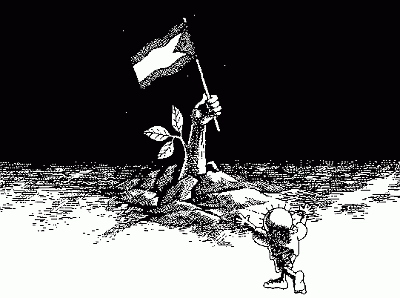
One of the biggest contradictions about Lebanon is the symbolism it represents.
For starters, Lebanon represents co-existence and the symbol of peace, where 18 sects co-exist with each other. The Lebanese President even praised the Lebanese model as "a model of coexistence". The other face of Lebanon is the fact it is the next of sectarianism. Sectarian wars that exploded in 1958, 1975 – 1990, 2008, are a proof also that Lebanon is a model for war. I am certain that a lot of Lebanese abroad spend a lot of their time explaining to the world that Lebanon is divided according to sectarian lines, but all Lebanese love each other. Personally, I agree with the former position, sectarianism is imposed from above, and was legitimated since the French mandate. Like all 19th and early 20th century colonial empires, the French mandate imposed a political body that was aimed to divide the communities in order to renew their mandate. The French are gone, but that type of a regime, that suits the traditional family leaders, remained. Few politicians are exceptions to the norm, they bulldozed their way and became integrated into the system. Coexistence also includes the abolishment of sectarianism towards the Palestinian refugees, seek common solutions with them, and the obliteration of racism towards foreign labor (unless they come from the West, then they are treated with royalty).
Lebanon is "Modern and European" but also "Backward". Sure, wherever the Lebanese go, everyone calls Beirut as the "Paris of the East", or dub Lebanon "Switzerland of the East". Of course the difference is, Paris with all its historic glory, is the symbol of academic discussions on racism exploding there: what it means to be a real French. Switzerland is famous for its historic breakthroughs in patching up its communities and enjoy a prosperous peace. Lebanon on the other hand, enjoys a unique night life that is undisputed by any capital in the world. Dubai, Tel Aviv, Istambul, and others tried to recreate that "rich night life" in Lebanon, but so far it didn't reach Beirut's standards. Nevertheless, Beirut, was the city that demolished on daily basis. Theodor Hanf highlights the remarkable phenomenon, during the 1975 – 1990 civil war, how Beirut was rebuilt itself every time there is a seize fire. Nevertheless, it gets demolished again. After the end of the Israeli aggression on Lebanon in 2006, Beirut automatically restored its night life after the Israeli siege of Lebanon was lifted. As a matter of fact, while Israel was bombing Lebanon, nightlife was also booming in Beirut's nightlife. Couple of pub and nightclub managers told me that their profits maxed out to a new level (two in Ras Beirut, two in Gemayzi) during the Israeli aggression. The time when night life plumbed down was during the 2008 mini civil war we experienced, everyone hid in their houses with few peace activists who were trying to build a front for peace. However, nightlife is not a standard measure for modernity. Such a belief makes some people to become backward. Backward is not to have a religious community as well. It is about sectarianism. Backward is not remembering that the politicians need the people, and not as it currently stands, the people need the leaders.
Lebanon is the beacon of "democracy in the Middle East", but Lebanon is ruled by feudal lords. Hence, is it really democratic when the bourgeoisie elites meet up for months and months discussing the layout of the electoral constituencies whereby most of the results are already determined by the borders and alliances? Sure, Lebanon has a democratic competition between two gigantic coalitions, nevertheless, the results of the competitive coalitions appear when only few constituencies determine the real victor. Usually, such constituencies, have the real balance of power. Another side of the coin is how sectarian or political minorities appear to be beaten up by the supporters of the majority. The elections of 2009 showed how even minorities in the same sect are beaten up. Hence, elections in general rotate around how many traditional figureheads will return. The electoral platform of a party or candidate doesn't matter much, it rotates around who is a real Shiite, Christian, Druzi, and Sunni, in the eyes of the voters. Other voters, who are not really that low in number, vote on the premises of choosing between "the lesser evil". In that sense, who will ruin Lebanon's economic statures less than the others. This boils down usually to two coalitions which we already have. Last but not least, Lebanon's "democratic" system is usually hostage for the elites. They spend a lot of time of choosing a government that suits all the tastes of the elites, and that doesn't save the Lebanese from political tensions. As a matter of fact, the stressing-out-of-the-people phenomena contributes in creating sectarian walls.
There is no war but class war
MFL
Showing posts with label Lebanon's Bipolarity. Show all posts
Showing posts with label Lebanon's Bipolarity. Show all posts
Friday, February 12, 2010


Thursday, January 28, 2010
Lessons of the Ethiopian Airlines: Chauvinism and Political Points
The tragic horrible death of the Ethiopian airlines led to a shock, and a week of mourning. In what was a stand-off between the different reactionary parties in regards to several reforms, the plane crash bought some time.
There are several shocking events that generated prior and after the terrible crash which left several people of different nationalities mourning.
The first event were the reforms to be discussed in the Parliament.
The first focused on reducing the voting age to 18. The advocator to such change came as a surprise, at least in terms of parliamentary blocs, Nabih Berri and his hooligan AMAL. This of course, provides a trauma for me, since AMAL are notorious to enter fist-to-fist fights with almost anyone (a tend that has been operational since the days of the Lebanese Civil War). Nabih Berri, for the past three months or so has advocated all types of change, supporting Ziad Baroud's proposals, and seems to be trying to bring back the legacy of Imam Moussa Sadre's goals for reform back in the 1970s. Berri was involved in sparking the "Cancelation of Sectarianism" act, protecting the Ta'ef Accords (ironically), the Age Act reform, and giving strength to the Parliament (which was shut down for over two years by Berri himself).
The clash of reforms began with the head of the Reform and Change bloc, with lunatic General Aoun, and the other two Christian parties: Lebanese Forces and Phalange. The fear from the voting age reform scared the Christians that they will be overwhelmed by 'Muslim Votes'. The Christian parties eventually proposed that the Immigrants would have the right to vote under the basis that one reform cannot go without the other. This of course hinders all possibilities to implement the age 18 voting law. Since, the new age of the new parliament began under the banner of "Age of Love and Flirtations" among the elites, it was natural that the two camps in Lebanon bickered each other along the same alliances.
Just like the 14th of March and Opposition collisions, historical insights are highlighted and others forgotten, specially when Berri attacked Aoun that the latter was not present to forge the Ta'ef Accords.
The showdown between these two reached its climax when the infamous Monday parliamentary meeting was supposed to take place. Hezbollah attempted to sooth the situation, and it was anticipated that most of the blocs (pro Harriri or not) were going to avoid the making of such a meeting by making sure that the Parliament's quorum was not met. The different news media reported that meetings between AMAL and the Free Patriotic Movement remained taking place till 4:00 in the morning. The same day, the tragic death of the Ethiopian Airlines took place. This saved the politicians of the embarrassment of shooting down the parliament's meeting to take place.
Naomi Klein dubbed the Haiti disaster as Shock Capitalism, with highlights to Israel's 'humanitarian' activities to cover away its past sins in Gaza which turned world opinion against it. This is exactly what took place in Lebanon. A national mourning day took place, the parliamentary session was postponed.
The Lebanese-Ethiopian tragedy
As the plane collapsed, and all efforts took place in a very remarkable manner to salvage survivors, Lebanese pride rose up. Everyone on facebook, msn, and whatever placed a Lebanese flag with a black strip on their profiles. This is indeed a human tragedy.
All politicians diverted their attention into supporting the Red Cross and the Lebanese Army to save the survivors.
Nevertheless, Lebanese fascism sprang. Several Ethiopian blue collar proletariat in Lebanon were denied entrance to the hospitals in order to identify the bodies of their beloved. That is a typical country of contradiction: Co-existence and racism, tolerance and intolerance, and finally democracy and tyranny.
The incident itself was preceded by a controversial acts of beating activists in front of the Egyptian embassy because the activists there found it unusual to attack the apartheid wall of Israel, while Egypt's Moubarak is building another Iron Wall on the Rafah route, to force "coexistence between Hamas and Fatah".
Back to the plane incident, as much as Lebanon's president attempted to show Lebanon's humanitarian face to the world, the Human Rights Watch group slammed Lebanon for its mistreatment of foreign labor and Palestinians. Ironically that was celebrated by Fascist Israel who never bothered to read the entire report, as well to read the reports on their own country.
The acts of racism towards the foreign proletariat proved yet again, amidst this disaster, that foreign labor needs to be protected. The proletariat across the world, like the Lebanese, need to be protected and treated as humans. Every week we hear a story about a foreign laborer being maltreated, specially those who are abused to work almost for free as maids in households. It comes as a surprise for some Lebanese (those whom I spit on their faces) that labor from Sri Lanka, Syria, Jordan, Palestinians, India, Egypt, Ethiopia, Philippines, others are their own equal: simply humans. If Lebanese culture means superiority, for me, that equates to trash (Zionism is even more terrible by the way). It reminds me of France hailing itself as democratic while it was too busy demolishing Algerian proletariat back in the late 1950s and early 1960s, or Israeli "democracy" which rotates around only Judaism while trashing the rest of non-Jewish (and giving Jews of the world a bad name).
For those racist Lebanese, thing of it that Lebanese, Ethiopians, and others died equally as humans on that plane, equals also to the wife of the French Ambassador in Lebanon. May those who mourn find peace again in their hearts.
Again, we see that the whole world is governed by Class War under the banner of different logos: racism, reform, and political points
MFL
PS: The fact Berri is proposing all those reforms is still hard for me to digest
There are several shocking events that generated prior and after the terrible crash which left several people of different nationalities mourning.
The first event were the reforms to be discussed in the Parliament.
The first focused on reducing the voting age to 18. The advocator to such change came as a surprise, at least in terms of parliamentary blocs, Nabih Berri and his hooligan AMAL. This of course, provides a trauma for me, since AMAL are notorious to enter fist-to-fist fights with almost anyone (a tend that has been operational since the days of the Lebanese Civil War). Nabih Berri, for the past three months or so has advocated all types of change, supporting Ziad Baroud's proposals, and seems to be trying to bring back the legacy of Imam Moussa Sadre's goals for reform back in the 1970s. Berri was involved in sparking the "Cancelation of Sectarianism" act, protecting the Ta'ef Accords (ironically), the Age Act reform, and giving strength to the Parliament (which was shut down for over two years by Berri himself).
The clash of reforms began with the head of the Reform and Change bloc, with lunatic General Aoun, and the other two Christian parties: Lebanese Forces and Phalange. The fear from the voting age reform scared the Christians that they will be overwhelmed by 'Muslim Votes'. The Christian parties eventually proposed that the Immigrants would have the right to vote under the basis that one reform cannot go without the other. This of course hinders all possibilities to implement the age 18 voting law. Since, the new age of the new parliament began under the banner of "Age of Love and Flirtations" among the elites, it was natural that the two camps in Lebanon bickered each other along the same alliances.
Just like the 14th of March and Opposition collisions, historical insights are highlighted and others forgotten, specially when Berri attacked Aoun that the latter was not present to forge the Ta'ef Accords.
The showdown between these two reached its climax when the infamous Monday parliamentary meeting was supposed to take place. Hezbollah attempted to sooth the situation, and it was anticipated that most of the blocs (pro Harriri or not) were going to avoid the making of such a meeting by making sure that the Parliament's quorum was not met. The different news media reported that meetings between AMAL and the Free Patriotic Movement remained taking place till 4:00 in the morning. The same day, the tragic death of the Ethiopian Airlines took place. This saved the politicians of the embarrassment of shooting down the parliament's meeting to take place.
Naomi Klein dubbed the Haiti disaster as Shock Capitalism, with highlights to Israel's 'humanitarian' activities to cover away its past sins in Gaza which turned world opinion against it. This is exactly what took place in Lebanon. A national mourning day took place, the parliamentary session was postponed.
The Lebanese-Ethiopian tragedy
As the plane collapsed, and all efforts took place in a very remarkable manner to salvage survivors, Lebanese pride rose up. Everyone on facebook, msn, and whatever placed a Lebanese flag with a black strip on their profiles. This is indeed a human tragedy.
All politicians diverted their attention into supporting the Red Cross and the Lebanese Army to save the survivors.
Nevertheless, Lebanese fascism sprang. Several Ethiopian blue collar proletariat in Lebanon were denied entrance to the hospitals in order to identify the bodies of their beloved. That is a typical country of contradiction: Co-existence and racism, tolerance and intolerance, and finally democracy and tyranny.
The incident itself was preceded by a controversial acts of beating activists in front of the Egyptian embassy because the activists there found it unusual to attack the apartheid wall of Israel, while Egypt's Moubarak is building another Iron Wall on the Rafah route, to force "coexistence between Hamas and Fatah".
Back to the plane incident, as much as Lebanon's president attempted to show Lebanon's humanitarian face to the world, the Human Rights Watch group slammed Lebanon for its mistreatment of foreign labor and Palestinians. Ironically that was celebrated by Fascist Israel who never bothered to read the entire report, as well to read the reports on their own country.
The acts of racism towards the foreign proletariat proved yet again, amidst this disaster, that foreign labor needs to be protected. The proletariat across the world, like the Lebanese, need to be protected and treated as humans. Every week we hear a story about a foreign laborer being maltreated, specially those who are abused to work almost for free as maids in households. It comes as a surprise for some Lebanese (those whom I spit on their faces) that labor from Sri Lanka, Syria, Jordan, Palestinians, India, Egypt, Ethiopia, Philippines, others are their own equal: simply humans. If Lebanese culture means superiority, for me, that equates to trash (Zionism is even more terrible by the way). It reminds me of France hailing itself as democratic while it was too busy demolishing Algerian proletariat back in the late 1950s and early 1960s, or Israeli "democracy" which rotates around only Judaism while trashing the rest of non-Jewish (and giving Jews of the world a bad name).
For those racist Lebanese, thing of it that Lebanese, Ethiopians, and others died equally as humans on that plane, equals also to the wife of the French Ambassador in Lebanon. May those who mourn find peace again in their hearts.
Again, we see that the whole world is governed by Class War under the banner of different logos: racism, reform, and political points
MFL
PS: The fact Berri is proposing all those reforms is still hard for me to digest
Thursday, October 08, 2009
And the Lebanese Never Learn... (surprised?)
Not having a government is not noticed in Lebanon... some joke about it, and they are correct to joke about it; sadly, I notice that having a government eases down the tension between the bougeoisie of Lebanon.
Commenting briefly on the elections before proceeding to the incidents: Was anyone surprised of the results? Everyone claimed they are won, the 14th of March gathered the highest number of seats, and the Opposition gathered the highest number of votes; last but not least, Junblatt opened a minimarket for himself and became the actual veto vote on the government. Meanwhile, it was impressive that not much riots broke up on election days, nevertheless, while waiting for the government to form, we open the TV over here, we see bulletins telling us a grenade was thrown by a "mysterious" evil hand, and everyone denounces it. Tripoli became the source of clashes again, whereby "mysterious rpj" missiles fly, and then "mysterious" gunners reply back. Now wait, isn't that everyday news, I mean why I got bored from blogging on Lebanon? It is the same news, and everyone expects the results. Finally, a person died, stabbed brutally three times, who was supposed to hold a riot between two young groups. Hence, he became the latest in the line of martyrs for the "Lebanese cause", whatever the cause these days it is.
Are we surprised? Hell no, are we sad? Hell yes, I mean doesn't it bother you to hear a riot then you have to call your direct relatives first to check on them, and then call your friends who live there to double check, and finally call friends who actually might be in the region? Will we ever be used to that? Definietly not!
The reason for all of this is simple. All parties still preserve their militia weaponry. Access to arms is still cheap, and none of the political leaders are doing anything to stop it. This of course excludes the arms of Hezbollah which lost some credibility after last year's events of shoot-outs, at least in my own perspective, and also the Palestinian Refugee camps were at least three major factions have large stock of arms: Fatah, Osbat el Ansar, and PFLP-General Command (Gibreel's faction). In all of this chaos, we also had two coalitions going head to head in a militarily sense last year, one group overwhelmed the other, and the winner in these street to street shootouts had disarmed the loser and gave the light and middle ranged weapons to the Lebanese Army. The Lebanese army in such situations, where political parties clearly go and shoot at each other (ie the downfall of the government into militias) can do nothing but sit and watch. Last time the Lebanese army was ordered to bomb an armed political party, it was Hezbollah back in 1989. The result was Nabih Berri (then fresh of clashes with Hezbollah) told the Shiites to leave the army; guess what, they did! The army lost 60% of its units, and the army was threatened then (but yet again) to crumble down. The army these days are called to detect Israeli hidden cells (and may others be captured for the security of the citizens) but to be a riot intercepter: shoot out takes place, army comes, and case closed. Some are captured, but then we lack the follow-up on what happened. Hence, the army is really crippled to disarm anyone, probably not even We'am Wahhab's militants as well.
The reason these ugly incidents take place, like the Cola "mysterious" grenade (and whose echo rang in my ear the other day), is simple! The top leaders are soothing things down, but we see their second in command escalating (well except for Aoun and Jaajaa both competing to prove who is the real Lebanese Christian while Sami Gemayel and Suleiman Franjieh are just trying put their own political space in the mainstream. Walid Junblatt returned to be the pendulum of agreeing one day with this faction or that one, or even both at the same time. Bottom line is, each political party is driving a hard bargain on the government level, mainly Mr. Aoun wants his beloved adorable nephew, Jubran Bathil, to be a minister of interior, then a minister of something else (el-mohem: a minister), and Harriri. Harriri and everyone else would tell us on TV, "we are all happy about the atmosphere", but then their MPs and figureheads lash out on each other. This double tongue doesn't work out at all. Already people are overcharged, and the party militants won't hesitate to blow off some steam. The reason they would blow steam is for the fact simply they are fully convinced the leaders are representing their own sectarian interests (I would exclude the SSNP and the Democratic Left for two reasons):
1) The SSNP had been gaining a lot of grounds politically in Syria, and after last year's militant performance in Beirut, they are being rewarded; also for the fact they are the only official group in the Opposition that is secular (after all Aoun gave up years ago on secularism and preached Christianity). This allows Hassan Nasrallah to argue that whenever Sunni and Shiite militants collide (Future and AMAL to be exact), it is strictly political and not sectarian (same as Harriri) Of course, on TV, we see the MPs joking around, and the sort, hugging each other, laughing, and go back home to their fancy houses. I might exclude Ali Ammar (the MP that was actually a football player who takes in charge of agressively "purifying the chins" of those who mention Hezbollah badly. This guy is a walking time bomb to explode in the parliament. The fact that the Lebanese Communist Party walked out from the Opposition, means the SSNP are the only secular party within the Opposition, within the Lebanese borders.
2) The Democratic Left: Yes, you read that right. They are, much of my hate to them, back to the Parliament, even though with one MP. Why we may ask that question? Well they are the only group that is secular within the 14th of March, but also they carry the maryrdom of Samir Qassir in their files. For such a reason, again to preserve the monopoly of the 2005 - 2007 martyrs of figureheads, a DLM had to be elected. The other reason is the fact that the DLM figureheads, specially Elias Atallah, was the cofounder of the Resistance Front, which fought Israel skin to the teeth; hence 14th of March can use the fascinating relic of Elias Atallah to preach that they have militants that fought Israel in the past. We both remember how Prime Minister Seniora and Hassan Nasrallah competed about whose block was the resistance.
Main issue is: citizens are dying. The man who got stabbled, he may be a part of the Free Patriotic Movement, but he was a citizen, and not an armed militant. It gets worse, by-standers are getting wounded or killed (remember when AMAL's Berri spoke and couple recieved raining bullets? That case was closed swiftly). If we don't have Israel bombing over our heads, we have the political parties shooting at each other, with the occassion of someone mysterious releasing a missile from South Lebanon on Israel's Northern Frontier, and Israel replies with a massive bombardment on nearby villages as if these civilians shot the rockets. Security wise? Fantastic, what more can we ask?
The double tongue of the politicians of escalations and "love affairs of each other" caused this. The economic situation makes it worse, for people's lives are horrible in the country with minimum wages, and frustration goes on the "enemy". The "enemy" is not Israel, it is not the Qa'eda based Fatah Islam (whom we are still debating if it was Syria sending them through the borders or the US sent them), but each other. These riots just escalate more problems, for riots and hate bring more riots and fear, and eventually one day we will have those sporadic violence spreading across sensitive regions in less than 20 minutes. Of course, everyone will yell to their supporters: "go home" or "these parties are armed". I got news for you, a very nice juicy secret news for you: EVERYONE IS ARMED! What happened with the arms that the SSNP or AMAL carried with them? Still there under the banner of Resistance Arms! What happened with the weapons of 14th of March, apparently new ones can be bought easily, and with the latest military blunder of last year, they can learn from their mistakes (super yay for 14th of March, boohoo for the citizens). Having said all these, what about the Labenese in general?
This is why I watch few channels in Lebanon that go on Middle Grounds: LBC and NTV. The problem with NTV though, like Junblatt, they got a moodswing of their own as well: they swing between 14th of March, middle grounds, and the Opposition. By Middle Grounds, I sure do not mean "All the President's men", these people, like Ziad Baroud, will never be elected in a sectarian based state.
Anyways, the reason why I watch the LBC roundabout (yes, sure they put Jaajaa couple of minutes more than the rest) is the fact they ask everyone what happened and what they think. Well, what do they think?! Anyone noticed how the citizens of both sides of a conflicting regions go down screaming and yelling: "we have no problems with our neighbors", "we are all Lebanese", "Don't involve us with party politics", "Leave us alone". Anyone noticed as we sit on our chair (with a nice juicy glass of white wine in my hand) and notice how our proletariat hate what is going on? Notice that there are always a mini-angry crowd blaming the other party while the majority just expressing regrets? (glass finished in one sip after watching the old lady, heartbroken, saying to the politicians: leave us alone). The reason is that these political riots, including the mysterious Inerga (whatever spelled) missiles, and the hand grenades are just the beginning. They suit the politicians to divide the Proletariat according to their sects, and furthermore, and worse, they impose the political divisions on the Lebanese people. Thus, if affiliates of Sect A, but not party affiliates (perhaps some sympathy) has no issues with Sect B, on the contrary relations are fantastic, and these riots take place. Sect A, if losing casualties in this or that region, or even experiencing fear, doubts Sect B. What if some hot head militant that belongs to sect A, pays retaliates and hurts Sect B, the domino effect rolls. All politicians (including Hezbollah, our "defenders" and the "secular" Lebanese Forces) get what they want: isolated sects that clutch to the secatarian parties. Why? Simple... if Sect A for example supports Harriri, but its people are in good relations with Sect B (say supporters of Hezbollah), how to get neighbors to shoot at each other? Simple: bring the hooligans to do some riots, then viola! Fear of the other!
Who benefits: the politicians; who mourns: the proletariat
Who gets richer: the politicians; who mourns: the proletariat
Who goes to their rich houses, the politicians, who is getting poorer: the Proletariat.
The media of the parties are still charging the situation, depends on whenever Minister Baroud yells at them to cool it down aggressively or not!
Lately, these incidents (after the riots of three years, and of course 17 years of civil wars) seem normal to a lot of us. It is as if a Pavlov effect whereby we got accustomed to it!
As my beloved friend Darko said in two posts earlier, we are losing hope, I lost it ages ago, I mean I am still a Marxist, and not any Marxist, the one who still dreams to unite the world into a single classless society where everyone are equal (reminds us of John Lennon's Imagine; good song) I say, we have no choice, as activists to carry on with our belief and quest we can change Lebanon and the whole world (no, I am not doing an Obama ad. of Yes We Can), more like Connelly's logo of: Our demands most humble, we want the world. Neverthelesss, if we do not have the vision, what do we have on the ground? Sad pictures of Iraqis dying by the 100s every day while enjoying what Bush Jr. said: "Giving Freedom and Democracy?" (Side note: Bush Jr. I am still waiting for those damn Weapons of Mass Destructions, you did promise us they will pop up eventually).
It is now 6:51 in Beirut, I bid thee all good night/morning (yes, I am a night crawler, and had a whole rakwi of caffeine for myself in the afternoon)
PS: Doesn't my post on Iran, Hezbollah, and Wilayat el Faqih click on what happened on the elections over there? I love it when my analysis hits the right bullseye
MFL
Commenting briefly on the elections before proceeding to the incidents: Was anyone surprised of the results? Everyone claimed they are won, the 14th of March gathered the highest number of seats, and the Opposition gathered the highest number of votes; last but not least, Junblatt opened a minimarket for himself and became the actual veto vote on the government. Meanwhile, it was impressive that not much riots broke up on election days, nevertheless, while waiting for the government to form, we open the TV over here, we see bulletins telling us a grenade was thrown by a "mysterious" evil hand, and everyone denounces it. Tripoli became the source of clashes again, whereby "mysterious rpj" missiles fly, and then "mysterious" gunners reply back. Now wait, isn't that everyday news, I mean why I got bored from blogging on Lebanon? It is the same news, and everyone expects the results. Finally, a person died, stabbed brutally three times, who was supposed to hold a riot between two young groups. Hence, he became the latest in the line of martyrs for the "Lebanese cause", whatever the cause these days it is.
Are we surprised? Hell no, are we sad? Hell yes, I mean doesn't it bother you to hear a riot then you have to call your direct relatives first to check on them, and then call your friends who live there to double check, and finally call friends who actually might be in the region? Will we ever be used to that? Definietly not!
The reason for all of this is simple. All parties still preserve their militia weaponry. Access to arms is still cheap, and none of the political leaders are doing anything to stop it. This of course excludes the arms of Hezbollah which lost some credibility after last year's events of shoot-outs, at least in my own perspective, and also the Palestinian Refugee camps were at least three major factions have large stock of arms: Fatah, Osbat el Ansar, and PFLP-General Command (Gibreel's faction). In all of this chaos, we also had two coalitions going head to head in a militarily sense last year, one group overwhelmed the other, and the winner in these street to street shootouts had disarmed the loser and gave the light and middle ranged weapons to the Lebanese Army. The Lebanese army in such situations, where political parties clearly go and shoot at each other (ie the downfall of the government into militias) can do nothing but sit and watch. Last time the Lebanese army was ordered to bomb an armed political party, it was Hezbollah back in 1989. The result was Nabih Berri (then fresh of clashes with Hezbollah) told the Shiites to leave the army; guess what, they did! The army lost 60% of its units, and the army was threatened then (but yet again) to crumble down. The army these days are called to detect Israeli hidden cells (and may others be captured for the security of the citizens) but to be a riot intercepter: shoot out takes place, army comes, and case closed. Some are captured, but then we lack the follow-up on what happened. Hence, the army is really crippled to disarm anyone, probably not even We'am Wahhab's militants as well.
The reason these ugly incidents take place, like the Cola "mysterious" grenade (and whose echo rang in my ear the other day), is simple! The top leaders are soothing things down, but we see their second in command escalating (well except for Aoun and Jaajaa both competing to prove who is the real Lebanese Christian while Sami Gemayel and Suleiman Franjieh are just trying put their own political space in the mainstream. Walid Junblatt returned to be the pendulum of agreeing one day with this faction or that one, or even both at the same time. Bottom line is, each political party is driving a hard bargain on the government level, mainly Mr. Aoun wants his beloved adorable nephew, Jubran Bathil, to be a minister of interior, then a minister of something else (el-mohem: a minister), and Harriri. Harriri and everyone else would tell us on TV, "we are all happy about the atmosphere", but then their MPs and figureheads lash out on each other. This double tongue doesn't work out at all. Already people are overcharged, and the party militants won't hesitate to blow off some steam. The reason they would blow steam is for the fact simply they are fully convinced the leaders are representing their own sectarian interests (I would exclude the SSNP and the Democratic Left for two reasons):
1) The SSNP had been gaining a lot of grounds politically in Syria, and after last year's militant performance in Beirut, they are being rewarded; also for the fact they are the only official group in the Opposition that is secular (after all Aoun gave up years ago on secularism and preached Christianity). This allows Hassan Nasrallah to argue that whenever Sunni and Shiite militants collide (Future and AMAL to be exact), it is strictly political and not sectarian (same as Harriri) Of course, on TV, we see the MPs joking around, and the sort, hugging each other, laughing, and go back home to their fancy houses. I might exclude Ali Ammar (the MP that was actually a football player who takes in charge of agressively "purifying the chins" of those who mention Hezbollah badly. This guy is a walking time bomb to explode in the parliament. The fact that the Lebanese Communist Party walked out from the Opposition, means the SSNP are the only secular party within the Opposition, within the Lebanese borders.
2) The Democratic Left: Yes, you read that right. They are, much of my hate to them, back to the Parliament, even though with one MP. Why we may ask that question? Well they are the only group that is secular within the 14th of March, but also they carry the maryrdom of Samir Qassir in their files. For such a reason, again to preserve the monopoly of the 2005 - 2007 martyrs of figureheads, a DLM had to be elected. The other reason is the fact that the DLM figureheads, specially Elias Atallah, was the cofounder of the Resistance Front, which fought Israel skin to the teeth; hence 14th of March can use the fascinating relic of Elias Atallah to preach that they have militants that fought Israel in the past. We both remember how Prime Minister Seniora and Hassan Nasrallah competed about whose block was the resistance.
Main issue is: citizens are dying. The man who got stabbled, he may be a part of the Free Patriotic Movement, but he was a citizen, and not an armed militant. It gets worse, by-standers are getting wounded or killed (remember when AMAL's Berri spoke and couple recieved raining bullets? That case was closed swiftly). If we don't have Israel bombing over our heads, we have the political parties shooting at each other, with the occassion of someone mysterious releasing a missile from South Lebanon on Israel's Northern Frontier, and Israel replies with a massive bombardment on nearby villages as if these civilians shot the rockets. Security wise? Fantastic, what more can we ask?
The double tongue of the politicians of escalations and "love affairs of each other" caused this. The economic situation makes it worse, for people's lives are horrible in the country with minimum wages, and frustration goes on the "enemy". The "enemy" is not Israel, it is not the Qa'eda based Fatah Islam (whom we are still debating if it was Syria sending them through the borders or the US sent them), but each other. These riots just escalate more problems, for riots and hate bring more riots and fear, and eventually one day we will have those sporadic violence spreading across sensitive regions in less than 20 minutes. Of course, everyone will yell to their supporters: "go home" or "these parties are armed". I got news for you, a very nice juicy secret news for you: EVERYONE IS ARMED! What happened with the arms that the SSNP or AMAL carried with them? Still there under the banner of Resistance Arms! What happened with the weapons of 14th of March, apparently new ones can be bought easily, and with the latest military blunder of last year, they can learn from their mistakes (super yay for 14th of March, boohoo for the citizens). Having said all these, what about the Labenese in general?
This is why I watch few channels in Lebanon that go on Middle Grounds: LBC and NTV. The problem with NTV though, like Junblatt, they got a moodswing of their own as well: they swing between 14th of March, middle grounds, and the Opposition. By Middle Grounds, I sure do not mean "All the President's men", these people, like Ziad Baroud, will never be elected in a sectarian based state.
Anyways, the reason why I watch the LBC roundabout (yes, sure they put Jaajaa couple of minutes more than the rest) is the fact they ask everyone what happened and what they think. Well, what do they think?! Anyone noticed how the citizens of both sides of a conflicting regions go down screaming and yelling: "we have no problems with our neighbors", "we are all Lebanese", "Don't involve us with party politics", "Leave us alone". Anyone noticed as we sit on our chair (with a nice juicy glass of white wine in my hand) and notice how our proletariat hate what is going on? Notice that there are always a mini-angry crowd blaming the other party while the majority just expressing regrets? (glass finished in one sip after watching the old lady, heartbroken, saying to the politicians: leave us alone). The reason is that these political riots, including the mysterious Inerga (whatever spelled) missiles, and the hand grenades are just the beginning. They suit the politicians to divide the Proletariat according to their sects, and furthermore, and worse, they impose the political divisions on the Lebanese people. Thus, if affiliates of Sect A, but not party affiliates (perhaps some sympathy) has no issues with Sect B, on the contrary relations are fantastic, and these riots take place. Sect A, if losing casualties in this or that region, or even experiencing fear, doubts Sect B. What if some hot head militant that belongs to sect A, pays retaliates and hurts Sect B, the domino effect rolls. All politicians (including Hezbollah, our "defenders" and the "secular" Lebanese Forces) get what they want: isolated sects that clutch to the secatarian parties. Why? Simple... if Sect A for example supports Harriri, but its people are in good relations with Sect B (say supporters of Hezbollah), how to get neighbors to shoot at each other? Simple: bring the hooligans to do some riots, then viola! Fear of the other!
Who benefits: the politicians; who mourns: the proletariat
Who gets richer: the politicians; who mourns: the proletariat
Who goes to their rich houses, the politicians, who is getting poorer: the Proletariat.
The media of the parties are still charging the situation, depends on whenever Minister Baroud yells at them to cool it down aggressively or not!
Lately, these incidents (after the riots of three years, and of course 17 years of civil wars) seem normal to a lot of us. It is as if a Pavlov effect whereby we got accustomed to it!
As my beloved friend Darko said in two posts earlier, we are losing hope, I lost it ages ago, I mean I am still a Marxist, and not any Marxist, the one who still dreams to unite the world into a single classless society where everyone are equal (reminds us of John Lennon's Imagine; good song) I say, we have no choice, as activists to carry on with our belief and quest we can change Lebanon and the whole world (no, I am not doing an Obama ad. of Yes We Can), more like Connelly's logo of: Our demands most humble, we want the world. Neverthelesss, if we do not have the vision, what do we have on the ground? Sad pictures of Iraqis dying by the 100s every day while enjoying what Bush Jr. said: "Giving Freedom and Democracy?" (Side note: Bush Jr. I am still waiting for those damn Weapons of Mass Destructions, you did promise us they will pop up eventually).
It is now 6:51 in Beirut, I bid thee all good night/morning (yes, I am a night crawler, and had a whole rakwi of caffeine for myself in the afternoon)
PS: Doesn't my post on Iran, Hezbollah, and Wilayat el Faqih click on what happened on the elections over there? I love it when my analysis hits the right bullseye
MFL
Friday, January 16, 2009
The Doha Conference, A Great Divide, and A Whirlpool of Ironies
The Doha Conference:
'They come in fancy planes while the people are dying...'
As the number of Palestinian casualties jumps to 1133, those rotten Arab countries so far offered nothing to Palestine. Just as Israel got away in dissecting the West Bank, the massacres of Gaza are exceeding all forms of butcheries. More than 20 Palestinians had been located under the ruins of a building, which means some of them died out of suffocation. Of course, this is dubbed self – defense by Israel.
Conferences and more conferences
The split of the Arab League peaked officially today. Saudi Arabia and Egypt clearly displayed their muscles by blocking the Qataris from having a quorum to meet under the patronage of the Arab League, and take decisions in that regard. This however doesn't mean Qatar is a weakling compared to the former two. Qatar managed to gather 13 voters within the Arab league despite Egypt and Saudi Arabia's obstructions, even though that was not enough to hold a quorum. The Saudi Regime and their allies the Egyptian Regime never forgave how Prince Hamad bin Khalifa al-Thani took the lead in spearheading a Lebanese Dialogue that brought a temporary peace to Lebanon.
Meanwhile, Abbas still argues that the peace treaty is under threat, and still unaware that there never was anything called Peace. The Israeli war-machinery never stopped to do peace. Elsewhere the Doha conference kicked off in order to discuss different means of halting the war. Again, no results, but interesting headlines popped out.
Hamas's Mishaal was present, which is natural. Where there is no Fatah, there is Hamas. Hamas repeated their insistence on halting the butchery of the innocent civilians. He argued that Israeli Forces should withdraw from Gaza, cut their war, end the blockade, open the routes of Gaza, and hold Israel accountable for their war crimes. He insisted on how the Palestinians are practically unarmed. He insisted on the time factor, where as they speak, more citizens are dying. Hamas had secured its representation of the Palestinian resistance and the sufferings of the people of Gaza. He also stressed on how Israel is trying to invent new realities, something that Rice supported. In her own words, the seize fire will not take place or else a temporary peace will take place and a new war. Nevertheless, she failed to mention who is the real aggressor on the issue. Mishaal also described the harsh conditions the people of Gaza are living through, and equated his resistance to that of Hezbollah where he argued that it was the same resistance that expelled Israel from the Southern Lebanese region and Gaza. He also highlighted that the resistance of the Palestinians is capable to achieve victory, mainly because they can remain alive after Israel bombed everything. Nevertheless, as I mentioned earlier, Israel's main purpose is not to dismantle Hamas, rather the Zionist country needs Hamas to gain more funds, arms, and settle internal scores in the elections. For example Ehud Barak jumped 17% in the Israeli opinion when the offensive started, which made him the primary competitor to Levni for the Prime Minister position. Nevertheless, Mishaal's pleas to save the Palestinians was fully felt, but the method he gave his pleas, with a steadfast position, allowed him to divulge the charisma he has. Unlike Abbas who is begging the international community to send an international force, similar to UNIFIL, but to bring Hamas under control so that he can live in peace Israel; hence disregarding all the demonstrations that took place in the West Bank in solidarity with Gaza, to which he barely expressed anything.
I have to admit, what nerves of steel Meshaal displayed, specially in less than 24 hours the Israelis killed his colleague, Hamas's minister of interior Said Siam, along with his brother and son.
The Syrian President
The Syrian President spoke next, as always, he took the leadership of opposing the Israelis and fighting for the Arab cause. He gave credit to the Lebanese resistance for defeating the Israelis in 2000 and 2006, and how both the Lebanese and Palestinians are exporting the spirit of resistance to elsewhere in the Arab world. Indirectly, he separated the Arab world to those who surrender, and those who are resisting. He also argued how those who achieve peace by resisting an occupier, and those who accept peace in seeking their own interests. He also, to give himself credit for the July war, also stressed on the importance of standing next to a country. Although as far as I remember, Syria made money on Lebanon's expense due to the July war, he refused to open a front on his side, denied any Israeli missiles falling on Syrian grounds, and probably the credit he takes is using his land to smuggle weaponry to Hezbollah and their allies.
Nevertheless, the Syrian president, in my personal opinion scored highly in the face of other Arab leaders. While it is true that the majority of the Arab citizens are frustrated by their helplessness, he used the 1970s language of the 'Arab revolutionary' where he summarized that time is not on the Israeli side, but he got philosophical on how each generation becomes more wrathful to Israeli brutality. Throughout his speech, he also hinted to Egypt and Saudi Arabia on their unwillingness to do anything about the on-going massacres. He also expressed the distrust of the Arab world in the International Court to hold Israel accountable.
Finally, his contribution to the summit is by suspending the indirect negotatiations with Israel, spoke in an apocalyptic manner in regards to Gaza and the Golan Heights witnessing a new victory, and the importance of funding the Palestinians with all means possible, ranging from materialistic aid to moral boast.
Lebanese President
The Lebanese President, Michel Suleiman, was next to speak. Unlike the days of Emil Lahoud, for once the Lebanese President's speech was different than what the Syrians wanted him to deliver. The other side of the story, Michel Suleiman's travel to Qatar was dubbed as Hezbollah and Amal imposing their demands on the Lebanese President to travel. Nevertheless, the speech he read in Doha was quiet different. Again, the Suleiman succeeded in copy pasting demands of what was known as the 'Opposition' and 14th of March demands. The Prince of Qatar, Sheikh Hamad bin Khalifa, back in the July war was regarded a 14th of March supporter, now he is regarded as an 8th of March follower.
President Suleiman's speech began with how Lebanon 'victoriously' extracted UN resolution 1701, and insisted on how Israel continued to breach it. He gave credit to the Lebanese citizens, the Lebanese resistance, and the Lebanese army for crushing the Israeli offensive of 2006. Nevertheless, Suleiman's speech rotated around on keeping Lebanon out of war with Israel, and stressed on how Lebanon's role is non-alignment, whereby its role is to tackle those rifts in the Arab World. Of course, he didn't give any hints on Egypt, Saudi Arabia, or any other country, rather projecting on how the Arabs should be united and gave a long-run period for that, which till then probably half of the people of Gaza would be killed.
Nevertheless, being a president of country that defeated Israel on three different eras, he had the aura to escalate, but didn't escalate beyond providing sympathy to the people of Gaza. Prince Hamad bin Khalifa hailed the President as being part of the resistance when he was the head of the Lebanese Army.
It has to be noted, that the Qatari Prince, and the Lebanese & Syrian Presidents, appeared while reading their speeches as if they are in the middle of an Arabic reading test. Other than Meshaal's eloquent Arabic, the others repeated several times Arabic words, and corrected grammar rules as they read.
The Moon Islands , Mauritania, and Iraq
The Moon islands are a couple of small islands that were glued into a republic. While repeating the atrocities of the Israelis, and like the earlier presidents, blamed the Arab leaderships for taking so much time in taking any actions, proposed to form a committee from the attendees, and tour around the major players in the International Community to raise awareness against the Israelis, and properly to unify media efforts in exposing the Israeli brutality, mainly to the Western audience.
Mauritania was probably the most hilarious country of them all. Just recovering from a military coup and preserving a peace treaty with Israel, all eyes went on the speaker. Nobody understood anything what he said, as his Arabic was rather very weak, and he didn't discuss anything about cutting ties with Israel. He did condemn the Israeli brutality, based on what was understood, but that was it. Everyone issued relief sighs of 'Thank Heaven the torture is over' when he finished.
The Iraqi Vice President was next, as much as he condemned the Israeli aggression, he reiterated Iraq's historical role in standing next to Palestine. Nevertheless, he didn't express anything about the US intervention in Iraq, nor whether Iraq as a nation state still exists theoretically with all the cantons present there. But I also realized that their minister of education was targeted in a bomb there, and I wondered for how long this man will stay alive.
Iran's Ahmadinejad
As probably participating as a guest, he expressed his ideas as well. We all know what Iran's role in arming Hezbollah, and giving them the right technology in beating Israel's ass out of Lebanon, then watching how their infantry were sitting ducks to Hezbollah's warriors. Who would thought that those Merkava tanks are destructible? Not complaining on seeing a popped out tank of that caliber. Yet, the Iranian president repeated the same words where Israel's attrocities in Lebanon and Palestine had been repeating themselves for so long, and demanded that the leadership of Israel should be held in a court.
In Parallel...
The Arab League's official meeting of foreign ministers FINALLY agreed for calling the opening of the borders of Gaza. In a nutshell, that is the biggest crap I ever heard for a while. After three weeks of butchery, the Arab League till this day simply issued out such a decision? After what, 1133 (so far), had been killed, and over 5000 wounded? Isn’t it ironical that such decisions come out when Israel is so close to accept a seize fire agreement? That doesn't stop the butchery of the Palestinians...
Collisions also took place in the West Bank between the Palestinian Authority and Hamas. In a large demonstration in solidarity with the people of Gaza, a small group raised the flags of Hamas, where the PA security beat and arrested them. Hence, Abbas reinforces the division between Fatah and Hamas. BBC's article, under the title of Gaza and West Bank: Growing Divide explains it in a nice way.
Bush's final speech:
Bush hailed himself as giving democracy for different countries; some of those he named were Lebanon, Kosovo, and Iraq.
I accuse Bush of being the biggest liar the world has ever seen, and makes Saddam Hussein look like an angel next to him. For starters, Bush didn't do anything to Lebanon, he sold out on his allies (yet again) the 14th of March, leaving them stranded in the middle of nowhere. The expulsion of the Syrian army didn't come from Bush, rather a strong reaction of the Lebanese on the assassination of Harriri and the fact they were fed up from their crap. As a matter of fact, it was his 'Green Card' to the Israelis that allowed all those Lebanese and Palestinian citizens to flourish.
Kosovo was totally irrelevant to Bush's policy, It was Bill Clinton's policy to the Balkans that gave Kosovo its independence, amidst never-ending chaos in the Balkans that secured Kosovo its independence.
Finally, Iraq, Bush gave them no democracy at all. He shattered a country into a three way ethnic divisions, and gave the al-Qaeda the space to crawl into Iraq. His war on terror cost the Iraqis over 650,000 citizens, and that was prior to the execution of the tyrant Saddam. He waged a war on Iraq under the banner of saving the Americans from weapons of mass destruction which were never found, then turned out Jesus inspired him. He also ruined the US economy, which in turn ruined the global economy by spending over 800 billion dollars a year on upgrading weapons, and producing unneeded weapons that no way a group of Qaeda or even the Iraqi regime was able to counter.
Democracy in Bush meant also to support the Moubarak regime, the Saudi regime, and the Jordanian regime. This led the Muslim Brotherhood in specific to grow even stronger in Egypt, while Saudi Arabia's instability is growing even more.
I will tackle his farewell speeches in details. But I would like to add one note: Afghanistan:
His 'War on Drugs' prior to his 'War on Terror' made him a buffoon in protecting his own citizens, when he was warned. Earlier US Administrations funded the Taliban who were actually needed to counter the Soviet invasion of Afghanistan. Actually in a period of four months prior to 9/11, he disregarded the issue of Bin Laden wanting to strike the US, and gave the Taliban government almost 45 million dollars in fighting drugs and opium. Ironic, isn't it?
Bush is responsible for almost every civilian's death that took place, for promoting dictatorships, and even funding terrorists like al-Qaeda. So the hell with you Bush, and I sure wish there is a hell, to see you rotting in it.
'They come in fancy planes while the people are dying...'
As the number of Palestinian casualties jumps to 1133, those rotten Arab countries so far offered nothing to Palestine. Just as Israel got away in dissecting the West Bank, the massacres of Gaza are exceeding all forms of butcheries. More than 20 Palestinians had been located under the ruins of a building, which means some of them died out of suffocation. Of course, this is dubbed self – defense by Israel.
Conferences and more conferences
The split of the Arab League peaked officially today. Saudi Arabia and Egypt clearly displayed their muscles by blocking the Qataris from having a quorum to meet under the patronage of the Arab League, and take decisions in that regard. This however doesn't mean Qatar is a weakling compared to the former two. Qatar managed to gather 13 voters within the Arab league despite Egypt and Saudi Arabia's obstructions, even though that was not enough to hold a quorum. The Saudi Regime and their allies the Egyptian Regime never forgave how Prince Hamad bin Khalifa al-Thani took the lead in spearheading a Lebanese Dialogue that brought a temporary peace to Lebanon.
Meanwhile, Abbas still argues that the peace treaty is under threat, and still unaware that there never was anything called Peace. The Israeli war-machinery never stopped to do peace. Elsewhere the Doha conference kicked off in order to discuss different means of halting the war. Again, no results, but interesting headlines popped out.
Hamas's Mishaal was present, which is natural. Where there is no Fatah, there is Hamas. Hamas repeated their insistence on halting the butchery of the innocent civilians. He argued that Israeli Forces should withdraw from Gaza, cut their war, end the blockade, open the routes of Gaza, and hold Israel accountable for their war crimes. He insisted on how the Palestinians are practically unarmed. He insisted on the time factor, where as they speak, more citizens are dying. Hamas had secured its representation of the Palestinian resistance and the sufferings of the people of Gaza. He also stressed on how Israel is trying to invent new realities, something that Rice supported. In her own words, the seize fire will not take place or else a temporary peace will take place and a new war. Nevertheless, she failed to mention who is the real aggressor on the issue. Mishaal also described the harsh conditions the people of Gaza are living through, and equated his resistance to that of Hezbollah where he argued that it was the same resistance that expelled Israel from the Southern Lebanese region and Gaza. He also highlighted that the resistance of the Palestinians is capable to achieve victory, mainly because they can remain alive after Israel bombed everything. Nevertheless, as I mentioned earlier, Israel's main purpose is not to dismantle Hamas, rather the Zionist country needs Hamas to gain more funds, arms, and settle internal scores in the elections. For example Ehud Barak jumped 17% in the Israeli opinion when the offensive started, which made him the primary competitor to Levni for the Prime Minister position. Nevertheless, Mishaal's pleas to save the Palestinians was fully felt, but the method he gave his pleas, with a steadfast position, allowed him to divulge the charisma he has. Unlike Abbas who is begging the international community to send an international force, similar to UNIFIL, but to bring Hamas under control so that he can live in peace Israel; hence disregarding all the demonstrations that took place in the West Bank in solidarity with Gaza, to which he barely expressed anything.
I have to admit, what nerves of steel Meshaal displayed, specially in less than 24 hours the Israelis killed his colleague, Hamas's minister of interior Said Siam, along with his brother and son.
The Syrian President
The Syrian President spoke next, as always, he took the leadership of opposing the Israelis and fighting for the Arab cause. He gave credit to the Lebanese resistance for defeating the Israelis in 2000 and 2006, and how both the Lebanese and Palestinians are exporting the spirit of resistance to elsewhere in the Arab world. Indirectly, he separated the Arab world to those who surrender, and those who are resisting. He also argued how those who achieve peace by resisting an occupier, and those who accept peace in seeking their own interests. He also, to give himself credit for the July war, also stressed on the importance of standing next to a country. Although as far as I remember, Syria made money on Lebanon's expense due to the July war, he refused to open a front on his side, denied any Israeli missiles falling on Syrian grounds, and probably the credit he takes is using his land to smuggle weaponry to Hezbollah and their allies.
Nevertheless, the Syrian president, in my personal opinion scored highly in the face of other Arab leaders. While it is true that the majority of the Arab citizens are frustrated by their helplessness, he used the 1970s language of the 'Arab revolutionary' where he summarized that time is not on the Israeli side, but he got philosophical on how each generation becomes more wrathful to Israeli brutality. Throughout his speech, he also hinted to Egypt and Saudi Arabia on their unwillingness to do anything about the on-going massacres. He also expressed the distrust of the Arab world in the International Court to hold Israel accountable.
Finally, his contribution to the summit is by suspending the indirect negotatiations with Israel, spoke in an apocalyptic manner in regards to Gaza and the Golan Heights witnessing a new victory, and the importance of funding the Palestinians with all means possible, ranging from materialistic aid to moral boast.
Lebanese President
The Lebanese President, Michel Suleiman, was next to speak. Unlike the days of Emil Lahoud, for once the Lebanese President's speech was different than what the Syrians wanted him to deliver. The other side of the story, Michel Suleiman's travel to Qatar was dubbed as Hezbollah and Amal imposing their demands on the Lebanese President to travel. Nevertheless, the speech he read in Doha was quiet different. Again, the Suleiman succeeded in copy pasting demands of what was known as the 'Opposition' and 14th of March demands. The Prince of Qatar, Sheikh Hamad bin Khalifa, back in the July war was regarded a 14th of March supporter, now he is regarded as an 8th of March follower.
President Suleiman's speech began with how Lebanon 'victoriously' extracted UN resolution 1701, and insisted on how Israel continued to breach it. He gave credit to the Lebanese citizens, the Lebanese resistance, and the Lebanese army for crushing the Israeli offensive of 2006. Nevertheless, Suleiman's speech rotated around on keeping Lebanon out of war with Israel, and stressed on how Lebanon's role is non-alignment, whereby its role is to tackle those rifts in the Arab World. Of course, he didn't give any hints on Egypt, Saudi Arabia, or any other country, rather projecting on how the Arabs should be united and gave a long-run period for that, which till then probably half of the people of Gaza would be killed.
Nevertheless, being a president of country that defeated Israel on three different eras, he had the aura to escalate, but didn't escalate beyond providing sympathy to the people of Gaza. Prince Hamad bin Khalifa hailed the President as being part of the resistance when he was the head of the Lebanese Army.
It has to be noted, that the Qatari Prince, and the Lebanese & Syrian Presidents, appeared while reading their speeches as if they are in the middle of an Arabic reading test. Other than Meshaal's eloquent Arabic, the others repeated several times Arabic words, and corrected grammar rules as they read.
The Moon Islands , Mauritania, and Iraq
The Moon islands are a couple of small islands that were glued into a republic. While repeating the atrocities of the Israelis, and like the earlier presidents, blamed the Arab leaderships for taking so much time in taking any actions, proposed to form a committee from the attendees, and tour around the major players in the International Community to raise awareness against the Israelis, and properly to unify media efforts in exposing the Israeli brutality, mainly to the Western audience.
Mauritania was probably the most hilarious country of them all. Just recovering from a military coup and preserving a peace treaty with Israel, all eyes went on the speaker. Nobody understood anything what he said, as his Arabic was rather very weak, and he didn't discuss anything about cutting ties with Israel. He did condemn the Israeli brutality, based on what was understood, but that was it. Everyone issued relief sighs of 'Thank Heaven the torture is over' when he finished.
The Iraqi Vice President was next, as much as he condemned the Israeli aggression, he reiterated Iraq's historical role in standing next to Palestine. Nevertheless, he didn't express anything about the US intervention in Iraq, nor whether Iraq as a nation state still exists theoretically with all the cantons present there. But I also realized that their minister of education was targeted in a bomb there, and I wondered for how long this man will stay alive.
Iran's Ahmadinejad
As probably participating as a guest, he expressed his ideas as well. We all know what Iran's role in arming Hezbollah, and giving them the right technology in beating Israel's ass out of Lebanon, then watching how their infantry were sitting ducks to Hezbollah's warriors. Who would thought that those Merkava tanks are destructible? Not complaining on seeing a popped out tank of that caliber. Yet, the Iranian president repeated the same words where Israel's attrocities in Lebanon and Palestine had been repeating themselves for so long, and demanded that the leadership of Israel should be held in a court.
In Parallel...
The Arab League's official meeting of foreign ministers FINALLY agreed for calling the opening of the borders of Gaza. In a nutshell, that is the biggest crap I ever heard for a while. After three weeks of butchery, the Arab League till this day simply issued out such a decision? After what, 1133 (so far), had been killed, and over 5000 wounded? Isn’t it ironical that such decisions come out when Israel is so close to accept a seize fire agreement? That doesn't stop the butchery of the Palestinians...
Collisions also took place in the West Bank between the Palestinian Authority and Hamas. In a large demonstration in solidarity with the people of Gaza, a small group raised the flags of Hamas, where the PA security beat and arrested them. Hence, Abbas reinforces the division between Fatah and Hamas. BBC's article, under the title of Gaza and West Bank: Growing Divide explains it in a nice way.
Bush's final speech:
Bush hailed himself as giving democracy for different countries; some of those he named were Lebanon, Kosovo, and Iraq.
I accuse Bush of being the biggest liar the world has ever seen, and makes Saddam Hussein look like an angel next to him. For starters, Bush didn't do anything to Lebanon, he sold out on his allies (yet again) the 14th of March, leaving them stranded in the middle of nowhere. The expulsion of the Syrian army didn't come from Bush, rather a strong reaction of the Lebanese on the assassination of Harriri and the fact they were fed up from their crap. As a matter of fact, it was his 'Green Card' to the Israelis that allowed all those Lebanese and Palestinian citizens to flourish.
Kosovo was totally irrelevant to Bush's policy, It was Bill Clinton's policy to the Balkans that gave Kosovo its independence, amidst never-ending chaos in the Balkans that secured Kosovo its independence.
Finally, Iraq, Bush gave them no democracy at all. He shattered a country into a three way ethnic divisions, and gave the al-Qaeda the space to crawl into Iraq. His war on terror cost the Iraqis over 650,000 citizens, and that was prior to the execution of the tyrant Saddam. He waged a war on Iraq under the banner of saving the Americans from weapons of mass destruction which were never found, then turned out Jesus inspired him. He also ruined the US economy, which in turn ruined the global economy by spending over 800 billion dollars a year on upgrading weapons, and producing unneeded weapons that no way a group of Qaeda or even the Iraqi regime was able to counter.
Democracy in Bush meant also to support the Moubarak regime, the Saudi regime, and the Jordanian regime. This led the Muslim Brotherhood in specific to grow even stronger in Egypt, while Saudi Arabia's instability is growing even more.
I will tackle his farewell speeches in details. But I would like to add one note: Afghanistan:
His 'War on Drugs' prior to his 'War on Terror' made him a buffoon in protecting his own citizens, when he was warned. Earlier US Administrations funded the Taliban who were actually needed to counter the Soviet invasion of Afghanistan. Actually in a period of four months prior to 9/11, he disregarded the issue of Bin Laden wanting to strike the US, and gave the Taliban government almost 45 million dollars in fighting drugs and opium. Ironic, isn't it?
Bush is responsible for almost every civilian's death that took place, for promoting dictatorships, and even funding terrorists like al-Qaeda. So the hell with you Bush, and I sure wish there is a hell, to see you rotting in it.
Friday, August 29, 2008
Hezbollah Slap Themselves in the Face!
While facing a powerful army like Israel, they are accurate with their operations.
While sweeping through Beirut, they were accurate! They never shot a single bullet on the army...
But in time of peace, how the hell a Hezbollah militant shot a Lebanese Army helicopter in the head?
Hezbollah could defeat anyone militarily, and obviously only a Hezbollah militant can mess Hezbollah's role on victory, and give 14th of March the stamina to return back politically.
Whereby 14th of March are having a field day on Hezbollah's blunder, the assassination of of the officer stunned the Lebanese society. Furthermore, the co-pilot was detained for two hours, handcuffed, and beaten.
The incident confirmed the fear of Hezbollah-land. Very few people argued that the army should have informed Hezbollah; however, these few people are not aware that the Lebanese army, by Nasrallah's own words, is the ultimate authority. Hence, chaos occurred. The Free Patriotic Movement, which has key-figures of ex-army officials, toned down the incident on their official site, and officially the supporters are lost. The 14th of March became more wrathful than ever, ever since Hezbollah's allies ended the deadlock of almost two years in less than 3 days.
Hezbollah's only statement was that the culprit should be handed out and condemned the operation; however, the Hezbollah militant couldn't have shot the helicopter without an order, and also what about the others who detained the copilot and beat him; specially the helicopter had been conducting training flights for two days.
The picture of Samer Hannah's fiance crying is all that left the Lebanese audience in tears. They were supposed to be wed this saturday.
Hezbollah to ease down tensions, surrendered the "supposed" shooter on the helicopter, but not the others who beat up the co-pilot. Now, we will see how the different party will tone down the publicities.
A final question goes to MP Ali Ammar: "Is it his turn to purify his own chin after Elias Atallah?" Or we are still not allowed to form critiques of his party because it is "God Given"?
MFL
While sweeping through Beirut, they were accurate! They never shot a single bullet on the army...
But in time of peace, how the hell a Hezbollah militant shot a Lebanese Army helicopter in the head?
Hezbollah could defeat anyone militarily, and obviously only a Hezbollah militant can mess Hezbollah's role on victory, and give 14th of March the stamina to return back politically.
Whereby 14th of March are having a field day on Hezbollah's blunder, the assassination of of the officer stunned the Lebanese society. Furthermore, the co-pilot was detained for two hours, handcuffed, and beaten.
The incident confirmed the fear of Hezbollah-land. Very few people argued that the army should have informed Hezbollah; however, these few people are not aware that the Lebanese army, by Nasrallah's own words, is the ultimate authority. Hence, chaos occurred. The Free Patriotic Movement, which has key-figures of ex-army officials, toned down the incident on their official site, and officially the supporters are lost. The 14th of March became more wrathful than ever, ever since Hezbollah's allies ended the deadlock of almost two years in less than 3 days.
Hezbollah's only statement was that the culprit should be handed out and condemned the operation; however, the Hezbollah militant couldn't have shot the helicopter without an order, and also what about the others who detained the copilot and beat him; specially the helicopter had been conducting training flights for two days.
The picture of Samer Hannah's fiance crying is all that left the Lebanese audience in tears. They were supposed to be wed this saturday.
Hezbollah to ease down tensions, surrendered the "supposed" shooter on the helicopter, but not the others who beat up the co-pilot. Now, we will see how the different party will tone down the publicities.
A final question goes to MP Ali Ammar: "Is it his turn to purify his own chin after Elias Atallah?" Or we are still not allowed to form critiques of his party because it is "God Given"?
MFL
Wednesday, July 30, 2008
The Lebanese – Israeli Lullaby
Introduction
Probably the most interesting and most complex relationship between the Zionists and the Lebanese was the contradictions of regarding Lebanon as part of the Israeli plans.
Lebanon Proper, under the Ottomans, was divided into several regions, which included some parts existing in Syria and Palestine. Lebanon by the 19th century was divided into an autonomous Mutasarifieh in Mt. Lebanon which covered the Druze and Christian lands, the Tripoli governorate which included Northern Lebanon and parts of Syria, the Damascus governorate, which included the Bekaa, and the A'ka governorate, which included parts of the South as well as occasionally Sour (aka Tyre). Now these borders fluctuated, but in general, for most of the centuries of Ottoman rule, that is how Lebanon administratively was divided.
For starters, Lebanon since Prince Fakhridean II had enjoyed autonomy, sometimes that autonomy expanded to include certain Syrian areas, and sometimes that autonomy got demolished. Eventually, there was an interruption of 9 years under Mohammad Ali Basha, and his son Ibrahim Basha, of Egypt, for nine years. In the 19th century, Prince Bashir II, an ex-Sunni converting to Christianity, created the concept of Mt. Lebanon based on Christian premises, the concept of sovereign Lebanon and the Lebanese Christians became intertwined since then, specially in a later phase of the 19th century, when it was an autonomous region, under an Ottoman governor, with the patronage of six European imperial forces. By then, Europe's super powers followed the logic of "protecting the minorities" to expand their territorial acquisitions.
By the time the French successfully dominated Syria and Lebanon Proper regions, the British successfully ousted the French from the Sykes-Pico agreement, and took over Palestine. Jordan was separated from Syria, under the British Mandate, while Iraq broke the norm of carving out nations, rather, that country was patched up from three large governorates into a gigantic country, Iraq. Under Archbishop Howayek, from Mt. Lebanon, the second Lebanese delegation travelled to Versailles negotiations, and demanded that the French rule Lebanon directly after WWI. Clemenceau appeared in the newspapers hugging Archbishop Howayek. Modern Lebanon was officially created in 1920. One purpose for its creation was the Christians seeking autonomy in a Muslim world. It has to be noted, the Christians were the first to advocate Arab nationalism in the face of the Ottomans, but when having the chance to break free, the Versailles treaty gave them that chance.

The Zionists, on the other hand, didn't have a land to demand. The Palestinians, made up of Muslims, Christians, and Jews were living in harmony and didn't accept the isolationist logic of the Zionists. Till current days, Arab Jews still argue that Zionism came from Europe. Israel was not supposed to take place, the British promised the Zionists a national home and not a nation in the infamous Balfour Declaration of 1917. The Zionists were actually desperate, they were cajoled by the Germans and the British, and the Zionists almost opted for the German option, however, due to Germany's alliance to Turkey, the Germans couldn’t deliver their promises. It has to be noted, that the Zionists were a huge minority in Europe. The Communist Jews, the Jewish Socialist Party (Bund), and the Jewish assimilation associations were much more popular. Probably the most famous Jews of that era were Clara Zatkin, Rosa Luxemburg, Leon Trotsky, Grigory Zinoviev, and Leon Kamenev. The fact that Jews were leading revolutions throughout Europe placed Weizmann in an awkward position to the extent in a 1919 meeting with Lord Balfour in Paris, his men had to convince Lord Balfour that Lenin's mother was not a Jew, rather Lenin's background was pure Christian.
Nevertheless, once landing in Palestine, the Zionists started their expulsions, purchases of land, and importation of Jews from Europe under the promise of a better world. The British officials were surprised that Palestine "was not empty".
The Zionists nevertheless, using history to justify their 19th century ethnic and segregationist movement, to argue that they are reunite a Diaspora of Jews that dated back 2000 years ago. The irony is that Israel as a nation state didn't last even a century when it was crushed by the Romans. Nevertheless, they regarded themselves as a minority surrounded by Arabs and Islam. The Lebanese Christians, unlike the Palestinian Christians, were regarded differently. While the Palestinian Christians were regarded as enemies, same as the Muslims, the Zionists used history to regard the Lebanese Christians as Phoenicians.
Certain Christians did promote the Phoenician nationality in the area of Lebanon then. Their argument is to give legitimacy for the ideals of independent Lebanon by providing roots that dated back to the pre-Islamic conquests, hence the Phoenician identity. It was first triggered in the 19th century by a certain French sociologist, however, it didn't gain momentum accept when the Christians needed autonomy. There was never a Phoenician state, the Phoenicians were divided into Phoenician city states and kingdoms. Each mini-kingdom had its own policy, such as the colonization of Libya as an escape route for what was happening in the homelands. Probably the only time the Phoenicians fought as a single identity is when they pooled their resources to halt the advancing Assyrians. They were successful the first time militarily.

Several Zionist documents in the early 20th century referred to the Christians as Phoenicians and wanted to revive the over 2200 year old relationship with them. They regarded the Phoenicians as the perfect allies. Since the Lebanese Jews and Zionist Jews were a minority. Probably the first contact between the Zionists and the Lebanese was through the Soursok family, which sold the Jewish Agency Palestinian Lands, even though they didn't own property of them. According to Amin Mustapha's book: History of Resistance in Lebanon, the Zionists even had the proposal to shift the Christians to South in an autonomous region in alliance to Israel, to safeguard their Northern borders.
1930s - 1940s
The most notorious Lebanese back then to have contacts with them was the Lebanese President Emile Edde (Lebanese President from 1936 – 1941), whose offspring Reymond Edde challenged his father's ideas. Emile Edde was known for his Christian hardliner perspective. He was quoted of saying that whoever doesn't like Lebanon, there is always Mecca. In the early half of the 1930s, he sent Weizmann a congratulating letter that it seems he will establish the nation-state he seeks.
Even worse, Emile Edde had plans to carve out Lebanon and give parts of Muslim majority to the Zionists' forthcoming nation. Itimar Rabinovich wrote: "Another School of thought, headed by Emile Edde, was convinced by the 1932 census that the Muslims were about to become the majority in the Lebanese state and that the possibility of France abandoning the Lebanese Christians had to be taken seriously. Edde concluded that it was essential that to 'expedite the territorial reduction of Lebanon in order to enable the latter state to have a more consistent Christian majority.' By 'amputating' Tripoli and Southern Lebanon from the Lebanese state, 'Lebanon will be rid of almost 140,000 Shi'I and Sunni Muslims and will be left with a Christian majority equaling about 80% of its population.' Edde tried to win the support of the French government, which was not unimpressed with his reasoning but which in the end chose to preserve the territorial status quo. Still, Edde did not abandon his idea, and in 1946 he sent an emissary to Chaim Weizmann, the Zionist leader, to attempt to persuade Weizmann to seek the incorporation of southern Lebanon and its predominantly Muslim population into the Jewish national home."

(Picture Above: President Emile Edde)
To confirm the validity of this historical disastrous point in Lebanese history, Itimar Rabinovich's footnote included the following: "In a meeting of the directorate of the Jewish Agency on February 11, 1945, Weizmann, the president of the agency, reported that, "The son of the former president came to me. A Christian under a strong French influence – he came with a proposal ... that he would like to hand over to us, to the national home Tyre and Sidon ... because there are there a hundred thousand Muslims. I responded by saying that my grandfather used to say that he would not receive a 'biting' gift; but he would not relent and said that he will come again" (minutes of the Jewish Agency Directorate General).

(Picture Above: Ben Gurion)
Of course, Israel was announced as an entity in 1948, and Lebanon participated in the mockery of the Arab world sending their soldiers to Israel. Lebanon won its front at Malikieh, and progressed to link up with the Syrian army. However, the Jordanian and Egyptian treason for territorial expansion led to the Israeli Defense Forces to have time to equip their armies and eventually ousting all Arab regions except Ghaza and the West Bank due to Egyptian and Jordanian treason.
It has to be noted, that Lebanon was under the French Mandate from Post WWI till 1943, and the Phoenician Christians didn't represent the entire Christian community. According to Wilson's commission, the majority of the Christians preferred the link-up with Faysal's Kingdom.
To understand the vision of the Israelis to Lebanon in the 1950s, we have to look at Yossi Schwartz's article, who highlighted important aspects on Ben Gurion's perspective and Israeli aims. I hope he will continue to highlight more: "
Two important sources on the Zionist plans for Lebanon are the diary of Moshe Sharett, who was the Prime Minster of Israel in 1954-1955 and who was considered a "soft Zionist", and Livia Rokach's Israel's Sacred Terrorism: A study based on Moshe Sharett's Personal Diary, and other documents. In the latter we find some very interesting information, and it is worth quoting from Sharett's diary at length:
"Then he [Ben Gurion] passed on to another issue. This is the time, he said, to push Lebanon, that is, the Maronites in that country, to proclaim a Christian State. I said that this was nonsense. The Maronites are divided. The partisans of Christian separatism are weak and will dare do nothing. A Christian Lebanon would mean their giving up Tyre, Tripoli, and the Beka'a. There is no force that could bring Lebanon back to its pre-World War I dimensions, and all the more so because in that case it would lose its economic raison-d'etre. Ben Gurion reacted furiously. He began to enumerate the historical justification for a restricted Christian Lebanon. If such a development were to take place, the Christian Powers would not dare oppose it. I claimed that there was no factor ready to create such a situation, and that if we were to push and encourage it on our own we would get ourselves into an adventure that will place shame on us. Here came a wave of insults regarding my lack of daring and my narrow-mindedness. We ought to send envoys and spend money. I said there was no money. The answer was that there is no such thing. The money must be found, if not in the Treasury then at the Jewish Agency! For such a project it is worthwhile throwing away one hundred thousand, half a million, a million dollars. When this happens a decisive change will take place in the Middle East, a new era will start. I got tired of struggling against a whirlwind. (27 February 1954,)"
The next day David Ben Gurion sent Sharett the following letter:
"To Moshe Sharett the Prime Minister,
Sdeh Boker, February 27, 1954
"Upon my withdrawal from the government I decided in my heart to desist from intervening and expressing my opinion on current political affairs so as not to make things difficult for the government in any way. And if you hadn't called on me, the three of you, yourself, Lavon and Dayan, I would not have, of my own accord, expressed an opinion on what is being done or what ought to be done. But as you called me, I deem it my duty to comply with your wishes, and especially with your own wish as Prime Minister. Therefore, I permit myself to go back to one issue which you did not approve of and discuss it again, and this is the issue of Lebanon.

(Picture Above: Moshe Sharrett)
"It is clear that Lebanon is the weakest link in the Arab League. The other minorities in the Arab States are all Muslim, except for the Copts. But Egypt is the most compact and solid of the Arab States and the majority there consists of one solid block, of one race, religion and language, and the Christian minority does not seriously affect their political and national unity. Not so the Christians in Lebanon. They are a majority in the historical Lebanon and this majority has a tradition and a culture different from those of the other components of the League. Also within the wider borders (this was the worst mistake made by France when it extended the borders of Lebanon), the Muslims are not free to do as they wish, even if they are a majority there (and I don't know if they are, indeed, a majority) for fear of the Christians. The creation of a Christian State is therefore a natural act; it has historical roots and it will find support in wide circles in the Christian world, both Catholic and Protestant...
D.B.G. (27 February 1954)"
Sharett responded a few weeks later with the following:
"Mr. David Ben Gurion, March 18, 1954, Sdeh Boker
"As far as I know, in Lebanon today exists no movement aiming at transforming the country into a Christian State governed by the Maronite community...
"This is not surprising. The transformation of Lebanon into a Christian State as a result of an outside initiative is unfeasible today... I don't exclude the possibility of accomplishing this goal in the wake of a wave of shocks that will sweep the Middle East... will destroy the present constellations and will form others. But in the present Lebanon, with its present territorial and demographic dimensions and its international relations, no serious initiative of the kind is imaginable.
"The Christians do not constitute the majority in Lebanon. Nor are they a unified block, politically speaking or community-wise. The Orthodox minority in Lebanon tends to identify with their brethren in Syria. They will not be ready to go to war for a Christian Lebanon, which is for a Lebanon smaller than it is today, and detached from the Arab League. On the contrary, they would probably not be opposed to a Lebanon united to Syria, as this would contribute to strengthening their own community and the Orthodox community throughout the region... In fact, there are more Orthodox Christians in Syria than in Lebanon, and the Orthodox in Syria and Lebanon together are more numerous than the Maronites...
"... There are also decisive economic arguments against it. We are not discussing the issue in 1920/21... but 30 years later. Mount Lebanon has meanwhile integrated into one organic unit with the coastal plane of Tyre and Sidon, the Valley of Baalbeck and the city of Tripoli. They are commercially and economically interdependent and inseparable. Mount Lebanon was not a self-sufficient unit even before World War 1... The annexation of the three regions plus the city of Beirut to the Lebanese State has rendered possible the creation of a balanced economy. A return to the past would not just mean a surgical operation but also a disintegration leading to the end of Lebanon...
"When all this has been said, [I should add that] I would not have objected, and on the contrary I would have certainly been favorable to the idea, of actively aiding any manifestation of agitation in the Maronite community tending to strengthen its isolationist tendencies, even if there were no real chances of achieving the goals; I would have considered positive the very existence of such an agitation and the destabilization it could bring about, the trouble it would have caused the League, the diversion of attention from the Arab-Israeli complications that it would have caused, and the very kindling of a fire made up of impulses toward Christian independence. But what can I do when such an agitation is nonexistent? ... In the present condition, I am afraid that any attempt on our part would be considered as lightheartedness and superficiality or worse-as an adventurous speculation upon the well being and existence of others and a readiness to sacrifice their basic good for the benefit of a temporary tactical advantage for Israel.
"Moreover, if this plan is not kept a secret but becomes known a danger which cannot be underestimated in the Middle Eastern circumstances-the damage which we shall suffer... would not be compensated even by an eventual success of the operation itself...
"M. S. (18 March 1954)"
At that time Ben Gurion did not convince Sharett. The conditions were not ripe for such an attempt. But the idea never went away and remained in the minds of the leading Zionists as an option. The time to put into practice came in 1978 during the civil war when the "Litani Operation" was launched.
Israel was created at a terrible price. The Palestinians were expelled from their homeland, pushed into refugee camps all around the region. Israel thus came into being in an almost permanent state of war against its Arab neighbours. Israel was envisaged as an outpost of western imperialism, a "safe ally" that could police this oil-rich region. For decades it played that role quite successfully. Part of that task involved trying to get at least one "friendly" regime to its north in Lebanon. But this was easier said than done. Because of its delicate ethnic makeup, Lebanon dominated by the Christian elite could never be a stable country. Class conflict would emerge and re-emerge in the form of ethnic conflict due to the lack of a clear working class, socialist leadership that could cut across the ethnic divide.
1960s - 1970s

(Picture Above: Kamal Junblatt)
1960s and 1970s witnessed the Israelis focusing on the destruction of the PLO who started to gain international recognition. The Christians and Israelis had common interests. The Christians considered PLO activities as downsizing the sovereignty of Lebanon, and worse, their own, specially the PLO misconduct gave the Phalange mainly the ability to recruit over 90,000 Christian, whereby such a number is too large for a small country like Lebanon. They were already allocated densely in Lebanon and Jordan. Their warplanes saved the Monarchy and the PLO became cornered in Lebanon. As thousands of PLO warriors moved to Lebanon from Jordan after 1970, Israeli efforts were focused on how to contain the PLO in Lebanon.

(Picture Above: Palestinian Refugee Camp in Jabal Hussein in 1970)

(Picture Above: Refugee Camp in New Amman following Black September in 1970)
The first logic was bomb Lebanon and specially the entire South and blame it on the PLO operations, which actually paid off extensively because the Shiites became wrathful of the Palestinians and stood politically next to the Christian Government. Moussa al Sadre and later Nabih Berri built AMAL movement based on the anti-Palestinian resentments. Kamal Junblatt was critical against Moussa el Sadre's indirect alignment with the Christians despite the fact that Fatah played a role in building that militia. The second logic was how to help the Christians, who were the primary spearheads against the PLO activities. Hence, minor arms were sent to the Phalange/Tigers/Tanzeem via Jounieh port. Most of the weapons that were sent have been Soviet manufactured and captured from the PLO militants in occupied Palestine and Jordan. The smuggling occurred via Cyprus, and in case the weaponries were discovered, the Lebanese National Movement, PLO's allies, or the Palestinians themselves will take the blame and Israel will not be linked to the Christians. The Israelis clearly didn't want direct confrontation in Lebanon, rather, they preferred that the Christians were helped to stand on their own two feet. The first man to establish contacts with the Israelis was head of the most feared militia, the army offshoot leader of al-Tanzeem, Georges Adwan (current member of Parliament).

(Picture Above: Yasser Arafat reacts to applause at the U.N. General Assembly in New York in this Nov. 13, 1974)
Prior to the Lebanese Civil War, Yasser Arafat gave the peace initiative of "Olive Instead of Bullets", whereby he declared that he will be satisfied with rump Palestine, which included the West Bank and Ghazza, the Israelis refused such a peace offering, however, it gave the Palestinian people the status of observant in the UN, which meant half-way recognition of Palestinians internationally. Some question if the Israelis accepted the offer then instead almost 20 years later, would have been there war in Lebanon? Or at least a war to last 17 years?

(Picture Above: Syrians enter Lebanon)
When the Lebanese National Movement and the PLO dominated over 81% of Lebanon in 1975-1976 wars, Israeli interests switched whereby they gave Henry Kissinger the blessing to let the Syrians uproot the PLO from existence. Hence, the Syrians, under the hesitated blessings of Pierre Gemayel, Camille Shamoun, and Suleiman Franjieh, as well as Israel and USA, entered Lebanon. The Israelis still didn't want to be directly involved, because then the Christian militias would lose legitimacy in the Arab World. In 1977, Israel pulled the Litani operation to safeguard its Northern borders.
1980s

(Picture Above: War-Criminal Ariel Sharon)
Bashir Gemayel's Zahli Crisis successfully got the Israelis and Syrians involved. When Israeli planes should down Syrian aerial vehicles, the Palestinians rained in the South missiles on Northern Israel. Hence, Ariel Sharon, then Minister of Defense, wanted to permanently demolish the PLO. The settlement in post-Zahli crisis, stopped everyone from shooting, but kept the PLO growing stronger without any interventions. In 1981, Sharon visited Bashir Gemayel in East Beirut, and had dinner with Pierre Gemayel and Camille Shamoun, with the promise to invade Lebanon since now the Syrians – Lebanese National Movement – PLO forged an undefeatable alliance. The logic for such a move was to uproot the PLO once and for all and block any sovereignty. Sharon's second logic was install a satellite president and impose a peace treaty. Bashir Gemayel already became the most popular Christian since the 100 Days War where the Syrian forces bombed brutally East Beirut for a 100 days.
When the invasion began in 1982, the Israelis failed to demolish the PLO since they were severely allocated in West Beirut. Sharon's plan was to have the Lebanese Forces (then a unity of militias under one banner militarily) enter the street to street fights. Bashir Gemayel, knowing his men's disability to face the cornered PLO and Lebanese National Movement, preferred not to.

(Picture Above: Israel Bombing West Beirut residential areas)

(Picture Above: Times cover in 1982)
Israel's main man was Bashir Gemayel, he suited their plans to be president, whereby Israel will have military benefits, and even joint business markets, Bashir became stubborn under US support. For the Israelis, they always thought that peace with Lebanon will eventually come, but after a stronger country signs peace. Bashir was assassinated. Prior to the assassination; however, Bashir had his undelivered inauguration speech. In it again, Bashir stressed on how Lebanon is an Orientalist nation rather an Arab nation again giving its existance roots to a pre-Islamic era. Furthermore, he didn't regard Lebanon in a state of civil war, rather under Palestinian and Syrian invasion without refering to the Israelis, more like hinting to the Israelis to oust the PLO militant remainders and Syrian forces out. It is worthy to note, that Sharon had a Plan B, which was transferring the PLO and the whole Palestinians to Jordan after assassinating the Jordanian King, hence establish a "New Palestine" for the Palestinians. The US diplomats accused Sharon as an 'asshole'.

(Picture Above: Bashir Gemayel)
While trying to salvage a deal with Amin Gemayel, even the Americans hindered several of their efforts. However, it is known that Sharon tried to pull a deal with Amin Gemayel behind the Americans' backs, through a business merchant called Sami Marun. It was intercepted, and the Americans changed a lot of the items which went to Lebanon's benefits. However, the 17th of May Accord was shot down via Syria, and its allies Junblatt and Berri. Israel's primary concern became on how to pull out from Lebanon since they couldn't tolerate military operations conducted on them.
Their sudden pull-out from Mt. Lebanon, witnessed pro-Lebanese Forces residents demonstrating in front their headquarters over there not to withdraw, but the IDF couldn't tolerate any more casualties. The sudden pull-out from Mt. Lebanon witnessed the bloodiest collisions in Mt. Lebanon between Walid Junblatt and Samir Geagea, which ended up with bloodshed, mostly on Christian areas, and resulted in the biggest sectarian cleansing since Bashir Gemayel's cleansing of East Beirut from Non-Christians. Since then, the Christian leadership lost confidence with the Israelis and felt they were betrayed.

(Picture Above: Israel's occupation of Southern Lebanon)
1990s - 2000s
The case of the Northern borders became the priority of Israel, specially Hezbollah arming itself under the Syrian Mandate in Lebanon. They attempted to preserve the 40 Km area in South Lebanon with their puppy army, the South Lebanese Army, but failed. After confrontations in 1993, 1996, the year 2000 they were expelled in Lebanon.
Ehud Barak actually won elections in Israel with the promise of withdrawing from South Lebanon. At first, his government launched "Lebanon First", whereby they sought to seek a peace treaty, the negotiations were shot down because the Lebanese, under Syrian hegemony, demanded that Israel would negotiate with Lebanon and Syria at the same time. When the Israelis initiated "Syria First", the Syrian regime directly hopped the negotiating table. While Hezbollah operations aggravated, the Israelis preferred to preserve their tight grip on the Golan Heights in Syria, and withdrew suddenly from Southern Lebanon, leaving Syria shocked without any means to bargain in 2000.
Post 2005 events

(Picture Above: July War 2006 was more than the IDF soldiers can handle, another contributing factor on Israel's crackdown for Lebanese demands)
After Harriri's assassination in 2005, Israel held high hopes towards Lebanon after Syria was ousted out by internal activism and international pressure. Nevertheless, the participation of their sworn enemies, Hezbollah, in the government meant bad news. The US hoped that the anti-Syrian 14th of March can contain Hezbollah, but to no productive results. At first, some expressed hope when Hezbollah participated in the government that they will become gradually a political party, but they ended up as both: political and militant. Israel, in collaboration with the US, decided to end Hezbollah, with the support several Arab leaders, according to Bolton at Marcel Ghanem's talk show. Their primary lookout was certain Christian Groups, the Druze, and the Sunni Street. When Hezbollah, for different speculated reasons pulled their military operation on July 12, 2006, the war began, and the promise of Olmert was "extermination of Hezbollah". From this perspective, they will proceed bombarding Hezbollah, and hoped that a civil war will break between the 14th of Marchers and Hezbollah. Yet, the Lebanese despite political divisions, united on assisting the refugees throughout Lebanon. Hence their plans that were relatively successful in the late 1960s, and very successful in the 1970s ended up in failure. Yet, Hezbollah emerged even stronger, calling the war "Divine Victory". Their hopes of 14th of March to balance against Hezbollah evaporated when Hezbollah within 72 hours swept Lebanon politically and militantly under their grip. Even worse for the Israelis, the appearance of two powerfully militant parties preserving their trainings since the days of the civil war: AMAL Movement and the Syrian Social Nationalist Party. This doesn't mean that 14th of March have been collaborating with Israel, rather, they shared the hatred to Syria in Lebanon. 14th of March also didn't express any need to forge any peace treaty with Israel, specially their mass butchery of the Lebanese, and destructive operation against Lebanon as a whole. Hence, Israel's key component, the undefeatable army, changed their plans and followed an informal disengagement plan. Whereby they successfully were willing to give Hezbollah the remaining prisoners, and a large chunk of martyrs, willing to withdraw from Sheba'a farms, and initiated via Turkey, under US patronage, the withdrawal from the Golan Heights, in order to focus on their internal problems, and probably gain some time to rebuild their army and sort internal problems for future wars.

(Picture Above: Israeli Brutality on Beirut during the July War of 2006)
MFL
Probably the most interesting and most complex relationship between the Zionists and the Lebanese was the contradictions of regarding Lebanon as part of the Israeli plans.
Lebanon Proper, under the Ottomans, was divided into several regions, which included some parts existing in Syria and Palestine. Lebanon by the 19th century was divided into an autonomous Mutasarifieh in Mt. Lebanon which covered the Druze and Christian lands, the Tripoli governorate which included Northern Lebanon and parts of Syria, the Damascus governorate, which included the Bekaa, and the A'ka governorate, which included parts of the South as well as occasionally Sour (aka Tyre). Now these borders fluctuated, but in general, for most of the centuries of Ottoman rule, that is how Lebanon administratively was divided.
For starters, Lebanon since Prince Fakhridean II had enjoyed autonomy, sometimes that autonomy expanded to include certain Syrian areas, and sometimes that autonomy got demolished. Eventually, there was an interruption of 9 years under Mohammad Ali Basha, and his son Ibrahim Basha, of Egypt, for nine years. In the 19th century, Prince Bashir II, an ex-Sunni converting to Christianity, created the concept of Mt. Lebanon based on Christian premises, the concept of sovereign Lebanon and the Lebanese Christians became intertwined since then, specially in a later phase of the 19th century, when it was an autonomous region, under an Ottoman governor, with the patronage of six European imperial forces. By then, Europe's super powers followed the logic of "protecting the minorities" to expand their territorial acquisitions.
By the time the French successfully dominated Syria and Lebanon Proper regions, the British successfully ousted the French from the Sykes-Pico agreement, and took over Palestine. Jordan was separated from Syria, under the British Mandate, while Iraq broke the norm of carving out nations, rather, that country was patched up from three large governorates into a gigantic country, Iraq. Under Archbishop Howayek, from Mt. Lebanon, the second Lebanese delegation travelled to Versailles negotiations, and demanded that the French rule Lebanon directly after WWI. Clemenceau appeared in the newspapers hugging Archbishop Howayek. Modern Lebanon was officially created in 1920. One purpose for its creation was the Christians seeking autonomy in a Muslim world. It has to be noted, the Christians were the first to advocate Arab nationalism in the face of the Ottomans, but when having the chance to break free, the Versailles treaty gave them that chance.

The Zionists, on the other hand, didn't have a land to demand. The Palestinians, made up of Muslims, Christians, and Jews were living in harmony and didn't accept the isolationist logic of the Zionists. Till current days, Arab Jews still argue that Zionism came from Europe. Israel was not supposed to take place, the British promised the Zionists a national home and not a nation in the infamous Balfour Declaration of 1917. The Zionists were actually desperate, they were cajoled by the Germans and the British, and the Zionists almost opted for the German option, however, due to Germany's alliance to Turkey, the Germans couldn’t deliver their promises. It has to be noted, that the Zionists were a huge minority in Europe. The Communist Jews, the Jewish Socialist Party (Bund), and the Jewish assimilation associations were much more popular. Probably the most famous Jews of that era were Clara Zatkin, Rosa Luxemburg, Leon Trotsky, Grigory Zinoviev, and Leon Kamenev. The fact that Jews were leading revolutions throughout Europe placed Weizmann in an awkward position to the extent in a 1919 meeting with Lord Balfour in Paris, his men had to convince Lord Balfour that Lenin's mother was not a Jew, rather Lenin's background was pure Christian.
Nevertheless, once landing in Palestine, the Zionists started their expulsions, purchases of land, and importation of Jews from Europe under the promise of a better world. The British officials were surprised that Palestine "was not empty".
The Zionists nevertheless, using history to justify their 19th century ethnic and segregationist movement, to argue that they are reunite a Diaspora of Jews that dated back 2000 years ago. The irony is that Israel as a nation state didn't last even a century when it was crushed by the Romans. Nevertheless, they regarded themselves as a minority surrounded by Arabs and Islam. The Lebanese Christians, unlike the Palestinian Christians, were regarded differently. While the Palestinian Christians were regarded as enemies, same as the Muslims, the Zionists used history to regard the Lebanese Christians as Phoenicians.
Certain Christians did promote the Phoenician nationality in the area of Lebanon then. Their argument is to give legitimacy for the ideals of independent Lebanon by providing roots that dated back to the pre-Islamic conquests, hence the Phoenician identity. It was first triggered in the 19th century by a certain French sociologist, however, it didn't gain momentum accept when the Christians needed autonomy. There was never a Phoenician state, the Phoenicians were divided into Phoenician city states and kingdoms. Each mini-kingdom had its own policy, such as the colonization of Libya as an escape route for what was happening in the homelands. Probably the only time the Phoenicians fought as a single identity is when they pooled their resources to halt the advancing Assyrians. They were successful the first time militarily.
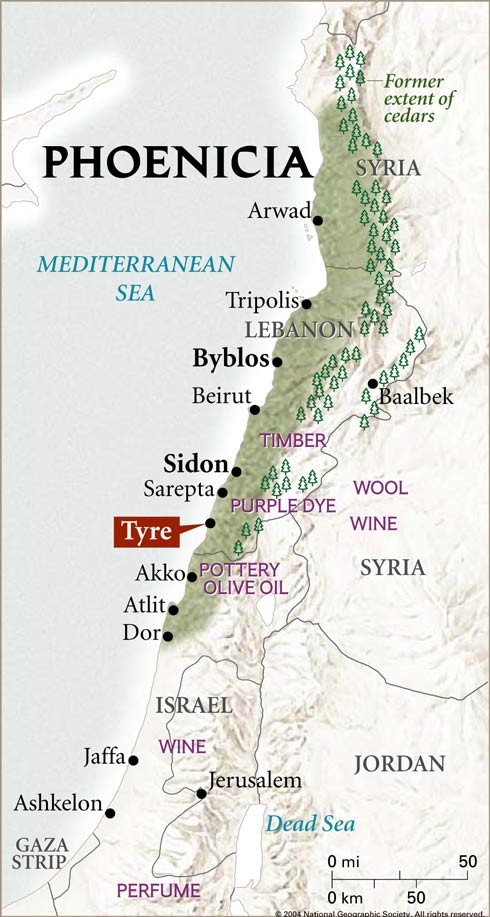
Several Zionist documents in the early 20th century referred to the Christians as Phoenicians and wanted to revive the over 2200 year old relationship with them. They regarded the Phoenicians as the perfect allies. Since the Lebanese Jews and Zionist Jews were a minority. Probably the first contact between the Zionists and the Lebanese was through the Soursok family, which sold the Jewish Agency Palestinian Lands, even though they didn't own property of them. According to Amin Mustapha's book: History of Resistance in Lebanon, the Zionists even had the proposal to shift the Christians to South in an autonomous region in alliance to Israel, to safeguard their Northern borders.
1930s - 1940s
The most notorious Lebanese back then to have contacts with them was the Lebanese President Emile Edde (Lebanese President from 1936 – 1941), whose offspring Reymond Edde challenged his father's ideas. Emile Edde was known for his Christian hardliner perspective. He was quoted of saying that whoever doesn't like Lebanon, there is always Mecca. In the early half of the 1930s, he sent Weizmann a congratulating letter that it seems he will establish the nation-state he seeks.
Even worse, Emile Edde had plans to carve out Lebanon and give parts of Muslim majority to the Zionists' forthcoming nation. Itimar Rabinovich wrote: "Another School of thought, headed by Emile Edde, was convinced by the 1932 census that the Muslims were about to become the majority in the Lebanese state and that the possibility of France abandoning the Lebanese Christians had to be taken seriously. Edde concluded that it was essential that to 'expedite the territorial reduction of Lebanon in order to enable the latter state to have a more consistent Christian majority.' By 'amputating' Tripoli and Southern Lebanon from the Lebanese state, 'Lebanon will be rid of almost 140,000 Shi'I and Sunni Muslims and will be left with a Christian majority equaling about 80% of its population.' Edde tried to win the support of the French government, which was not unimpressed with his reasoning but which in the end chose to preserve the territorial status quo. Still, Edde did not abandon his idea, and in 1946 he sent an emissary to Chaim Weizmann, the Zionist leader, to attempt to persuade Weizmann to seek the incorporation of southern Lebanon and its predominantly Muslim population into the Jewish national home."

(Picture Above: President Emile Edde)
To confirm the validity of this historical disastrous point in Lebanese history, Itimar Rabinovich's footnote included the following: "In a meeting of the directorate of the Jewish Agency on February 11, 1945, Weizmann, the president of the agency, reported that, "The son of the former president came to me. A Christian under a strong French influence – he came with a proposal ... that he would like to hand over to us, to the national home Tyre and Sidon ... because there are there a hundred thousand Muslims. I responded by saying that my grandfather used to say that he would not receive a 'biting' gift; but he would not relent and said that he will come again" (minutes of the Jewish Agency Directorate General).

(Picture Above: Ben Gurion)
Of course, Israel was announced as an entity in 1948, and Lebanon participated in the mockery of the Arab world sending their soldiers to Israel. Lebanon won its front at Malikieh, and progressed to link up with the Syrian army. However, the Jordanian and Egyptian treason for territorial expansion led to the Israeli Defense Forces to have time to equip their armies and eventually ousting all Arab regions except Ghaza and the West Bank due to Egyptian and Jordanian treason.
It has to be noted, that Lebanon was under the French Mandate from Post WWI till 1943, and the Phoenician Christians didn't represent the entire Christian community. According to Wilson's commission, the majority of the Christians preferred the link-up with Faysal's Kingdom.
To understand the vision of the Israelis to Lebanon in the 1950s, we have to look at Yossi Schwartz's article, who highlighted important aspects on Ben Gurion's perspective and Israeli aims. I hope he will continue to highlight more: "
Two important sources on the Zionist plans for Lebanon are the diary of Moshe Sharett, who was the Prime Minster of Israel in 1954-1955 and who was considered a "soft Zionist", and Livia Rokach's Israel's Sacred Terrorism: A study based on Moshe Sharett's Personal Diary, and other documents. In the latter we find some very interesting information, and it is worth quoting from Sharett's diary at length:
"Then he [Ben Gurion] passed on to another issue. This is the time, he said, to push Lebanon, that is, the Maronites in that country, to proclaim a Christian State. I said that this was nonsense. The Maronites are divided. The partisans of Christian separatism are weak and will dare do nothing. A Christian Lebanon would mean their giving up Tyre, Tripoli, and the Beka'a. There is no force that could bring Lebanon back to its pre-World War I dimensions, and all the more so because in that case it would lose its economic raison-d'etre. Ben Gurion reacted furiously. He began to enumerate the historical justification for a restricted Christian Lebanon. If such a development were to take place, the Christian Powers would not dare oppose it. I claimed that there was no factor ready to create such a situation, and that if we were to push and encourage it on our own we would get ourselves into an adventure that will place shame on us. Here came a wave of insults regarding my lack of daring and my narrow-mindedness. We ought to send envoys and spend money. I said there was no money. The answer was that there is no such thing. The money must be found, if not in the Treasury then at the Jewish Agency! For such a project it is worthwhile throwing away one hundred thousand, half a million, a million dollars. When this happens a decisive change will take place in the Middle East, a new era will start. I got tired of struggling against a whirlwind. (27 February 1954,)"
The next day David Ben Gurion sent Sharett the following letter:
"To Moshe Sharett the Prime Minister,
Sdeh Boker, February 27, 1954
"Upon my withdrawal from the government I decided in my heart to desist from intervening and expressing my opinion on current political affairs so as not to make things difficult for the government in any way. And if you hadn't called on me, the three of you, yourself, Lavon and Dayan, I would not have, of my own accord, expressed an opinion on what is being done or what ought to be done. But as you called me, I deem it my duty to comply with your wishes, and especially with your own wish as Prime Minister. Therefore, I permit myself to go back to one issue which you did not approve of and discuss it again, and this is the issue of Lebanon.

(Picture Above: Moshe Sharrett)
"It is clear that Lebanon is the weakest link in the Arab League. The other minorities in the Arab States are all Muslim, except for the Copts. But Egypt is the most compact and solid of the Arab States and the majority there consists of one solid block, of one race, religion and language, and the Christian minority does not seriously affect their political and national unity. Not so the Christians in Lebanon. They are a majority in the historical Lebanon and this majority has a tradition and a culture different from those of the other components of the League. Also within the wider borders (this was the worst mistake made by France when it extended the borders of Lebanon), the Muslims are not free to do as they wish, even if they are a majority there (and I don't know if they are, indeed, a majority) for fear of the Christians. The creation of a Christian State is therefore a natural act; it has historical roots and it will find support in wide circles in the Christian world, both Catholic and Protestant...
D.B.G. (27 February 1954)"
Sharett responded a few weeks later with the following:
"Mr. David Ben Gurion, March 18, 1954, Sdeh Boker
"As far as I know, in Lebanon today exists no movement aiming at transforming the country into a Christian State governed by the Maronite community...
"This is not surprising. The transformation of Lebanon into a Christian State as a result of an outside initiative is unfeasible today... I don't exclude the possibility of accomplishing this goal in the wake of a wave of shocks that will sweep the Middle East... will destroy the present constellations and will form others. But in the present Lebanon, with its present territorial and demographic dimensions and its international relations, no serious initiative of the kind is imaginable.
"The Christians do not constitute the majority in Lebanon. Nor are they a unified block, politically speaking or community-wise. The Orthodox minority in Lebanon tends to identify with their brethren in Syria. They will not be ready to go to war for a Christian Lebanon, which is for a Lebanon smaller than it is today, and detached from the Arab League. On the contrary, they would probably not be opposed to a Lebanon united to Syria, as this would contribute to strengthening their own community and the Orthodox community throughout the region... In fact, there are more Orthodox Christians in Syria than in Lebanon, and the Orthodox in Syria and Lebanon together are more numerous than the Maronites...
"... There are also decisive economic arguments against it. We are not discussing the issue in 1920/21... but 30 years later. Mount Lebanon has meanwhile integrated into one organic unit with the coastal plane of Tyre and Sidon, the Valley of Baalbeck and the city of Tripoli. They are commercially and economically interdependent and inseparable. Mount Lebanon was not a self-sufficient unit even before World War 1... The annexation of the three regions plus the city of Beirut to the Lebanese State has rendered possible the creation of a balanced economy. A return to the past would not just mean a surgical operation but also a disintegration leading to the end of Lebanon...
"When all this has been said, [I should add that] I would not have objected, and on the contrary I would have certainly been favorable to the idea, of actively aiding any manifestation of agitation in the Maronite community tending to strengthen its isolationist tendencies, even if there were no real chances of achieving the goals; I would have considered positive the very existence of such an agitation and the destabilization it could bring about, the trouble it would have caused the League, the diversion of attention from the Arab-Israeli complications that it would have caused, and the very kindling of a fire made up of impulses toward Christian independence. But what can I do when such an agitation is nonexistent? ... In the present condition, I am afraid that any attempt on our part would be considered as lightheartedness and superficiality or worse-as an adventurous speculation upon the well being and existence of others and a readiness to sacrifice their basic good for the benefit of a temporary tactical advantage for Israel.
"Moreover, if this plan is not kept a secret but becomes known a danger which cannot be underestimated in the Middle Eastern circumstances-the damage which we shall suffer... would not be compensated even by an eventual success of the operation itself...
"M. S. (18 March 1954)"
At that time Ben Gurion did not convince Sharett. The conditions were not ripe for such an attempt. But the idea never went away and remained in the minds of the leading Zionists as an option. The time to put into practice came in 1978 during the civil war when the "Litani Operation" was launched.
Israel was created at a terrible price. The Palestinians were expelled from their homeland, pushed into refugee camps all around the region. Israel thus came into being in an almost permanent state of war against its Arab neighbours. Israel was envisaged as an outpost of western imperialism, a "safe ally" that could police this oil-rich region. For decades it played that role quite successfully. Part of that task involved trying to get at least one "friendly" regime to its north in Lebanon. But this was easier said than done. Because of its delicate ethnic makeup, Lebanon dominated by the Christian elite could never be a stable country. Class conflict would emerge and re-emerge in the form of ethnic conflict due to the lack of a clear working class, socialist leadership that could cut across the ethnic divide.
1960s - 1970s

(Picture Above: Kamal Junblatt)
1960s and 1970s witnessed the Israelis focusing on the destruction of the PLO who started to gain international recognition. The Christians and Israelis had common interests. The Christians considered PLO activities as downsizing the sovereignty of Lebanon, and worse, their own, specially the PLO misconduct gave the Phalange mainly the ability to recruit over 90,000 Christian, whereby such a number is too large for a small country like Lebanon. They were already allocated densely in Lebanon and Jordan. Their warplanes saved the Monarchy and the PLO became cornered in Lebanon. As thousands of PLO warriors moved to Lebanon from Jordan after 1970, Israeli efforts were focused on how to contain the PLO in Lebanon.

(Picture Above: Palestinian Refugee Camp in Jabal Hussein in 1970)

(Picture Above: Refugee Camp in New Amman following Black September in 1970)
The first logic was bomb Lebanon and specially the entire South and blame it on the PLO operations, which actually paid off extensively because the Shiites became wrathful of the Palestinians and stood politically next to the Christian Government. Moussa al Sadre and later Nabih Berri built AMAL movement based on the anti-Palestinian resentments. Kamal Junblatt was critical against Moussa el Sadre's indirect alignment with the Christians despite the fact that Fatah played a role in building that militia. The second logic was how to help the Christians, who were the primary spearheads against the PLO activities. Hence, minor arms were sent to the Phalange/Tigers/Tanzeem via Jounieh port. Most of the weapons that were sent have been Soviet manufactured and captured from the PLO militants in occupied Palestine and Jordan. The smuggling occurred via Cyprus, and in case the weaponries were discovered, the Lebanese National Movement, PLO's allies, or the Palestinians themselves will take the blame and Israel will not be linked to the Christians. The Israelis clearly didn't want direct confrontation in Lebanon, rather, they preferred that the Christians were helped to stand on their own two feet. The first man to establish contacts with the Israelis was head of the most feared militia, the army offshoot leader of al-Tanzeem, Georges Adwan (current member of Parliament).

(Picture Above: Yasser Arafat reacts to applause at the U.N. General Assembly in New York in this Nov. 13, 1974)
Prior to the Lebanese Civil War, Yasser Arafat gave the peace initiative of "Olive Instead of Bullets", whereby he declared that he will be satisfied with rump Palestine, which included the West Bank and Ghazza, the Israelis refused such a peace offering, however, it gave the Palestinian people the status of observant in the UN, which meant half-way recognition of Palestinians internationally. Some question if the Israelis accepted the offer then instead almost 20 years later, would have been there war in Lebanon? Or at least a war to last 17 years?

(Picture Above: Syrians enter Lebanon)
When the Lebanese National Movement and the PLO dominated over 81% of Lebanon in 1975-1976 wars, Israeli interests switched whereby they gave Henry Kissinger the blessing to let the Syrians uproot the PLO from existence. Hence, the Syrians, under the hesitated blessings of Pierre Gemayel, Camille Shamoun, and Suleiman Franjieh, as well as Israel and USA, entered Lebanon. The Israelis still didn't want to be directly involved, because then the Christian militias would lose legitimacy in the Arab World. In 1977, Israel pulled the Litani operation to safeguard its Northern borders.
1980s

(Picture Above: War-Criminal Ariel Sharon)
Bashir Gemayel's Zahli Crisis successfully got the Israelis and Syrians involved. When Israeli planes should down Syrian aerial vehicles, the Palestinians rained in the South missiles on Northern Israel. Hence, Ariel Sharon, then Minister of Defense, wanted to permanently demolish the PLO. The settlement in post-Zahli crisis, stopped everyone from shooting, but kept the PLO growing stronger without any interventions. In 1981, Sharon visited Bashir Gemayel in East Beirut, and had dinner with Pierre Gemayel and Camille Shamoun, with the promise to invade Lebanon since now the Syrians – Lebanese National Movement – PLO forged an undefeatable alliance. The logic for such a move was to uproot the PLO once and for all and block any sovereignty. Sharon's second logic was install a satellite president and impose a peace treaty. Bashir Gemayel already became the most popular Christian since the 100 Days War where the Syrian forces bombed brutally East Beirut for a 100 days.
When the invasion began in 1982, the Israelis failed to demolish the PLO since they were severely allocated in West Beirut. Sharon's plan was to have the Lebanese Forces (then a unity of militias under one banner militarily) enter the street to street fights. Bashir Gemayel, knowing his men's disability to face the cornered PLO and Lebanese National Movement, preferred not to.

(Picture Above: Israel Bombing West Beirut residential areas)
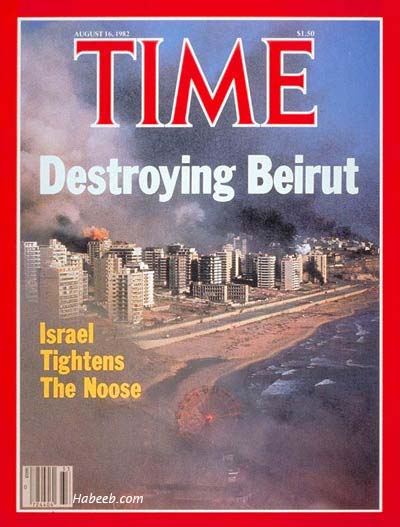
(Picture Above: Times cover in 1982)
Israel's main man was Bashir Gemayel, he suited their plans to be president, whereby Israel will have military benefits, and even joint business markets, Bashir became stubborn under US support. For the Israelis, they always thought that peace with Lebanon will eventually come, but after a stronger country signs peace. Bashir was assassinated. Prior to the assassination; however, Bashir had his undelivered inauguration speech. In it again, Bashir stressed on how Lebanon is an Orientalist nation rather an Arab nation again giving its existance roots to a pre-Islamic era. Furthermore, he didn't regard Lebanon in a state of civil war, rather under Palestinian and Syrian invasion without refering to the Israelis, more like hinting to the Israelis to oust the PLO militant remainders and Syrian forces out. It is worthy to note, that Sharon had a Plan B, which was transferring the PLO and the whole Palestinians to Jordan after assassinating the Jordanian King, hence establish a "New Palestine" for the Palestinians. The US diplomats accused Sharon as an 'asshole'.

(Picture Above: Bashir Gemayel)
While trying to salvage a deal with Amin Gemayel, even the Americans hindered several of their efforts. However, it is known that Sharon tried to pull a deal with Amin Gemayel behind the Americans' backs, through a business merchant called Sami Marun. It was intercepted, and the Americans changed a lot of the items which went to Lebanon's benefits. However, the 17th of May Accord was shot down via Syria, and its allies Junblatt and Berri. Israel's primary concern became on how to pull out from Lebanon since they couldn't tolerate military operations conducted on them.
Their sudden pull-out from Mt. Lebanon, witnessed pro-Lebanese Forces residents demonstrating in front their headquarters over there not to withdraw, but the IDF couldn't tolerate any more casualties. The sudden pull-out from Mt. Lebanon witnessed the bloodiest collisions in Mt. Lebanon between Walid Junblatt and Samir Geagea, which ended up with bloodshed, mostly on Christian areas, and resulted in the biggest sectarian cleansing since Bashir Gemayel's cleansing of East Beirut from Non-Christians. Since then, the Christian leadership lost confidence with the Israelis and felt they were betrayed.

(Picture Above: Israel's occupation of Southern Lebanon)
1990s - 2000s
The case of the Northern borders became the priority of Israel, specially Hezbollah arming itself under the Syrian Mandate in Lebanon. They attempted to preserve the 40 Km area in South Lebanon with their puppy army, the South Lebanese Army, but failed. After confrontations in 1993, 1996, the year 2000 they were expelled in Lebanon.
Ehud Barak actually won elections in Israel with the promise of withdrawing from South Lebanon. At first, his government launched "Lebanon First", whereby they sought to seek a peace treaty, the negotiations were shot down because the Lebanese, under Syrian hegemony, demanded that Israel would negotiate with Lebanon and Syria at the same time. When the Israelis initiated "Syria First", the Syrian regime directly hopped the negotiating table. While Hezbollah operations aggravated, the Israelis preferred to preserve their tight grip on the Golan Heights in Syria, and withdrew suddenly from Southern Lebanon, leaving Syria shocked without any means to bargain in 2000.
Post 2005 events

(Picture Above: July War 2006 was more than the IDF soldiers can handle, another contributing factor on Israel's crackdown for Lebanese demands)
After Harriri's assassination in 2005, Israel held high hopes towards Lebanon after Syria was ousted out by internal activism and international pressure. Nevertheless, the participation of their sworn enemies, Hezbollah, in the government meant bad news. The US hoped that the anti-Syrian 14th of March can contain Hezbollah, but to no productive results. At first, some expressed hope when Hezbollah participated in the government that they will become gradually a political party, but they ended up as both: political and militant. Israel, in collaboration with the US, decided to end Hezbollah, with the support several Arab leaders, according to Bolton at Marcel Ghanem's talk show. Their primary lookout was certain Christian Groups, the Druze, and the Sunni Street. When Hezbollah, for different speculated reasons pulled their military operation on July 12, 2006, the war began, and the promise of Olmert was "extermination of Hezbollah". From this perspective, they will proceed bombarding Hezbollah, and hoped that a civil war will break between the 14th of Marchers and Hezbollah. Yet, the Lebanese despite political divisions, united on assisting the refugees throughout Lebanon. Hence their plans that were relatively successful in the late 1960s, and very successful in the 1970s ended up in failure. Yet, Hezbollah emerged even stronger, calling the war "Divine Victory". Their hopes of 14th of March to balance against Hezbollah evaporated when Hezbollah within 72 hours swept Lebanon politically and militantly under their grip. Even worse for the Israelis, the appearance of two powerfully militant parties preserving their trainings since the days of the civil war: AMAL Movement and the Syrian Social Nationalist Party. This doesn't mean that 14th of March have been collaborating with Israel, rather, they shared the hatred to Syria in Lebanon. 14th of March also didn't express any need to forge any peace treaty with Israel, specially their mass butchery of the Lebanese, and destructive operation against Lebanon as a whole. Hence, Israel's key component, the undefeatable army, changed their plans and followed an informal disengagement plan. Whereby they successfully were willing to give Hezbollah the remaining prisoners, and a large chunk of martyrs, willing to withdraw from Sheba'a farms, and initiated via Turkey, under US patronage, the withdrawal from the Golan Heights, in order to focus on their internal problems, and probably gain some time to rebuild their army and sort internal problems for future wars.

(Picture Above: Israeli Brutality on Beirut during the July War of 2006)
MFL
Sunday, July 27, 2008
Not the Final Chapter of the July War
I have not been blogging due to personal obligations but intended to return blogging in two months. Now, that a lot of events took place, I have no choice but to write...
Introduction and Cont'd of an Earlier Article
Last year, I wrote extensive analysis in "Lessons from the July War". Now, the main logo of Hezbollah for launching their July War "Operation Honest Promise" was achieved. Israel gave Hezbollah Samir Quntar in return for their two soldiers, who so far, we didn't know what happened to them till the last moment.
In Israel, the primary question was bombarded on Olmert and his allies as follows: "Why did we enter a war if there was going to be a swipe?" Hence, what started Israel's humiliation in 2000, aggravated in 2006, and climaxed in the liberation of Lebanon's national hero, Samir Quntar, a man who symbolized resistance to the Zionists, and resilience to the Zionists' attempts to crush the soul of resistance.
Samir Quntar argued in TV that his 1978 operation, the hostages were shot by Israeli soldiers. While the Israeli media hovered around how their government released him, the whole media of the world forgot how many Lebanese children the Israelis have cold-bloodedly butchered. Of course, whenever the pictures of our massacred children pop up the news, the Israelis rudely accuse the Lebanese as "faking" the picture.
The Israeli media also accused Nasrallah as shrewd, since he considered the liberation of Samir Quntar as a national victory. This was not the first time, when the Lebanese ousted the Israeli Defense Forces and their puppies, the Southern Lebanese Army, from Lebanese soil, Nasrallah argued it was a victory for the resistance, Lebanon, the Muslims, and the entire Arab World. The fact all the Lebanese politicians were there to welcome Quntar and the last Hezbollah soldiers, reflected the dimension of the long awaited victory of Samir Quntar, whom we were raised to hear his name: the man whose will never shook down.
Brief Bolshevik Point
Now for me, as a revolutionary Marxist, we oppose individual acts of operations from the view point that such operations aggravate the unity of the Proletariat across borders, hence our unity as Lebanese Proletariat, with the residents of Occupied Palestine and Israel minus the Arab reactionary leaders and the Zionists. We believe in longer run emancipation tactics which requires more patience while focusing on welfare policies and women empowerment in the short-run. What I would respect about Samir Quntar is what he did inside the Israeli prisons. The man was named "Dean of the Prisoners" not because he is the oldest of prisoners, rather, his activism inside the Israeli prisons. He was the one who organized informal networks inside Israeli prisons across nationalities whereby the prisoners self-educated themselves, resisted Israeli pressure to break the will of the prisoners, and always held their heads high in the face of Zionist brutalities.
Impact of Samir Quntar's release
The release of Samir Quntar was greeted by over a million Lebanese (mainly) citizens, among a small minority of others. Quntar's freedom brought Lebanon to the 1970s nostalgia where dreamers hoped for the crush of Israel and liberation of Palestine whereby the Palestinians can finally and peacefully return to their homes. This nostalgia which witnessed the PLO and other radical factions waging operations against Israel also included the factions of the Lebanese National Front, and the Lebanese Resistance Front (whose three pillars were the SSNP – LCP – Order for Communist Action). Now my personal opinion is known, I oppose the ideological demands of the Lebanese National Movement, while I oppose their tactics, specially going blindly behind the PLO. The higher euphoria, in the words of Jubran Arayji, an SSNP top official to NBN," was the belief in your own platform to be actualized".
While Israel wept, Lebanon celebrated. The Israelis in a pathetic manner tried to show that the Lebanese are barbaric while they are a civilized nation surviving this barbaric world is the fact that the Lebanese danced, celebrated, while Hassan Nasrallah did a sudden appearance in the festivalities to greet his own soldiers and Samir Quntar. Quntar, for a man living 30 years in prisons, always kept his head up and till now he doesn't show his real age, 47. The insistence of Quntar to remain wearing his military suit showed to what extent his will remained unbroken.
Dancing Coffins
The Israelis also were baffled on how the Lebanese and Palestinians welcomed the martyrs' bodies with rice, dancing, and flowers. To this Perez called our traditions as "shameful". The Lebanese and the Palestinians, from years of agony, learnt to welcome their beloved in a "marriage" ceremonial manner. Several Muslim and Christian traditions of funerals included whistling, dancing, clapping, throwing rice, and "dancing the coffin" whereby the people carrying the coffin get the coffin to move up and down which appears dancing. The purpose of such a process is to pay tribute to the deceased. When Samir Qassir was buried, his coffin was dancing amidst flying flowers, wedding singing called "Zalghota" in Arabic, amongst others. When George Hawwi, the ex-stalinist Communist Party leader was assassinated, everyone clapped and danced as the men "danced the coffins". Such traditions are a tribute to the deceased and paying respect. The second significance is to show for the deceased and whoever wanted him/her dead that the people are not weeping, rather they do a wedding instead of a funeral to pay respect because one popular culture includes the belief that the deceased do not want their beloved to cry for them, rather they should celebrate and rejoice. The final reason for such festivities is to prove to the deceased and to recharge amongst them that they are celebrating instead of mourning because the person involved is not dead, rather still alive in their hearts. And that is how the Lebanese, Syrians, Palestinians welcomed the deceased martyrs' bodies.
Israel yet again Humiliated
Now for the celebrations of what that ugly Levni proclaimed as shameful welcome of a criminal, the Lebanese are over-joyous in welcoming a hero who made the enemy cry on their knees after killing over 60,000 Lebanese, across the years, displacing over a quarter of citizens (in 2006), and eventually proving how stupid she and her country is. They waged a war on the Lebanese, called it "War on Hezbollah" which included the killing of everyone except Hezbollah in general, such as the red cross, the foreign journalists, the Lebanese Army, and the Police, and even three members of Hezbollah's archenemies: the Lebanese Forces. Hence, that war was everything but a war on Hezbollah. The other dimension is that almost the entire Lebanese citizens across political and sectarian lines in one way or another cooperated to contain the Southern exodus. Even Palestinian camps such as Ain el Hilwi welcomed Lebanese fleeing under bombardment their homes for safety. After all, Israel used the refugee buses as target practice. Shameful and uncivilized. Hence, how can Lebanon not welcome Samir Quntar as a hero, or even as a liberator, who proved to the Lebanese and Palestinians that the Israelis are ineffective to do anything right? He even inspired to others that Israel's days are countable, so many believed that thought, happily to see their Southern racist neighbor drowning in tears, same people whose media forgot to announce how many they killed of children in Palestine and Lebanon, forgot to compare Israel's operation to Palestine in 1948 to Milosevic's ethnic cleansing in 1999 to Kosovo. In one of those few occasions Lebanon celebrated in joy and happiness while Tel Aviv drowned in tears.
Israeli reactions to the Lebanese victory were different in several manners. For starters, the Israeli intelligence added Samir Quntar's name to be assassinated next to Nasrallah. After all, Lebanon shouldn't go against the flow of Arab regimes trying to convince that Israel is here to stay. Reactions from normal Israeli citizens within Israeli media demanded that the next war with Lebanon have Beirut leveled down. I have news to them, in the last war, half of it was already leveled down. Finally, to the families of the deceased soldiers, they should expect such operations when they are wearing the military suit.
Israel since the year 2000 has had their victories cut short. All of Israel is in a way trained soldiers because all its citizens should serve the Israeli Defense Forces. Hence such an operation impacted them in 2006 because each citizen thought to himself/herself "It could have been me or my relatives". Well, to them, start changing your racist policies if you want legitimacy within your neighborhoods.
Impacts of Hezbollah and Lebanese Victory
While the entire cabinet of different political parties gathered in the airport , Israel tried to downsize Lebanon's happiness as "Nasrallah has the entire Lebanese as hostages". If that is true, I love Israel's way of dealing with a hostage crisis, burn the entire country to kingdom come (2006).
Hezbollah have been in a winning since 2000. They ousted the Israelis outside Lebanon in 2000 and proclaimed themselves as the descendants of the Resistance front forged by the Lebanese Communist Party and Order for Communist Action, and followed by the Syrian Social Nationalist Party. However, the latter three's leaders were marginalized and persecuted by Syria. In the words of one Iranian Diplomat during the July war to Ahmad Fatat, "we the Iranians learnt how to resist from the Christians, such as George Habbash and George Hawwi." Hezbollah by 2004 proved their complete dominance over the Bekaa and South in municipalities elections whereby AMAL movement's influence was downsized. In the end, Syria had to intervene to face-save their allies AMAL. Hence, Hezbollah officially dominated the Shiite sect while AMAL became a relative minority. The defeat of 2006 of Israel on the infantry level reflected how the underdogs caught up with the giants. Israel's army is not indestructible. The assassination of Imad Moghnieh was again a defeat to Israel even if it is not 100% confirmed that they assassinated him. Hezbollah's alliance to the Christian bloc, the Free Patriotic Movement, moved them away from isolation as well as a Shiite sect. Their military power also remained undisputed in Lebanon when they swept Beirut against 14th of March in one evening, while Mt. Lebanon collapsed in two hours. Hence, they got the demands they have been requesting: Red lines on Hezbollah's arms, no Western power can oust Hezbollah out, got the national unity government they needed to veto any governmental decisions that might touch their arms. Finally, to complete Hezbollah's euphoria, they did the impossible and liberated Samir Quntar and left the Israelis feeling canned inside their borders. The timing of Samir Quntar was marked with the 2nd memory of the July war.
The liberation of Samir Quntar was highly valuable for Israel. Their 2006 across borders operation was called "The Honest Promise", which means the promise to liberate Samir Quntar. Olmert and his goons crumbled down at timing more perfect for Hezbollah. For starters, they pulled Lebanon in a euphoria outside the last civil war we had couple of months ago and diverted attention to this blunder operation they did whereby retribution will take a long run form between the Sunnis and Druze and the Shiites. Their and their allies' vulgar behavior "as peaceful" diverted to the liberation of Samir Quntar. Trying to erase the breach in their promise "no weapon shall be turned to the inside of Lebanon", they proved that they are the only force to inflict defeat on Israel and their arms are still needed.
As a matter of fact, the pro-14th of March are trying to pull a symbolic victory by getting Shebaa farms diplomatically. Second, Samir Quntar's allegiance to Hezbollah was also what they needed. After all, Quntar spent his time reading Israeli media, whereas the most hated to them were Hezbollah, hence, they became his favorites, specially they were the ones who liberated him. So, whereas March 14th accused Hezbollah to ignite the July war in 2006 to protect their allies Syria from the International Tribunal, now got their promise actualized and diverted attention that the war was not about Syria's attention. Although, Bashar Assad's hypocritical attitude celebrating the July war as the real victor on the ashes of Lebanon is quiet lame. Sadly, Quntar supported Syria blindly without investigating what has happened during their era. Hopefully he will have much more time to do so to fill the gap.
Now the term resistance became over-charged, Ali Kanso was bragging that the SSNP will not surrender their weapons because it is "Arms for Resistance" although we didn't see a single shot directed on Israel all this time except on other Lebanese. The election of Assad Herdan as SSNP president shows the partial return of the Syrians, and the military urgency that the SSNP are currently living in especially several Ras Beirut zones are still within the newly resurrected SSNP cantons. Hence, Hezbollah's allies are now justified to preserve their weapons while leaving the 14th of Marchers in another security dilemma to rebuild their forces, hence a new showdown coming soon within the next decade.
Now, Hezbollah can behave the Judge and Executioner if things don't go the way they don't like. Simply unleash the AMAL movement goons on those supporters.
More to the point, Hezbollah's victories have an impact on the Arab region and the World as a whole. Most of the Arab regime, dictators like Egypt's Moubarak, Jordan's King Abdullah, Saudi Arabia's al-Saud, Qatar's Hamad bin Khalifa al Thani, and most recently Iraq's Maliki, among others, are having aftermaths of Hezbollah and Lebanon's victories. While al-Assad, along with Libya and few other Arab nations support War with Israel, the majority don't The mentioned states are satellite regimes for the USA, who established peace with Israel on the account that "Israel is here to stay" and "let us do the best out of it". Hence, they oppressed their people under that logo plus receiving US funds as support. Egypt and Jordan are the second and third most funded governments by the US for signing peace treaties. Such victories, destabilize Saudi Arabia, Jordan and Egypt whereby the oppressed majorities can dream of ousting their tyrants and boycott Israel.
The questions goes: how long Israel plans to distort history, for 1948 has its impact on all Arab worlds, specially Lebanon. How long they plan to remain racists and Zionists, after all Racism and Zionism go hand in hand with each other. The underdogs in a military sense are catching up, once the underdogs know how to shoot down Israeli planes, Israel's very existence is threatened with extermination and the Jewish Proletariat are threatened with another ethnic cleansing as a payback for what their Zionist leaders pushed to do throughout the British mandate. The on-going atrocities do not help on the Palestinians. Furthermore, how long can those US satellite regimes hold on, and haven't they realized the more the Israelis are brutal, the more secular and progressive forces are purged or shoved into Islamic movements, like Hamas in Palestine, Hezbollah in Lebanon, Muslim Brotherhoods. Finally, Hezbollah's victories sustained the Assad regime to rule for the next decade or two with maximum peace inside his lands and oppress his own people; specially the British themselves declared that Assad is different than Saddam. The reason for this is the fact that the alternative to Assad's regime in Syria would be the three more oppressive, the Muslim Brotherhood.
Last, I hope Nasrallah would live as long as possible, because the scariest of all is the relations of Hezbollah to Ali Khamanei through the Iranian funds and Wilayat el Faqih. If Nasrallah passes away, the option is not a moderate tolerant leader like Hassan Nasrallah, rather the extremist Na'im Qassem who, all Hezbollah's allies on grassroots level from pro-Hezbollah Palestinians, Syrians, Aounis, and even the SSNP, expressed that "all hell would break loose if he takes control."
Unwanted Palestinians
What were most disgusting about 14th of March, the Opposition, Hezbollah, the Lebanese President, and others is their behavior: "Palestinians are not welcomed to stay here" hence the "Liberation".
Finally
With Nasrallah declaring that the war with Israel is an open war, following Moghnieh's assassination, and promising us future wars, paralleled with Israel's nutcases such as Olmert and Perez that new wars are coming up as retributions, a doomed nation like Lebanon has no choice but to wait for the next disaster.
MFL
Introduction and Cont'd of an Earlier Article
Last year, I wrote extensive analysis in "Lessons from the July War". Now, the main logo of Hezbollah for launching their July War "Operation Honest Promise" was achieved. Israel gave Hezbollah Samir Quntar in return for their two soldiers, who so far, we didn't know what happened to them till the last moment.
In Israel, the primary question was bombarded on Olmert and his allies as follows: "Why did we enter a war if there was going to be a swipe?" Hence, what started Israel's humiliation in 2000, aggravated in 2006, and climaxed in the liberation of Lebanon's national hero, Samir Quntar, a man who symbolized resistance to the Zionists, and resilience to the Zionists' attempts to crush the soul of resistance.
Samir Quntar argued in TV that his 1978 operation, the hostages were shot by Israeli soldiers. While the Israeli media hovered around how their government released him, the whole media of the world forgot how many Lebanese children the Israelis have cold-bloodedly butchered. Of course, whenever the pictures of our massacred children pop up the news, the Israelis rudely accuse the Lebanese as "faking" the picture.
The Israeli media also accused Nasrallah as shrewd, since he considered the liberation of Samir Quntar as a national victory. This was not the first time, when the Lebanese ousted the Israeli Defense Forces and their puppies, the Southern Lebanese Army, from Lebanese soil, Nasrallah argued it was a victory for the resistance, Lebanon, the Muslims, and the entire Arab World. The fact all the Lebanese politicians were there to welcome Quntar and the last Hezbollah soldiers, reflected the dimension of the long awaited victory of Samir Quntar, whom we were raised to hear his name: the man whose will never shook down.
Brief Bolshevik Point
Now for me, as a revolutionary Marxist, we oppose individual acts of operations from the view point that such operations aggravate the unity of the Proletariat across borders, hence our unity as Lebanese Proletariat, with the residents of Occupied Palestine and Israel minus the Arab reactionary leaders and the Zionists. We believe in longer run emancipation tactics which requires more patience while focusing on welfare policies and women empowerment in the short-run. What I would respect about Samir Quntar is what he did inside the Israeli prisons. The man was named "Dean of the Prisoners" not because he is the oldest of prisoners, rather, his activism inside the Israeli prisons. He was the one who organized informal networks inside Israeli prisons across nationalities whereby the prisoners self-educated themselves, resisted Israeli pressure to break the will of the prisoners, and always held their heads high in the face of Zionist brutalities.
Impact of Samir Quntar's release
The release of Samir Quntar was greeted by over a million Lebanese (mainly) citizens, among a small minority of others. Quntar's freedom brought Lebanon to the 1970s nostalgia where dreamers hoped for the crush of Israel and liberation of Palestine whereby the Palestinians can finally and peacefully return to their homes. This nostalgia which witnessed the PLO and other radical factions waging operations against Israel also included the factions of the Lebanese National Front, and the Lebanese Resistance Front (whose three pillars were the SSNP – LCP – Order for Communist Action). Now my personal opinion is known, I oppose the ideological demands of the Lebanese National Movement, while I oppose their tactics, specially going blindly behind the PLO. The higher euphoria, in the words of Jubran Arayji, an SSNP top official to NBN," was the belief in your own platform to be actualized".
While Israel wept, Lebanon celebrated. The Israelis in a pathetic manner tried to show that the Lebanese are barbaric while they are a civilized nation surviving this barbaric world is the fact that the Lebanese danced, celebrated, while Hassan Nasrallah did a sudden appearance in the festivalities to greet his own soldiers and Samir Quntar. Quntar, for a man living 30 years in prisons, always kept his head up and till now he doesn't show his real age, 47. The insistence of Quntar to remain wearing his military suit showed to what extent his will remained unbroken.
Dancing Coffins
The Israelis also were baffled on how the Lebanese and Palestinians welcomed the martyrs' bodies with rice, dancing, and flowers. To this Perez called our traditions as "shameful". The Lebanese and the Palestinians, from years of agony, learnt to welcome their beloved in a "marriage" ceremonial manner. Several Muslim and Christian traditions of funerals included whistling, dancing, clapping, throwing rice, and "dancing the coffin" whereby the people carrying the coffin get the coffin to move up and down which appears dancing. The purpose of such a process is to pay tribute to the deceased. When Samir Qassir was buried, his coffin was dancing amidst flying flowers, wedding singing called "Zalghota" in Arabic, amongst others. When George Hawwi, the ex-stalinist Communist Party leader was assassinated, everyone clapped and danced as the men "danced the coffins". Such traditions are a tribute to the deceased and paying respect. The second significance is to show for the deceased and whoever wanted him/her dead that the people are not weeping, rather they do a wedding instead of a funeral to pay respect because one popular culture includes the belief that the deceased do not want their beloved to cry for them, rather they should celebrate and rejoice. The final reason for such festivities is to prove to the deceased and to recharge amongst them that they are celebrating instead of mourning because the person involved is not dead, rather still alive in their hearts. And that is how the Lebanese, Syrians, Palestinians welcomed the deceased martyrs' bodies.
Israel yet again Humiliated
Now for the celebrations of what that ugly Levni proclaimed as shameful welcome of a criminal, the Lebanese are over-joyous in welcoming a hero who made the enemy cry on their knees after killing over 60,000 Lebanese, across the years, displacing over a quarter of citizens (in 2006), and eventually proving how stupid she and her country is. They waged a war on the Lebanese, called it "War on Hezbollah" which included the killing of everyone except Hezbollah in general, such as the red cross, the foreign journalists, the Lebanese Army, and the Police, and even three members of Hezbollah's archenemies: the Lebanese Forces. Hence, that war was everything but a war on Hezbollah. The other dimension is that almost the entire Lebanese citizens across political and sectarian lines in one way or another cooperated to contain the Southern exodus. Even Palestinian camps such as Ain el Hilwi welcomed Lebanese fleeing under bombardment their homes for safety. After all, Israel used the refugee buses as target practice. Shameful and uncivilized. Hence, how can Lebanon not welcome Samir Quntar as a hero, or even as a liberator, who proved to the Lebanese and Palestinians that the Israelis are ineffective to do anything right? He even inspired to others that Israel's days are countable, so many believed that thought, happily to see their Southern racist neighbor drowning in tears, same people whose media forgot to announce how many they killed of children in Palestine and Lebanon, forgot to compare Israel's operation to Palestine in 1948 to Milosevic's ethnic cleansing in 1999 to Kosovo. In one of those few occasions Lebanon celebrated in joy and happiness while Tel Aviv drowned in tears.
Israeli reactions to the Lebanese victory were different in several manners. For starters, the Israeli intelligence added Samir Quntar's name to be assassinated next to Nasrallah. After all, Lebanon shouldn't go against the flow of Arab regimes trying to convince that Israel is here to stay. Reactions from normal Israeli citizens within Israeli media demanded that the next war with Lebanon have Beirut leveled down. I have news to them, in the last war, half of it was already leveled down. Finally, to the families of the deceased soldiers, they should expect such operations when they are wearing the military suit.
Israel since the year 2000 has had their victories cut short. All of Israel is in a way trained soldiers because all its citizens should serve the Israeli Defense Forces. Hence such an operation impacted them in 2006 because each citizen thought to himself/herself "It could have been me or my relatives". Well, to them, start changing your racist policies if you want legitimacy within your neighborhoods.
Impacts of Hezbollah and Lebanese Victory
While the entire cabinet of different political parties gathered in the airport , Israel tried to downsize Lebanon's happiness as "Nasrallah has the entire Lebanese as hostages". If that is true, I love Israel's way of dealing with a hostage crisis, burn the entire country to kingdom come (2006).
Hezbollah have been in a winning since 2000. They ousted the Israelis outside Lebanon in 2000 and proclaimed themselves as the descendants of the Resistance front forged by the Lebanese Communist Party and Order for Communist Action, and followed by the Syrian Social Nationalist Party. However, the latter three's leaders were marginalized and persecuted by Syria. In the words of one Iranian Diplomat during the July war to Ahmad Fatat, "we the Iranians learnt how to resist from the Christians, such as George Habbash and George Hawwi." Hezbollah by 2004 proved their complete dominance over the Bekaa and South in municipalities elections whereby AMAL movement's influence was downsized. In the end, Syria had to intervene to face-save their allies AMAL. Hence, Hezbollah officially dominated the Shiite sect while AMAL became a relative minority. The defeat of 2006 of Israel on the infantry level reflected how the underdogs caught up with the giants. Israel's army is not indestructible. The assassination of Imad Moghnieh was again a defeat to Israel even if it is not 100% confirmed that they assassinated him. Hezbollah's alliance to the Christian bloc, the Free Patriotic Movement, moved them away from isolation as well as a Shiite sect. Their military power also remained undisputed in Lebanon when they swept Beirut against 14th of March in one evening, while Mt. Lebanon collapsed in two hours. Hence, they got the demands they have been requesting: Red lines on Hezbollah's arms, no Western power can oust Hezbollah out, got the national unity government they needed to veto any governmental decisions that might touch their arms. Finally, to complete Hezbollah's euphoria, they did the impossible and liberated Samir Quntar and left the Israelis feeling canned inside their borders. The timing of Samir Quntar was marked with the 2nd memory of the July war.
The liberation of Samir Quntar was highly valuable for Israel. Their 2006 across borders operation was called "The Honest Promise", which means the promise to liberate Samir Quntar. Olmert and his goons crumbled down at timing more perfect for Hezbollah. For starters, they pulled Lebanon in a euphoria outside the last civil war we had couple of months ago and diverted attention to this blunder operation they did whereby retribution will take a long run form between the Sunnis and Druze and the Shiites. Their and their allies' vulgar behavior "as peaceful" diverted to the liberation of Samir Quntar. Trying to erase the breach in their promise "no weapon shall be turned to the inside of Lebanon", they proved that they are the only force to inflict defeat on Israel and their arms are still needed.
As a matter of fact, the pro-14th of March are trying to pull a symbolic victory by getting Shebaa farms diplomatically. Second, Samir Quntar's allegiance to Hezbollah was also what they needed. After all, Quntar spent his time reading Israeli media, whereas the most hated to them were Hezbollah, hence, they became his favorites, specially they were the ones who liberated him. So, whereas March 14th accused Hezbollah to ignite the July war in 2006 to protect their allies Syria from the International Tribunal, now got their promise actualized and diverted attention that the war was not about Syria's attention. Although, Bashar Assad's hypocritical attitude celebrating the July war as the real victor on the ashes of Lebanon is quiet lame. Sadly, Quntar supported Syria blindly without investigating what has happened during their era. Hopefully he will have much more time to do so to fill the gap.
Now the term resistance became over-charged, Ali Kanso was bragging that the SSNP will not surrender their weapons because it is "Arms for Resistance" although we didn't see a single shot directed on Israel all this time except on other Lebanese. The election of Assad Herdan as SSNP president shows the partial return of the Syrians, and the military urgency that the SSNP are currently living in especially several Ras Beirut zones are still within the newly resurrected SSNP cantons. Hence, Hezbollah's allies are now justified to preserve their weapons while leaving the 14th of Marchers in another security dilemma to rebuild their forces, hence a new showdown coming soon within the next decade.
Now, Hezbollah can behave the Judge and Executioner if things don't go the way they don't like. Simply unleash the AMAL movement goons on those supporters.
More to the point, Hezbollah's victories have an impact on the Arab region and the World as a whole. Most of the Arab regime, dictators like Egypt's Moubarak, Jordan's King Abdullah, Saudi Arabia's al-Saud, Qatar's Hamad bin Khalifa al Thani, and most recently Iraq's Maliki, among others, are having aftermaths of Hezbollah and Lebanon's victories. While al-Assad, along with Libya and few other Arab nations support War with Israel, the majority don't The mentioned states are satellite regimes for the USA, who established peace with Israel on the account that "Israel is here to stay" and "let us do the best out of it". Hence, they oppressed their people under that logo plus receiving US funds as support. Egypt and Jordan are the second and third most funded governments by the US for signing peace treaties. Such victories, destabilize Saudi Arabia, Jordan and Egypt whereby the oppressed majorities can dream of ousting their tyrants and boycott Israel.
The questions goes: how long Israel plans to distort history, for 1948 has its impact on all Arab worlds, specially Lebanon. How long they plan to remain racists and Zionists, after all Racism and Zionism go hand in hand with each other. The underdogs in a military sense are catching up, once the underdogs know how to shoot down Israeli planes, Israel's very existence is threatened with extermination and the Jewish Proletariat are threatened with another ethnic cleansing as a payback for what their Zionist leaders pushed to do throughout the British mandate. The on-going atrocities do not help on the Palestinians. Furthermore, how long can those US satellite regimes hold on, and haven't they realized the more the Israelis are brutal, the more secular and progressive forces are purged or shoved into Islamic movements, like Hamas in Palestine, Hezbollah in Lebanon, Muslim Brotherhoods. Finally, Hezbollah's victories sustained the Assad regime to rule for the next decade or two with maximum peace inside his lands and oppress his own people; specially the British themselves declared that Assad is different than Saddam. The reason for this is the fact that the alternative to Assad's regime in Syria would be the three more oppressive, the Muslim Brotherhood.
Last, I hope Nasrallah would live as long as possible, because the scariest of all is the relations of Hezbollah to Ali Khamanei through the Iranian funds and Wilayat el Faqih. If Nasrallah passes away, the option is not a moderate tolerant leader like Hassan Nasrallah, rather the extremist Na'im Qassem who, all Hezbollah's allies on grassroots level from pro-Hezbollah Palestinians, Syrians, Aounis, and even the SSNP, expressed that "all hell would break loose if he takes control."
Unwanted Palestinians
What were most disgusting about 14th of March, the Opposition, Hezbollah, the Lebanese President, and others is their behavior: "Palestinians are not welcomed to stay here" hence the "Liberation".
Finally
With Nasrallah declaring that the war with Israel is an open war, following Moghnieh's assassination, and promising us future wars, paralleled with Israel's nutcases such as Olmert and Perez that new wars are coming up as retributions, a doomed nation like Lebanon has no choice but to wait for the next disaster.
MFL
Monday, June 09, 2008
Iran, Wilayat el Faqih, and Historical Facts
Introduction
A lot of the Shiites never heard of this theory, the Wilayat el Faqih theory, championed by a man who have this famous quote: "There is no fun in Islam!", Mr. Ayatollah Khomeini. I have been studying this dimension for three years. Personally I hate it for different reasons. I remember one person from the LCP and two others from the SSNP telling me: "If Nasrallah supports it, then it is our pride". It saddens me how these two forgot the magic formula of the 1980s while the seculars resisted Israel: AMAL butchered Communists, Hezbollah butchered SSNP. Someone would tell me Hezbollah of the 1980s are different after Nasrallah. Well let us investigate it BRIEFLY, and I repeat this post is briefly written on the topic.
The summary of the Wilayat el Faqih is as follows:
With the early Islamic Expansions, the Sunnis dominated politically. The Shiites kept a low profile and they followed as what is called in th medieval times: "The Quietest Movements". The base of the theory rotates around the Theory of 12 Imams in the Shiites. The first Imam is of course, Imam Ali, what you would call as the Imam el Ma'soum, as the know it all. One man who was offensive on that theory was the man who paved way for the term "Who ever thought, committed Heresy", Ibn Ghazali under the hypothesis that the Prophet Mohammad came to the world, gave the complete theory and practice of Islam, and departed the world henceforth, there is no need for this Imam Ma'asoum.
Now the Wilayat el Faqih goes as follows: with the sudden disappearance of the 12th Imam, Imam el Mehdi el Montazar, Islamic theology of the Quietists argued that the Mehdi shall appear again, and most probably when Judgment Day appears. However, with the absence of the Imam, there is the need for a Wali el Faqih, or as the translation goes: Governor of the Jurisprudence. This theory was evolved and upgraded by Khomeini, and was of making Khomeini in post-revolutionary years as "the supreme leader". Guess who self-proclaimed himself as the Wali, Khomeini himself.
Now, I won't deny the Islamists didn’t play a role in the Iranian revolution, but I will not say to the extent as a lot of people try to depict it. I shall dedicate a nice post on that in the near (hopefully) future. For Starters, there were three players in Iran. The Shah mismanaged Iran drastically, and his ties with Israel/USA weren’t making him popular. Second, Mohammad Pahlavi didn't notice that when the Islamists failed to oust his father, Reza Shah, they were quiet. Reza Shah was more like the man who gave the command to the army "tear every veil you see", and forced women by this to hide at home. In any case, the big revolution exploded due to poverty, and the three parties were: the Communists – the Mujahidean (Islamists with a less extremism) – Wilayat el Faqih. Women who didn't wear the veil even wore it in solidarity of all revolutionaries against the Shah. The Communists took the lead and were successful to establish 9 Soviets throughout Iran. More to the point, Stalinist Moscow forced them to side with Khomeini since he too opposed the US (dubbing them as the white devil). Eventually, and not to dwell on details, Khomeini demolished all rivals as he installed himself as the "Supreme Leader of the Revolution", the position of the 20th Century Wali el Faqih, despite the fact there is an almost dead council.
Wali el Faqih in theory should be well-informed in the Koran, theology, and Islam as a whole. The second dimension of Wali el Faqih, that he should be the source of Emulation. The theory of Emulation itself is interesting. In medieval Islam (if you read Ibn Tufayl whose story explains it clearly), the person who got closest to God is the wisest. While European medieval theologians (like St. Augustine, St. Simonides, St. Acquinas, St. Damasenes...others) borrowed the logic from Aristotle: the more you get closer to God, the more you are wiser, hence this implies the following formula =
God = Ultimate Truth = Ultimate Wisdom = Ultimate Happiness
The theologians then added of course faith, and some tried to make Aristotle a Christian, and hence (as appearing in Dante's Purgatory), reason stops at a point, faith continues to guide the person to the ultimate truth. In Islam, the theory remained the same, but some theologians and thinkers added a touch of Emulation. A person has to emulate God to reach God. The Wali el Faqih is actually the source of emulation. This is where Khomeini became a tri-partite power source:
1) Source of Emulation
2) Ultimate Knowledge and Closest to the Truth
(hence the first two points make him the supreme leader of the revolution)
3) Leader beyond borders to lead the Revolution anywhere in the world
Now after Khomeini butchered in his last days over 21,000 Mujahid, he passed away. Khomeini, brutally oppressed all progressive powers, ruined all talents, and he stuck to his famous quote (and damaging Islam): "There is no fun in Islam". All Western features in Iran were taken out under his reign. You will never see a politician or citizen from Iran wearing "the tie", or a woman able to walk without having to worry about the threat of the Basij (Militant Youth of the Wali) or Ansar Hezbollah (not to be mistaken with the Lebanese Hezbollah) who are Ali Khamenei's hooligans, or as one author described them: "Angry Bearded Men on Motorcycles with Ak-47s". Dancing and Clapping are forbidden in Iran, even with the iron grip loosened up after Khatami's elections, it is forbidden. The Iranian theater suffered drastically (after all during the late 1970s, they were targeted most by Khomeini's followers) and massive censorships. You will notice by the late 1990s, the directors had to improvise new forms of Cinema directing and script writing. Finally, nothing takes place in Iran without the consent of the Wali's council, who elect the Wali himself for a lifetime, the Guardian Council.
So it is true that Iran has a quasi – democratic system. Yet let us take a deeper look on that quasi-democratic system. The Iranians vote for their municipalities, constituencies, and their president. Yet, everything has to pass by the Guardian Council. The Candidates have to be decided that they fit to be Muslim enough to pass. Even Parliamentary decisions have to pass by the Guardian Council, which pushed the reformist leader himself, President Khatami, to pass a bill by the Parliament that the Guardian Council doesn’t intervene in political life. Of course, Khatami was repaid with Ansar Hezbollah and Basij beating the hell out of his supporters.
To bring back to life something I wrote (but a paper I wrote 3 years back, and I wish the footnotes can appear as they did at Word)
The Iranian Revolution: Hegemony and Survival
The political framework has to be understood within Iran in order to understand the social framework whereby movements function within in the disappearance of solid Political Parties. Without understanding the hegemony of Ali Khamenei and his allies, from a religious, dogmatic, and political perspective, the framework of the social movements and social life in general cannot be tackled. Despite the fact that Iran has a parliament and presidential elections, the President of the republic is rather weak and cannot pass any legislative reform without the satisfaction of the Supreme Leader of the Revolution: Ayatollah Ali Khamenei since he can veto anything through the constitutional systems.
Supremacy of the Clerical Elites
When the 1979 revolution was over, the most powerful figure was Ayatollah Rouhallah Khomeini. He demolished anything that can be considered as Western whether from Legislative or Social perspective. The authority went directly to the Elite Clerics (el-Foqaha), and assigned them supremacy on the basis that the nation is ruled by those who understand God most. Hence, they interpret God’s law and rely on jurisprudence as an alternate means to Parliamentary votes. He also assigned the Guardian Council which is composed of 12 clerics who can over-rule any parliamentary decisions and are allowed to intervene in the President’s political affairs directly.
The Wali el-Faqih
The Guardianship Council is given the title of “Welayat-e Faqih” while its leader is considered the Wali, Guardian, and Supreme Leader of the revolution. Khomeini was the first Supreme Leader and he even reversed several decisions taken by Guardian Council and the Parliament. The Wali’s term is a life long period, the moment the candidate is elected by the Assembly of Experts as Wali, his mandate lasts as long as he is alive. The Experts have a sole performance which is to elect the Leader and do periodical reviews on the Leader. They are the sole authority to take away the Leader’s mandate.
The Wali el Faqih’s concept, which was advocated by Ayatollah Khomeini, is a hybrid mix of Islam and Modernity. In the Shiite ideology, there is a need for a source of emulation in the absence of the twelfth Imam in order to understand his will. Khomeini made the theory modern by integrating it within the Iranian Constitution.
The current Wali is Ali Khamenei, who was elected on the basis of having religious credentials and is supposed to be a “modern Leader” to act on the basis what the society required; however, he was no religious source of emulation. The clerics who attained such a status were the quietist clerics who focused on understanding the “Shari’a” and always attacked the Waliyat el Faqih concept. Ali Khamenei, like his predecessor Khomeini, attacked the quietest clerics for focusing on the details of the society rather the overall situation. Khamanei’s overall situation started rather unstable as the constitution was amended in 1989 which spared the Supreme Leader to be a source of emulation and after Khomeini’s close friend and designated successor as a Leader resigned (Ayatollah Montazari), henceforth Khamanei became the Leader. This information is important in order to understand the Islamic moderate clerics’ opposition in the mid-1990s, activists who will try to establish a better freedom and are willing to take the risk to contradict loudly anti-Supreme Leadership slogans.
What keeps Ali Khamenei’s on going mandate in the face of a political coup d’etat from within is his direct control of the Revolutionary Guards, his ability to intervene in any decisions within the government or parliament, and even decide the overall nation’s policy. He also got the non-governmental hooligans of the Ansar-e Hezbollah movement to support the Revolutionary Guards and the Basij, who are composed of youth military volunteers in allegiance to the Wali. Such abuse of power would determine the different strategies of the social movements, specially after the election of the advocates of democracy in the face of the Supreme Leader.
Khamenei’s Ground Forces
Khamenei’s role as the Supreme Leader was supposed to be the judge when disputes rise in the Parliament, called the Majles, but always ended up siding with the Conservative Hard-liners. His three primary ground forces are the official Revolutionary Guards, the Basij, and Ansar-e Hezbollah.
The Ansar-e Hezbollah are not to be mistaken with Lebanon’s Hezbollah, even though its leader believes in the Wali el Faqih. Ansar-e Hizbollah are usually present to attack any student or journalist activism and rid the accusation towards the government. They have been extensively involved in putting down the students’ reprisal in 1999, and several units were armed with automatic rifles. They are used to counter any demonstration or ruin it if it is directed away from the “Islamic Iran”. The Ansar-e Hezbollah do not dress any Western Clothes and they are made mainly of youth. They, on several occasions, have beaten up girls, couples, or western dressed like guys without being held accountable. The sponsor of Ansar-e Hezbollah is the Guardian Council spokesman himself, Ayatollah Jannati.
The Basij are youth volunteers in the service of the Islamic Republic of Iran and are also support to the revolutionary guards. Their allegiance is to Imam Khomeini and to the current Wali Faqih, Ali Khamenei. One Basiji member told an author of a book : “We will continue the path of our imam [Ayatollah Khomeini]. We will not let the West’s cultural onslaught take over and dilute our Islamic principles.” They are deployed extensively to scatter the youth with open gunshots to the air or engage in arrests when the crowds to do not move. The Ansar-e Hezbollah would come to their aid in case the gatherings or demonstrations are not controlled.
The Revolutionary Guard were established in 1979 with the sole purpose of protecting the Islamic revolution inland and exporting it outside Iran. They and the Law Enforcement Forces, have been involved in subduing possible de-stabilizing factors in Iran’s social or political life. They have the authority to interrogate anyone they want, arrest anyone under the “Moral Law Enforcement” and even beat up detainees. One academic observant was arrested for simply spending time with his female friend in a park, slapped couple of times and eventually detained for a night. It is also reported that bureaucratic corruption at the police station is intolerable to the extent some people prefer not to file a complaint of a robbery instead of being humiliated.
Against The Great West and Reform
When Khomeini took power in Iran and his faction overcame all rivalry parties, the 1980s can be identified with the gradual elimination of Western ideas. The Shah dynasty was symbolic against the West’s “Satanic” ideas and the elimination of all symbols of the west was necessary. Streets that carried names of the Shah or Western titles were transformed into Islamic names. For example, Shah Street and Shah Reza Street were renamed Islamic Republic Street and Revolution Street respectively. Any movements or parties that were secular were arrested, such as the arrest of the Communist Tudeh Party leader, Noureddin Kianouri, in 1983 as well as 1000 others of his comrades.
The media was in no better situation. Satellites were banned in 1994 since they contain Western poisoned ideas and Khamenei’s newspaper, Kayhan, waged an offensive on ex-President Rafsanjani’s brother, then director-general of Iranian broadcasting, while mobs of Ansar-e Hezbollah demonstrated in front of the TV stations. Films, such as Baywatch, Neighbors, and even Cartoons as far as Tin Tin, were all part of the “West’s scheme to invade culturally Iran”. The hardliners were optimistic that local media can replace the ill-intentioned Western Media. Even commercials, which are assumed to be symbols of Western Greed, were even banned after the revolution. Newspapers, magazines, TV programs about earthly love and materialism are always censored or banned. Any newspaper that would advocate social change or even attempt to discuss process of reforms were also closed through the accusation of “Westoxification”, even if they belonged to the close friends of Khatami when he was president. Poets or academics were also imprisoned or assassinated if they spoke of overall freedom/democracy or attacked by the clerics on Friday Sermons.
Now this is what you get from a Wali el Faqih :
Every time he nominated someone, that someone lost. Probably elections were the pacifist tool. When Ali Khamenei nominated Nateq Nouri in face of Khatami , Khatami swept with the majority of votes, special thanks to the votes of the women, student movements, and intellects. When Ali Khamenei nominated Rafsanjani, he lost to Ahmadinejad. Probably now the only way to express solid dislike to Khamanei is to outvote his candidate.
What Hezbollah do not tell you about Iran is as follows:
1) Iran witnessed its official mass demonstration when Iran defeated USA in Football, while Hezbollah supporters in 1998 were celebrating by shooting in the air, Tehran witnessed women in a massive way taking out the veil, demonstrations, dancing in the streets and a lot of clapping. As a matter of fact, when the Basij came to intervene, the demonstrators clapped to them and sang: "Basij must dance!"
2) Ayatollah Yezdi called those who voted Khatami as "20,000,000 punks voted for Khatami" which ignited what also Hezbollah do not tell you in Lebanon, the students' revolution. Of course, Ansar Hezbollah over there are unleashed to beat the hell out of the Reformist supporters. Khamenei called them: "the mysterious hand of God.
3) Over a 100 Newspaper and Media was closed in the year 2000 alone
4) The Man who was supposed to be the next Wali el Faqih was Ayatollah el Muntazari, a man who called for the empowerment of women, get the Wali elected by the people for a periodic time, separate powers in Iran, and open Iran to the world. He was overruled when the Guardian Council amended the council to oust him out as the next heir under the accusation that he betrayed Khomeini when he objected to the execution of the over 20,000 mujahid.
5) Iran is democratic? Not... The Council bars out anyone they want (including Khatami's brother) which actually in the recent years so the decline of the reformists because they refused to confront the Supreme Leader directly and went on a very slow pace of reforming, hence between barring out several candidates, growing political apathy, and extortion (yes we haven’t forgot the purges of the intellects in post-1999 events).
6) Khamanei has total control of the Revolutionary Guards, the police, the courts, the barring of parliament/presidential candidates (as not Muslim enough), the Ministry of Interior, the Secret Service, and practically the capability to terrorize anyone who opposes him.
7) To the 14th of Marchers, Iran witnessed a gigantic revolution in Tehran triggered by the brutality of the Ansar-Hezbollah when they beaten students in their dormitory, and Tehran was closed down for three days. Khatami was given the choice of revolution/civil war or obedience, he chose the latter. The students till this very day remain the most powerful source of anti-Khamenei (whom he dubs as US puppets).
8) Khamenei's other rival to the Wilayat el Faqih was IRONICALLY Lebanon's Sheikh Fadlallah. He was the first to oppose Khomeini that Lebanon can never be an Islamic republic. Khomeini hated him; however, he is the source of emulation. This made him in defecto the second rival to the Wilayat el Faqih after el Muntazari (who remained under house arrest). Ironically, Sheikh Fadlallah's views affected Lebanon's Hezbollah, but Khamenei never forgave him for being that rival. It appeared clearly when Khatami visited Lebanon, and visited almost all Shiite figures except Sheikh Fadlallah. The biggest Irony is when Israel attempted to bomb Sheikh Fadlallah during the July War, the only real obstacle between Khamenei and Hezbollah.
9) Iran has barred out every woman nominating herself for presidency, and of course the Basij or the Ansar were sent to arrest her.
10) Despite satellite bans and internet bans, Iran was successful through its pirated satellites. Actually, if Iran was so "wonderful", why the green card lottery online was so popular that businesses opened up in 2005 to get as many people to sign up for that.
11) Women may have received a better form of rights than the 1980s, however, things are still reversible. A lot of court issues were given on women to be executed for doing what we in a liberal form of countries take for granted: enjoy life. Now behind the scenes and underground life, things may be a better way to loosen up, but still... it is a sexist law.
12) When the moderate Sheikh el Mussawi was assassinated, Sheikh Tufayli lusted power again as the General Secretary. Tehran intervened to block his return and favored his number 1 disciple, Sayyed Hassan Nasrallah. Actually, Khomeini himself read some writings for Hassan Nasrallah when he was in his youth years and predicted that he will play a glorious part in Hezbollah's history and recommended that this person should be well preserved. Now the purpose I am mentioning that part is because again, out of the blues, we have no gurantees when Tehran will intervene again, and who knows, probably Sheikh Na'em Qassem would return. As a matter of fact, AMAL supporters, another Shiite group, themselves dread the moment Sheikh Na'em Qassem takes over because he is famous for his hardlining policies.
Now Nasrallah was quoted several times saying that the strength of Hezbollah emerges from Wilayat el Faqih. It is true, the supreme "living" leader of Hezbollah is Wali el Faqih, who comes after the disappeared Imam, outranked by Imam Ali, Prophet Mohammad, and eventually God. To Hassan Nasrallah, I opposed your party, and everything else. By all means I oppose Wilayat el Faqih, specially in the memory of our fallen comrades who sacrificed their lives to make Iran a better life, and got executed for their progressive beliefs. I consider myself lucky to be in Lebanon because what I as a teenager in a post-war era I had a way of life, a lot in Iran would have to fight for it. One revolutionary guard arrested a woman in 1993 and beat her because she was dancing "naked" in a "WOMAN'S BEACH"; when the reporter asked how "naked", he said she was wearing a top and jeans, without the veil!! To all those women who suffered in the past. To all our comrades in Iran and abroad fighting the Wilayat el Faqih, to our fellow student movements who are beaten till this very day, and to the stupidity and blindness of the people in the last appearance of Nasrallah when they cheered for him when Nasrallah expressed his pride in Wilayat el Faqih. Let them know what to expect, even pro-AMAL movement Beydoun recently nicely said: "not all the Shiites endorse that theory". However it is not a theory, it is a practice, and oppressive! Hezbollah may have liberated the South, and may defeated (at least on the infantry level) the Israelis, but excuse me, as a Marxist, I say NO TO YOUR Wilayat el Faqih! No to the Opium of the Masses! And No to anyone who promotes Wilayat el Faqih.
I would like to say, I tracked the Wilayat el Faqih liasson with Hezbollah for four fours, long before Junblatt used it as a campaign. I didn't change my opinion for almost a decade, I oppose all political parties and still do. A lot accused me I am an Opposition supporter, well here was my answer. Let us see how interesting to be accused of 14th of March sympathy. Even more, the fact Hezbollah changed their policies and aimed their weaponry to the inside, that makes me fear even more the Liasson. Hezbollah should provide better proofs about their intentions, their renewed promise!
Having expressed a long post pending (and I wish I can upload fully what I wrote on the topic; however, it is 32 pages long, with the reference to over 41 books).
No War but Class War!!!!!!!!!!!!!!
MFL
PS: There are few trusted comrades that I trust, I urge them not to open this blog in a nearby place, and also won't recommend anyone to read this article because it might get them in trouble. I prefer to be 100% secure!
A lot of the Shiites never heard of this theory, the Wilayat el Faqih theory, championed by a man who have this famous quote: "There is no fun in Islam!", Mr. Ayatollah Khomeini. I have been studying this dimension for three years. Personally I hate it for different reasons. I remember one person from the LCP and two others from the SSNP telling me: "If Nasrallah supports it, then it is our pride". It saddens me how these two forgot the magic formula of the 1980s while the seculars resisted Israel: AMAL butchered Communists, Hezbollah butchered SSNP. Someone would tell me Hezbollah of the 1980s are different after Nasrallah. Well let us investigate it BRIEFLY, and I repeat this post is briefly written on the topic.
The summary of the Wilayat el Faqih is as follows:
With the early Islamic Expansions, the Sunnis dominated politically. The Shiites kept a low profile and they followed as what is called in th medieval times: "The Quietest Movements". The base of the theory rotates around the Theory of 12 Imams in the Shiites. The first Imam is of course, Imam Ali, what you would call as the Imam el Ma'soum, as the know it all. One man who was offensive on that theory was the man who paved way for the term "Who ever thought, committed Heresy", Ibn Ghazali under the hypothesis that the Prophet Mohammad came to the world, gave the complete theory and practice of Islam, and departed the world henceforth, there is no need for this Imam Ma'asoum.
Now the Wilayat el Faqih goes as follows: with the sudden disappearance of the 12th Imam, Imam el Mehdi el Montazar, Islamic theology of the Quietists argued that the Mehdi shall appear again, and most probably when Judgment Day appears. However, with the absence of the Imam, there is the need for a Wali el Faqih, or as the translation goes: Governor of the Jurisprudence. This theory was evolved and upgraded by Khomeini, and was of making Khomeini in post-revolutionary years as "the supreme leader". Guess who self-proclaimed himself as the Wali, Khomeini himself.
Now, I won't deny the Islamists didn’t play a role in the Iranian revolution, but I will not say to the extent as a lot of people try to depict it. I shall dedicate a nice post on that in the near (hopefully) future. For Starters, there were three players in Iran. The Shah mismanaged Iran drastically, and his ties with Israel/USA weren’t making him popular. Second, Mohammad Pahlavi didn't notice that when the Islamists failed to oust his father, Reza Shah, they were quiet. Reza Shah was more like the man who gave the command to the army "tear every veil you see", and forced women by this to hide at home. In any case, the big revolution exploded due to poverty, and the three parties were: the Communists – the Mujahidean (Islamists with a less extremism) – Wilayat el Faqih. Women who didn't wear the veil even wore it in solidarity of all revolutionaries against the Shah. The Communists took the lead and were successful to establish 9 Soviets throughout Iran. More to the point, Stalinist Moscow forced them to side with Khomeini since he too opposed the US (dubbing them as the white devil). Eventually, and not to dwell on details, Khomeini demolished all rivals as he installed himself as the "Supreme Leader of the Revolution", the position of the 20th Century Wali el Faqih, despite the fact there is an almost dead council.
Wali el Faqih in theory should be well-informed in the Koran, theology, and Islam as a whole. The second dimension of Wali el Faqih, that he should be the source of Emulation. The theory of Emulation itself is interesting. In medieval Islam (if you read Ibn Tufayl whose story explains it clearly), the person who got closest to God is the wisest. While European medieval theologians (like St. Augustine, St. Simonides, St. Acquinas, St. Damasenes...others) borrowed the logic from Aristotle: the more you get closer to God, the more you are wiser, hence this implies the following formula =
God = Ultimate Truth = Ultimate Wisdom = Ultimate Happiness
The theologians then added of course faith, and some tried to make Aristotle a Christian, and hence (as appearing in Dante's Purgatory), reason stops at a point, faith continues to guide the person to the ultimate truth. In Islam, the theory remained the same, but some theologians and thinkers added a touch of Emulation. A person has to emulate God to reach God. The Wali el Faqih is actually the source of emulation. This is where Khomeini became a tri-partite power source:
1) Source of Emulation
2) Ultimate Knowledge and Closest to the Truth
(hence the first two points make him the supreme leader of the revolution)
3) Leader beyond borders to lead the Revolution anywhere in the world
Now after Khomeini butchered in his last days over 21,000 Mujahid, he passed away. Khomeini, brutally oppressed all progressive powers, ruined all talents, and he stuck to his famous quote (and damaging Islam): "There is no fun in Islam". All Western features in Iran were taken out under his reign. You will never see a politician or citizen from Iran wearing "the tie", or a woman able to walk without having to worry about the threat of the Basij (Militant Youth of the Wali) or Ansar Hezbollah (not to be mistaken with the Lebanese Hezbollah) who are Ali Khamenei's hooligans, or as one author described them: "Angry Bearded Men on Motorcycles with Ak-47s". Dancing and Clapping are forbidden in Iran, even with the iron grip loosened up after Khatami's elections, it is forbidden. The Iranian theater suffered drastically (after all during the late 1970s, they were targeted most by Khomeini's followers) and massive censorships. You will notice by the late 1990s, the directors had to improvise new forms of Cinema directing and script writing. Finally, nothing takes place in Iran without the consent of the Wali's council, who elect the Wali himself for a lifetime, the Guardian Council.
So it is true that Iran has a quasi – democratic system. Yet let us take a deeper look on that quasi-democratic system. The Iranians vote for their municipalities, constituencies, and their president. Yet, everything has to pass by the Guardian Council. The Candidates have to be decided that they fit to be Muslim enough to pass. Even Parliamentary decisions have to pass by the Guardian Council, which pushed the reformist leader himself, President Khatami, to pass a bill by the Parliament that the Guardian Council doesn’t intervene in political life. Of course, Khatami was repaid with Ansar Hezbollah and Basij beating the hell out of his supporters.
To bring back to life something I wrote (but a paper I wrote 3 years back, and I wish the footnotes can appear as they did at Word)
The Iranian Revolution: Hegemony and Survival
The political framework has to be understood within Iran in order to understand the social framework whereby movements function within in the disappearance of solid Political Parties. Without understanding the hegemony of Ali Khamenei and his allies, from a religious, dogmatic, and political perspective, the framework of the social movements and social life in general cannot be tackled. Despite the fact that Iran has a parliament and presidential elections, the President of the republic is rather weak and cannot pass any legislative reform without the satisfaction of the Supreme Leader of the Revolution: Ayatollah Ali Khamenei since he can veto anything through the constitutional systems.
Supremacy of the Clerical Elites
When the 1979 revolution was over, the most powerful figure was Ayatollah Rouhallah Khomeini. He demolished anything that can be considered as Western whether from Legislative or Social perspective. The authority went directly to the Elite Clerics (el-Foqaha), and assigned them supremacy on the basis that the nation is ruled by those who understand God most. Hence, they interpret God’s law and rely on jurisprudence as an alternate means to Parliamentary votes. He also assigned the Guardian Council which is composed of 12 clerics who can over-rule any parliamentary decisions and are allowed to intervene in the President’s political affairs directly.
The Wali el-Faqih
The Guardianship Council is given the title of “Welayat-e Faqih” while its leader is considered the Wali, Guardian, and Supreme Leader of the revolution. Khomeini was the first Supreme Leader and he even reversed several decisions taken by Guardian Council and the Parliament. The Wali’s term is a life long period, the moment the candidate is elected by the Assembly of Experts as Wali, his mandate lasts as long as he is alive. The Experts have a sole performance which is to elect the Leader and do periodical reviews on the Leader. They are the sole authority to take away the Leader’s mandate.
The Wali el Faqih’s concept, which was advocated by Ayatollah Khomeini, is a hybrid mix of Islam and Modernity. In the Shiite ideology, there is a need for a source of emulation in the absence of the twelfth Imam in order to understand his will. Khomeini made the theory modern by integrating it within the Iranian Constitution.
The current Wali is Ali Khamenei, who was elected on the basis of having religious credentials and is supposed to be a “modern Leader” to act on the basis what the society required; however, he was no religious source of emulation. The clerics who attained such a status were the quietist clerics who focused on understanding the “Shari’a” and always attacked the Waliyat el Faqih concept. Ali Khamenei, like his predecessor Khomeini, attacked the quietest clerics for focusing on the details of the society rather the overall situation. Khamanei’s overall situation started rather unstable as the constitution was amended in 1989 which spared the Supreme Leader to be a source of emulation and after Khomeini’s close friend and designated successor as a Leader resigned (Ayatollah Montazari), henceforth Khamanei became the Leader. This information is important in order to understand the Islamic moderate clerics’ opposition in the mid-1990s, activists who will try to establish a better freedom and are willing to take the risk to contradict loudly anti-Supreme Leadership slogans.
What keeps Ali Khamenei’s on going mandate in the face of a political coup d’etat from within is his direct control of the Revolutionary Guards, his ability to intervene in any decisions within the government or parliament, and even decide the overall nation’s policy. He also got the non-governmental hooligans of the Ansar-e Hezbollah movement to support the Revolutionary Guards and the Basij, who are composed of youth military volunteers in allegiance to the Wali. Such abuse of power would determine the different strategies of the social movements, specially after the election of the advocates of democracy in the face of the Supreme Leader.
Khamenei’s Ground Forces
Khamenei’s role as the Supreme Leader was supposed to be the judge when disputes rise in the Parliament, called the Majles, but always ended up siding with the Conservative Hard-liners. His three primary ground forces are the official Revolutionary Guards, the Basij, and Ansar-e Hezbollah.
The Ansar-e Hezbollah are not to be mistaken with Lebanon’s Hezbollah, even though its leader believes in the Wali el Faqih. Ansar-e Hizbollah are usually present to attack any student or journalist activism and rid the accusation towards the government. They have been extensively involved in putting down the students’ reprisal in 1999, and several units were armed with automatic rifles. They are used to counter any demonstration or ruin it if it is directed away from the “Islamic Iran”. The Ansar-e Hezbollah do not dress any Western Clothes and they are made mainly of youth. They, on several occasions, have beaten up girls, couples, or western dressed like guys without being held accountable. The sponsor of Ansar-e Hezbollah is the Guardian Council spokesman himself, Ayatollah Jannati.
The Basij are youth volunteers in the service of the Islamic Republic of Iran and are also support to the revolutionary guards. Their allegiance is to Imam Khomeini and to the current Wali Faqih, Ali Khamenei. One Basiji member told an author of a book : “We will continue the path of our imam [Ayatollah Khomeini]. We will not let the West’s cultural onslaught take over and dilute our Islamic principles.” They are deployed extensively to scatter the youth with open gunshots to the air or engage in arrests when the crowds to do not move. The Ansar-e Hezbollah would come to their aid in case the gatherings or demonstrations are not controlled.
The Revolutionary Guard were established in 1979 with the sole purpose of protecting the Islamic revolution inland and exporting it outside Iran. They and the Law Enforcement Forces, have been involved in subduing possible de-stabilizing factors in Iran’s social or political life. They have the authority to interrogate anyone they want, arrest anyone under the “Moral Law Enforcement” and even beat up detainees. One academic observant was arrested for simply spending time with his female friend in a park, slapped couple of times and eventually detained for a night. It is also reported that bureaucratic corruption at the police station is intolerable to the extent some people prefer not to file a complaint of a robbery instead of being humiliated.
Against The Great West and Reform
When Khomeini took power in Iran and his faction overcame all rivalry parties, the 1980s can be identified with the gradual elimination of Western ideas. The Shah dynasty was symbolic against the West’s “Satanic” ideas and the elimination of all symbols of the west was necessary. Streets that carried names of the Shah or Western titles were transformed into Islamic names. For example, Shah Street and Shah Reza Street were renamed Islamic Republic Street and Revolution Street respectively. Any movements or parties that were secular were arrested, such as the arrest of the Communist Tudeh Party leader, Noureddin Kianouri, in 1983 as well as 1000 others of his comrades.
The media was in no better situation. Satellites were banned in 1994 since they contain Western poisoned ideas and Khamenei’s newspaper, Kayhan, waged an offensive on ex-President Rafsanjani’s brother, then director-general of Iranian broadcasting, while mobs of Ansar-e Hezbollah demonstrated in front of the TV stations. Films, such as Baywatch, Neighbors, and even Cartoons as far as Tin Tin, were all part of the “West’s scheme to invade culturally Iran”. The hardliners were optimistic that local media can replace the ill-intentioned Western Media. Even commercials, which are assumed to be symbols of Western Greed, were even banned after the revolution. Newspapers, magazines, TV programs about earthly love and materialism are always censored or banned. Any newspaper that would advocate social change or even attempt to discuss process of reforms were also closed through the accusation of “Westoxification”, even if they belonged to the close friends of Khatami when he was president. Poets or academics were also imprisoned or assassinated if they spoke of overall freedom/democracy or attacked by the clerics on Friday Sermons.
Now this is what you get from a Wali el Faqih :
Every time he nominated someone, that someone lost. Probably elections were the pacifist tool. When Ali Khamenei nominated Nateq Nouri in face of Khatami , Khatami swept with the majority of votes, special thanks to the votes of the women, student movements, and intellects. When Ali Khamenei nominated Rafsanjani, he lost to Ahmadinejad. Probably now the only way to express solid dislike to Khamanei is to outvote his candidate.
What Hezbollah do not tell you about Iran is as follows:
1) Iran witnessed its official mass demonstration when Iran defeated USA in Football, while Hezbollah supporters in 1998 were celebrating by shooting in the air, Tehran witnessed women in a massive way taking out the veil, demonstrations, dancing in the streets and a lot of clapping. As a matter of fact, when the Basij came to intervene, the demonstrators clapped to them and sang: "Basij must dance!"
2) Ayatollah Yezdi called those who voted Khatami as "20,000,000 punks voted for Khatami" which ignited what also Hezbollah do not tell you in Lebanon, the students' revolution. Of course, Ansar Hezbollah over there are unleashed to beat the hell out of the Reformist supporters. Khamenei called them: "the mysterious hand of God.
3) Over a 100 Newspaper and Media was closed in the year 2000 alone
4) The Man who was supposed to be the next Wali el Faqih was Ayatollah el Muntazari, a man who called for the empowerment of women, get the Wali elected by the people for a periodic time, separate powers in Iran, and open Iran to the world. He was overruled when the Guardian Council amended the council to oust him out as the next heir under the accusation that he betrayed Khomeini when he objected to the execution of the over 20,000 mujahid.
5) Iran is democratic? Not... The Council bars out anyone they want (including Khatami's brother) which actually in the recent years so the decline of the reformists because they refused to confront the Supreme Leader directly and went on a very slow pace of reforming, hence between barring out several candidates, growing political apathy, and extortion (yes we haven’t forgot the purges of the intellects in post-1999 events).
6) Khamanei has total control of the Revolutionary Guards, the police, the courts, the barring of parliament/presidential candidates (as not Muslim enough), the Ministry of Interior, the Secret Service, and practically the capability to terrorize anyone who opposes him.
7) To the 14th of Marchers, Iran witnessed a gigantic revolution in Tehran triggered by the brutality of the Ansar-Hezbollah when they beaten students in their dormitory, and Tehran was closed down for three days. Khatami was given the choice of revolution/civil war or obedience, he chose the latter. The students till this very day remain the most powerful source of anti-Khamenei (whom he dubs as US puppets).
8) Khamenei's other rival to the Wilayat el Faqih was IRONICALLY Lebanon's Sheikh Fadlallah. He was the first to oppose Khomeini that Lebanon can never be an Islamic republic. Khomeini hated him; however, he is the source of emulation. This made him in defecto the second rival to the Wilayat el Faqih after el Muntazari (who remained under house arrest). Ironically, Sheikh Fadlallah's views affected Lebanon's Hezbollah, but Khamenei never forgave him for being that rival. It appeared clearly when Khatami visited Lebanon, and visited almost all Shiite figures except Sheikh Fadlallah. The biggest Irony is when Israel attempted to bomb Sheikh Fadlallah during the July War, the only real obstacle between Khamenei and Hezbollah.
9) Iran has barred out every woman nominating herself for presidency, and of course the Basij or the Ansar were sent to arrest her.
10) Despite satellite bans and internet bans, Iran was successful through its pirated satellites. Actually, if Iran was so "wonderful", why the green card lottery online was so popular that businesses opened up in 2005 to get as many people to sign up for that.
11) Women may have received a better form of rights than the 1980s, however, things are still reversible. A lot of court issues were given on women to be executed for doing what we in a liberal form of countries take for granted: enjoy life. Now behind the scenes and underground life, things may be a better way to loosen up, but still... it is a sexist law.
12) When the moderate Sheikh el Mussawi was assassinated, Sheikh Tufayli lusted power again as the General Secretary. Tehran intervened to block his return and favored his number 1 disciple, Sayyed Hassan Nasrallah. Actually, Khomeini himself read some writings for Hassan Nasrallah when he was in his youth years and predicted that he will play a glorious part in Hezbollah's history and recommended that this person should be well preserved. Now the purpose I am mentioning that part is because again, out of the blues, we have no gurantees when Tehran will intervene again, and who knows, probably Sheikh Na'em Qassem would return. As a matter of fact, AMAL supporters, another Shiite group, themselves dread the moment Sheikh Na'em Qassem takes over because he is famous for his hardlining policies.
Now Nasrallah was quoted several times saying that the strength of Hezbollah emerges from Wilayat el Faqih. It is true, the supreme "living" leader of Hezbollah is Wali el Faqih, who comes after the disappeared Imam, outranked by Imam Ali, Prophet Mohammad, and eventually God. To Hassan Nasrallah, I opposed your party, and everything else. By all means I oppose Wilayat el Faqih, specially in the memory of our fallen comrades who sacrificed their lives to make Iran a better life, and got executed for their progressive beliefs. I consider myself lucky to be in Lebanon because what I as a teenager in a post-war era I had a way of life, a lot in Iran would have to fight for it. One revolutionary guard arrested a woman in 1993 and beat her because she was dancing "naked" in a "WOMAN'S BEACH"; when the reporter asked how "naked", he said she was wearing a top and jeans, without the veil!! To all those women who suffered in the past. To all our comrades in Iran and abroad fighting the Wilayat el Faqih, to our fellow student movements who are beaten till this very day, and to the stupidity and blindness of the people in the last appearance of Nasrallah when they cheered for him when Nasrallah expressed his pride in Wilayat el Faqih. Let them know what to expect, even pro-AMAL movement Beydoun recently nicely said: "not all the Shiites endorse that theory". However it is not a theory, it is a practice, and oppressive! Hezbollah may have liberated the South, and may defeated (at least on the infantry level) the Israelis, but excuse me, as a Marxist, I say NO TO YOUR Wilayat el Faqih! No to the Opium of the Masses! And No to anyone who promotes Wilayat el Faqih.
I would like to say, I tracked the Wilayat el Faqih liasson with Hezbollah for four fours, long before Junblatt used it as a campaign. I didn't change my opinion for almost a decade, I oppose all political parties and still do. A lot accused me I am an Opposition supporter, well here was my answer. Let us see how interesting to be accused of 14th of March sympathy. Even more, the fact Hezbollah changed their policies and aimed their weaponry to the inside, that makes me fear even more the Liasson. Hezbollah should provide better proofs about their intentions, their renewed promise!
Having expressed a long post pending (and I wish I can upload fully what I wrote on the topic; however, it is 32 pages long, with the reference to over 41 books).
No War but Class War!!!!!!!!!!!!!!
MFL
PS: There are few trusted comrades that I trust, I urge them not to open this blog in a nearby place, and also won't recommend anyone to read this article because it might get them in trouble. I prefer to be 100% secure!
Subscribe to:
Posts (Atom)