Showing posts with label Lebanon's History. Show all posts

Wednesday, July 30, 2008

The Lebanese – Israeli Lullaby

Introduction

Probably the most interesting and most complex relationship between the Zionists and the Lebanese was the contradictions of regarding Lebanon as part of the Israeli plans.

Lebanon Proper, under the Ottomans, was divided into several regions, which included some parts existing in Syria and Palestine. Lebanon by the 19th century was divided into an autonomous Mutasarifieh in Mt. Lebanon which covered the Druze and Christian lands, the Tripoli governorate which included Northern Lebanon and parts of Syria, the Damascus governorate, which included the Bekaa, and the A'ka governorate, which included parts of the South as well as occasionally Sour (aka Tyre). Now these borders fluctuated, but in general, for most of the centuries of Ottoman rule, that is how Lebanon administratively was divided.

For starters, Lebanon since Prince Fakhridean II had enjoyed autonomy, sometimes that autonomy expanded to include certain Syrian areas, and sometimes that autonomy got demolished. Eventually, there was an interruption of 9 years under Mohammad Ali Basha, and his son Ibrahim Basha, of Egypt, for nine years. In the 19th century, Prince Bashir II, an ex-Sunni converting to Christianity, created the concept of Mt. Lebanon based on Christian premises, the concept of sovereign Lebanon and the Lebanese Christians became intertwined since then, specially in a later phase of the 19th century, when it was an autonomous region, under an Ottoman governor, with the patronage of six European imperial forces. By then, Europe's super powers followed the logic of "protecting the minorities" to expand their territorial acquisitions.
By the time the French successfully dominated Syria and Lebanon Proper regions, the British successfully ousted the French from the Sykes-Pico agreement, and took over Palestine. Jordan was separated from Syria, under the British Mandate, while Iraq broke the norm of carving out nations, rather, that country was patched up from three large governorates into a gigantic country, Iraq. Under Archbishop Howayek, from Mt. Lebanon, the second Lebanese delegation travelled to Versailles negotiations, and demanded that the French rule Lebanon directly after WWI. Clemenceau appeared in the newspapers hugging Archbishop Howayek. Modern Lebanon was officially created in 1920. One purpose for its creation was the Christians seeking autonomy in a Muslim world. It has to be noted, the Christians were the first to advocate Arab nationalism in the face of the Ottomans, but when having the chance to break free, the Versailles treaty gave them that chance.


The Zionists, on the other hand, didn't have a land to demand. The Palestinians, made up of Muslims, Christians, and Jews were living in harmony and didn't accept the isolationist logic of the Zionists. Till current days, Arab Jews still argue that Zionism came from Europe. Israel was not supposed to take place, the British promised the Zionists a national home and not a nation in the infamous Balfour Declaration of 1917. The Zionists were actually desperate, they were cajoled by the Germans and the British, and the Zionists almost opted for the German option, however, due to Germany's alliance to Turkey, the Germans couldn’t deliver their promises. It has to be noted, that the Zionists were a huge minority in Europe. The Communist Jews, the Jewish Socialist Party (Bund), and the Jewish assimilation associations were much more popular. Probably the most famous Jews of that era were Clara Zatkin, Rosa Luxemburg, Leon Trotsky, Grigory Zinoviev, and Leon Kamenev. The fact that Jews were leading revolutions throughout Europe placed Weizmann in an awkward position to the extent in a 1919 meeting with Lord Balfour in Paris, his men had to convince Lord Balfour that Lenin's mother was not a Jew, rather Lenin's background was pure Christian.

Nevertheless, once landing in Palestine, the Zionists started their expulsions, purchases of land, and importation of Jews from Europe under the promise of a better world. The British officials were surprised that Palestine "was not empty".
The Zionists nevertheless, using history to justify their 19th century ethnic and segregationist movement, to argue that they are reunite a Diaspora of Jews that dated back 2000 years ago. The irony is that Israel as a nation state didn't last even a century when it was crushed by the Romans. Nevertheless, they regarded themselves as a minority surrounded by Arabs and Islam. The Lebanese Christians, unlike the Palestinian Christians, were regarded differently. While the Palestinian Christians were regarded as enemies, same as the Muslims, the Zionists used history to regard the Lebanese Christians as Phoenicians.

Certain Christians did promote the Phoenician nationality in the area of Lebanon then. Their argument is to give legitimacy for the ideals of independent Lebanon by providing roots that dated back to the pre-Islamic conquests, hence the Phoenician identity. It was first triggered in the 19th century by a certain French sociologist, however, it didn't gain momentum accept when the Christians needed autonomy. There was never a Phoenician state, the Phoenicians were divided into Phoenician city states and kingdoms. Each mini-kingdom had its own policy, such as the colonization of Libya as an escape route for what was happening in the homelands. Probably the only time the Phoenicians fought as a single identity is when they pooled their resources to halt the advancing Assyrians. They were successful the first time militarily.
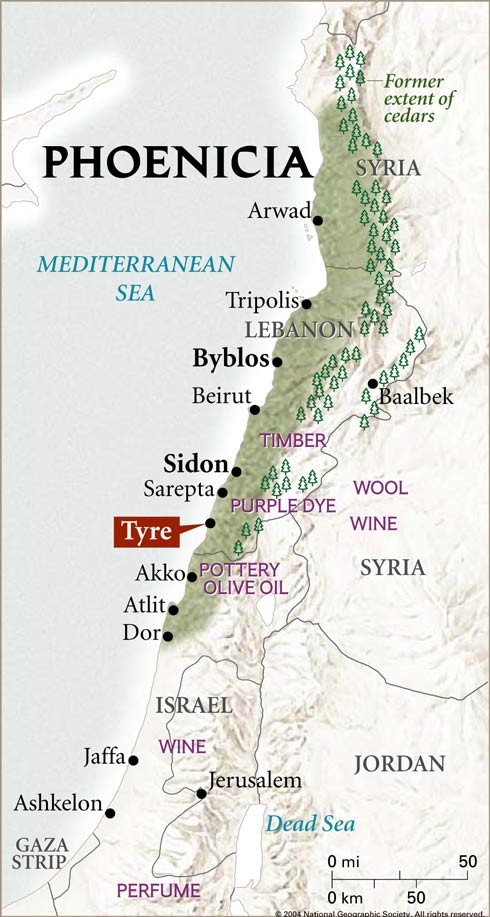


Several Zionist documents in the early 20th century referred to the Christians as Phoenicians and wanted to revive the over 2200 year old relationship with them. They regarded the Phoenicians as the perfect allies. Since the Lebanese Jews and Zionist Jews were a minority. Probably the first contact between the Zionists and the Lebanese was through the Soursok family, which sold the Jewish Agency Palestinian Lands, even though they didn't own property of them. According to Amin Mustapha's book: History of Resistance in Lebanon, the Zionists even had the proposal to shift the Christians to South in an autonomous region in alliance to Israel, to safeguard their Northern borders.

1930s - 1940s

The most notorious Lebanese back then to have contacts with them was the Lebanese President Emile Edde (Lebanese President from 1936 – 1941), whose offspring Reymond Edde challenged his father's ideas. Emile Edde was known for his Christian hardliner perspective. He was quoted of saying that whoever doesn't like Lebanon, there is always Mecca. In the early half of the 1930s, he sent Weizmann a congratulating letter that it seems he will establish the nation-state he seeks.
Even worse, Emile Edde had plans to carve out Lebanon and give parts of Muslim majority to the Zionists' forthcoming nation. Itimar Rabinovich wrote: "Another School of thought, headed by Emile Edde, was convinced by the 1932 census that the Muslims were about to become the majority in the Lebanese state and that the possibility of France abandoning the Lebanese Christians had to be taken seriously. Edde concluded that it was essential that to 'expedite the territorial reduction of Lebanon in order to enable the latter state to have a more consistent Christian majority.' By 'amputating' Tripoli and Southern Lebanon from the Lebanese state, 'Lebanon will be rid of almost 140,000 Shi'I and Sunni Muslims and will be left with a Christian majority equaling about 80% of its population.' Edde tried to win the support of the French government, which was not unimpressed with his reasoning but which in the end chose to preserve the territorial status quo. Still, Edde did not abandon his idea, and in 1946 he sent an emissary to Chaim Weizmann, the Zionist leader, to attempt to persuade Weizmann to seek the incorporation of southern Lebanon and its predominantly Muslim population into the Jewish national home."


(Picture Above: President Emile Edde)

To confirm the validity of this historical disastrous point in Lebanese history, Itimar Rabinovich's footnote included the following: "In a meeting of the directorate of the Jewish Agency on February 11, 1945, Weizmann, the president of the agency, reported that, "The son of the former president came to me. A Christian under a strong French influence – he came with a proposal ... that he would like to hand over to us, to the national home Tyre and Sidon ... because there are there a hundred thousand Muslims. I responded by saying that my grandfather used to say that he would not receive a 'biting' gift; but he would not relent and said that he will come again" (minutes of the Jewish Agency Directorate General).


(Picture Above: Ben Gurion)

Of course, Israel was announced as an entity in 1948, and Lebanon participated in the mockery of the Arab world sending their soldiers to Israel. Lebanon won its front at Malikieh, and progressed to link up with the Syrian army. However, the Jordanian and Egyptian treason for territorial expansion led to the Israeli Defense Forces to have time to equip their armies and eventually ousting all Arab regions except Ghaza and the West Bank due to Egyptian and Jordanian treason.

It has to be noted, that Lebanon was under the French Mandate from Post WWI till 1943, and the Phoenician Christians didn't represent the entire Christian community. According to Wilson's commission, the majority of the Christians preferred the link-up with Faysal's Kingdom.

To understand the vision of the Israelis to Lebanon in the 1950s, we have to look at Yossi Schwartz's article, who highlighted important aspects on Ben Gurion's perspective and Israeli aims. I hope he will continue to highlight more: "

Two important sources on the Zionist plans for Lebanon are the diary of Moshe Sharett, who was the Prime Minster of Israel in 1954-1955 and who was considered a "soft Zionist", and Livia Rokach's Israel's Sacred Terrorism: A study based on Moshe Sharett's Personal Diary, and other documents. In the latter we find some very interesting information, and it is worth quoting from Sharett's diary at length:

"Then he [Ben Gurion] passed on to another issue. This is the time, he said, to push Lebanon, that is, the Maronites in that country, to proclaim a Christian State. I said that this was nonsense. The Maronites are divided. The partisans of Christian separatism are weak and will dare do nothing. A Christian Lebanon would mean their giving up Tyre, Tripoli, and the Beka'a. There is no force that could bring Lebanon back to its pre-World War I dimensions, and all the more so because in that case it would lose its economic raison-d'etre. Ben Gurion reacted furiously. He began to enumerate the historical justification for a restricted Christian Lebanon. If such a development were to take place, the Christian Powers would not dare oppose it. I claimed that there was no factor ready to create such a situation, and that if we were to push and encourage it on our own we would get ourselves into an adventure that will place shame on us. Here came a wave of insults regarding my lack of daring and my narrow-mindedness. We ought to send envoys and spend money. I said there was no money. The answer was that there is no such thing. The money must be found, if not in the Treasury then at the Jewish Agency! For such a project it is worthwhile throwing away one hundred thousand, half a million, a million dollars. When this happens a decisive change will take place in the Middle East, a new era will start. I got tired of struggling against a whirlwind. (27 February 1954,)"

The next day David Ben Gurion sent Sharett the following letter:
"To Moshe Sharett the Prime Minister,
Sdeh Boker, February 27, 1954

"Upon my withdrawal from the government I decided in my heart to desist from intervening and expressing my opinion on current political affairs so as not to make things difficult for the government in any way. And if you hadn't called on me, the three of you, yourself, Lavon and Dayan, I would not have, of my own accord, expressed an opinion on what is being done or what ought to be done. But as you called me, I deem it my duty to comply with your wishes, and especially with your own wish as Prime Minister. Therefore, I permit myself to go back to one issue which you did not approve of and discuss it again, and this is the issue of Lebanon.


(Picture Above: Moshe Sharrett)

"It is clear that Lebanon is the weakest link in the Arab League. The other minorities in the Arab States are all Muslim, except for the Copts. But Egypt is the most compact and solid of the Arab States and the majority there consists of one solid block, of one race, religion and language, and the Christian minority does not seriously affect their political and national unity. Not so the Christians in Lebanon. They are a majority in the historical Lebanon and this majority has a tradition and a culture different from those of the other components of the League. Also within the wider borders (this was the worst mistake made by France when it extended the borders of Lebanon), the Muslims are not free to do as they wish, even if they are a majority there (and I don't know if they are, indeed, a majority) for fear of the Christians. The creation of a Christian State is therefore a natural act; it has historical roots and it will find support in wide circles in the Christian world, both Catholic and Protestant...

D.B.G. (27 February 1954)"

Sharett responded a few weeks later with the following:
"Mr. David Ben Gurion, March 18, 1954, Sdeh Boker

"As far as I know, in Lebanon today exists no movement aiming at transforming the country into a Christian State governed by the Maronite community...
"This is not surprising. The transformation of Lebanon into a Christian State as a result of an outside initiative is unfeasible today... I don't exclude the possibility of accomplishing this goal in the wake of a wave of shocks that will sweep the Middle East... will destroy the present constellations and will form others. But in the present Lebanon, with its present territorial and demographic dimensions and its international relations, no serious initiative of the kind is imaginable.


"The Christians do not constitute the majority in Lebanon. Nor are they a unified block, politically speaking or community-wise. The Orthodox minority in Lebanon tends to identify with their brethren in Syria. They will not be ready to go to war for a Christian Lebanon, which is for a Lebanon smaller than it is today, and detached from the Arab League. On the contrary, they would probably not be opposed to a Lebanon united to Syria, as this would contribute to strengthening their own community and the Orthodox community throughout the region... In fact, there are more Orthodox Christians in Syria than in Lebanon, and the Orthodox in Syria and Lebanon together are more numerous than the Maronites...

"... There are also decisive economic arguments against it. We are not discussing the issue in 1920/21... but 30 years later. Mount Lebanon has meanwhile integrated into one organic unit with the coastal plane of Tyre and Sidon, the Valley of Baalbeck and the city of Tripoli. They are commercially and economically interdependent and inseparable. Mount Lebanon was not a self-sufficient unit even before World War 1... The annexation of the three regions plus the city of Beirut to the Lebanese State has rendered possible the creation of a balanced economy. A return to the past would not just mean a surgical operation but also a disintegration leading to the end of Lebanon...

"When all this has been said, [I should add that] I would not have objected, and on the contrary I would have certainly been favorable to the idea, of actively aiding any manifestation of agitation in the Maronite community tending to strengthen its isolationist tendencies, even if there were no real chances of achieving the goals; I would have considered positive the very existence of such an agitation and the destabilization it could bring about, the trouble it would have caused the League, the diversion of attention from the Arab-Israeli complications that it would have caused, and the very kindling of a fire made up of impulses toward Christian independence. But what can I do when such an agitation is nonexistent? ... In the present condition, I am afraid that any attempt on our part would be considered as lightheartedness and superficiality or worse-as an adventurous speculation upon the well being and existence of others and a readiness to sacrifice their basic good for the benefit of a temporary tactical advantage for Israel.

"Moreover, if this plan is not kept a secret but becomes known a danger which cannot be underestimated in the Middle Eastern circumstances-the damage which we shall suffer... would not be compensated even by an eventual success of the operation itself...
"M. S.
(18 March 1954)"

At that time Ben Gurion did not convince Sharett. The conditions were not ripe for such an attempt. But the idea never went away and remained in the minds of the leading Zionists as an option. The time to put into practice came in 1978 during the civil war when the "Litani Operation" was launched.

Israel was created at a terrible price. The Palestinians were expelled from their homeland, pushed into refugee camps all around the region. Israel thus came into being in an almost permanent state of war against its Arab neighbours. Israel was envisaged as an outpost of western imperialism, a "safe ally" that could police this oil-rich region. For decades it played that role quite successfully. Part of that task involved trying to get at least one "friendly" regime to its north in Lebanon. But this was easier said than done. Because of its delicate ethnic makeup, Lebanon dominated by the Christian elite could never be a stable country. Class conflict would emerge and re-emerge in the form of ethnic conflict due to the lack of a clear working class, socialist leadership that could cut across the ethnic divide.

1960s - 1970s


(Picture Above: Kamal Junblatt)

1960s and 1970s witnessed the Israelis focusing on the destruction of the PLO who started to gain international recognition. The Christians and Israelis had common interests. The Christians considered PLO activities as downsizing the sovereignty of Lebanon, and worse, their own, specially the PLO misconduct gave the Phalange mainly the ability to recruit over 90,000 Christian, whereby such a number is too large for a small country like Lebanon. They were already allocated densely in Lebanon and Jordan. Their warplanes saved the Monarchy and the PLO became cornered in Lebanon. As thousands of PLO warriors moved to Lebanon from Jordan after 1970, Israeli efforts were focused on how to contain the PLO in Lebanon.


(Picture Above: Palestinian Refugee Camp in Jabal Hussein in 1970)


(Picture Above: Refugee Camp in New Amman following Black September in 1970)

The first logic was bomb Lebanon and specially the entire South and blame it on the PLO operations, which actually paid off extensively because the Shiites became wrathful of the Palestinians and stood politically next to the Christian Government. Moussa al Sadre and later Nabih Berri built AMAL movement based on the anti-Palestinian resentments. Kamal Junblatt was critical against Moussa el Sadre's indirect alignment with the Christians despite the fact that Fatah played a role in building that militia. The second logic was how to help the Christians, who were the primary spearheads against the PLO activities. Hence, minor arms were sent to the Phalange/Tigers/Tanzeem via Jounieh port. Most of the weapons that were sent have been Soviet manufactured and captured from the PLO militants in occupied Palestine and Jordan. The smuggling occurred via Cyprus, and in case the weaponries were discovered, the Lebanese National Movement, PLO's allies, or the Palestinians themselves will take the blame and Israel will not be linked to the Christians. The Israelis clearly didn't want direct confrontation in Lebanon, rather, they preferred that the Christians were helped to stand on their own two feet. The first man to establish contacts with the Israelis was head of the most feared militia, the army offshoot leader of al-Tanzeem, Georges Adwan (current member of Parliament).


(Picture Above: Yasser Arafat reacts to applause at the U.N. General Assembly in New York in this Nov. 13, 1974)

Prior to the Lebanese Civil War, Yasser Arafat gave the peace initiative of "Olive Instead of Bullets", whereby he declared that he will be satisfied with rump Palestine, which included the West Bank and Ghazza, the Israelis refused such a peace offering, however, it gave the Palestinian people the status of observant in the UN, which meant half-way recognition of Palestinians internationally. Some question if the Israelis accepted the offer then instead almost 20 years later, would have been there war in Lebanon? Or at least a war to last 17 years?


(Picture Above: Syrians enter Lebanon)

When the Lebanese National Movement and the PLO dominated over 81% of Lebanon in 1975-1976 wars, Israeli interests switched whereby they gave Henry Kissinger the blessing to let the Syrians uproot the PLO from existence. Hence, the Syrians, under the hesitated blessings of Pierre Gemayel, Camille Shamoun, and Suleiman Franjieh, as well as Israel and USA, entered Lebanon. The Israelis still didn't want to be directly involved, because then the Christian militias would lose legitimacy in the Arab World. In 1977, Israel pulled the Litani operation to safeguard its Northern borders.

1980s


(Picture Above: War-Criminal Ariel Sharon)

Bashir Gemayel's Zahli Crisis successfully got the Israelis and Syrians involved. When Israeli planes should down Syrian aerial vehicles, the Palestinians rained in the South missiles on Northern Israel. Hence, Ariel Sharon, then Minister of Defense, wanted to permanently demolish the PLO. The settlement in post-Zahli crisis, stopped everyone from shooting, but kept the PLO growing stronger without any interventions. In 1981, Sharon visited Bashir Gemayel in East Beirut, and had dinner with Pierre Gemayel and Camille Shamoun, with the promise to invade Lebanon since now the Syrians – Lebanese National Movement – PLO forged an undefeatable alliance. The logic for such a move was to uproot the PLO once and for all and block any sovereignty. Sharon's second logic was install a satellite president and impose a peace treaty. Bashir Gemayel already became the most popular Christian since the 100 Days War where the Syrian forces bombed brutally East Beirut for a 100 days.
When the invasion began in 1982, the Israelis failed to demolish the PLO since they were severely allocated in West Beirut. Sharon's plan was to have the Lebanese Forces (then a unity of militias under one banner militarily) enter the street to street fights. Bashir Gemayel, knowing his men's disability to face the cornered PLO and Lebanese National Movement, preferred not to.


(Picture Above: Israel Bombing West Beirut residential areas)
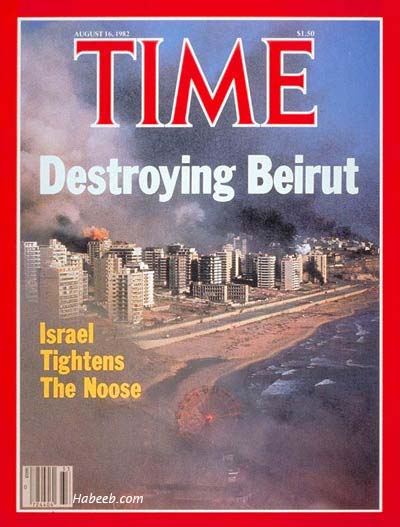


(Picture Above: Times cover in 1982)

Israel's main man was Bashir Gemayel, he suited their plans to be president, whereby Israel will have military benefits, and even joint business markets, Bashir became stubborn under US support. For the Israelis, they always thought that peace with Lebanon will eventually come, but after a stronger country signs peace. Bashir was assassinated. Prior to the assassination; however, Bashir had his undelivered inauguration speech. In it again, Bashir stressed on how Lebanon is an Orientalist nation rather an Arab nation again giving its existance roots to a pre-Islamic era. Furthermore, he didn't regard Lebanon in a state of civil war, rather under Palestinian and Syrian invasion without refering to the Israelis, more like hinting to the Israelis to oust the PLO militant remainders and Syrian forces out. It is worthy to note, that Sharon had a Plan B, which was transferring the PLO and the whole Palestinians to Jordan after assassinating the Jordanian King, hence establish a "New Palestine" for the Palestinians. The US diplomats accused Sharon as an 'asshole'.


(Picture Above: Bashir Gemayel)

While trying to salvage a deal with Amin Gemayel, even the Americans hindered several of their efforts. However, it is known that Sharon tried to pull a deal with Amin Gemayel behind the Americans' backs, through a business merchant called Sami Marun. It was intercepted, and the Americans changed a lot of the items which went to Lebanon's benefits. However, the 17th of May Accord was shot down via Syria, and its allies Junblatt and Berri. Israel's primary concern became on how to pull out from Lebanon since they couldn't tolerate military operations conducted on them.
Their sudden pull-out from Mt. Lebanon, witnessed pro-Lebanese Forces residents demonstrating in front their headquarters over there not to withdraw, but the IDF couldn't tolerate any more casualties. The sudden pull-out from Mt. Lebanon witnessed the bloodiest collisions in Mt. Lebanon between Walid Junblatt and Samir Geagea, which ended up with bloodshed, mostly on Christian areas, and resulted in the biggest sectarian cleansing since Bashir Gemayel's cleansing of East Beirut from Non-Christians. Since then, the Christian leadership lost confidence with the Israelis and felt they were betrayed.


(Picture Above: Israel's occupation of Southern Lebanon)

1990s - 2000s

The case of the Northern borders became the priority of Israel, specially Hezbollah arming itself under the Syrian Mandate in Lebanon. They attempted to preserve the 40 Km area in South Lebanon with their puppy army, the South Lebanese Army, but failed. After confrontations in 1993, 1996, the year 2000 they were expelled in Lebanon.
Ehud Barak actually won elections in Israel with the promise of withdrawing from South Lebanon. At first, his government launched "Lebanon First", whereby they sought to seek a peace treaty, the negotiations were shot down because the Lebanese, under Syrian hegemony, demanded that Israel would negotiate with Lebanon and Syria at the same time. When the Israelis initiated "Syria First", the Syrian regime directly hopped the negotiating table. While Hezbollah operations aggravated, the Israelis preferred to preserve their tight grip on the Golan Heights in Syria, and withdrew suddenly from Southern Lebanon, leaving Syria shocked without any means to bargain in 2000.

Post 2005 events


(Picture Above: July War 2006 was more than the IDF soldiers can handle, another contributing factor on Israel's crackdown for Lebanese demands)

After Harriri's assassination in 2005, Israel held high hopes towards Lebanon after Syria was ousted out by internal activism and international pressure. Nevertheless, the participation of their sworn enemies, Hezbollah, in the government meant bad news. The US hoped that the anti-Syrian 14th of March can contain Hezbollah, but to no productive results. At first, some expressed hope when Hezbollah participated in the government that they will become gradually a political party, but they ended up as both: political and militant. Israel, in collaboration with the US, decided to end Hezbollah, with the support several Arab leaders, according to Bolton at Marcel Ghanem's talk show. Their primary lookout was certain Christian Groups, the Druze, and the Sunni Street. When Hezbollah, for different speculated reasons pulled their military operation on July 12, 2006, the war began, and the promise of Olmert was "extermination of Hezbollah". From this perspective, they will proceed bombarding Hezbollah, and hoped that a civil war will break between the 14th of Marchers and Hezbollah. Yet, the Lebanese despite political divisions, united on assisting the refugees throughout Lebanon. Hence their plans that were relatively successful in the late 1960s, and very successful in the 1970s ended up in failure. Yet, Hezbollah emerged even stronger, calling the war "Divine Victory". Their hopes of 14th of March to balance against Hezbollah evaporated when Hezbollah within 72 hours swept Lebanon politically and militantly under their grip. Even worse for the Israelis, the appearance of two powerfully militant parties preserving their trainings since the days of the civil war: AMAL Movement and the Syrian Social Nationalist Party. This doesn't mean that 14th of March have been collaborating with Israel, rather, they shared the hatred to Syria in Lebanon. 14th of March also didn't express any need to forge any peace treaty with Israel, specially their mass butchery of the Lebanese, and destructive operation against Lebanon as a whole. Hence, Israel's key component, the undefeatable army, changed their plans and followed an informal disengagement plan. Whereby they successfully were willing to give Hezbollah the remaining prisoners, and a large chunk of martyrs, willing to withdraw from Sheba'a farms, and initiated via Turkey, under US patronage, the withdrawal from the Golan Heights, in order to focus on their internal problems, and probably gain some time to rebuild their army and sort internal problems for future wars.


(Picture Above: Israeli Brutality on Beirut during the July War of 2006)

MFL

Friday, May 23, 2008

What's Next After this Mockery?

Ever since the July War was over, escalations rose between the Government and the Opposition loyalists. The Shiites (AMAL and Hezbollah members) and One Greek Orthodox Minister (ex-President Lahoud Loyalists) withdrew, things took a bigger U-Turn. People called Lebanon a proxy war between Iran and the United States; however, I tend to support the perspective on Lebanon's problems as not "foreign intervention", rather the system itself which paved way for foreign sponsors to enter the Arena. This perspective was advocated by President Reagan's top diplomat, Philip Habib, who considered Lebanon as a "last minute mosaic patch-work" and a cyclone which sucked all regional and international players in its never-ending mazes.

With the Opposition demonstrating since end of November 2006, after the one week of the assassination of Pierre Gemayel, Pandora's box was opened to a point of no-return. Both, the Government and the Opposition threatened with escalations and took stands that didn’t open a back route, which ended up with the military offensive led by Hezbollah, and assisted by AMAL Movement and the Syrian Social Nationalist Party. By January, 2 collisions occurred alerting the Lebanese Society that the worse is yet to come. In March, Nasrallah announced that the Government would have collapsed sooner; however, the government was well supported by the International Community. The United States hoped that the Government can contain Hezbollah and gradually disarm them.

After the last offensive, the government and the opposition finally agreed on the nature of the Government (16: Government Loyalists, 11 Opposition Loyalists, and three selected ministers by the President – The Opposition has its veto right, and the Government loyalists only choose the Prime Minister). As for the Electoral Law, sadly the Proportional Ratio was abandoned, and instead of progressing forward, the 1960 electoral law (with several amendments) was adopted; it has to be noted that the first to propose this law was Speaker of the Parliament (and AMAL leader) Nabih Berri. I find it a bit ironical that Hezbollah bombed Junblatt's zone like the Israelis bombed Lebanon and Hezbollah. If Junblatt didnt go for the peace option, would Hezbollah have bombed his areas till he surrendered? (sounds familiar between USA and Iraq at the early stages of the second war).

Greedy Players

The anti-Syrian 14th of March Coalition, also known as the Government Loyalist or as dubbed by George Bush according to Blanford "the Cedars Revolutionaries", depended on the international political support, the Opposition depended on the military balance of power and their grass-roots that we saw in the early stages of the Open Demonstration. When the opposition almost agreed to elect the President (who both agree on and compete who want him more), one man was disappointed because he shoved himself as the "reconciliatory president of both coalitions", although he is the head of block in the Opposition himself: ex-general Michel Aoun. Now his dream won't come true, unless the next round he plans to nominate himself on a wheelchair.
Now, since late November 2006 till 2008, the Opposition set up their tents under different logos "protecting the resistance", "fighting USA", "Overthrowing the 14th of March Government", "National Unity Government", "We Want to Live... with Dignity", "fighting Israeli Government", "Wanting Dialogue", and several others. Ironically, the one that got the people's sympathy most was "Down with the thieves" and "We want bread" whereby plenty of anti-US imperialists journalists thought that this was a battle of the Poor Versus the Rich. After the latest "civil disobedience" which included the resistance directing its arms Beirut and Lower Matn (with the heavier weaponry reserved to the Jabal area, aka Durzistan). The opposition eventually proved that they launched their offensive for political scores, sending a deeper impulse of hatred among two other Lebanese sects. Why didn't the Opposition accept to do such a negotiation sooner in Beirut rather than do all that fiasco and murders. I would like to add, the ones that died are not just 65, they are spread among victims that died in the cross fire whenever the Opposition launched its open demonstrations in 2006; however, this doesn’t mean the Opposition alone was doing all the killings. Worse, Hezbollah never mentioned anything about their offensive, they called it "Peaceful Demonstration"

Now our esteemed self-proclaimed "freedom fighters", the Government, they said that nothing in the world will get them to budge from their decisions. Their liberal policies already led to this class difference (and not just for the Opposition, but also among their supporters), never also decided to step down on any of their decisions, never analyzed what they were up against, totally depended on Western and Gulf Support, and played a massive role in halting the country. Worse, turns out they were accusing the others of carrying arms while they were arming themselves as well. The weaponry seized from Future Movement (which NBN called the targeting of all Sunni pro-government locations that represent the majority of the Lebanese as "Freeing the Sunnis") and the heavier weaponry from Junblatt's PSP tells us that this is a long road for a solution.

Now, we see the Opposition sharing the government in a National Unity Matter. The logical question goes to al-Manar TV, if the Opposition is fighting Zionism; on what basis they are seeking "National Unity" with them? The Government on the other hand are fighting the executioners of their figureheads, well fine, on what basis you want a dialogue with your cadres' supposed assassins.

The last step is the head of the Syndicates Union: Mr. Ghosn. If anyone to be accused of ultimate treason to the Proletariat, it will be him. We all know what lies the Government and the Opposition are made of. Some of the comrades never expected that Hezbollah will turn their missiles on Mt. Lebanon, rather we thought it will be under his expected successor , Naem Qassem , because he known for his hardliner position. Yet Nasrallah proved to be a liar, and the worse of him is Mr. Ghosn. Ghosn's demonstration was hijacked by the Opposition to pull their military offensive and trigger these six days of civil wars throughout almost Lebanon. He blamed everything on the Government without shedding light about the Opposition even though the Opposition are to be blamed for the crisis, like the Government. All he still needs to do is to thank the Opposition for "protecting the demonstrators from the US agents, Future Movement." To hell with those General Syndicates. The irony is that the Opposition didn’t bring back any economical change. Rather, they spent it arguing on what street this or that town should be a political constituency. Do those who demanded for bread feel suckered? The sect-driven , or party- affiliate ones I am sure they would feel victorious.

One thing for Sure

Just as 14th of March blamed the economic situation on the Syrians Mandate, and everything rotten, the Opposition did the same on the Government. Now they both lost momentum. Those who will go down to demonstrations are the Sect-Driven ones (excluding the Syrian Social Nationalist Party, Lebanese Communist Party, and the Democratic Left; if they are still existent)

A Massacre, Breaching already the Doha Agreement, and Flushing the Civil Society

Both factions started already breaching the Doha Conference. This conference required strictly that both coalitions should study the Boutros Electoral Law Reform in details. Rather, now they are going to go and elect the President, get him inaugurated, and vote on the amended 1960 law. Now a question to the Opposition supporters, how do they feel that the ending of their tents in Down Town and all this time ended as a gift from Berri to Qatar, his token of appreciation to them. What Berri didn’t notice the opening a Pandora's Box, whereby we saw certain Salafi extremists attacking the SSNP and beating to death (or following the wounded and killing them in the hospital and mutilating their bodies.) The horrific videos were out, and the bodies of those 11 SSNP were used as a political point against Harriri. The Future Movement tried to blame it on certain extreme Salafis and condemned the Massacre. However, as well all now the SSNP, they seek revenge... and such a gigantic scale of a massacre will beget a retaliation (my expectation that the murderers are currently dubbed as 'the living dead') because they appeared on TV. The most logical part is the army (if it still has any pride after what happened) to arrest the killers who appear clear on the video. One man described the situation in a realist manner, to my surprise Samir Jaajaa, whereby he admitted they are supporters of the Future Movement who are the moer fanatic factions of the Sunnis, and admitted how difficult it is to control them once Future Movement are weakened. As a matter of fact, I think Hezbollah wouldn’t think of it, they need Harriri's business elites' friends to block Lebanon from falling to a worse economical situation.

As for the Civil Society, well they were knocked in a shock and didn’t know what to do. A lot thought that their years of "long-term projects", "democratization Lebanon", and "lobbying" went down the drain. Well guess what, it taught them two lessons:

One, no person can assume carrying his/her principles from abroad and just apply them in Lebanon without understanding its history, problems, and ignore the situation of the region.

Two, they spent quiet a while on law reform and hit the wall. The ones with the real bargaining chips are the key-players.

Three, if they want to spend so much time on lobbying, at least lobby for something correct, such as Civil Marriage, making the Personal Law (whereby each sect is governed in personal affairs to Sect laws), progressive tax on an individual level rather corporate because the corporate means the rich get richer, and the ultimate law to insure real democracy = transparency, and hence the law advocated by Junblatt Sr. in the 1950s "From Where You Have This". Of course this to be followed by the "Six by Six" norm in the public sector recruitment (ie for 2 Catholics, you get 2 Orthodox employees, two Druze, two Muslims...etc). Structural changes and emancipation from above can never happen. The only real solution is the workers emancipated to their causes despite class, gender, race, religion, and gender, and even Nationality (in reference to protecting non-Lebanese proletariat). Again, how can you have an effective Civil Society if the majority are politically affiliated, or without a clue on Lebanon's contingency history?

The only ones who proved to have guts were the Disabled organization "Lebanese Physically Handicapped Union" (LPHU) whereby they simply proceeded to face the politicians as they went to the airport with banners "Don't Come Back till You Agree" and "Shame on You!". Those organizations such as "Our Unity, Our Salvation", National Democratic Institute (NDI), and a lot uncountable others proved weak. They just followed LPHU to the demonstrations or attempted to support them. After all, what better message is seeing all those courageous handicapped on wheelchairs demonstrating against the Politicians' Greed?

Who Lost Most?

Well, Aoun! For starters, his ally got back into the sphere as Zgharta now became alone as a constituency hence forth we will see Suleiman Frangieh making it to the Parliament. He didn’t secure anything in Beirut, as a great battle awaits him down there. And on the top of it all, his "legendary sweep" of Matn is not secure at all, now that 14th of March in last year's individual elections balanced against him, and now he doesn’t have Michel el Murr as an ally. This doesn’t account for how the Christian street will vote after all those incidents. Aoun made it to elections as the man who promised the Christians a strong leader, mainly himself! With all those fluctuations, I even expect breaches elsewhere for Aoun, such as even as far as Zahli. In 2005 elections, Future Movement was successful to breach to the parliament with an MP.

Text of the Deal (as taken from Daily Star) as follows:

DOHA: Under the auspices of Qatari Emir Sheikh Hamad bin Khalifa al-Thani and in continuation of the efforts of the Arab Ministerial Committee, headed by Qatari Prime Minister and Foreign Minister Sheikh Hamad bin Jassem bin Jabr al-Thani, and the efforts of Arab League Secretary General Amr Moussa and the foreign ministers of Jordan, United Arab Emirates, Bahrain, Algeria, Djibouti, Oman, Morocco, and Yemen,
And based on the Arab initiative to contain the Lebanese crisis and in implementation of the Arab-brokered Beirut agreement which took place on May 15, 2008,

The Lebanese National Dialogue Conference was held in Doha from May 16, 2008 to May 21, 2008 in the presence of the different Lebanese political leaders, who asserted their will to save Lebanon by ending the current political impasse and avoiding its dangerous consequences on national coexistence and civil peace between the Lebanese, and voiced their commitment to the principles of the Lebanese Constitution and the Taif Accord.

As a result of the different meetings, discussions, and consultations that the Arab committee had with all the parties participating in the conference, the following agreement has been reached:

1 - The Parliament speaker will summon the Lebanese Parliament to convene, according to rules in force, within 24 hours to elect consensus candidate General Michel Suleiman as president.

2 - A national unity government of 30 ministers to be formed. It will comprise 16 ministers from the majority, 11 ministers from the opposition and three ministers to be named by the new president. All parties pledge not to resign from the government or hinder its work.

3 - Adopting the qada as the electoral constituency based on the 1960 electoral law, but the qadas of Marjayoun and Hasbaya will continue to be one constituency and so will the qadas of Westrern Bekaa and Rashaya and the qadas of Baalbek and Hermel.

As for Beirut, it will be divided in the following manner:

First constituency: Achrafieh, Rmeil, Saifi
Second constituency: Bashoura, Medawar, Marfaa
Third constituency: Mina al-Hosn, Ain al-Mreisseh, Mazraa, Mosseitbeh, Ras Beirut, Zokak al-Balat.

The parties also agree on forwarding to the Lebanese Parliament the electoral reforms that were proposed by the National Committee for Drafting the Electoral Law, headed by former Minister Fouad Boutros.

4 - All parties will commit not to resort to arms or violence in order to resolve political conflicts.

Resuming dialogue over strength ening state authority over all parts of Lebanon and defining the relations between the state and the different political groups in the country.

This dialogue has already started in Doha and resulted in:

- Agreeing that security and military powers to be solely in the hands of the state and spreading state authority over all parts of the country so that outlaws will have no safe havens.

5 - Reiteration of a pledge by Lebanese political leaders to immediately refrain from using language that incites political rifts or sectarianism and from accusing each other of treason.

This agreement was signed in Doha on May 21, 2008, by the Lebanese leaders participating in the conference and in the presence of the head of the Arab Ministerial Committee and its members.

As for the rest of the Constituencies:

I didn’t have time to translate them yet to English, but they are taken from Assafir, and they are in Arabic over here.

One Last Irony

Isn't it ironical that once the Lebanese ended their dialogue, Syria began its Dialogue through Turkey? How come the Opposition didn’t react to that?

Last Speculation?

Will the assassinations of 14th of March cadres continue or not?

Saturday, May 17, 2008

... And the Poker Round Table Returns

After all this shooting, and all this surging hatred; however, this round table is in Doha. It is ironic all of this bloodshed occurred and now a new bad case of amnesia will be imposed on the Lebanese Society and we will see a new re-writing of history, a la 1984 doze, if they pull it through.

Now why Qatar? Qatar, of all the Arab countries has the best interesting ties with all coalitions. For starters, if you focus on the Qatari media, everyday you read the Prince, Hamad bin Khalifa al-Thani, sends to a country a letter congratulating the country for having "unique relationships" with Qatar. Qatar politically has strong ties with Egypt and Saudi Arabia, it has the largest military base for the US army in the Arab World (except for Iraq). They welcomed Israel's Levni and already had an open excellent relationship with Israel for the past decade. They also are on excellent relations equally with Hamas and Fatah. Qatar and the Syrians never had frictions before, and mind you, the Prince's "congratulating relationships with global leaders" has covered Assad. Qatar also has almost 20% of its population composed from Iranian Labor, and not to forget that some powerful business clans with Iranian origins (such as Ali Bin Ali Clan).

In Lebanon, things are different. The Opposition tagged the entire Gulf as 14th of March supporters that of course included Qatar. With Qatar visiting Syria, the Opposition changed drastically their attitude.

Qatar as a whole is almost the size of Lebanon with the largest gas reserve in the world (taking the size – quantity). Its population five years ago was barely 800,000, with expected the local Qataris to be barely 30%. Everyone in Lebanon expects a super deal is coming on its way.

Some people compared the Doha round to the 1969 Cairo round. Well, there might be similarities. However, there are different issues. Despite the fact the PLO had a country within a country in Lebanon, the PLO were par excellence Palestinian. Some would consider Hezbollah Iranian, yet I doubt that it is when you have over a million supporter in Lebanon. The PLO were supported by the Lebanese National movement then, but the Cairo agreement allowed the PLO to take control over the Palestinian Refugee Camps and transform them to military training bases. Hezbollah on the hand already have their arms as legitimate after the Ta'ef Accord, at least had till last week they turned their military to the inside of Lebanon. Hezbollah's legitimacy was renewed in the 2000 victory when they successfully kicked out the Israeli army from the South and considered their victory as "a National Victory for Lebanon". In 1969 also, both camps agreed to have anyone as a Lebanese President just to get rid of the Chehabist regime, let for two presidential periods under Presidents Chehab and Helou. In 2008, both camps agree on Suleiman head of the army as a reconciliation president. The 1969 deal eventually led to a national government whereby Kamal Junblatt was Minister of Interior. Kamal Junblatt's decisive vote allowed the election of Suleiman Frangieh because the Second Bureau and non-alignment policy of the Presidency no longer suited both factions. Ironically, the candidate who was defeated by Suleiman Frangieh Sr. was Elias Sarkis, who will succeed Frangieh in 1976 and become Bashir Gemayel's closest ally. In 1969, the details of the accords were not fully displayed and the Parliament, except for Reymond Edde and his parliamentary coalition, voted for it and later one faction regretted it. The agreement on Michel Suleiman reminds us of Fouad Chehab; however, Michel Suleiman is not part of the Chebist school.

However, I prefer the comparison of Doha Negotiations to the Riyadh Ac of 1976. Again, Fouad Sarkis was elected as President to represent the third line of political force, which was supposed to be the Chehabist rule. The Opposition supported Sarkis in return the Syrians wont impose any political restraints. More to the point, the Lebanese National Movement, prior of the Syrian entrance of Lebanon under the invitation of Frangieh , Pierre Gemayel, and Camille Shamoun, has overwhelmed the Lebanese Army and the Lebanese Front with the help of the PLO. The Syrian intervention was justified in Lebanon as a "deterrent force", but this not focus of similarity.

Kamal Junblatt considered the Syrian offensive (and the justification of the Arab World for it) as a direct attack on Lebanon's democracy and progressive forces, this is something that we have seen ironically with his son Walid Junblatt again accusing the Syrians with their offensive via Hezbollah. The Accords of Riyadh also didn’t tackle in details the PLO weaponry, because the Lebanese Army was not able to disarm them, something similar to the arms of Hezbollah. Now the difference is between now and then, that the Syrians did start disarming the PLO, as el-Khaddam clearly said: "Even taking away the PLO kitchen fork", until Egypt signed the Peace Treaty with Israel. Currently, Syria is negotiating Peace with Israel, while Syria's role is more recognized than ever in Lebanon. The resistance arms of the PLO and Hezbollah were both turned to the inside of Lebanon, while the Christian forces wanted to preserve the status quo of their political gains then and now (hence 14th of March Christians now, and the Lebanese Front then). Yet, unlike 1976 whereby two foreign forces existed n Lebanon: PLO and Syria, Hezbollah single-handedly can face the entire 14th of March militarily, and not to forget its allies: the SSNP and AMAL.

Yet, let us hope the new President wont do what Sarkis did, siding with one side against the other and increase the gap between East and West Beirut. Although the Doha Round, unlike the others, has all the actors and parties in it, hence time will tell what will come out of it.

The actors who went there, (taken from Daily Star) are:

AMAL: Parliament Speaker Nabih Berri and MPs Samir Azar and Ali Hassan Khalil and advisers Mahmoud Berri, Ali Hamdan and Ali Hamad.
Future Movement leader Saad Hariri and MPs Bassem Sabaa, Nabil De Freij, Samir Jisr, former MP Ghattas Khoury and political adviser Hani Hammoud.
Prime Minister Fouad Siniora and ministers Tarek Mitri, Khaled Qabbani, Michel Pharaon, Ahmad Fatfat and political advisers Mohammad Chatah, Radwan al-Sayyed, Roula Noureddine, and Aref al-Abed.
Progressive Socialist Party leader Walid Jumblat and ministers Ghazi al -Aridi, Marwan Hamadeh and MPs Nehme Tohme and Wael Bou Faour.
Free Patriotic Movement leader MP Michel Aoun and MPs Abbass Hashem, Nabil Nkoula, Farid Khazen, FPM political relations official Gibran Bassil and political advisers Mario Aoun and Jean Aziz.
Hizbullah MPs Mohammad Raad and Hussein al-Hajj Hassan and resigned Energy and Water Minister Mohammad Fneish.
Lebanese Forces leader Samir Geagea and MPs George Adwan, Antoine Zahra and foreign affairs adviser Joseph Nehme.
Former President and Phalange Party leader Amin Gemayel and party members Chaker Aoun, Walid Fares, Elie Dagher, Sassine Sassine and political adviser Joseph Khalil.
Zahle's Popular Bloc head MP Elie Skaff and MP Salim Aoun.
Tripoli Bloc leader and Transport and Public Works Minister Mohammad Safadi.
MPs Michel Murr, Ghassan Tueini, Boutros Harb, Jawad Boulos and Hagop Pakradounian.


On a side note, a demonstration was carried by the Lebanese Physically handicapped Union whose long was: "Don't Come Back if you don’t have a Solution" aiming at all the leaders of both coalitions and representing the demands of the majority of the Lebanese. The demonstration was staged on the Airport Highway.

Tuesday, April 15, 2008

Regarding the Divorce of Aoun and Murr

It is amazing how everything is bi-polar to the extent that 14th of March has a lot of supporters now calling Michel Murr as "The Wiseman" while the Opposition call him "The Traitor". The Opposition seems to have forgotten what he has done to the Syrians.

One of the shakiest alliances that took place between any two individuals was between Aoun and Michel el Murr. During last year elections, 14th of March gambled on the chance that Aoun and Murr will break their alliance, to which the latter two disappointed them when both announced loud and clear that the trilogy alliance between Aoun, Murr, and Tashnag is still alive and kicking. Although it has to be noted, Murr and Aoun forgot to mention the Syrian Social Nationalist Party's votes (estimated at least 4500) that gave Camille Khoury the breaking factor.
Couple of months later, Michel el Murr appeared on Marcel Ghanem's show, and he defended his alliance to Aoun on the basis of paying back an old friend a favor for saving his son during the last couple of years in the civil war. But Michel el Murr was explicit to also state that he doesn’t talk with Aoun's men, and in fact he indirectly slapped their form of talking on TV with the highest pitch (almost every time between Tony Nasrallah, Alain Aoun, Salim Aoun, Nicholas Khoury, Jubran Ba"th"il, and others. Michel el Murr also stated that if he was a Maronite Christian, instead a Greek Orthodox Christian, he would have run on the elections.

To be honest, in my personal opinion, the smartest politician to join then Michel Aoun's coalition "Reform and Change" was el Murr. The man managed since the late sixties to sustain himself in the parliament, knocked out Bshara Merhej to grab hold of the Ministry of Interior, and developed a gigantic empire in Matn whereby he swept over 80% of the municipalities. To be more exact, Murr's empire was gigantic. At a one point, he was the deputy for the Speaker of the Parliament, his son was the Minister of Interior, and his daughter was head of the Upper Matn Municipalities. When Albert Mokhaiber passed away in 2002, he ran his daughter to the Parliamentary elections. The only candidate who was supposed to block his daughter from making it to the Parliament and attain a seat next to her daddy was ironically Gabriel el Murr, his own brother. When Gabriel el Murr, supported by anti-Syrian forces, won, Michel el Murr successfully closed down his channel (and don't laugh it was called MTV, aka Murr TV), and found charges to disqualify his own brother, which ironically made Ghassan Mokhaiber win in default the elections (who was actually Joubran Tuieni's and Walid Junblatt's candidate, eventually the tides changed when MP Ghassan ran against his ex - allies in Matn).

Prior to the divorce between Aoun and Murr, Michel Murr still remained one of the most powerful politicians within the Reform and Change coalition. He emerged victorious from Upper Matn elections, he became a powerful figure head in the Opposition while his son is a powerful figure in the Government. Even strangely, the current government is hanging on the edge, if one more Minister resigns/gets assassinated, the government collapses. Elias Murr remained within the government. Probably what triggered the distrust in the first place between these two figures is the assassination attempt on his son, the current minister of Defense: Elias Murr. Hence, Michel Murr immerged as the most controversial figure of 2005 elections, and of course preserved his title as "King of the Upper Matn Constituency".

So who is Michel Murr?

Michel Murr has been a powerful figure that won elections since the late 1960s in Matn area. In 1979, he was a minister of President Sarkis. It has to be noted that by then Sarkis was a close ally of Bashir Gemayel who didn’t mind bringing Bashir Gemayel's loyalists to the government. Michel el Murr is actually the primary funder of Bashir Gemayel's child "the Lebanese Forces." He was the one responsible to secure that the Lebanese Forces were properly funded. Eventually, he remained a minister till 1982, primarily when Bashir Gemayel was blown to kingdom come due to his alliance with Israel.

Like Michel Aoun, Elie Hobeika, Samir Jaajaa, Karim Bakradouni, Fadi Freim, the Sarkis family, and a lot others: he was one of Bashir Gemayel's powerful figures. His marriage to the Syrians secured Upper Matn as his little kingdom, and of course Murr abused his Ministerial authority and made sure that everyone in that district found work as long as they found work.

Through blackmail, giving the Lebanese nationality to over 10,000 blue collared Syrians (and not to forget the non-Syrians), by "coincidence" they were allocated in Upper Matn. He is associated and accused of the Burj Hammoud cheating when "the electricity went out" in 1996 and of course the expulsion of Nassib Lahoud's "Freedom List" observant in 2000. Murr is also notorious for his generousity in elections during the vote cast.

Personally, I think I am risking my life by talking about this man. I myself fear him more than any other politician. This is also not to forget the speed of securing Elections Voting Cards for his supporters and their relatives while it took almost forever to secure these cards for opposition supporters. Murr's strength grew to give license for arms to all his hooligans (and a shoot-out occurred on Nassib Lahoud without the 'Ministry of Interior' investigating it).

The man, don’t get me wrong on this, has an amazing sense of humor. I think he is really the devil's advocate when it comes to politics.

Murr and Aoun lullaby

Now this is the interesting part. Aoun and Murr knew each other since 1978, when Bashir Gemayel completed his climbing of the ladder of the Phalange Party. Aoun was Bashir's Gemayel's hand inside the army; however, in Bashir's last final days he switched his allegiance to Amin Gemayel, who was then the last person to oppose Bashir politically (since Bashir militarily ended Amin's pocket cell in Bikfaya).
While Michel Murr participated in the Syrian game and the forging of the Ta'ef agreement, Aoun eventually went to exile by living in a "five-stars hotel". Murr's network and Aoun's alliance in 2005 came as a bombshell to everyone. The alliance proved fruitful for both of them, since the government wanted to politically end Michel Murr's winning streak. Even Sarkis Sarkis almost defeated Pierre Gemayel Jr. in the elections.

With Michel Murr's son in the government holding the most powerful ministry, Ministry of Defense, and he is holding a powerful position at the Opposition, specially due to his highly controversial links to Syria, the family seemed to have won the hearts of both coalitions. Probably the only person to hate him till he goes to the grave his Gabriel Murr. It is only a matter of time how long can Murr tolerate Aoun's ego and worse, Aoun's footsoldiers: the figureheads of the Free Patriotic Movement. Despite the fact that Murr tried to end his alliance peacefully with Aoun, again Aoun had to explode on Murr.

Murr argued that it is illogical to keep the nation without a president for so long, and it is insane to keep the parliament closed for that long as well. He was one of the figureheads who supported the closure of the Parliament. Yet, the top of the iceberg was exposed when Murr went to elect a President when his Son supported the election of Michel Suleiman as the President of Lebanon. While Murr said it loud and clear he wants to vote for a president, all the Free Patriotic Movement in December boycotted the Parliamentary Session to occur, and pushed the Opposition to break the quorum of 2/3 to get things rolling within the parliament. (Only AMAL's coalition in a symbolic manner were


What About the 2009 Parliamentary Elections

Well, I know one powerful leader who told me in December 2007: "Be prepared, in six months, the alliances will fluctuate and the borders will change between 14th of March and the Opposition." In fact, he added: "Expect anything!". Seems he is right although I was skeptical at first.

If the 2009 parliamentary elections take place , then where Murr will stand? Will he step down and allow his son lead his tens of thousands of supporters? Technically the primary obstacle for the 14th of March was Rafi Madayan since he is the sworn enemy of the Tashnag. Yet, now Murr fluctuated his alliances currently to neutral grounds. This may lead to a scenario of throwing Nassib Lahoud outside the Matn Formula and forge a strong alliance between 14th of March , Murr, and the Tashnag. After all, Rafi Mayadan switched sides.

Another scenario would be that Murr himself, in a vigorous manner, will go elections again but he will seek to win Matn as a whole. He might be weaker without the SSNP votes and the Free Patriotic Movement's votes (as well as the foreign votes), he still can pull it through. The Opposition and the Government can leave two or three seats for him and vote for him in the face of the others.

Or Aoun and Murr would probably strike a new alliance under different circumstances and run the elections again. This, I have to stress, has lost its cutting edge after Aoun's Tsunami disappeared to only 400 votes against Amin Gemayel. Someone will tell me that it was a nobody (Mr. Camille Khoury) crushing the ex-President, I would like to stress that Camille Khoury was not running but in name, the man who behaved as if he was running was Aoun himself.

The question would have to be asked: What about Murr's allies from the reign of the Syrian Mandate? What about Hezbollah and AMAL movement? Will they in defecto abandon the man who facilitated all black market issues for them and covered them politically? The other question is: Did Michel Murr divorce the Syrian Baathi Regime? Did the attempt on Elias Murr's life break that alliance? Time will tell…
Now isn’t it hilarious how 14th of March and the Opposition automatically switch sides in terms of Opinion?

Update: Seems Murr is heading to an alliance with Gemayel ever since announced publicly that he regrets shooting down Amin Gemayel's parliamentary electoral campaign. Interesting, does this mean that Nassib Lahoud is out of the formula? Is Murr joining 14th of March? Or a powerful coalition of Tashnag - Murr - Lahoud - Lebanese Forces/Phalange is under construction?

As lunatic Aoun, since he is trying to get out of this mess by opening the issue of a mass grave whereby the confronation took place between the Lebanese Army (whatever remained from it then) and the Lebanese Forces. Why doesnt he go to the court since he fully took the credit for the Tel Za'atar massacres on al-Jazeera's War for Lebanon?

What a long road we still have to go through…

MFL

Monday, January 14, 2008

The New Philosophy of Martyrdom

Ok, one thing for sure, it is dying as routine has struck a year and half stagnation. A lot are losing hopes of everything, and mass mobilizations are shrinking in size (well unless Hezbollah command their supporters to hit the barricades). Nevertheless, the overall political mobilizations have been shrinking in size, and even members from the Democratic Left Movement and Lebanese Communist Party (the two current cartoonish comical parties) have been expressing disappointments and de-activating themselves. In fact, when I stood against the hilarious Democratic Left, they mocked me and some went as far as to accuse me as a Syrian agent. Now, a majority of the ones I know are apologizing to me (after 4 years) and some even thanked me for keeping the line of return active. This does not mean that these members became progressive, oh no, they are stuck in the whirlpool of being trapped in 14th of March coalition and in their endless “epical” heroic battles against Syria and Iran.

Having said all that, what is the New Philosophy of Martyrdom? It is of course from my concept not related to Jihad nor anything else that is religious. It is process whereby one reactionary leader gets his/her agenda through by claiming to defend an influential figure’s ideas. This probably first appeared when Lenin died, Stalin self-proclaimed himself as defender of what he invented as “Leninism”, whereby he iconized Lenin (despite the fact that Lenin wrote extensively against iconization) and argued that whoever opposes him, opposes the glorious Lenin. Now Lenin died a natural death, but the process in Lebanese politics became active. We probably first witnessed that in Lebanon when Antoun Saadi was executed, different party members self-proclaimed themselves as the defenders of his radical ideas. After only 9 years of Antoun Saadi’s death, the Syrian Social Nationalist Party suffered from its first split.

A more clearer activity appeared when Imam Moussa el Sadre disappeared. AMAL movement was suffering from disorganization, lack of members, and lack of alternatives to rebuild. When Moussa el Sadre disappeared, AMAL movement members started to preach how they are defending el Sadre’s ideas, and of course, that was accompanied with over inflating el Sadre’s character/role in real life. AMAL movement after 1978 increased to incredible dimension even el Sadre himself didn’t expect to gather so much members.

A third one would be the assassination of Kamal Junblatt. With Kamal Junblatt, Walid Junblatt gambled a lot on his father’s name to also pursue his own goals. The fact that till 2005 he revived the concept of Syria killing his father makes it hilarious. Currently, a lot of PSP members call Kamal Junblatt as “the Teacher”, and some of them praise Walid Junblatt as the true heir, because Kamal Junblatt now is downsized to simply anti-Syrian and disregarded his socialist beliefs, his war against Zionism, and his solidarity with the Palestinians. (Even some try to erase the fact that the Progressive Socialist Party and the Syrian Social Nationalist Party were allies and their military men functioned sometimes as a single unit during the two year war).

A fourth one would be the assassination of Bashir Gemayel. Rewriting history on how he struck a deal with Sharon to get the Israeli Defense Forces to Beirut and install him as a Lebanese President, he was perceived as a hero by his followers. He was shortly assassinated with an explosion. The logo “Bashir Hayy Finna” (translation Bashir is still alive in us) is widely used by Phalange and Lebanese Forces supporters. Even Karim Bakradoni, with his short-lived flirtations as head of the Phalange Party with the Syrians, tried to link Bashir Gemayel to loving the Syrians. Jaajaa, Amin Gemayel, and other figures remain till this day at any chance to mention Bashir Gemayel to enforce their ideas on their supporters.

In any case, how does this apply in our community now? Ever since Rafiq el Harriri died, and along with him the economist Basil Fliehan, the philosophy of Martyrdom reached a new level. Directly after Harriri’s death, Samir Qassir and George Hawwi were assassinated, and eventually Joubran Tuieni followed them. The idea was to link all people assassinated under different circumstances and place them under one umbrella: anti-Syria. Hence, Kamal Junblatt, Bashir Gemayel, Mufti Khaled, and Rene Moua’awad were all associated with Rafiq Harriri, Samir Qassir, Bassil Fleihan, George Hawwi, and Jubran Tuieni. The difference between the former and the latter that the former is the fact all died at separate political circumstances at separate times during the civil war. Syria at a one point flirted Kamal Junblatt, Gemayel’s father, and of course Rafiq el Harriri and others. This means that 14th of March sought legitimacy in fighting Syria’s influence ever since Kamal Jumblatt was assassinated, despite the fact that Walid Junblatt allied after 4 years with them in the face of the Phalange/Lebanese Forces/Ahhrar/Israel. From Kamal Junblatt to Antoine Ghanem (the last target is still disputed regarding the assassinated General), the names has been placed into a single umbrella to face the opposing camps. Hence Aoun is fighting Pierre Gemayel Jr. and Samir Qassir. In fact, Samir Qassir never dreamt in real life that his name would be that inflated and used, but media inflated his martyrdom to fully retaliate on Pro-Syrian parties. The same applies about Pierre Gemayel Jr., he was hailed as the heir of Bashir and Pierre (Sr.) Gemayel.

While Hezbollah claims the 1300 civilians to be their own martyrs, 14th of March balanced out through their claim over all the names since Kamal Junblatt’s death. The on-going assassinations of the politicians within 14th of March camp reinforces their philosophy on the grassroots level. However, it should be noticed that due to the stalemate between the government and the opposition, each martyr dies gets less and less media attention compared to Samir Qassir, George Hawwi, Joubran Tueini, and Rafiq el Harriri. Walid Eido and Antoine Ghanem’s death got least media attention while the pro-14th of March media played and replayed the life stories of the early assassinated politicians.

A brief example of the new philosophy would be me going head to head with a stupid Democratic Left member:

Me: I seriously cant think a leftist should be part of 14th of March because it is too nationalist, and too liberal economically.

DLMer: Why? Because you disrespect Samir Qassir? Join us and don’t let his name be stained.
Me: What does that has to do with this?
DLMer: Because if you are not with us, you hate freedom, and you are not Leftist, Samir Qassir died for Lebanon and DLM. For Qassir join us!
Me: More like join you, and worship Elias Atallah and play ping-pong between Elias Khoury & Ziad Majed versus Elias Attallah And in the end, none of them is leftist, whatever happened to ‘long live the workers’!

Hence, the debate goes on and on. Bottomline is, DLMers tried to apply this philosophy; they are only successful in recruiting partly through the Samir Qassir foundation. Yet, their number shrank from what was supposed to be 5000 members to barely 340 participating in internal elections last year. I used the DLM excuse because it always amuses me. All the other parties are doing the same. Some PSP members almost think Kamal Jumblatt died 3 years ago (technically they are living it “we are seeking to avenge the First Teacher”).

Harriri is a more logical example. Before he died, everyone was complaining from taxes and unemployment. When he died, suddenly he became the angelic saint blindly, while the majority of the Sunnis became mobilized towards 14th of March. This media transformation can’t seize to amaze me how the transformation occurred. His movement’s station Future TV, daily replays historic moments from his life. His death became the political torpedo not only to oust the Syrians out of Lebanon, but also a missile spearhead to attempt and shoot the Syrian Baathi regime in Damascus. His “tomb” became a pilgrimage and history again was re-written disregarding the bad side of what happened in relations to Rafiq el Harriri. Now we see every liberalization of a sector, Seniora (Previously hated and dubbed MR. TVA in reference to value added taxes and all taxes as a matter of fact) blesses it “for the memory of my good friend Rafiq el Harriri. Soon we will enter the World Trade Organization to bless Rafiq Harriri’s memory!!!

Yet, this philosophy allowed the Government to gain recharged support from the International Community every time one of their politicians die to the extent Nasrallah himself complaint that the International Community gave the government too much support to be ‘simply ousted’.

Again, for respecting the dead people, cherish their ideas and not inflate them for private uses.

MFL

Israel, Bush, Hezbollah, and Lebanon

While watching Nasrallah’s A’shoura speech being replayed on Mannar, I decided to think loudly on some issues. Yes, I do agree with Hassan Nasrallah’s logic of how Bush was worried over 3 soldiers and their families while overlooking Israel’s butchery and terrorist acts over civilians with over 11,000 detainees.

What Bush doesn’t understand is that the majority of the Lebanese if given the choice between Israel and Hezbollah, they would choose Hezbollah. When I say majority, I surely don’t mean 50% plus 1%, rather like two years ago, almost the whole Lebanese population was with Hezbollah in the middle of the July War.

Bush doesn’t seem to understand that Israel’s past cost Lebanon a lot. Ever since Israel did the Litani operation back in the 1970s, a lot of the South despised Israel. Actually, then they also despised the Palestinians, but more the Israelis for killing their relatives. Almost everyone in the South has a relative who was kidnapped by Israel, killed, wounded, mutilated, shocked in traumas, and had material destruction. When Israel decided to invade Lebanon back in 1982, everyone in West Beirut had known someone who got killed by Israeli shelling. When Israel suddenly pulled out, the majority of the Christians in East Beirut and Mt. Lebanon felt they were abandoned and left to rot in the face of the other camp. When Israel occupied Southern Lebanon till 2000, a lot of families were brutally treated by the SLA, several tortured and even worse. When Israel broke out lashing Lebanon with missiles in 1993 and 1996, the Lebanese sat in anger as they watched helplessly Israeli plans killing fellow citizens. When July 2006 broke out, one quarter of the Lebanese (a whole million) were refugees, 1300 were killed (and still get killed from cluster bombs), 5000 wounded, a lot in trauma shocks, and land/agriculture/different industries were burnt to the ground. Even Samir Jaajaa (Israel’s ex-ally) stated out bluntly that the Lebanese Force sustained three martyrs during the July War. Hence, every Israel remains in the collective memory of the Lebanese as the spoiled prostitute of the United States. The fact Israel remains unpunished, special thanks to the US Veto power at the UN, will never allow peace to reign over between Lebanon and Israel (and even much worse between Palestine and Israel because Israel was constructed at the blood and houses of Palestinians). I also didn’t mention how many times day to day Israel’s warplanes and artillery randomly bombed people’s houses during their occupation.

In a nutshell, peace with Israel will never take place. The Lebanese cannot tolerate such peace with Israel. If given the choice between Israel and Hezbollah, the Lebanese would choose Hezbollah (Christians included) due to the previous butcheries and treacheries of Israel to Lebanon. Meanwhile, what Mr. Cowboy from hell Bush doesn’t understand, his blunders and Israel’s unpunished butchery make Hezbollah stronger and stronger only when it comes between the choice of Israel and Hezbollah. The Israeli humiliated retreat of 2000 transformed Hezbollah from a religious party to a Lebanese National Liberation Party. Nasrallah was smart when he dedicated his victory in the name of all Lebanese when Israel was kicked out from Southern borders. The victory even got anti-Hezbollah parties to respect their military victory. This transformation appeared clearly in the July War. While Israel and the US hoped for a civil war in Lebanon to cripple Hezbollah (probably hoped to give anti-Hezbollah supporters Israeli Air Force support), the Lebanese stood as a single line. Actually, at the ground, that was one rare moment whereby the Lebanese stood as a single line. This doesn’t mean we forget what happened to racist practices towards Palestinians living in Beirut (those who didn’t have a Lebanese identity were locked out of schools).

The other dimension is Bush’s failure to promote Hezbollah as a terrorist organ in the International Arena. So far, only the US administration and Israel recognize Hezbollah as a terrorist organ while all the rest of the world regard Hezbollah as a legitimate body with full rights to be existent in Lebanon. Even European Community members meet with Hezbollah, and the US administration itself meets indirectly with Hezbollah through mediators. Henceforth, the question goes, what did the US do? Get the Christians to support Hezbollah? Well done Mr. Bush. If any proper war against Hezbollah to be waged, get Israel punished severely for its entire war crimes so that the survivors in Lebanon (and I do say survivors, because the whole country since 1982 have been survivors of Israeli aggression, and 1977 the whole South civilians have been survivors). Hezbollah isn’t born out of scratch because certain people are born wicked, may be he should do a research why Hezbollah got all that popularity, and at least why all coalitions would support Hezbollah amidst a war with Israel who pathetically is still trying to promote that their war was not with Lebanon, rather with Hezbollah. All 14th of March, opposition, and independents directed their energy on relieving the refugees by helping them out 2 years ago, and if they didn’t do that, only then the Shiites would have hated Nasrallah and the Israeli plan would have worked to cripple Hezbollah. So again, to all stupid Zionists (and when I say stupid Zionists, I seriously mean that anyone pro-Zionism is stupid), go research history, and not what Israel says…

MFL

Saturday, September 29, 2007

Enemy of My Enemy is My Friend? Part II

While tackling the issue on certain situations, I would like to apply the concept Enemy of my Enemy is my Friend on the Lebanese level.

Lebanon by now has two dictated lines of “friends.” The first is embodied with 14th of March considering the following scenario: The Trio alliance of Future – Lebanese Forces/Phalange – the Progressive Socialist Party (feudal to my new readers). In any occasion the latter two parties were major antagonistic factors in opposing each other during the war, and spearheaded the Lebanese Front and the Lebanese National Movement during the civil war. Of course the coalition also has several minor actors as well which makes it even stronger. Hence three rivals shook hands together in an attempt to repel the returning ‘Syrian-Iranian’ axis. Afterwards, the PSP shook hands with a new friend, which is the United States, which previously also was an arch-enemy for the PSP during most of the years of the civil war. We should not forget the powerful non-party figures with 14th of March, such as Neyla Mou’awad and Ghassan Tuieni.

Hence the current final equation of the 14th of March would be: their own coalition, in addition Saudi Arabia, Egypt, Qatar, Jordan, Egypt, other gulf countries, United States, France, and others. This also include on the Palestinian level the support for Fatah, which enjoys currently US support and Israeli sympathy (proved again this week by releasing over 160 Fatah prisoners, and to be released, in an attempt to balance against Hamas).

Now we have the Opposition. The Opposition is composed mainly of 8th of March and the Free Patriotic Movement. The 8th of March is made of Hezbollah, powerful political figures (such as Michel el Murr, Sulieman Frangieh, yes I know he has a party but primarily it is a one man show figure, and Elias Skaiff), the Syrian Social Nationalist Party, AMAL, Tashnag, and others. The addition of the Free Patriotic Movement broke the trademark of 8th of March being tagged “Shiite” by the government, specially at the FPM’s earlier stages it dominated the majority of the Christian Street. The FPM has a lot of figureheads, but sadly everyone simply remains quoting Aoun. Aoun also dubbed Hezbollah as “terrorists” when he was in exile only to find himself in alliance with him for political interests. Hezbollah and AMAL intervened a lot on the SSNP and Lebanese Communist Party only to end up as allies. Several members of the SSNP used to accuse Aoun on public TV as a “traitor”, now they call him “the Perfect Presidential Candidate”.

With the Opposition come their alliances: Iran and Syria. With those alliances of course comes the support for George Galloway and Hugo Chavez, as opponents to US Imperialism. Third, they support Hamas, as a Hezbollah replica for resistance and political survivors. Fourth, support to (and vice versa) from anti-US imperialism. This increased in dimension when the July war broke out and Hezbollah were tagged as “National Liberation Army”, “New Zapatistas” (although that surprises me drastically as they differ in their platforms), “anti-US Imperialism”, and last “Anecdote to Zionist Aggression.” Fifth, they enjoy support (again via Hassan Nasrallah) the support of a lot of masses subject under Arab dictatorships such as Egypt. The Palestinian Jordanians in specific had a controversy among each other after Saddam was “executed”, they wept because Saddam always expressed solidarity to the Palestinians, but Hezbollah were celebrating in Dahhieh when Saddam died. Solidarity to Hezbollah dispersed. In most cases, the driving force is Hezbollah and the Free Patriotic Movement.

So, as we notice, a lot of enemies are friends. Jaajaa and Junblatt shaking hands, SSNP becoming the breaking factor of hording votes to let Aoun’s candidate win against Gemayel, and so on. All of these are considered as short term alliances. They love each other for short run goals. A member of the Democratic Left would tell you: “Do you think I love Jaajaa, but hey I don’t want to be living in an Islamist Princedom.” Or a Aouni fan would say: “What do you think? You think we forgot how AMAL used to deliver us to Syrian Second Bureau? But we are fed up of Harriri stealing our food and money.” A trillion example can be found, but yes, as one fellow Palestinian activist in Lebanon told me: “I personally don’t care if Galloway is screwing up currently Marxism, but we have no choice in the matter, we have to think on how to oppose the United States, then after we win, we face them.” This is the same, another Democratic Leftist told me: “Once we are victorious against the Iranian Hezbollah, then puppet Syrian AMAL, then we will go and question Seniora’s policy, for now he is doing perfectly great.”

In any case, the last two cited quotes are excessively repeated on every situation. A member of the Lebanese Communist Party will find any chance to go and celebrate victory with Hezbollah because their rigid dogma would tell them: “Resistance to Israel comes first and above everything else.” Hence the Lebanese Communist Party argues he is with no one, but rushes down at every chance to support Hezbollah “in the name of resistance.” During the July war, actually I saw it one step further: Hezbollah assisting Helem in the relief work (via Samidoun) with maximum support. For those who do not know what Helem is, it is a movement composed of gay, lesbian, bisexuals, and even straights to defend homosexual rights in Lebanon (personally that movement is on my respect list). May be the July war was a survival critical moment, but that shows how the political arena is a survival moment.

The politicians impose historical amnesia on their supporters. Not one supporter encouraged the writing of a single unified history of Lebanon, because all of them have their hands dirty. And “Enemy of my Enemy is My Friend” is justified for survival moments. We have seen it in the past as well. In the 1950s, the Phalange and the SSNP were comrades in arms to defend the reign of Chamoun in the face of Nasser’s growing influence while the LCP was on the other side. Just a word not related to the entire topic, it never seizes to amaze me how politicians constantly downsize the historical role played by the LCP and the SSNP. Then we saw in 2005 George Hawwi (before getting assassinated) happy to see his step-son Rafi Madayan getting votes from the Phalange and doing vice versa. Actually the only illogical alliance, to top Aoun-Nasrallah lullaby would be Nasrallah ordering his supporters to support the Lebanese Forces in 2005 elections. More than once Nasrallah and Walid Junblatt supported each other as well. The greatest shock would be all key players agreeing on Suleiman Franjieh Sr. as President to get rid of the “Third Force”. This means Kamal Junblatt and Pierre Gemayel agreed with each other briefly. Even more ironic is the present, indirectly Samir Jaajaa and Amin Gemayel currently support via 14th of March their arch-enemies during the Lebanese Civil War, Fatah.

Once you support any of the two lines, you are stuck with the two earlier formulas or equations I said earlier. None of them would really care about real issues. 14th of March would say: “Oppose Syria/Iran”; the Opposition would say “Oppose Israel/United States” (except for the Aouni fans, they get lost sometimes between support for Aoun and that issue). Each neglects his own foreign sponsors and attacks the other’s.

In relation to Marxism and the situation, there can never be a “An Enemy of my Enemy is my Friend”. Marxism knows no such details, nothing at all except the emancipation of the Proletariat. Henceforth, we may support middle run goals which I would define gradual progress (such as better welfare system, civil marriage, transparency) but the bulk would remain: “Revolution of the Proletariat”. Someone told me that because we think that way the Lebanese Communist Party became that rigid, while Order for Communist Action disbanded. I say it is quiet the opposite. What made us go down is the quite the opposite. It is thinking of Short Run goals that got us to the situation. To bandwagon with the right-wing, declining on our goals, worse, drifting gradually away from the essence of our ideas that got us here because we lost the way to mingle with the masses, and lost them to Sectarian parties. While the Communists of the 1920s were doing a great job in building trade unions, now the trade unions became institutions under capitalist dictatorships that oppress their own syndicate members rather protect them from Capitalism. The most famous example in this regard would be the Syndicate of Engineers. No fresh engineer can find work in Lebanon unless he pays heavy material expenses to the Union and acquire membership. The Lebanese Communist Party still lacks the incentive to investigate whether Stalin is a real Marxist or not. It is irrelevant for them after all. It is also irrelevant for them to see the resurrection waves of Islamist and Patriarchal oppression to women. For once I would like to see the LCP proving me wrong about something, and it is easy to do so: let a female comrade for once lead the Lebanese Communist Party!

No War but Class War!
MFL

Monday, August 20, 2007

Short Run Goals Vs. Long Run Goals

Bumping into ex-activists, personally I keep wondering how far our goals are in Lebanon. With everyone being involved in “fighting Iran” or “Fighting Israel”, no one has tackled the real core issue which haunted Lebanon (and Mt. Lebanon in the 19th Century) with blood baths, wars, and the sort.

A 14th of Marcher would tell me that “A Strong State is needed once Hezbollah is disarmed!” Fine, I can understand people are terrified from having out of the blues a war and seeing their children bombed to kingdom by a ruthless cold blooded army out of retaliation. Second, let us assume this tiny nation would assume such a strong state with a mighty army to sustain it despite all those tiny armed groups, the country will never stand economically. The Lebanese Diaspora remains to increase in number, and more than ever. Someone may say: “Services” is the solution, yet I cant imagine us competing with the Gulf, and their immense wealth. Rather, the gulf supports certain elites, and in case money would spread around, it will go to the elites. The assumption of the Liberals that wealth would be generated in large quantities can’t hold true, there is no such logic that the top elites will make so much money to the extent that money will spill downwards to the people. If that is the case, Latin America, Saudi Arabia, and Iran would have witnessed a gigantic economic boom, and the welfare of the people would have expanded. Rather, unemployment rate increases, and the rich simply get richer.

However, this article is not about Political Economy and world Economics.

Ok, what about an 8th of Marcher? He/She would tell me “We are fighting Israel and protecting our land and demolish starvation from thieves!” Again, that scenario can’t stand still. The governments in the past had figureheads of 8th of March (most famous two probably would be Michel el Murr and Asa’ad Herdain). The 8th of March were always part of the economical gain to gain advantages. Now the core alliance of the Opposition is made of two parties that never stepped foot in the government during the Syrian Mandate (unless we consider the Free Patriotic Movement dating back to Aoun’s days as a ‘Prime Minister’), but all their allies were part of it. In fact, Hezbollah for almost two years were participants of the government and took part in the privatization process of the Electricity Institution. Now the other half of the hypothesis: “Resisting Israel and US imperialism”. Again, the scenario cant take place at a Lebanese scale, because even the previous more gigantic international institutions and countries failed to block US penetration on political or economical (which instigates political) level. Hezbollah’s monopoly of the resistance can be given credit to Syria, who can keep a close eye on them due to their alliance with Tehran. Furthermore, the “Resistance Movement” itself is lost due to the fact of “where is the resistance active”. When a youth was killed in hooligan riots, he was proclaimed by Nasrallah a “Martyr of the Resistance” since the whole open demonstration is aimed in fact to oust out a US supported government. Yet, the US government supported in the first two years the Seniora government, which also included directly 2 ministers of Hezbollah. In fact, resistance today is such an over-rated word, because a lot believe they are fighting for Israel while the other half of Lebanon is tagged as “traitors”. Furthermore, the FPM’s economical platform is close to that of Seniora’s.

However, the purpose of this article is not to discuss what resistance is, and who the poor people…are

And here I begin the purpose of my post… short run versus long run goals. Now of course, we all agree that part of the problem is Sectarianism. Now if we look at the problem as a whole, Lebanon as a country is doomed for constant wars and instability. Plus, Lebanon will always be a gateway for foreign powers to intervene (actually since Prince Fakhridean II with his alliance with Tuscany in the face of the Ottomans). Now, the first impression of Lebanon is that Lebanon is divided into two sectarian hostile camps that will not stop till one dumps the other in the sea. Moreover, the people love each other as long as their “Sect-Leaders” love each other. The most beautiful example is seeing the supporters of Aoun and Nasrallah loving each other (to a certain extent) when they allied with each other. Another beautiful example is the Sunnis of Harriri and Christians of Jaajaa/Gemayel loving each other because their leaders love each other. All of this, and we didn’t tackle the institutional corruption of all the parties in hiring their “own people” into the public sector (most famous would be probably Nabih Berri and his Shiite supporters). So the country is doomed… plus of course, we got resistance to Israel through a religious party that is building networks similar to the Muslim Brotherhood, and of course Syria and Israel remain destabilizing factors for the safety of the whole nation. All of this of course is accompanied with bad economical situation, almost zero welfarism, and the class breach remains expanding as the rich get richer and the poor poorer. Did I forget anything? Oh yeah, and we can add tiny terrorist groups popping out of the blues and the whole country is on the verge of war in case one member of a political group slaps the other on the cheek.

The problem is throughout Lebanon’s history, the legislators and previous governments never thought about a long-run goal. Probably the only person who did was Kamal Junblatt when he decided to annihilate sectarianism and enforce a progressive reform plan; however, the sad part of the story that he had to depend on Yasser Arafat to balance militarily against the Christian dominated Lebanese Army, and one day we will discuss in details how the PLO messed up in Lebanon since that topic deserves an article on its own.

So let us look at the first independent government spearheaded by Prime Minister el-Solh (well before he got sniped out). The President and the government were freed from the French due to the National Pact. The aim of the unwritten National Pact of 1943 is to get rid from the French. The Christians and the Sunni Muslims (along with the Druze) agreed to unite against the French for short term goals. The Sunni Muslims gave the Christians too much institutional and constitutional power to sway them that they have to get rid of the French and they don’t need the French mandate. When both Bchara Khoury and el-Solh were shaking hands, they doomed the nation for chaos in the future because such power declined to the Christians would be one of the several wars to explode in the future, primarily the Left versus the Christians. Yet, President Khoury and Prime Minister el-Solh never thought about the disasters of their National Pact, and almost lost its legitimacy in 1958 (ie 15 years later), because they were thinking of short-run gains and personal power. The fact President Khoury tried to renew his mandate proves my point, specially President Khoury’s brother was so much involved in illegal activities, that people bestowed upon him the title “Sultan”.

Now, we jump in time to the reign of the Camille Shamoun, which witnessed the birth of several institutions; however, all “civilization privileges” were made mainly in Beirut, parts of Mount Lebanon and Northern Lebanon, the rest of the country was left-out. The parts left out were primarily Shiites in nature, and they were excluded from “Shamoun’s Building Lebanon Campaign” because they didn’t generate profit and gain to that stubborn leader. Rather, they were excluded, and later suffered from Israeli retaliation and butchery due to Palestinian offensives. Actually when the Israelis invaded Lebanon in 1982, several Shiites greeted the Israelis with rice, along with the Maronites. They remained excluded from the political formula (or actually undermined with Shiite feudal puppies in allegiance with stronger Sect leaders), till 1970, when it was seen important to grant the South some attention in order to win over the Shiites towards the Christian side by creating the “South Council” and spearheaded by Moussa el Sadr (and in the same year the Council suffered from a lot of accusations related to corruption). Again, if the governments of the past thought in the long-run all Lebanon should equally benefit from the governmental welfare, none of the current leaders would have worried about Hezbollah’s rise to power because poverty, lack of a welfare system, Israeli bombing, and other factors pushed the majority of the Shiites to embrace Nasrallah as their saint.

A third incident would be of course, the case of Pierre Gemayel versus Kamal Junblatt. Kamal Junblatt wanted to strip off all Sect leaders from their privileges, and made sure that his direct allies were secular parties, such as the Syrian Social Nationalist Party, Lebanese Communist Party, and Order for Direct Action, while he was leader of the Progressive Socialist Party (when Socialism meant something for that party). Pierre Gemayel didn’t want those benefits lost, because he thought the Christians would be over-run by non-Christian Lebanese. So a civil war broke out, and Kamal Junblatt depended on a swift victory since the army would weaken and lose plenty of its members to their sects, and Pierre Gemayel wasn’t simply willing to see his life’s work go down the drain and witness the Christians becoming Lebanese like all Sects (as well as fear from the Palestinian factor). So, the war broke out, and none of them expected it will last for almost a decade and a half. From the civil war itself, it has dozens of short-term goals thought over at the expense of the long-ones. Henry Kissinger discusses heavily how Israel-Syria-USA-and the Lebanese Christian Elites invited the Syrians over to disarm the PLO and save their skins (since the PLO and the Lebanese National Movement swept about 81% of Lebanon), but eventually such a short run goal cost Lebanon to be puppet for Syria till 2005 things took a different turn, and more “Sponsors arrived to the scene”.

I will not go with the details why people are Sectarian and support blindly their leaders, but the logic would flow on how to solve such a huge problem? The Taef Agreement/Constitution is barely holding on, no Camp (14th of March/Opposition) is willing to step down till the other is politically destroyed. Yet, that can never take place, with the primary leaders/actors got their own support, instead, the solution for these two camps is to dump the other in the open sea, and that means civil war, which we didn’t returned to that stage yet

So, what do we mean by long-run goals. When Lebanon was created in 1920 out of the blues, more than 80% objected to the French regarding that, and primarily the Greek Orthodox Sect and the Sunnis, and demanded a unity with Faysal’s Syria. Ever since then, chaos and sectarianism as increased, and now it means we have to listen to what Archbishop Mar Nasrallah Sfeir has to say, or Mufti Qabbani and Sheikh Fadlallah what they have to say. Moreover, short run goals and policies are being done without proposing the real issue of salvation for this messed up nation: Civil Marriage and the Separation of Religion from the State. People since childhood are brought up to think in a sectarian sense one way or another. A Durzi can only marry a Durzi is one example. Inter-Christian sects means a bit of turmoil for the families, but it is there. What equates to the Durzi in tragedy is the Tashnag ultra-nationalistic concept of “Armenians only marry Armenians”, and of course, in the cases between the Sunnis and Shiites finds the extended families rather hostile. And of course, no family in general inside Lebanon (and majority of outside) would support inter-sect marriages.

So, what is the short run goal? Saving Lebanon? Lebanon First?! What logo you want to call for? The situation remains the same, it is run by powerful Sect Leaders that need each other to form coalitions. Now, the only time Civil Marriage witnessed a proposal was in the late 1990s, it caused a drastic fiasco, while all religious figures (Muslims first, followed with Archbishop’s during a later stage aggression on Civil Marriage). The President to propose it, during the Syrian Mandate, was Elias Hrawi. Most of the Sect Leaders refuted it due to pressure from their tools of brainwashing: the religious figures. Walid Junblatt’s son got married in a civil marriage fashion, but his followers oppose civil marriage and prefer to see the a Durzi marrying a Durzi. I cant think of a more important long-run goal to save Lebanon from bloodshed other than civil marriage. At least the gates of marital marriages would be open, and the isolation of sects would not be almost complete…. It will weakens and the Sect-Leaders would be much weaker as well…

This is something to ponder upon, you want to save “Lebanon from Bloodshed”, start building a secular society. This is the long goal at least. May be then proposals can have a meaning for candidates rather blindly following their leaders because they fear ‘the other’ would kill them!!!

Short Run Goals are a waste of time and lead us to vicious circles, the long run ones are much fewer in number, but they are the cause of salvation for this devastated nation in restoring people from slitting each other’s throats under the logic of “self-security”.

MFL