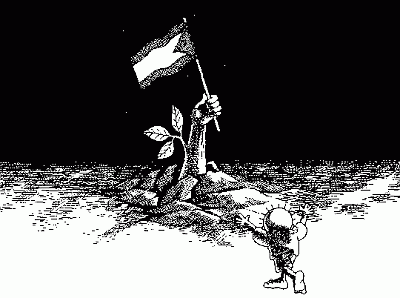
A wave has been sweeping over the Arab world, and US Foreign Policy journal wondered that who would be the next Arab dictator to go down.
I would like to dissect the latest events and their broader implications for the long run:
The Revolutions themselves
Several Westerners considered the revolutions as sparked by a man who set himself on fire in Tunisia. This is a reductionist approach where US intelligence misread (probably on purpose given the available wrath of your average Arab “Joe” or “Omar”) with the hope that stability would prevail over the wishes of the average Arab citizen.
I have to admit, I did anticipate that Tunis would eventually go head to head with its dictator, but like many, I thought that the first spark would be in Egypt. Moubarak’s regime has bled dry his society and the Egyptian revolution informally started since 2000 against the regime. By revolution; I define people going down the streets and demanding a simple request under the threat of the gun: “Freedom of Expression.”
General Petreus warned last year that the Arab-Israeli conflict (well I would like to define it these days as Palestinian/Lebanese conflict with Israel) has serious impact on the US interests. The brutality of the Israeli conflict on different fronts and the fact Israel on daily basis is criticized for its on-going settlements, destroying the prospects of peace, and a regional bully. The fact that the US Administration blindly supports Israel; US troops are under constant threat and furthermore US interests in the region are under threat.
General Petreus’s comments came 9 years late (if not at least four decades late). As the Second Intifada exploded; its spill-over hit Egypt. Protestors hit the streets in solidarity with the Palestinian civilians while Hosni Mubarak’s apparatus simply crushed the demonstrators with an Iron Fist. Since then, solidarity with the Palestinians became the symbol of resisting Hosni Mubarak.
For those who have no clue about Palestine’s symbolism on the Arab world (and by Arab I do not mean Muslim only). Palestine proper (which includes currently Israel) has been regarded as the last of European colonialism by the Arabs; especially the Western support it harvested. The fact dictators of the Arab world (excluding Syria even though Syria and the US always flirted with each other) shook hands with the following agreement: “Pro-West alliances at the expense of the average citizen.” The Arab citizen has been oppressed by dictators who seek to renew their mandate indefinitely and the West who seek “stable Middle East” (a synonym for oil and imposing normalization with Israel on the people without Israel itself coming into terms on how it was founded on genocidal base).
In my opinion, pride as humans, economic repressions, Orientalism, and ongoing colonialism played its role. The Arab-Israeli conflict is included within all of them. The Palestinian question, as Arabs (Christians and Muslims) regard that the Palestinians historically have been most wronged among the Arabs. The fact the UN has been (till recently Libya) has been regarded a muscle show forum among the regional and international powers). They remained crippled against on-going atrocities (especially due to the veto power) and the very fact that the US-UK coalition simply by-passed the UN and invaded Iraq for securing the oils.
In a way, the average citizen lost voice; their dictators are praised as democratic or “friend of the West”. The Arab citizen has been depicted as stupid, Islamist conservative, and a hopeless case for evolving towards Western standards (as if your American average Joe as a clue at least about the geography of the world or Israel itself is really Western). There was no greater irony than Obama giving the greatest speech on Human Rights in Cairo in 2009 amidst mass demonstrations against Hosni Mubarak. Whether Obama was aloof (on purpose or not), but he did not mention the dictator of over 80,000,000 people.
Some people argued that faceook created those revolutions., I doubt that at all. In my opinion, online means of communications and reporting (in Egypt people read blogs to know what is going on and not puppy like official newspapers). If anything, the facebook phenomenon became a catalyst for the forthcoming rage of citizens oppressed for decades.
What are the implications due to the rise of the Arab spring?
For starters, there is no longer media blackout. The world became too small to cover the incidents across the Arab world. Just as the revolution resurrected on new levels in Egypt, the Western media (most of it) tried to marginalize the revolution as another factory rebellion and stressed on the peace process. Despite the fact that Tunis was the first to shoot down its dictator in the most heroic manner, Egypt was on the spotlight due to the peace treaty. Israel informed all its embassies across the world that they should pressure governments globally to support Mubarak. The US administration itself fluctuated its speeches depending whether the revolution appeared at its final breath or not. When it looked like Mubarak was about to reassert his iron grip, Clinton insisted that Mubarak should “lead” the democratic wave. When Mubarak finally fell down, Merkel appeared as ignorant as it can gets: “New Egypt should respect the peace treaty with Israel.” Israeli officials were pushing support to Hosni Mubarak without realizing that this accelerated his downfall.
The selfishness of Israel in imposing Hosni Mubarak on the Egyptian people for its own interest will have (hopefully) repercussions in the near future. Israel disregarded the beautiful images of demonstrators’ heroics because that entity expects a special treatment from the world. Even if we believe that Israel represents the interests of the Jews across the world (which we all know it is false), the number of Egyptians outnumbers the Jews globally).
Due to the dense coverage of al-Jazeera English in Tunis and Egypt forced other media outlets to follow pace with the Arab media. As a matter of fact, even US officials were depending on al-Jazeera to issue statements. With al-Jazeera proving its superiority against Western outlets, more and more non-Arabs will be exposed to the real situation in the Arab world, and actually hear Arab opinions on whatever happens anywhere (the next war on the Palestinian or Lebanese, I bet plenty of Westerns will be shocked to see the brutality of the Israeli army and its fascistic elements).
Just as Hosni Mubarak was promoted as a true friend of the West, it changed in a week as the horrible dictator. The same can be applied on Israel. It takes only a week of objective reporting to change the US mainstream towards Israel. Already the Palestinian papers showed that it was the Palestinians who were the true partners of “peace” (whatever that peace Fatah thought of) and they declined it. Pro Human Rights groups, Palestinian solidarity groups, Jewish and Arab organizations, American NGOs, the stupidity of the current Israeli leadership in not hiding its on-going genocidal policies, and other factors exerts more pressure on AIPAC to maintain its iron grip in the main hubs (DC, New York, Chicago, others).
The final question goes: “ok, what about Syria?”. Syria as I mentioned earlier as always flirted with the US Administration. The US regarded al-Assad regime as the lesser evil in the face of the Muslim Brotherhood in Syria. From such a view, al-Assad is a darling angel. When the tyrant Saddam hid, Bush declared that the Syrian Baathi Party shall follow the Iraqi Baathi, Tony Blair in less than an hour went on TV and gave a detailed speech why al-Assad is different than Saddam. Al-Assad regime has been brutal on its people; the difference is al-Assad gambled on a heavy security apparatus, provide the minimum of welfare (when available) to his people, and relied on the Arab-Israeli conflict to marginalize his opponents. I still find it amusing how he dubs the Syrian opposition as American or Israeli agents even though the ones accused are loud and clear Marxists.
The current situation teaches us that anything can happen in the Arab world. Just as CNN, despite AIPAC’s iron grip on the US media, tried the impossible to blackout the incidents of Egypt, started reporting the incidents as they were happening. CNN only reported objectively (despite blaming the victims themselves) was during the Qana massacres of 1996 and 2006 in Lebanon, where the CNN were present on site. Despite the challenges, Israel’s true face will one day be exposed and the US mainstream media will change its opinion (a growing fear for the past five years in Lebanon).
The current countries that have been affected by the Arab spring as follows: Tunis, Egypt, Libya, Yaman, and Bahrain. To a lesser extent, Morocco, Saudi Arabia, Jordan, Iraq, and Syria. You never know where the Arab spring will explode.
Now when looking at the bigger picture, a different set of lessons are prevalent
1) The Arabs are not waiting for Western blessings to proceed and seek their freedom
2) The Revolutions are completely sparked from the inside.
3) Once the revolution picks up, the Arabs are willing to go seek their freedom or just die trying, as the case of Libya taught us. The Libyans from day 1 warned al-Qazzafi to step down or go ahead and kill the people; if the latter had happened, the Libyans were proud that Qazzafi would just rule empty buildings.
4) (This is my favorite part) The Arabs are teaching the whole world about freedom, human rights, and even democracy; something the average citizen has forgot about in the West or 3rd World due to media alienation and class struggle.
The other dimension to focus on is the decline of the West
Almost all the leaders facing protests and revolutions have been the friends of the West. AL-Saleh of Yamen or lunatic Qazzafi (Tony Blair’s best friend) were regarded as tyrants installed by the West. The West’s interests fluctuates and it is apparent on how they react. A dense media blackout was imposed on Bahrain (easiest way to call the Bahrain incidents as Iran led revolution, reminds us of Lebanon in 2006) as Bahrain is in the direct sphere of influence that is owned by Saudi Arabia. Bahrain in specific is a new battleground where the revolution in Al-Jazeera itself has been blacked out. Bahrain is a monarchy , and the only Arab state where the Arab spring has threatened a monarchy. While most gulf states are monarchies, they have to support militarily the Bahraini monarchy in order to maintain their own rule. Last thing the Monarchs of the Arab gulf want a domino effect spreading in their own turf (although factory strikes did start briefly in Saudi Arabia).
The other dimension to focus on is the stupidity of the US foreign Administration in approaching the Arab world historically. Their blatant arrogance of dictating terms on the dictators in returns of arms (Egypt’s entire aid from the US went to the pockets of Husni Mubarak who turned out to have more money than the Hariri family itself) cost it several allies. Whether Tunis’s Ben Ali, Hosni Mubarak, or excommunicating Qazzafi served as a lesson for the rest of the Arab dictators. They can be replaced. Tunis was swift and ended up in the downfall of its dictator. Egypt was a greater battle arena as Mubarak tried to contain the situation by draining the protestors’ energy, and stepped down just as the evening before the protestors started to become more militants and started to form a siege across governmental locations. Libya is the most brutal of all; because the nature of its dictator= insane with enough militias across the African continent. Anther blow for the US came when its primary ally, Saad el Hariri was ousted from the government (even though that is not related to the Arab Spring, but fits the picture of the different slaps the US administration has been facing).
As for Lebanon, the leftist youth tried to ride the wave and now are pushing for the abolition of the sectarian system. On weekly basis there has been the most beautiful demonstrations against the system. Sadly, we cannot go against our own leaders (for now) because Lebanon does not have one Hosni, one Qazzafi, or one Ben Ali. Each of Lebanon’s sects has three or four Hosni style of dictators and the battle in Lebanon is yet to rage on. In one of my greatest wishes and hopes to see the Left in Lebanon unified as the heroics of the proletariat across the Arab world inspired us.
As for the Palestinians, as hopeless as it is, especially for those in Palestine proper, their leaderships turned out to have one thing in common with the Israeli fascist government: they did their best to block demonstrators express solidarity with the Arab freedom lovers. Hamas, Fatah, and Israel are the biggest bad news for their people, with a bigger highlight on the fact that Israel is the biggest bad news for the global Jewish world as the latter bargains on the racism of the West to renew their legitimacy.
Finally , I would like to add the last lesson acquired from the Arab Spring. Several bourgeoisies in the Arab world and the West stressed that the civil society is the best option to reform the Arab world and make it democratic (for my readers’ information US AID was promoting in Tunis Ben Ali as the man for democracy). Some NGOs may achieve a tiny (irrelevant) progress but without impacting the structure of the state. In the end of the day, a class awareness is needed to demolish those dictators in power, with or without the approval of the West. The entire hopes on the civil society should be understood by now that it is false. Some NGOs are good in reporting and documenting violations or propose some changes (as long as it is not a free market or neocon logic).
The day of the proletariat in the Arab world has come. Decades of boiling wrath can no longer be subdued.
I apologize for not writing as often for different reasons that I will explain thoroughly one day.
No war but class war
MFL
Showing posts with label Iraq. Show all posts
Showing posts with label Iraq. Show all posts
Tuesday, March 22, 2011


Saturday, December 12, 2009
Responding to Tony Blair
In Response to Blair's "Removing Saddam Was Right"
Nobody likes Saddam, Mr. Blair.
Nevertheless, the problem is pulling such a crazy operation and by-passing the entire UN forums,
Attempting to re-invent the causes of war after the WMDs were not located, specially the invasion couldn't wait any longer due to Saddam's 'nuclear threat'.
There was no Qa'eda in Iraq till the US-UK invasion took place, thank you "democracy" for bringing terrorism to that region.
Thank you for demolishing a state entity called Iraq. If this war is war of democracy, then how come in the first two years of the Iraqi invasion, more Iraqis died than lunatic Saddam's entire rule era?
Wasn't the United States that funded Saddam in the Iranian-Iraqi war and made him a super dictator over his people? We know democracy, and fight for it, it is the United States that funds most of the dictators in the Arab World (Egypt's Moubarak, Morocco's Sultan dynasty, The Saudi Dynasty, ... etc).
Of all the Iraqi officials, whose legitimacy is severely under check, they couldn't find but this minister? BBC can do better.
Accelerating the operation without a Plan B to Iraq which led to the swift breakdown of the regime and the presence of terrorist groups and ethnic wars?
Does Blair know that every Iraqi that died and still dies blame him and Bush Jr. due to the swift breakdown of the state?
Finally, I love it how several people underscore the Iraqi lives by simply calling the war on Iraq as 'policy changing' and conflict management. People's lives from that corner can be so cheap for such men from this corner of the world.
MFL
Nobody likes Saddam, Mr. Blair.
Nevertheless, the problem is pulling such a crazy operation and by-passing the entire UN forums,
Attempting to re-invent the causes of war after the WMDs were not located, specially the invasion couldn't wait any longer due to Saddam's 'nuclear threat'.
There was no Qa'eda in Iraq till the US-UK invasion took place, thank you "democracy" for bringing terrorism to that region.
Thank you for demolishing a state entity called Iraq. If this war is war of democracy, then how come in the first two years of the Iraqi invasion, more Iraqis died than lunatic Saddam's entire rule era?
Wasn't the United States that funded Saddam in the Iranian-Iraqi war and made him a super dictator over his people? We know democracy, and fight for it, it is the United States that funds most of the dictators in the Arab World (Egypt's Moubarak, Morocco's Sultan dynasty, The Saudi Dynasty, ... etc).
Of all the Iraqi officials, whose legitimacy is severely under check, they couldn't find but this minister? BBC can do better.
Accelerating the operation without a Plan B to Iraq which led to the swift breakdown of the regime and the presence of terrorist groups and ethnic wars?
Does Blair know that every Iraqi that died and still dies blame him and Bush Jr. due to the swift breakdown of the state?
Finally, I love it how several people underscore the Iraqi lives by simply calling the war on Iraq as 'policy changing' and conflict management. People's lives from that corner can be so cheap for such men from this corner of the world.
MFL
Saturday, April 19, 2008
History of Foreign Intervention in the Lebanese Civil War (Part I & Introduction)
Please Check: Causes of the Lebanese Civil War, Lebanon and Democracy: Doomed to Repeat the Past, Investigating Lebanon: Investigating the Ethnic Dilemma
On the memory of the ignition of the Lebanese Civil War, I decided to write these several series of posts... and hopefully will have the time to finish them.
For a tiny country whose area is 10420 KM2 and a population of 4,000,000, Lebanon sure took the attention of the world, or almost the world. I will not argue what Ghassan Tuieni once described our Civil War as the War of others, rather , I will record each foreign intervention as they occurred. This will give a highlight on Syria, PLO, Israel, USA, among the countries involved.
To be honest if you want to count the number of foreign powers involved in our civil war, they can be counted as follows: Unites States of America, Palestinian Liberation Organization – Egypt – Syria – Jordan – Israel – Saudi Arabia – Libya – Soviet Union – Iran – Iraq – France – Italy – Eastern Europe – Tunis – Cyprus – China – Kuwait – Others. For a tiny country as Lebanon, it sure took a focal point of foreign powers to be interested in this country. Each power had its own foreign cliental, and supplier of funds/arms.
The Case of Lebanon
As I explained in an earlier post "Causes of the Civil War", Lebanon had several situations for having a war. Some were innate due to failed 1943 Pact, and others involved regional interest in the war. The Saddest part of the story, that all the war criminals (ie all the party figureheads) are not locked up in prisons, and their audiences still believe they are fighting for their Lebanon. For me, I think Aoun, Berri, Jaajaa should be locked up in prison and throw the key in a bucket of acid. Actually, I can't exclude anyone. They all deserve to be locked up in prison, they all are well-funded while the victims voices remain screaming from the graves unpunished. This concludes that the ones who inflicted maximum butcheries on the Lebanese were the Israelis, then invited by different Christian powers to come and rid them from the PLO. Now of course, the Israelis killed more Lebanese rather than harming PLO warriors. The Lebanese Front cadres failed to mention that there are also the Lebanese National Movement, which was strictly Lebanese raising arms in front of their "Christian-like" Lebanon.
The war to be clear, didn’t start as several Western (and even local) scholars like to describe between the Muslims and the Christians. As a matter of fact, several Shiite and Sunni leadership supported the Christians, while others supported the Left. Hence on a local level, it will be rather naïve and childish to say that the war broke out between these two religious sects. Other downsized it as the war between the PLO and the Christians, which again suits a lot of Western audience to believe so, but again, that is a bogus 'humbug' truth. The war broke out between the Lebanese among themselves. The Palestinian military became severely involved in post 1975 towards the end of it, when Tel Za'atar Camp was severely surrounded. The combatant coalitions were:
The Lebanese Front (Christian Extreme Parties):
The Phalange Party (Spearheaded by Pierre Gemayel Sr.) – The Partisan Liberation Party (Spear headed by Camille Shamoun) – The Marada (Spearheaded by Suleiman Franjieh Sr.), Guardians of the Cedars (Spearheaded by Etienne Sakr) – The Organization aka Tanzeem (Spearheaded by George Adwan).
The Lebanese National Movement included:
The Progressive Socialist Party (Spearheaded by Kamal Junblatt) - The Lebanese Communist Party (Spearheaded by George Hawi) – The Order for Communist Action (Spearheaded by Mohsen Ibrahim) – Syrian Social Nationalist Party (Spearheaded by Inaam Raad) .
Now both parties had mini-militias supporting them, such as AMAL Movement (which in fact fluctuated between both coalitions). They were part of the Lebanese National Movement, then switched sides when the Christians begged the Syrians to enter Lebanon.
Nature of the Civil War
Now the question to ask: "Was the Lebanese Civil war the same when the War broke out and it ended?" The answer is definitely not. The Progressive Socialist Party for example underwent drastic changes with the assassination of Kamal Junblatt and becoming more Durzi in nature in post 1982 era. There are of course new parties/players that changed the form of the war. The Morabitoun for example became a powerful militia then was destroyed by four parties allying briefly with each other into a single coalition. The fact it took four powerful militias in the 1980s to annihilate them shows their strength: The Lebanese Communist Party – The Progressive Socialist Party – AMAL Movement - Order for Communist Action. New parties/players would include the rise of Nabih Berri on a new more militant AMAL movement, Michel Aoun with the Lebanese Army, Samir Jaajaa for the Lebanese Forces, and Hezbollah as a whole. The war between the Left and the Christians ended up with the Christians battling each other, the Shiites battling each other, and the Left Wing battling the Shiites and Christians alike. Israel and the United States seized to be powerful players in Lebanon after 1985, and loyalties changed. Iraq and Iran became integral players in the war, while Egypt's role got marginalized.
Finally, only the stupid members of the Lebanese Forces would argue that is due to the Palestinians that the war broke out; the Palestinians lost politicially and most of their major powers in 1982 and ended up battling a Muslim Party = AMAL Movement. In fact, AMAL Movement opened fronts on all levels against almost everyone on a separate front. They battled Hezbollah on one wide, they battled the Lebanese Communist Party and the Progressive Party on another, and they battled the PLO on a third front. As for the Sunnis, there were two separate parties that were tagged Sunnis. The first is called "The Mourabitoun" while the other was the Islamist Movement of Unification (in Tripoli). Other than that, they were severely marginalized during the war. The Shiites almost lacked any organization prior to the war, eventually they immerged with two powerful Parties: Hezbollah and AMAL. Someone may ask why I write AMAL Movement in capital letters because AMAL is an abbreviation in Arabic to Affwaj Mouaqawa el Lebanieh (which means Legions of the Lebanese Resistance, which is ironic because they killed more Lebanese and Palestinians than they killed Israelis).
Methodology
To fully comprehed the civil war, the Marxist dialect has to be followed. This includes objectivity. The Sciences of Marxism are based on re-constructing history as it happened. This means as far as trashing the Soviet Union and anything else because they already happened. In the case of Lebanon, we have to document each event as it happened. Understand how we jumped from one phase to another, and of course liberate ourselves from the War mythes we inherited from our parents/friends/relatives. The core of Marxism states that the present cannot be understood unless we understand the past and how we arrived. This means I will mention the Communist parties same as I mention the other. This also means it is not enough to say there was only a Sabra - Chatila Massacre, there were massacres at Saida, Damour, Chicca, Port Beirut, Ba'abda, West Beirut, and several others equally. In the end, to carry arms in the name of the Proletariat is one thing, but shooting innocent citizens and take away 15 years of their lives means that all parties are all accountable in the civil war.
This means that the Phalange or AMAL Movement should come out clean and say: "Yes, we butchered people based on Sect". This means that the supporters of Bashir Gemayel or Camille Shamoun should admit they invited the Israelis to enter, the US archives prove so. This leads me to analyze the sources of information. We are lucky that a lot of key players displayed their information to the public, the most recent would be Joseph Abu Khalil's memoirs. Others would include the CIA archives (we have full knowledge of what happened in 1975-1976 on the party-leadership levels). Other sources would be the Israelis (yes, you read me right, their archives also are important despite the fact several Zionist scholars try to distort history to satisfy their extremist readers). Other information would be the media, documentaries, and first person witnesses. A lot of information might involve deducation, but if deducation can be avoided and reach the truth as it happened from a fixed reference, then by all means that what should happen. Finally the current politicians shouldnt impose a bad case of amnesia on the Lebanese because they shouldnt be selfish to defend their politicial interests and expose for real what they have done to a tiny country called Lebanon.
Conclusion
Now mentioning so many political parties means one thing: so many foreign cliental involved in the Lebanese Civil War, and it would be interesting to investigate (as much as possible) their role in the Lebanese Civil War.
On the memory of the ignition of the Lebanese Civil War, I decided to write these several series of posts... and hopefully will have the time to finish them.
For a tiny country whose area is 10420 KM2 and a population of 4,000,000, Lebanon sure took the attention of the world, or almost the world. I will not argue what Ghassan Tuieni once described our Civil War as the War of others, rather , I will record each foreign intervention as they occurred. This will give a highlight on Syria, PLO, Israel, USA, among the countries involved.
To be honest if you want to count the number of foreign powers involved in our civil war, they can be counted as follows: Unites States of America, Palestinian Liberation Organization – Egypt – Syria – Jordan – Israel – Saudi Arabia – Libya – Soviet Union – Iran – Iraq – France – Italy – Eastern Europe – Tunis – Cyprus – China – Kuwait – Others. For a tiny country as Lebanon, it sure took a focal point of foreign powers to be interested in this country. Each power had its own foreign cliental, and supplier of funds/arms.
The Case of Lebanon
As I explained in an earlier post "Causes of the Civil War", Lebanon had several situations for having a war. Some were innate due to failed 1943 Pact, and others involved regional interest in the war. The Saddest part of the story, that all the war criminals (ie all the party figureheads) are not locked up in prisons, and their audiences still believe they are fighting for their Lebanon. For me, I think Aoun, Berri, Jaajaa should be locked up in prison and throw the key in a bucket of acid. Actually, I can't exclude anyone. They all deserve to be locked up in prison, they all are well-funded while the victims voices remain screaming from the graves unpunished. This concludes that the ones who inflicted maximum butcheries on the Lebanese were the Israelis, then invited by different Christian powers to come and rid them from the PLO. Now of course, the Israelis killed more Lebanese rather than harming PLO warriors. The Lebanese Front cadres failed to mention that there are also the Lebanese National Movement, which was strictly Lebanese raising arms in front of their "Christian-like" Lebanon.
The war to be clear, didn’t start as several Western (and even local) scholars like to describe between the Muslims and the Christians. As a matter of fact, several Shiite and Sunni leadership supported the Christians, while others supported the Left. Hence on a local level, it will be rather naïve and childish to say that the war broke out between these two religious sects. Other downsized it as the war between the PLO and the Christians, which again suits a lot of Western audience to believe so, but again, that is a bogus 'humbug' truth. The war broke out between the Lebanese among themselves. The Palestinian military became severely involved in post 1975 towards the end of it, when Tel Za'atar Camp was severely surrounded. The combatant coalitions were:
The Lebanese Front (Christian Extreme Parties):
The Phalange Party (Spearheaded by Pierre Gemayel Sr.) – The Partisan Liberation Party (Spear headed by Camille Shamoun) – The Marada (Spearheaded by Suleiman Franjieh Sr.), Guardians of the Cedars (Spearheaded by Etienne Sakr) – The Organization aka Tanzeem (Spearheaded by George Adwan).
The Lebanese National Movement included:
The Progressive Socialist Party (Spearheaded by Kamal Junblatt) - The Lebanese Communist Party (Spearheaded by George Hawi) – The Order for Communist Action (Spearheaded by Mohsen Ibrahim) – Syrian Social Nationalist Party (Spearheaded by Inaam Raad) .
Now both parties had mini-militias supporting them, such as AMAL Movement (which in fact fluctuated between both coalitions). They were part of the Lebanese National Movement, then switched sides when the Christians begged the Syrians to enter Lebanon.
Nature of the Civil War
Now the question to ask: "Was the Lebanese Civil war the same when the War broke out and it ended?" The answer is definitely not. The Progressive Socialist Party for example underwent drastic changes with the assassination of Kamal Junblatt and becoming more Durzi in nature in post 1982 era. There are of course new parties/players that changed the form of the war. The Morabitoun for example became a powerful militia then was destroyed by four parties allying briefly with each other into a single coalition. The fact it took four powerful militias in the 1980s to annihilate them shows their strength: The Lebanese Communist Party – The Progressive Socialist Party – AMAL Movement - Order for Communist Action. New parties/players would include the rise of Nabih Berri on a new more militant AMAL movement, Michel Aoun with the Lebanese Army, Samir Jaajaa for the Lebanese Forces, and Hezbollah as a whole. The war between the Left and the Christians ended up with the Christians battling each other, the Shiites battling each other, and the Left Wing battling the Shiites and Christians alike. Israel and the United States seized to be powerful players in Lebanon after 1985, and loyalties changed. Iraq and Iran became integral players in the war, while Egypt's role got marginalized.
Finally, only the stupid members of the Lebanese Forces would argue that is due to the Palestinians that the war broke out; the Palestinians lost politicially and most of their major powers in 1982 and ended up battling a Muslim Party = AMAL Movement. In fact, AMAL Movement opened fronts on all levels against almost everyone on a separate front. They battled Hezbollah on one wide, they battled the Lebanese Communist Party and the Progressive Party on another, and they battled the PLO on a third front. As for the Sunnis, there were two separate parties that were tagged Sunnis. The first is called "The Mourabitoun" while the other was the Islamist Movement of Unification (in Tripoli). Other than that, they were severely marginalized during the war. The Shiites almost lacked any organization prior to the war, eventually they immerged with two powerful Parties: Hezbollah and AMAL. Someone may ask why I write AMAL Movement in capital letters because AMAL is an abbreviation in Arabic to Affwaj Mouaqawa el Lebanieh (which means Legions of the Lebanese Resistance, which is ironic because they killed more Lebanese and Palestinians than they killed Israelis).
Methodology
To fully comprehed the civil war, the Marxist dialect has to be followed. This includes objectivity. The Sciences of Marxism are based on re-constructing history as it happened. This means as far as trashing the Soviet Union and anything else because they already happened. In the case of Lebanon, we have to document each event as it happened. Understand how we jumped from one phase to another, and of course liberate ourselves from the War mythes we inherited from our parents/friends/relatives. The core of Marxism states that the present cannot be understood unless we understand the past and how we arrived. This means I will mention the Communist parties same as I mention the other. This also means it is not enough to say there was only a Sabra - Chatila Massacre, there were massacres at Saida, Damour, Chicca, Port Beirut, Ba'abda, West Beirut, and several others equally. In the end, to carry arms in the name of the Proletariat is one thing, but shooting innocent citizens and take away 15 years of their lives means that all parties are all accountable in the civil war.
This means that the Phalange or AMAL Movement should come out clean and say: "Yes, we butchered people based on Sect". This means that the supporters of Bashir Gemayel or Camille Shamoun should admit they invited the Israelis to enter, the US archives prove so. This leads me to analyze the sources of information. We are lucky that a lot of key players displayed their information to the public, the most recent would be Joseph Abu Khalil's memoirs. Others would include the CIA archives (we have full knowledge of what happened in 1975-1976 on the party-leadership levels). Other sources would be the Israelis (yes, you read me right, their archives also are important despite the fact several Zionist scholars try to distort history to satisfy their extremist readers). Other information would be the media, documentaries, and first person witnesses. A lot of information might involve deducation, but if deducation can be avoided and reach the truth as it happened from a fixed reference, then by all means that what should happen. Finally the current politicians shouldnt impose a bad case of amnesia on the Lebanese because they shouldnt be selfish to defend their politicial interests and expose for real what they have done to a tiny country called Lebanon.
Conclusion
Now mentioning so many political parties means one thing: so many foreign cliental involved in the Lebanese Civil War, and it would be interesting to investigate (as much as possible) their role in the Lebanese Civil War.
Thursday, January 17, 2008



Tuesday, December 25, 2007
Fawwaz Traboulsi: For an Arab-Kurdish Federation in Iraq
taken from here
[Translator's Introduction: The article below by Fawwaz Traboulsi first appeared in Arabic in the Beirut weekly Mulhaq al-Nahar al-Thaqafi (the Literary Supplement of the daily al-Nahar) of November 6, 2005. The article has not previously been translated into English, and it is offered here for its continuing relevance to Iraqi political developments.
The article was originally written as, part of a series of pieces by different commentators on "the consequences of Iraqi federalism on the Arab world," just a few weeks after the October 15 referendum approving a new Iraqi constitution -- or, more precisely, an incomplete version of it.
The struggle for Iraq's constitution is still very much ongoing, as I explain in a separate article , and Traboulsi's article is no less germane today than it was at the time of the October 2005 referendum. If anything, positions of the different Iraqi parties have become more polarized and entrenched over the last two years. Two of the most contentious issues yet to be decided in the constitutional document are the nature of Iraq's federalism and the disposition of the country's natural resources. Traboulsi addresses both issues.
One of Traboulsi's warning calls to Iraqis is about the sectarian character of the draft constitution. Traboulsi's criticism draws additional force as he writes from the vantage point of a historian of the modern Middle East, who has also been a direct witness to the ravages repeatedly brought about by a sectarian-based system of government (so-called confessionalism) for nearly a century in nearby Lebanon.
-- Assaf Kfoury]
Before we discuss the potential effects of establishing an Iraqi federation on the rest of the Arab world, we ought to give an examination of federalism in Iraq, in and of itself, its due. We ought to do this even though a detailed assessment of the proposed draft for an Iraqi constitution cannot be guaranteed as final yet, especially since the draft remains a working document that has been repeatedly adjusted and modified. If we are to examine the idea of federalism in Iraq and potential problems in putting it into practice, a good place to start from is the draft itself where a specific form of an Iraqi federation is proposed to the Iraqi people.
Any discussion of federalism in Iraq must take note of two important characteristics of the current situation. The first characteristic is that the American occupation accomplished more than just regime change. Not only did the occupation put an end to the Baath regime led by Saddam Hussein, it completely demolished the Iraqi state, eliminating the former state infrastructure and somehow aiming to rebuild it entirely from scratch: the legislative and judicial institutions, the army, the ministries, the civil service and all public administrations. And not only did it demolish the former state and its institutions which it directly targeted, it inevitably had a profound dislocating effect on the whole of Iraqi society. What concerns us here most are the changes and reversals which Iraq's three main communities have experienced in their mutual relations as a result. At the moment, Iraqis are facing a crucial turning point in their collective history: On the one hand, a majority of Iraqis reject a return to a centralized authoritarian government, whose remnants are no longer in a position to unite Iraqi society in any case, coercively or not. On the other hand, we are now witnessing an intense movement among the constituent parts of Iraqi society, whose outcome is yet to be determined -- in the form of new elements of domination or control or balance or leadership. The most salient features of this ongoing movement are:
· The two communities that suffered most from discrimination and deprivation under the Baath regime, namely the Shiites and the Kurds, are now exercising a new assertiveness, but in different ways that are often at cross-purposes. As most often reflected in pronouncements by Shiite leaders, the Shiite community is striving to impose the principle of majority rule on a political system still-in-the-making. By contrast, as indicated by its leaders' stated positions, the Kurdish community is trying to maximize the benefits of its self-autonomy and simultaneously preserve its position in the central government, against the background of a Kurdish public opinion strongly favoring secession -- an issue I shall return to shortly.
· The Sunni community is struggling to find a new place in the emerging order. It is doing so after long years during which Saddam Hussein monopolized power in its name and at the expense of its own majority. This search for a new place manifests itself in different ways. Some Sunni groups that espouse various nationalist ideologies are engaged in an armed insurgency with the declared aim of re-establishing a centralized Iraqi state, of one form or another, in which they will regain their privileges. Other Sunni groups, which have shunned the violence of the armed insurgency but also used it as a bargaining chip, are vying for a better position within the emerging political system. And lest we forget -- and how can we forget!! -- this armed insurgency has intermittently tolerated or abetted the kind of violence embraced by al-Qaeda in Mesopotamia that indiscriminately targets civilians and openly proclaims that Shiites are apostates deserving death.
· Last but not least, the various social movements and forces, including the labor movement and the women's movement, are all struggling to find a position and a role to play in the political system still-in-the-making. They are doing so in the face of a political system that is increasingly giving precedence to communal rights over individual rights, and increasingly sacrificing socio-economic interests to appease religious-regional demands.
In making the preceding points, we cannot stress enough the importance of the current juncture in Iraq's history -- this is a time when Iraq's state institutions are being rebuilt, its entire society remodeled, and the very basis of its existence as a single entity reconsidered.
So, how is it that we hope for Iraq to change from a centralized state to a federation? There is no point in saying that states in their historical development tend to go from loose federations or confederations to centralized states. In the case of Iraq, it may well be that the reverse will take place, and that this reverse may turn out to be the best way to re-unite its society by rebuilding its state and public institutions differently. Re-uniting Iraqi society is not the same thing as re-establishing a unitary centralized state; rather, if Iraqi society is to re-unite voluntarily, it will likely be the product of a form of government that devolves authority, permits all components of society to exercise their rights for self-rule, and distributes equitably national resources and public services.
The second important characteristic of the current situation in Iraq, insofar as the issue of federalism is concerned, is the growing current among Kurds for an outright secession, something I already alluded to before. An overwhelming majority of the Kurds once more expressed this sentiment in a poll conducted on the margin of the most recent parliamentary elections. Did the secessionist sentiment among Kurds predate the American invasion? And were the Kurds able to express this sentiment openly only after this invasion? Or was this secessionist sentiment the product of specific events and history? A number of factors have in fact contributed to this Kurdish shift, over many years, from a demand for self-rule in Kurdistan within a democratic Iraq to a call for outright secession.
Most of the available evidence indicates that the Kurdish population's shift towards secession started during the latter period of the Baath regime, and most significantly, since the so-called Anfal campaign of 1988-89. During that campaign, the Kurdish regions were subjected to wholesale massacres, ethnic cleansing, destruction of hundreds of villages, forced Arabization, and forced migration of thousands if not hundreds of thousands of their inhabitants. In other words, the movement favoring Kurdish secession grew in reaction to the extreme national-chauvinist and tyrannical policies pursued by the central government in dealing with the Kurdish question.
It is worth adding that the Kurdish movement towards secession was further nurtured during the years of self-rule in the 1990's and later, when the Kurdish regions in northern Iraq were outside Baghdad's control and largely isolated from the southern Arab-majority regions that remained under Baath rule.
Of course, the existence of a dominant separatist current among Kurds today does not mean, a priori, that it may not recede as a result of future circumstances, nor does it mean that Kurdish secession is bound to happen regardless of circumstances. Several internal and external factors militate against an outright secession. In particular, most of the Kurdish leaders and parties continue to search for a solution within the boundaries of a single Iraqi entity, while outright secession under current conditions would undermine the Kurdish regions' economic interests and external relations.
As I am talking about secession, I should point out that I fully support the Kurdish people's right to national self-determination, including its right to secede completely and form a separate state. But my support of this right is not neutral, and I find no contradiction in being partial to another alternative: As an Arab citizen, I am also in favor of Iraq's Kurds ultimately choosing to remain within the Arab world, as an affirmation that this Arab world can be open to ethnic, regional and religious communities -- in all their diversities and multiplicities -- in a context of coexistence and cooperation that are enriching to all.
Based on the preceding, I understand the proposal for a federal Iraq to be for a system of government that will grant the Kurdish minority all its legitimate rights: to exercise self-rule, use its own language, preserve and develop its cultural heritage, and receive its fair share of the national wealth and budget -- in the context of a united Iraq, as an alternative to the option of an outright secession.
That said, this vision of an Arab-Kurdish federation in Iraq is problematic and fraught with difficulties. While it provides an answer to part of the problem, it raises other problems. Any federal system, whether in Iraq or anywhere else, is erected on the presumed existence of two or more autonomous or semi-autonomous regions. In Iraq's present situation, there exists only one autonomous region in the Kurdish north, consisting of three provinces, where self-rule is already exercised through the creation of a regional government, a regional parliament, a regional administration and regional armed forces. In the face of this one autonomous region are: (1) a central government reflecting a twisted power-sharing formula* between a (Kurdish) ethnic community and (Arab) religious communities, and (2) a collection of 15 provinces in the rest of the country with an overwhelming Arab majority.
The question is: This proposed Iraqi federation is to be realized between whom and whom? An answer of sorts is in the draft constitution, which stipulates that any province (or group of provinces) can move to become a separate federal region, i.e. one of the units of the projected federation, provided the move to separate is approved by a majority of that region's eligible voters in a plebiscite. In the envisioned federal system according to the draft constitution, power and representation will be divided between four different levels: (1) the capital Baghdad and surrounding metropolitan area, with its own special executive and administrative organization; (2) the regions, each consisting of one or more provinces that elect to form a self-ruling federal unit; (3) the provinces, jointly administered by the federal and provincial authorities; and (4) what the draft calls "the local administrations," responsible for the affairs of religious minorities (Christians, Yazedis, Mandi Sabeans) and small ethnic minorities (Turkmen, Armenians). It does not take much imagination to foresee a situation of confusion and conflict when this projected system will be put to the test of practice, notably because the population of Baghdad and the surrounding area, representing more than one-fifth of Iraq's total, is a mix of all ethnic and religious communities.
The only plausible explanation for the adoption of this problematic system is that the commission responsible for the draft constitution refused to consider a single defining criterion for a federation, namely, an ethnic division between Arabs and Kurds. This is unfortunate, because the only meaningful and effective federation, one capable of embracing all the religious and sectarian diversities of Iraqi society, is an Arab-Kurdish federation consisting of two autonomous regions: one including all the provinces with a Kurdish majority, and one including all the provinces with an Arab majority. In this way, power and representation would be divided between two rather than four levels -- with the first of these two levels already mentioned in the draft constitution: (1) a national assembly of all the delegates elected by the entire Iraqi population, with one delegate for every 100,000 voters, and this assembly in turn elects a head of state and a council of ministers; (2) the regional institutions in each of the two autonomous regions. (To my knowledge, during the discussions on the draft constitution, there was a similar proposal that was not followed up, of a federation between two regions, one called Kurdistan and one called Mesopotamia.)
Such a federal solution leads us directly to the question of Iraq's identity. Is it an Arab country? Is it part of the Arab world?
There is no question that the American view of Iraq has been to divide Iraqi society into one ethnic community (the Kurds) and two Islamic sects (Sunnis and Shiites). The effect has been to diminish the role of Iraq's Arab population as its single ethnic majority. This has been the view underlying US policy since the 1990-91 Gulf War: the determination of the no-fly zones after 1991, the parceling out and distribution of food supplies during the UN food-for-oil program, the representation of the Iraqi regime as a Sunni regime, etc. This has been the view from our opponent's side -- the side of the imperial power and the interests it serves.
But from our side -- the side of those who support Iraq's liberation -- the crucial question is: What do we want? Do we adopt our opponent's view or do we confront it with an alternative view? An alternative view that expresses the Iraqi people's free will?
My sense is that much of the debate about Iraq's Arab identity is taking place in a context of symbols and images that ignore the facts. Some have criticized one of the clauses in the draft constitution that states that Iraq's "Arab citizens are a part of the Arab nation;" without any mention that Iraq is an Arab country or part of the Arab world, they read the draft as stripping Iraq the country of its Arab identity. There is some validity in this criticism, but there is a far more important omission in the draft constitution: It does not deal with Iraq's Arab inhabitants as one ethnicity and only identifies them according to their sectarian identities. Indeed, what is the gain in trying to amend the draft constitution to include some sort of clause proclaiming that Iraq is part of the Arab world -- just to please the Secretary General of the Arab League -- if the draft does not also recognize Iraq's Arabs as a single ethnic community and strips them of any constitutional role as such in the Iraqi political system?
One final remark is in order regarding the distribution of revenues from the oil and gas sector. This is a particularly sensitive issue in an Iraqi federal system, which must be considered against the current and past record inasmuch as it has all too often been an element of discord and division. First, we should give the draft constitution its due for explicitly stating that oil and gas resources are a common property of the entire Iraqi people, and that their revenues will be distributed proportionally to population size in every region. The draft constitution also allocates a special share to parts of the country that were deprived of the revenues under the former Baath regime. So far, this is in relation to ownership and distribution of revenues only. As for the administration of oil and gas production, the draft calls for it to be joint between federal and regional authorities, but limited to currently exploited fields. The draft leaves unspecified the administration of fields that are discovered in the future, allowing the possibility that these will be placed under sole control of the regional authorities. This is an unfortunate ambiguity, a portent of potentially divisive conflicts, especially since Iraq's oil reserves are estimated to far exceed its current production level.
An example of these potentially divisive problems is the current struggle over the city of Kirkuk in northern Iraq. The Kurdish claim to Kirkuk, the conflict regarding its ethnic makeup, and the debate on whether or not it should be part of the Kurdish autonomous region, become all the more critical precisely because of the city's importance in the oil industry. Unilateral insistence by any side on controlling Kirkuk undermines Iraqi federalism and, moreover, will embolden those who want to establish a separate region in southern Iraq to demand similar ownership rights on the southern oil fields. Regardless of the final status and geographical location of Kirkuk, inside or outside the autonomous Kurdish region, it is important that its oil wealth remains under federal control and administration, representing its joint ownership by the entire Iraqi people.
Note
* Translator's note: The power-sharing formula is "skewed" in that it is not a partnership between only ethnic communities, or between only religious communities, but between one ethnic community and two religious communities, with the latter two limited to Arabs. Kurds are religiously diverse, just like the Arabs. There are significant numbers of both Sunnis and Shiites (and other religious denominations) not only among Arabs, but also among Kurds and other smaller ethnic communities of Iraq (notably, Turkmen).
Fawwaz Traboulsi has taught at the Lebanese American University, Beirut-Lebanon. He has written on history, Arab politics, social movements and popular culture and translated works by Karl Marx, John Reed, Antonio Gramsci, Isaac Deutscher, John Berger, Etel Adnan, Sa`di Yusuf and Edward Said. His most recent book in English is A History of Modern Lebanon (Pluto Press, 2007). The translator, Assaf Kfoury, is Professor of Computer Science at Boston University.
[Translator's Introduction: The article below by Fawwaz Traboulsi first appeared in Arabic in the Beirut weekly Mulhaq al-Nahar al-Thaqafi (the Literary Supplement of the daily al-Nahar) of November 6, 2005. The article has not previously been translated into English, and it is offered here for its continuing relevance to Iraqi political developments.
The article was originally written as, part of a series of pieces by different commentators on "the consequences of Iraqi federalism on the Arab world," just a few weeks after the October 15 referendum approving a new Iraqi constitution -- or, more precisely, an incomplete version of it.
The struggle for Iraq's constitution is still very much ongoing, as I explain in a separate article , and Traboulsi's article is no less germane today than it was at the time of the October 2005 referendum. If anything, positions of the different Iraqi parties have become more polarized and entrenched over the last two years. Two of the most contentious issues yet to be decided in the constitutional document are the nature of Iraq's federalism and the disposition of the country's natural resources. Traboulsi addresses both issues.
One of Traboulsi's warning calls to Iraqis is about the sectarian character of the draft constitution. Traboulsi's criticism draws additional force as he writes from the vantage point of a historian of the modern Middle East, who has also been a direct witness to the ravages repeatedly brought about by a sectarian-based system of government (so-called confessionalism) for nearly a century in nearby Lebanon.
-- Assaf Kfoury]
Before we discuss the potential effects of establishing an Iraqi federation on the rest of the Arab world, we ought to give an examination of federalism in Iraq, in and of itself, its due. We ought to do this even though a detailed assessment of the proposed draft for an Iraqi constitution cannot be guaranteed as final yet, especially since the draft remains a working document that has been repeatedly adjusted and modified. If we are to examine the idea of federalism in Iraq and potential problems in putting it into practice, a good place to start from is the draft itself where a specific form of an Iraqi federation is proposed to the Iraqi people.
Any discussion of federalism in Iraq must take note of two important characteristics of the current situation. The first characteristic is that the American occupation accomplished more than just regime change. Not only did the occupation put an end to the Baath regime led by Saddam Hussein, it completely demolished the Iraqi state, eliminating the former state infrastructure and somehow aiming to rebuild it entirely from scratch: the legislative and judicial institutions, the army, the ministries, the civil service and all public administrations. And not only did it demolish the former state and its institutions which it directly targeted, it inevitably had a profound dislocating effect on the whole of Iraqi society. What concerns us here most are the changes and reversals which Iraq's three main communities have experienced in their mutual relations as a result. At the moment, Iraqis are facing a crucial turning point in their collective history: On the one hand, a majority of Iraqis reject a return to a centralized authoritarian government, whose remnants are no longer in a position to unite Iraqi society in any case, coercively or not. On the other hand, we are now witnessing an intense movement among the constituent parts of Iraqi society, whose outcome is yet to be determined -- in the form of new elements of domination or control or balance or leadership. The most salient features of this ongoing movement are:
· The two communities that suffered most from discrimination and deprivation under the Baath regime, namely the Shiites and the Kurds, are now exercising a new assertiveness, but in different ways that are often at cross-purposes. As most often reflected in pronouncements by Shiite leaders, the Shiite community is striving to impose the principle of majority rule on a political system still-in-the-making. By contrast, as indicated by its leaders' stated positions, the Kurdish community is trying to maximize the benefits of its self-autonomy and simultaneously preserve its position in the central government, against the background of a Kurdish public opinion strongly favoring secession -- an issue I shall return to shortly.
· The Sunni community is struggling to find a new place in the emerging order. It is doing so after long years during which Saddam Hussein monopolized power in its name and at the expense of its own majority. This search for a new place manifests itself in different ways. Some Sunni groups that espouse various nationalist ideologies are engaged in an armed insurgency with the declared aim of re-establishing a centralized Iraqi state, of one form or another, in which they will regain their privileges. Other Sunni groups, which have shunned the violence of the armed insurgency but also used it as a bargaining chip, are vying for a better position within the emerging political system. And lest we forget -- and how can we forget!! -- this armed insurgency has intermittently tolerated or abetted the kind of violence embraced by al-Qaeda in Mesopotamia that indiscriminately targets civilians and openly proclaims that Shiites are apostates deserving death.
· Last but not least, the various social movements and forces, including the labor movement and the women's movement, are all struggling to find a position and a role to play in the political system still-in-the-making. They are doing so in the face of a political system that is increasingly giving precedence to communal rights over individual rights, and increasingly sacrificing socio-economic interests to appease religious-regional demands.
In making the preceding points, we cannot stress enough the importance of the current juncture in Iraq's history -- this is a time when Iraq's state institutions are being rebuilt, its entire society remodeled, and the very basis of its existence as a single entity reconsidered.
So, how is it that we hope for Iraq to change from a centralized state to a federation? There is no point in saying that states in their historical development tend to go from loose federations or confederations to centralized states. In the case of Iraq, it may well be that the reverse will take place, and that this reverse may turn out to be the best way to re-unite its society by rebuilding its state and public institutions differently. Re-uniting Iraqi society is not the same thing as re-establishing a unitary centralized state; rather, if Iraqi society is to re-unite voluntarily, it will likely be the product of a form of government that devolves authority, permits all components of society to exercise their rights for self-rule, and distributes equitably national resources and public services.
The second important characteristic of the current situation in Iraq, insofar as the issue of federalism is concerned, is the growing current among Kurds for an outright secession, something I already alluded to before. An overwhelming majority of the Kurds once more expressed this sentiment in a poll conducted on the margin of the most recent parliamentary elections. Did the secessionist sentiment among Kurds predate the American invasion? And were the Kurds able to express this sentiment openly only after this invasion? Or was this secessionist sentiment the product of specific events and history? A number of factors have in fact contributed to this Kurdish shift, over many years, from a demand for self-rule in Kurdistan within a democratic Iraq to a call for outright secession.
Most of the available evidence indicates that the Kurdish population's shift towards secession started during the latter period of the Baath regime, and most significantly, since the so-called Anfal campaign of 1988-89. During that campaign, the Kurdish regions were subjected to wholesale massacres, ethnic cleansing, destruction of hundreds of villages, forced Arabization, and forced migration of thousands if not hundreds of thousands of their inhabitants. In other words, the movement favoring Kurdish secession grew in reaction to the extreme national-chauvinist and tyrannical policies pursued by the central government in dealing with the Kurdish question.
It is worth adding that the Kurdish movement towards secession was further nurtured during the years of self-rule in the 1990's and later, when the Kurdish regions in northern Iraq were outside Baghdad's control and largely isolated from the southern Arab-majority regions that remained under Baath rule.
Of course, the existence of a dominant separatist current among Kurds today does not mean, a priori, that it may not recede as a result of future circumstances, nor does it mean that Kurdish secession is bound to happen regardless of circumstances. Several internal and external factors militate against an outright secession. In particular, most of the Kurdish leaders and parties continue to search for a solution within the boundaries of a single Iraqi entity, while outright secession under current conditions would undermine the Kurdish regions' economic interests and external relations.
As I am talking about secession, I should point out that I fully support the Kurdish people's right to national self-determination, including its right to secede completely and form a separate state. But my support of this right is not neutral, and I find no contradiction in being partial to another alternative: As an Arab citizen, I am also in favor of Iraq's Kurds ultimately choosing to remain within the Arab world, as an affirmation that this Arab world can be open to ethnic, regional and religious communities -- in all their diversities and multiplicities -- in a context of coexistence and cooperation that are enriching to all.
Based on the preceding, I understand the proposal for a federal Iraq to be for a system of government that will grant the Kurdish minority all its legitimate rights: to exercise self-rule, use its own language, preserve and develop its cultural heritage, and receive its fair share of the national wealth and budget -- in the context of a united Iraq, as an alternative to the option of an outright secession.
That said, this vision of an Arab-Kurdish federation in Iraq is problematic and fraught with difficulties. While it provides an answer to part of the problem, it raises other problems. Any federal system, whether in Iraq or anywhere else, is erected on the presumed existence of two or more autonomous or semi-autonomous regions. In Iraq's present situation, there exists only one autonomous region in the Kurdish north, consisting of three provinces, where self-rule is already exercised through the creation of a regional government, a regional parliament, a regional administration and regional armed forces. In the face of this one autonomous region are: (1) a central government reflecting a twisted power-sharing formula* between a (Kurdish) ethnic community and (Arab) religious communities, and (2) a collection of 15 provinces in the rest of the country with an overwhelming Arab majority.
The question is: This proposed Iraqi federation is to be realized between whom and whom? An answer of sorts is in the draft constitution, which stipulates that any province (or group of provinces) can move to become a separate federal region, i.e. one of the units of the projected federation, provided the move to separate is approved by a majority of that region's eligible voters in a plebiscite. In the envisioned federal system according to the draft constitution, power and representation will be divided between four different levels: (1) the capital Baghdad and surrounding metropolitan area, with its own special executive and administrative organization; (2) the regions, each consisting of one or more provinces that elect to form a self-ruling federal unit; (3) the provinces, jointly administered by the federal and provincial authorities; and (4) what the draft calls "the local administrations," responsible for the affairs of religious minorities (Christians, Yazedis, Mandi Sabeans) and small ethnic minorities (Turkmen, Armenians). It does not take much imagination to foresee a situation of confusion and conflict when this projected system will be put to the test of practice, notably because the population of Baghdad and the surrounding area, representing more than one-fifth of Iraq's total, is a mix of all ethnic and religious communities.
The only plausible explanation for the adoption of this problematic system is that the commission responsible for the draft constitution refused to consider a single defining criterion for a federation, namely, an ethnic division between Arabs and Kurds. This is unfortunate, because the only meaningful and effective federation, one capable of embracing all the religious and sectarian diversities of Iraqi society, is an Arab-Kurdish federation consisting of two autonomous regions: one including all the provinces with a Kurdish majority, and one including all the provinces with an Arab majority. In this way, power and representation would be divided between two rather than four levels -- with the first of these two levels already mentioned in the draft constitution: (1) a national assembly of all the delegates elected by the entire Iraqi population, with one delegate for every 100,000 voters, and this assembly in turn elects a head of state and a council of ministers; (2) the regional institutions in each of the two autonomous regions. (To my knowledge, during the discussions on the draft constitution, there was a similar proposal that was not followed up, of a federation between two regions, one called Kurdistan and one called Mesopotamia.)
Such a federal solution leads us directly to the question of Iraq's identity. Is it an Arab country? Is it part of the Arab world?
There is no question that the American view of Iraq has been to divide Iraqi society into one ethnic community (the Kurds) and two Islamic sects (Sunnis and Shiites). The effect has been to diminish the role of Iraq's Arab population as its single ethnic majority. This has been the view underlying US policy since the 1990-91 Gulf War: the determination of the no-fly zones after 1991, the parceling out and distribution of food supplies during the UN food-for-oil program, the representation of the Iraqi regime as a Sunni regime, etc. This has been the view from our opponent's side -- the side of the imperial power and the interests it serves.
But from our side -- the side of those who support Iraq's liberation -- the crucial question is: What do we want? Do we adopt our opponent's view or do we confront it with an alternative view? An alternative view that expresses the Iraqi people's free will?
My sense is that much of the debate about Iraq's Arab identity is taking place in a context of symbols and images that ignore the facts. Some have criticized one of the clauses in the draft constitution that states that Iraq's "Arab citizens are a part of the Arab nation;" without any mention that Iraq is an Arab country or part of the Arab world, they read the draft as stripping Iraq the country of its Arab identity. There is some validity in this criticism, but there is a far more important omission in the draft constitution: It does not deal with Iraq's Arab inhabitants as one ethnicity and only identifies them according to their sectarian identities. Indeed, what is the gain in trying to amend the draft constitution to include some sort of clause proclaiming that Iraq is part of the Arab world -- just to please the Secretary General of the Arab League -- if the draft does not also recognize Iraq's Arabs as a single ethnic community and strips them of any constitutional role as such in the Iraqi political system?
One final remark is in order regarding the distribution of revenues from the oil and gas sector. This is a particularly sensitive issue in an Iraqi federal system, which must be considered against the current and past record inasmuch as it has all too often been an element of discord and division. First, we should give the draft constitution its due for explicitly stating that oil and gas resources are a common property of the entire Iraqi people, and that their revenues will be distributed proportionally to population size in every region. The draft constitution also allocates a special share to parts of the country that were deprived of the revenues under the former Baath regime. So far, this is in relation to ownership and distribution of revenues only. As for the administration of oil and gas production, the draft calls for it to be joint between federal and regional authorities, but limited to currently exploited fields. The draft leaves unspecified the administration of fields that are discovered in the future, allowing the possibility that these will be placed under sole control of the regional authorities. This is an unfortunate ambiguity, a portent of potentially divisive conflicts, especially since Iraq's oil reserves are estimated to far exceed its current production level.
An example of these potentially divisive problems is the current struggle over the city of Kirkuk in northern Iraq. The Kurdish claim to Kirkuk, the conflict regarding its ethnic makeup, and the debate on whether or not it should be part of the Kurdish autonomous region, become all the more critical precisely because of the city's importance in the oil industry. Unilateral insistence by any side on controlling Kirkuk undermines Iraqi federalism and, moreover, will embolden those who want to establish a separate region in southern Iraq to demand similar ownership rights on the southern oil fields. Regardless of the final status and geographical location of Kirkuk, inside or outside the autonomous Kurdish region, it is important that its oil wealth remains under federal control and administration, representing its joint ownership by the entire Iraqi people.
Note
* Translator's note: The power-sharing formula is "skewed" in that it is not a partnership between only ethnic communities, or between only religious communities, but between one ethnic community and two religious communities, with the latter two limited to Arabs. Kurds are religiously diverse, just like the Arabs. There are significant numbers of both Sunnis and Shiites (and other religious denominations) not only among Arabs, but also among Kurds and other smaller ethnic communities of Iraq (notably, Turkmen).
Fawwaz Traboulsi has taught at the Lebanese American University, Beirut-Lebanon. He has written on history, Arab politics, social movements and popular culture and translated works by Karl Marx, John Reed, Antonio Gramsci, Isaac Deutscher, John Berger, Etel Adnan, Sa`di Yusuf and Edward Said. His most recent book in English is A History of Modern Lebanon (Pluto Press, 2007). The translator, Assaf Kfoury, is Professor of Computer Science at Boston University.
Monday, December 24, 2007
Now the Iraqis have Turkey also
With all the semi-ethnic wars, terrorist explosions and al-Qa'eda, US brutality occupation, a pethatic muppet government, now the Iraqis have Turkey to worry about:
(article taken from the Daily Star Dec. 24, 2007)
Turkey stages third round of attacks on PKK positions in Iraqi Kurdish villages (AFP)
ANKARA: Turkey's military said it attacked Kurdish separatists in northern Iraq Saturday for the third time in less than a week, bombing and shelling positions and warning that more attacks will follow. "Turkish aircraft attacked between 1:35 p.m. and 2:00 p.m. major positions of the terrorist organization [Kurdistan Workers Party or PKK]," after which the Turkish artillery shelled the area for 15 minutes, the military said in a statement on its Web site.
It added that it would carry out more operations despite harsh winter conditions in the mountainous region.
Turkish television channel NTV said the raids were in the Al-Amadiyya area of northern Iraq.
"It will become well understood how effective the operations against the terrorist operations are," the military's statement said, adding that the PKK "no longer has a chance of success" against the Turkish Army.
Actions over recent weeks had left "hundreds of terrorists" dead, it said.
In northern Iraq, Jabbar Yawar, spokesman for the Iraqi Kurdish Peshmerga security force, said Turkish warplanes had hit isolated Kurdish villages.
"In the afternoon Turkish warplanes entered northern Iraqi airspace in Al-Amadiyya. Later at around 4:00 p.m. they bombed Iraqi Kurdish villages. We do not know the extent of the damage. But these areas are largely deserted and are along the border with Turkey," Yawar told AFP.
The PKK, listed as a terrorist group by Turkey and many other countries, has waged a bloody campaign for Kurdish self-rule in southeast Turkey since 1984. The conflict has claimed more than 37,000 lives.
Turkey has been stepping up pressure since its Parliament approved in October cross-border raids on PKK bases, with Ankara saying the Iraqi government and its US backers were not doing enough to halt PKK attacks.
Asked for a reaction, US State Department spokeswoman Nicole Thompson said in Washington: "The US does view the PKK as a terrorist group and is against any acts of violence against Turkey or Iraq. It will continue to work with the governments of Turkey and Iraq on how they can work together to deal with the PKK."
The new raids followed attacks on December 16 on the Qandil mountains near the border with Iran where Ankara says 3,500 PKK rebels are holed up, using the area as a springboard for attacks in Turkey.
On Tuesday, Turkish troops penetrated into northern Iraq from the southeast Turkish province of Hakkari, the army said. Iraqi officials said about 500 Turkish troops took part in the ground operation.
Ankara has accused Iraqi Kurds, who run an autonomous administration in the north of the country, of tolerating and even supporting the PKK.
Turkey, which has the second-largest army in the NATO military alliance after the US with 515,000 troops, has moved around 100,000 soldiers up to its 380-kilometer border with Iraq.
The United States fears that Turkey could launch a major cross-border operation and destabilize the relatively peaceful northern part of Iraq.
After a flurry of diplomatic activity, Iraq has promised to rein in the PKK and, in November, US President George W. Bush said Washington would provide Ankara with information on rebel movements from its satellites.
The US administration said Wednesday that it had been informed about the December 16 raids in advance.
Turkish Chief of Staff General Yasar Buyukanit said earlier that the United States approved the December 16 air raids by providing "intelligence" and opening Iraqi airspace.
Massoud Barzani, president of Iraq's Kurdish region, refused to meet visiting US Secretary of State Condoleezza Rice in Baghdad Tuesday in protest of US support for Turkey's strikes, a top Kurdish official said.
Ankara has denied that civilians were hit on December 16, blaming reports of villages being bombed and hospitals and schools destroyed on PKK sympathizers among Iraqi officials seeking to mislead the international community.
The UN refugee agency has said some 1,800 people fled their homes in Suleimaniyya and Irbil provinces in northern Iraq following the attacks. - AFP
(article taken from the Daily Star Dec. 24, 2007)
Turkey stages third round of attacks on PKK positions in Iraqi Kurdish villages (AFP)
ANKARA: Turkey's military said it attacked Kurdish separatists in northern Iraq Saturday for the third time in less than a week, bombing and shelling positions and warning that more attacks will follow. "Turkish aircraft attacked between 1:35 p.m. and 2:00 p.m. major positions of the terrorist organization [Kurdistan Workers Party or PKK]," after which the Turkish artillery shelled the area for 15 minutes, the military said in a statement on its Web site.
It added that it would carry out more operations despite harsh winter conditions in the mountainous region.
Turkish television channel NTV said the raids were in the Al-Amadiyya area of northern Iraq.
"It will become well understood how effective the operations against the terrorist operations are," the military's statement said, adding that the PKK "no longer has a chance of success" against the Turkish Army.
Actions over recent weeks had left "hundreds of terrorists" dead, it said.
In northern Iraq, Jabbar Yawar, spokesman for the Iraqi Kurdish Peshmerga security force, said Turkish warplanes had hit isolated Kurdish villages.
"In the afternoon Turkish warplanes entered northern Iraqi airspace in Al-Amadiyya. Later at around 4:00 p.m. they bombed Iraqi Kurdish villages. We do not know the extent of the damage. But these areas are largely deserted and are along the border with Turkey," Yawar told AFP.
The PKK, listed as a terrorist group by Turkey and many other countries, has waged a bloody campaign for Kurdish self-rule in southeast Turkey since 1984. The conflict has claimed more than 37,000 lives.
Turkey has been stepping up pressure since its Parliament approved in October cross-border raids on PKK bases, with Ankara saying the Iraqi government and its US backers were not doing enough to halt PKK attacks.
Asked for a reaction, US State Department spokeswoman Nicole Thompson said in Washington: "The US does view the PKK as a terrorist group and is against any acts of violence against Turkey or Iraq. It will continue to work with the governments of Turkey and Iraq on how they can work together to deal with the PKK."
The new raids followed attacks on December 16 on the Qandil mountains near the border with Iran where Ankara says 3,500 PKK rebels are holed up, using the area as a springboard for attacks in Turkey.
On Tuesday, Turkish troops penetrated into northern Iraq from the southeast Turkish province of Hakkari, the army said. Iraqi officials said about 500 Turkish troops took part in the ground operation.
Ankara has accused Iraqi Kurds, who run an autonomous administration in the north of the country, of tolerating and even supporting the PKK.
Turkey, which has the second-largest army in the NATO military alliance after the US with 515,000 troops, has moved around 100,000 soldiers up to its 380-kilometer border with Iraq.
The United States fears that Turkey could launch a major cross-border operation and destabilize the relatively peaceful northern part of Iraq.
After a flurry of diplomatic activity, Iraq has promised to rein in the PKK and, in November, US President George W. Bush said Washington would provide Ankara with information on rebel movements from its satellites.
The US administration said Wednesday that it had been informed about the December 16 raids in advance.
Turkish Chief of Staff General Yasar Buyukanit said earlier that the United States approved the December 16 air raids by providing "intelligence" and opening Iraqi airspace.
Massoud Barzani, president of Iraq's Kurdish region, refused to meet visiting US Secretary of State Condoleezza Rice in Baghdad Tuesday in protest of US support for Turkey's strikes, a top Kurdish official said.
Ankara has denied that civilians were hit on December 16, blaming reports of villages being bombed and hospitals and schools destroyed on PKK sympathizers among Iraqi officials seeking to mislead the international community.
The UN refugee agency has said some 1,800 people fled their homes in Suleimaniyya and Irbil provinces in northern Iraq following the attacks. - AFP
Tuesday, October 16, 2007
Iraqis Sue Blackwater for Baghdad Killings - Jeremy Scahill
Taken from here
(Who still thinks the US liberated Iraq again?)
Blackwater USA is facing a lawsuit over the September 16 killings in Baghdad’s Nisour Square. The largest mercenary company working for the US State Department in Iraq, Blackwater may soon need more lawyers on its payroll than it has armed operatives in Baghdad.
Even before its operatives opened fire on a crowded Baghdad street in mid-September, allegedly killing seventeen Iraqi civilians and wounding twenty-four others, Blackwater faced two wrongful death lawsuits in the United States stemming from its activities in Iraq and Afghanistan, a federal investigation into arms smuggling accusations and a mounting Congressional inquiry. Now the stakes have gotten even higher for the politically connected mercenary firm.
The families of three Iraqis killed in the Nisour Square shootings have filed a major lawsuit in a US federal court in Washington, DC, against Erik Prince’s firm, charging that Blackwater’s actions amounted to “extra-judicial killing” and “war crimes.” The case was filed by veteran lawyer Susan Burke in conjunction with the Center for Constitutional Rights and attorney Shereef Hadi Akeel.
“Blackwater’s repeated and consistent failure to act in accord with the law of war, US law and international law harms our nation and it harms Iraq,” says CCR president Michael Ratner. “For the good of both nations, as well as for countless innocent civilians, the company cannot be allowed to continue operating extra-legally, providing mercenaries who flout all kinds of law.” The suit is believed to be the first US case brought by Iraqi civilians against a private armed military company, though Burke is also suing the US contracting firms Titan and CACI for their alleged role in the torture of prisoners at Abu Ghraib.
The three Iraqis named in the lawsuit who were killed on September 16–Oday Ismail Ibraheem, Himoud Saed Atban and Usama Fadhil Abbass–had fourteen children among them, one an infant, according to Burke. “Needless to say, we are very interested in holding this company accountable and in pursuing the lawsuit vigorously,” she said. Another plaintiff, Talib Mutlaq Deewan, was injured during the incident. The lawsuit “seeks punitive damages in an amount sufficient to punish Erik Prince and his Blackwater companies for their repeated callous killing of innocents.”
The suit comes just days after the Iraqi government released its official report on the Nisour Square shooting. In the report, Baghdad calls on US authorities to hand over the Blackwater shooters to be prosecuted in Iraqi courts. The government also wants Blackwater to pay $8 million to each of the seventeen victims’ families, totaling $136 million, an amount the government report says is warranted “because Blackwater uses employees who disrespect the rights of Iraqi citizens even though they are guests in this country.” Iraq backed off initial demands that the company immediately leave the country, saying it wanted Washington to sever all contracts with Blackwater within six months.
Blackwater and the State Department have both shrugged off the Iraqi investigation, saying that judgment should be withheld until the official US investigation is complete. But that process has already proven to be severely compromised. Not only did a Blackwater contractor write the State Department’s initial report on the incident on official government stationary; many witnesses have not been interviewed, and vehicles containing forensic evidence have not been secured even though the investigation is wrapping up, according to CBS News. “A lot of that evidence has been destroyed,” retired military analyst Col. Steve Lyons told the network.
Burke says she filed the lawsuit after being approached by some of the victims’ families. Her legal team in Baghdad has already begun gathering evidence and interviewing witnesses. The lawsuit alleges that at the time of the Nisour Square shootings, Blackwater was no longer protecting a State Department official, having already dropped off the official under its protection prior to arriving in the square. “We allege that Blackwater personnel were not provoked, and that they had no legitimate reason to fire on civilians,” says Burke. “We look forward to forcing Blackwater and Mr. Prince to tell the world under oath why this attack happened, particularly since a Blackwater guard tried to stop his colleagues from indiscriminately firing.” Shortly after the incident, a US official told the Washington Post that at least one Blackwater operative at the scene “drew a weapon on his colleagues and screamed for them to ’stop shooting,’ ” indicating that even Blackwater personnel thought the situation had spiraled out of control.
The suit contains seven counts against Prince and Blackwater. Two of them, war crimes and extra-judicial killing, are being brought under the Alien Tort Statute, which allows for litigation in US courts for violations of fundamental human rights committed overseas. The other five counts are wrongful death; assault and battery; negligent and intentional infliction of emotional distress, and negligent hiring, training and supervision. Attorney Burke says this case is bigger than the four plaintiffs she is representing. Ultimately, through legal discovery, she wants to expose what the suit alleges is a pattern wherein “excessive and unnecessary use of deadly force by [Blackwater] employees is not investigated or punished in any way.”
“We are going to get at the internal corporate files, the e-mails, the memos to expose the corporate culture that is leading to all this death and destruction in Iraq,” Burke says. “What these Iraqi families are doing is a civil service to all Iraqis because they don’t want anyone else to be killed by Blackwater.”
Jeremy Scahill is the author of the New York Times bestseller Blackwater: The Rise of the World’s Most Powerful Mercenary Army. He is currently a Puffin Foundation Writing Fellow at the Nation Institute.
(Who still thinks the US liberated Iraq again?)
Blackwater USA is facing a lawsuit over the September 16 killings in Baghdad’s Nisour Square. The largest mercenary company working for the US State Department in Iraq, Blackwater may soon need more lawyers on its payroll than it has armed operatives in Baghdad.
Even before its operatives opened fire on a crowded Baghdad street in mid-September, allegedly killing seventeen Iraqi civilians and wounding twenty-four others, Blackwater faced two wrongful death lawsuits in the United States stemming from its activities in Iraq and Afghanistan, a federal investigation into arms smuggling accusations and a mounting Congressional inquiry. Now the stakes have gotten even higher for the politically connected mercenary firm.
The families of three Iraqis killed in the Nisour Square shootings have filed a major lawsuit in a US federal court in Washington, DC, against Erik Prince’s firm, charging that Blackwater’s actions amounted to “extra-judicial killing” and “war crimes.” The case was filed by veteran lawyer Susan Burke in conjunction with the Center for Constitutional Rights and attorney Shereef Hadi Akeel.
“Blackwater’s repeated and consistent failure to act in accord with the law of war, US law and international law harms our nation and it harms Iraq,” says CCR president Michael Ratner. “For the good of both nations, as well as for countless innocent civilians, the company cannot be allowed to continue operating extra-legally, providing mercenaries who flout all kinds of law.” The suit is believed to be the first US case brought by Iraqi civilians against a private armed military company, though Burke is also suing the US contracting firms Titan and CACI for their alleged role in the torture of prisoners at Abu Ghraib.
The three Iraqis named in the lawsuit who were killed on September 16–Oday Ismail Ibraheem, Himoud Saed Atban and Usama Fadhil Abbass–had fourteen children among them, one an infant, according to Burke. “Needless to say, we are very interested in holding this company accountable and in pursuing the lawsuit vigorously,” she said. Another plaintiff, Talib Mutlaq Deewan, was injured during the incident. The lawsuit “seeks punitive damages in an amount sufficient to punish Erik Prince and his Blackwater companies for their repeated callous killing of innocents.”
The suit comes just days after the Iraqi government released its official report on the Nisour Square shooting. In the report, Baghdad calls on US authorities to hand over the Blackwater shooters to be prosecuted in Iraqi courts. The government also wants Blackwater to pay $8 million to each of the seventeen victims’ families, totaling $136 million, an amount the government report says is warranted “because Blackwater uses employees who disrespect the rights of Iraqi citizens even though they are guests in this country.” Iraq backed off initial demands that the company immediately leave the country, saying it wanted Washington to sever all contracts with Blackwater within six months.
Blackwater and the State Department have both shrugged off the Iraqi investigation, saying that judgment should be withheld until the official US investigation is complete. But that process has already proven to be severely compromised. Not only did a Blackwater contractor write the State Department’s initial report on the incident on official government stationary; many witnesses have not been interviewed, and vehicles containing forensic evidence have not been secured even though the investigation is wrapping up, according to CBS News. “A lot of that evidence has been destroyed,” retired military analyst Col. Steve Lyons told the network.
Burke says she filed the lawsuit after being approached by some of the victims’ families. Her legal team in Baghdad has already begun gathering evidence and interviewing witnesses. The lawsuit alleges that at the time of the Nisour Square shootings, Blackwater was no longer protecting a State Department official, having already dropped off the official under its protection prior to arriving in the square. “We allege that Blackwater personnel were not provoked, and that they had no legitimate reason to fire on civilians,” says Burke. “We look forward to forcing Blackwater and Mr. Prince to tell the world under oath why this attack happened, particularly since a Blackwater guard tried to stop his colleagues from indiscriminately firing.” Shortly after the incident, a US official told the Washington Post that at least one Blackwater operative at the scene “drew a weapon on his colleagues and screamed for them to ’stop shooting,’ ” indicating that even Blackwater personnel thought the situation had spiraled out of control.
The suit contains seven counts against Prince and Blackwater. Two of them, war crimes and extra-judicial killing, are being brought under the Alien Tort Statute, which allows for litigation in US courts for violations of fundamental human rights committed overseas. The other five counts are wrongful death; assault and battery; negligent and intentional infliction of emotional distress, and negligent hiring, training and supervision. Attorney Burke says this case is bigger than the four plaintiffs she is representing. Ultimately, through legal discovery, she wants to expose what the suit alleges is a pattern wherein “excessive and unnecessary use of deadly force by [Blackwater] employees is not investigated or punished in any way.”
“We are going to get at the internal corporate files, the e-mails, the memos to expose the corporate culture that is leading to all this death and destruction in Iraq,” Burke says. “What these Iraqi families are doing is a civil service to all Iraqis because they don’t want anyone else to be killed by Blackwater.”
Jeremy Scahill is the author of the New York Times bestseller Blackwater: The Rise of the World’s Most Powerful Mercenary Army. He is currently a Puffin Foundation Writing Fellow at the Nation Institute.
Thursday, October 04, 2007
Traboulsi: Was the Iraq War Inevitable?
taken from here
[Translator's Introduction: The article below by Fawwaz Traboulsi first appeared in Arabic in the Beirut daily as-Safir on July 5, 2007.
Was the Iraq war inevitable? The anti-war movement in the West did what it could to prevent it. On February 15, 2003, in hundreds of American, European, and other cities across the globe an estimated ten million people demonstrated against the impending war. Massive demonstrations continued during the weeks preceding the invasion on March 20, 2003. World public opinion notwithstanding, the Bush administration plunged headlong into the war, and eventual catastrophe, with delusional fantasies: they would quickly win in a "shock-and-awe" campaign and the Iraqi people would welcome the invading troops with "rice and flowers" -- so they proclaimed.
What about the anti-war movement in Arab countries? There were demonstrations in Arab cities in the weeks preceding the invasion, to be sure, some turning violent in confrontations with the police (chiefly in Cairo); but these were few and sparse, sometimes organized by the state, and far smaller than anything witnessed in the West. Anecdotal evidence from expatriate Arab groups indicated a far larger turnout of Arabs abroad than in their home countries. No doubt the repressive police states that are the norm in most of the Arab world made it difficult to organize anti-war rallies without government authorization. Perhaps also the masses in Arab countries were weary of marching in demonstrations that would be perceived in support of Saddam Hussein's reviled government. But what about a wider oppositional movement in years preceding the war, if not in Iraq then in neighboring countries, that should have held Saddam Hussein and his government (and other despotic Arab regimes) accountable for their policies and deeds? What about intellectuals and journalists who should have written, and could still write critically, in a press whose freedom in many places (at least in Lebanon and the Gulf states) had not been curtailed? In the article below, Traboulsi addresses an Arab audience that has not always shown a disposition to take to task Saddam Hussein's regime and others like it. A particular target of Traboulsi's criticism are the political commentators that are prone to attribute the Arabs' woes to dark conspiracies or to external forces beyond their control, thus deflecting much of the blame from failed and discredited rulers. In doing so, these political commentators contribute, if not to public apathy and demobilization, then to a feeling of impotence and despair against current conditions.
-- Assaf Kfoury]
For anyone reviewing the record, it is now plain that the president of the United States was lying to the American people, his allies and the world when he was brandishing the specter of "weapons of mass destruction" as justification for the decision to invade Iraq. Not only was George W. Bush lying when he maintained WMD threatened the security of Iraq's neighbors, he managed to push the charade to the point of convincing a large segment of American and world public opinion that these weapons posed a direct threat to the security of the United States itself. His dutiful acolyte Tony Blair elevated the lie to an extra level of demagogy when he declared that Iraq's chemical weapons could be set and launched within 45 minutes!
The lie about WMD was coupled with another lie, this one about a presumed connection between Iraqi intelligence and al-Qaeda, which has since been totally exposed as a fabrication. Osama Bin Laden can now send reams of thanks to the American president for having turned Iraq into a haven for al-Qaeda and other Jihadi organizations. The Mesopotamian lands became a producer and exporter of terrorists within a brief period of importing them during the first few months of the occupation. And Bin Laden can double and redouble his thanks to the American president who has acted, wittingly or not, so as to help make al-Qaeda a truly international terrorist network which now reaches large portions of the planet.
While we recount lies that were used to justify the war, let's not forget that American neo-conservatives had been clamoring for regime change in Iraq since 1995. We now know preparations for regime change by force had been underway before the terrorist operation of September 11, 2001, and the latter provided the perfect excuse to put the plan to invade Iraq into action.
We know all of that, and a lot more, about the background that led to the war from the American side. But what about the background from the Iraqi side? We know very little about the latter and there does not seem to be much interest in finding out more. Nonetheless, during the WMD crisis in the months right before the invasion, there was one person in Iraq who knew with absolute certainty the non-existence of WMD -- this person was of course Saddam Hussein.
So, a question is in order: Why did Saddam Hussein procrastinate for months on end before permitting UN inspectors to proceed with the search for WMD? And why did he put up all sorts of obstacles before finally agreeing to let the inspectors freely pursue their assignment? By the time he agreed it was too late to stop or impede the inexorable drive to war. Many will rush to preempt the question with a flat answer: They were going to attack Iraq regardless!
The same answer came in response to another question several years before: Why didn't Saddam Hussein order his troops to withdraw from Kuwait in 1991 before the UN deadline? Had he done so, he would have invalidated the main and official reason the US and its allies used to attack Iraq in 1991.
In both situations, Saddam Hussein did not undertake to do any of the necessary steps to undercut the plans of the powers arrayed against Iraq. An attempt to do so may or may not have worked, but why refrain from it? There is no need to speculate why Saddam Hussein acted the way he did. He is no longer alive so that we could still hope he would be asked these questions in front of a truly independent Iraqi court -- a court that would judge him for the totality of his crimes and policies, not for only one relatively minor crime which, in the event, led to his execution in an act of tribal vengeance.
Was there a way to prevent the United States from invading Iraq?
Those who maintain the inevitability of the invasion, regardless of the Iraqi regime's conduct, repeat a logic heard before in justification of every war and every Arab defeat. That sort of logic of fated events complements another justificatory logic, this one preoccupied with conspiracies where the idea of a "trap" is central to the plot: After every war and every defeat, it must be that the unsuspecting leader fell into a "trap" set by his enemies. Some have said that Saddam Hussein's invasion of Kuwait and the Second Gulf War in 1991 resulted from his falling into a "trap" set by US Ambassador April Glaspie, who let him understand that her government would not intervene in inter-Arab conflicts, which led him to believe he would have a free hand in acting against Kuwait!
What is truly amazing in the conduct of our Arab rulers is that, while they literally follow the principles of Machiavelli's book "The Prince" when it comes to devising forms of internal repression and tyranny, they invariably fail to pay attention to the Prince's advice in being expert like the fox in uncovering "traps" and avoiding them. If they keep falling into "traps", it then stands to reason our rulers should be made accountable rather than absolved for their failure.
These questions may now seem from a different bygone time, but they haven't lost any of their relevance as we watch the unrelenting horrors in today's Iraq. There may be a lesson in pondering them. May they contribute to put an end to that pernicious habit of elevating defeated leaders to heroes -- these leaders who were often rewarded by promoting them to absolute ruler or by renewing their mandate by acclamation after ... a war they did not know how to avoid or a defeat that brought destruction to their country and their people!
Fawwaz Traboulsi teaches at the Lebanese American University, Beirut-Lebanon. He has written on history, Arab politics, social movements and popular culture and translated works by Karl Marx, John Reed, Antonio Gramsci, Isaac Deutscher, John Berger, Etel Adnan, Sa`di Yusuf and Edward Said. The translator, Assaf Kfoury, teaches computer science at Boston University.
[Translator's Introduction: The article below by Fawwaz Traboulsi first appeared in Arabic in the Beirut daily as-Safir on July 5, 2007.
Was the Iraq war inevitable? The anti-war movement in the West did what it could to prevent it. On February 15, 2003, in hundreds of American, European, and other cities across the globe an estimated ten million people demonstrated against the impending war. Massive demonstrations continued during the weeks preceding the invasion on March 20, 2003. World public opinion notwithstanding, the Bush administration plunged headlong into the war, and eventual catastrophe, with delusional fantasies: they would quickly win in a "shock-and-awe" campaign and the Iraqi people would welcome the invading troops with "rice and flowers" -- so they proclaimed.
What about the anti-war movement in Arab countries? There were demonstrations in Arab cities in the weeks preceding the invasion, to be sure, some turning violent in confrontations with the police (chiefly in Cairo); but these were few and sparse, sometimes organized by the state, and far smaller than anything witnessed in the West. Anecdotal evidence from expatriate Arab groups indicated a far larger turnout of Arabs abroad than in their home countries. No doubt the repressive police states that are the norm in most of the Arab world made it difficult to organize anti-war rallies without government authorization. Perhaps also the masses in Arab countries were weary of marching in demonstrations that would be perceived in support of Saddam Hussein's reviled government. But what about a wider oppositional movement in years preceding the war, if not in Iraq then in neighboring countries, that should have held Saddam Hussein and his government (and other despotic Arab regimes) accountable for their policies and deeds? What about intellectuals and journalists who should have written, and could still write critically, in a press whose freedom in many places (at least in Lebanon and the Gulf states) had not been curtailed? In the article below, Traboulsi addresses an Arab audience that has not always shown a disposition to take to task Saddam Hussein's regime and others like it. A particular target of Traboulsi's criticism are the political commentators that are prone to attribute the Arabs' woes to dark conspiracies or to external forces beyond their control, thus deflecting much of the blame from failed and discredited rulers. In doing so, these political commentators contribute, if not to public apathy and demobilization, then to a feeling of impotence and despair against current conditions.
-- Assaf Kfoury]
For anyone reviewing the record, it is now plain that the president of the United States was lying to the American people, his allies and the world when he was brandishing the specter of "weapons of mass destruction" as justification for the decision to invade Iraq. Not only was George W. Bush lying when he maintained WMD threatened the security of Iraq's neighbors, he managed to push the charade to the point of convincing a large segment of American and world public opinion that these weapons posed a direct threat to the security of the United States itself. His dutiful acolyte Tony Blair elevated the lie to an extra level of demagogy when he declared that Iraq's chemical weapons could be set and launched within 45 minutes!
The lie about WMD was coupled with another lie, this one about a presumed connection between Iraqi intelligence and al-Qaeda, which has since been totally exposed as a fabrication. Osama Bin Laden can now send reams of thanks to the American president for having turned Iraq into a haven for al-Qaeda and other Jihadi organizations. The Mesopotamian lands became a producer and exporter of terrorists within a brief period of importing them during the first few months of the occupation. And Bin Laden can double and redouble his thanks to the American president who has acted, wittingly or not, so as to help make al-Qaeda a truly international terrorist network which now reaches large portions of the planet.
While we recount lies that were used to justify the war, let's not forget that American neo-conservatives had been clamoring for regime change in Iraq since 1995. We now know preparations for regime change by force had been underway before the terrorist operation of September 11, 2001, and the latter provided the perfect excuse to put the plan to invade Iraq into action.
We know all of that, and a lot more, about the background that led to the war from the American side. But what about the background from the Iraqi side? We know very little about the latter and there does not seem to be much interest in finding out more. Nonetheless, during the WMD crisis in the months right before the invasion, there was one person in Iraq who knew with absolute certainty the non-existence of WMD -- this person was of course Saddam Hussein.
So, a question is in order: Why did Saddam Hussein procrastinate for months on end before permitting UN inspectors to proceed with the search for WMD? And why did he put up all sorts of obstacles before finally agreeing to let the inspectors freely pursue their assignment? By the time he agreed it was too late to stop or impede the inexorable drive to war. Many will rush to preempt the question with a flat answer: They were going to attack Iraq regardless!
The same answer came in response to another question several years before: Why didn't Saddam Hussein order his troops to withdraw from Kuwait in 1991 before the UN deadline? Had he done so, he would have invalidated the main and official reason the US and its allies used to attack Iraq in 1991.
In both situations, Saddam Hussein did not undertake to do any of the necessary steps to undercut the plans of the powers arrayed against Iraq. An attempt to do so may or may not have worked, but why refrain from it? There is no need to speculate why Saddam Hussein acted the way he did. He is no longer alive so that we could still hope he would be asked these questions in front of a truly independent Iraqi court -- a court that would judge him for the totality of his crimes and policies, not for only one relatively minor crime which, in the event, led to his execution in an act of tribal vengeance.
Was there a way to prevent the United States from invading Iraq?
Those who maintain the inevitability of the invasion, regardless of the Iraqi regime's conduct, repeat a logic heard before in justification of every war and every Arab defeat. That sort of logic of fated events complements another justificatory logic, this one preoccupied with conspiracies where the idea of a "trap" is central to the plot: After every war and every defeat, it must be that the unsuspecting leader fell into a "trap" set by his enemies. Some have said that Saddam Hussein's invasion of Kuwait and the Second Gulf War in 1991 resulted from his falling into a "trap" set by US Ambassador April Glaspie, who let him understand that her government would not intervene in inter-Arab conflicts, which led him to believe he would have a free hand in acting against Kuwait!
What is truly amazing in the conduct of our Arab rulers is that, while they literally follow the principles of Machiavelli's book "The Prince" when it comes to devising forms of internal repression and tyranny, they invariably fail to pay attention to the Prince's advice in being expert like the fox in uncovering "traps" and avoiding them. If they keep falling into "traps", it then stands to reason our rulers should be made accountable rather than absolved for their failure.
These questions may now seem from a different bygone time, but they haven't lost any of their relevance as we watch the unrelenting horrors in today's Iraq. There may be a lesson in pondering them. May they contribute to put an end to that pernicious habit of elevating defeated leaders to heroes -- these leaders who were often rewarded by promoting them to absolute ruler or by renewing their mandate by acclamation after ... a war they did not know how to avoid or a defeat that brought destruction to their country and their people!
Fawwaz Traboulsi teaches at the Lebanese American University, Beirut-Lebanon. He has written on history, Arab politics, social movements and popular culture and translated works by Karl Marx, John Reed, Antonio Gramsci, Isaac Deutscher, John Berger, Etel Adnan, Sa`di Yusuf and Edward Said. The translator, Assaf Kfoury, teaches computer science at Boston University.
Monday, July 23, 2007
Halliburton and Profits from Iraq
Everything you need to know about that capitalist corporation is located at CorpWatch over here
Subscribe to:
Posts (Atom)