Friday, January 18, 2008

Revolution of the Snails: Encounters with the Zapatistas by Rebecca Solnit

(Appeared on Jan. 16 on Zmag, Link)

I grew up listening to vinyl records, dense spirals of information that we played at 33-1/3 revolutions per minute. The original use of the word revolution was in this sense -- of something coming round or turning round, the revolution of the heavenly bodies, for example. It's interesting to think that just as the word radical comes from the Latin word for "roots" and meant going to the root of a problem, so revolution originally means to rotate, to return, or to cycle, something those who live according to the agricultural cycles of the year know well.


Only in 1450, says my old Oxford Etymological Dictionary, does it come to mean "an instance of a great change in affairs or in some particular thing." 1450: 42 years before Columbus sailed on his first voyage to the not-so-new world, not long after Gutenberg invented moveable type in Europe, where time itself was coming to seem less cyclical and more linear -- as in the second definition of this new sense of revolution in my dictionary, "a complete overthrow of the established government in any country or state by those who were previously subject to it."

We live in revolutionary times, but the revolution we are living through is a slow turning around from one set of beliefs and practices toward another, a turn so slow that most people fail to observe our society revolving -- or rebelling. The true revolutionary needs to be as patient as a snail.

The revolution is not some sudden change that has yet to come, but the very transformative and questioning atmosphere in which all of us have lived for the past half century, since perhaps the Montgomery Bus Boycott in 1955, or the publication of Rachel Carson's attack on the corporate-industrial-chemical complex, Silent Spring, in 1962; certainly, since the amazing events of 1989, when the peoples of Eastern Europe nonviolently liberated themselves from their Soviet-totalitarian governments; the people of South Africa undermined the white apartheid regime of that country and cleared the way for Nelson Mandela to get out of jail; or, since 1992, when the Native peoples of the Americas upended the celebration of the 500th anniversary of Columbus's arrival in this hemisphere with a radical rewriting of history and an assertion that they are still here; or even 1994, when this radical rewriting wrote a new chapter in southern Mexico called Zapatismo.

Five years ago, the Zapatista revolution took as one of its principal symbols the snail and its spiral shell. Their revolution spirals outward and backward, away from some of the colossal mistakes of capitalism's savage alienation, industrialism's regimentation, and toward old ways and small things; it also spirals inward via new words and new thoughts. The astonishing force of the Zapatistas has come from their being deeply rooted in the ancient past -- "we teach our children our language to keep alive our grandmothers" said one Zapatista woman -- and prophetic of the half-born other world in which, as they say, many worlds are possible. They travel both ways on their spiral.


Revolutionary Landscapes

At the end of 2007, I arrived on their territory for a remarkable meeting between the Zapatista women and the world, the third of their encuentros since the 1994 launch of their revolution. Somehow, among the miracles of Zapatista words and ideas I read at a distance, I lost sight of what a revolution might look like, must look like, on the ground -- until late last year when I arrived on that pale, dusty ground after a long ride in a van on winding, deeply rutted dirt roads through the forested highlands and agricultural clearings of Chiapas, Mexico. The five hours of travel from the big town of San Cristobal de las Casas through that intricate landscape took us past countless small cornfields on slopes, wooden houses, thatched pigsties and henhouses, gaunt horses, a town or two, more forest, and then more forest, even a waterfall.

Everything was green except the dry cornstalks, a lush green in which December flowers grew. There were tree-sized versions of what looked like the common, roadside, yellow black-eyed susans of the American west and a palm-sized, lavender-pink flower on equally tall, airily branching stalks whose breathtaking beauty seemed to come from equal parts vitality, vulnerability, and bravura -- a little like the women I listened to for the next few days.

The van stopped at the junction that led to the center of the community of La Garrucha. There, we checked in with men with bandannas covering the lower halves of their faces, who sent us on to a field of tents further uphill. The big sign behind them read, "You are in Territory of Zapatistas in Rebellion. Here the People Govern and the Government Obeys." Next to it, another sign addressed the political prisoners from last year's remarkable uprising in Oaxaca in which, for four months, the inhabitants held the city and airwaves and kept the government out. It concluded, "You are not alone. You are with us. EZLN."


As many of you may know, EZLN stands for Ejército Zapatista de Liberación Nacional (Zapatista Army for National Liberation), a name akin to those from many earlier Latin American uprisings. The Zapatistas -- mostly Mayan indigenous rebels from remote, rural communities of Chiapas, Mexico's southernmost and poorest state -- had made careful preparations for a decade before their January 1, 1994 uprising.

They began like conventional rebels, arming themselves and seizing six towns. They chose that first day of January because it was the date that the North American Free Trade Agreement went into effect, which meant utter devastation for small farmers in Mexico; but they had also been inspired by the 500th anniversary, 14 months before, of Columbus's arrival in the Americas and the way native groups had reframed that half-millenium as one of endurance and injustice for the indigenous peoples of this hemisphere.

Their rebellion was also meant to take the world at least a step beyond the false dichotomy between capitalism and the official state socialism of the Soviet Union which had collapsed in 1991. It was to be the first realization of what needed to come next: a rebellion, above all, against capitalism and neoliberalism. Fourteen years later, it is a qualified success: many landless campesino families in Zapatista-controlled Chiapas now have land; many who were subjugated now govern themselves; many who were crushed now have a sense of agency and power. Five areas in Chiapas have existed outside the reach of the Mexican government, under their own radically different rules, since that revolution.

Beyond that, the Zapatistas have given the world a model -- and, perhaps even more important, a language -- with which to re-imagine revolution, community, hope, and possibility. Even if, in the near future, they were to be definitively defeated on their own territory, their dreams, powerful as they have been, are not likely to die. And there are clouds on the horizon: the government of President Felipe Calderón may turn what has, for the last 14 years, been a low-intensity conflict in Chiapas into a full-fledged war of extermination. A war on dreams, on hope, on rights, and on the old goals of the hero of the Mexican Revolution a century before, Emiliano Zapata: tierra y libertad, land and liberty.

The Zapatistas emerged from the jungle in 1994, armed with words as well as guns. Their initial proclamation, the First Declaration of the Lacandon Jungle, rang with familiar, outmoded-sounding revolutionary rhetoric, but shortly after the uprising took the world by storm, the Zapatistas' tone shifted. They have been largely nonviolent ever since, except in self-defense, though they are ringed by the Mexican army and local paramilitaries (and maintain their own disciplined army, a long line of whose masked troops patrolled La Garrucha at night, armed with sticks). What shifted most was their language, which metamorphosed into something unprecedented -- a revolutionary poetry full of brilliant analysis as well as of metaphor, imagery, and humor, the fruit of extraordinary imaginations.

Some of their current stickers and t-shirts -- the Zapatistas generate more cool paraphernalia than any rock band -- speak of "el fuego y la palabra," the fire and the word. Many of those words came from the inspired pen of their military commander, the nonindigenous Subcomandante Marcos, but that pen reflected the language of a people whose memory is long and environment is rich -- if not in money and ease, then in animals, images, traditions, and ideas.

Take, for example, the word caracol, which literally means snail or spiral shell. In August 2003, the Zapatistas renamed their five autonomous communities caracoles. The snail then became an important image. I noticed everywhere embroideries, t-shirts, and murals showing that land snail with the spiraling shell. Often the snail wore a black ski mask. The term caracol has the vivid vitality, the groundedness, that often escapes metaphors as they become part of our disembodied language.

When they reorganized as caracoles, the Zapatistas reached back to Mayan myth to explain what the symbol meant to them. Or Subcomandante Marcos did, attributing the story as he does with many stories to "Old Antonio," who may be a fiction, a composite, or a real source of the indigenous lore of the region:

"The wise ones of olden times say that the hearts of men and women are in the shape of a caracol, and that those who have good in their hearts and thoughts walk from one place to the other, awakening gods and men for them to check that the world remains right. They say that they say that they said that the caracol represents entering into the heart, that this is what the very first ones called knowledge. They say that they say that they said that the caracol also represents exiting from the heart to walk the world.... The caracoles will be like doors to enter into the communities and for the communities to come out; like windows to see us inside and also for us to see outside; like loudspeakers in order to send far and wide our word and also to hear the words from the one who is far away."

The caracoles are clusters of villages, but described as spirals they reach out to encompass the whole world and begin from within the heart. And so I arrived in the center of one caracol, a little further up the road from those defiant signs, in the broad, unpaved plaza around which the public buildings of the village of La Garrucha are clustered, including a substantial two-story, half-built clinic. Walking across that clearing were Zapatista women in embroidered blouses or broad collars and aprons stitched of rows of ribbon that looked like inverted rainbows -- and those ever-present ski masks in which all Zapatistas have appeared publicly since their first moment out of the jungles in 1994. (Or almost all, a few wear bandannas instead.)

That first glimpse was breathtaking. Seeing and hearing those women for the three days that followed, living briefly on rebel territory, watching people brave enough to defy an army and the world's reigning ideology, imaginative enough to invent (or reclaim) a viable alternative was one of the great passages of my life. The Zapatistas had been to me a beautiful idea, an inspiration, a new language, a new kind of revolution. When they spoke at this Third Encounter of the Zapatista Peoples with the People of the World, they became a specific group of people grappling with practical problems. I thought of Martin Luther King Jr. when he said he had been to the mountaintop. I have been to the forest.


The Words of the Third Encounter

The encuentro was held in a big shed-like auditorium with a corrugated tin roof and crossbeams so long they could only have been hewn from local trees -- they would never have made it around the bends in the local roads. The wooden walls were hung with banners and painted with murals. (One, of an armed Zapatista woman, said, "cellulite sí, anorexia, no.") An unfinished mural showed a monumental ear of corn whose top half merged into the Zapatista ski mask, the eyes peering out of the corn. Among the embroideries local artisans offered were depictions of cornstalks with Zapatista faces where the ears would be. All of this -- snails and corn-become-Zapatistas alike -- portrayed the rebels as natural, pervasive, and fruitful.

Three or four times a day, a man on a high, roofed-over stage outside the hall would play a jaunty snippet of a tune on an organ and perhaps 250 of the colorfully dressed Zapatista women in balaclavas or bandannas would walk single file into the auditorium and seat themselves onstage on rows of backless benches. The women who had come from around the world to listen would gather on the remaining benches, and men would cluster around the back of the hall. Then, one caracol at a time, they would deliver short statements and take written questions. Over the course of four days, all five caracoles delivered reflections on practical and ideological aspects of their situation. Pithy and direct, they dealt with difficult (sometimes obnoxious) questions with deftness. They spoke of the challenge of living a revolution that meant autonomy from the Mexican government, but also of learning how to govern themselves and determine for themselves what liberty and justice mean.

The Zapatista rebellion has been feminist from its inception: Many of the comandantes are women -- this encuentro was dedicated to the memory of deceased Comandante Ramona, whose image was everywhere -- and the liberation of the women of the Zapatista regions has been a core part of the struggle. The testimonies addressed what this meant -- liberation from forced marriages, illiteracy, domestic violence, and other forms of subjugation. The women read aloud, some of them nervous, their voices strained -- and this reading and writing was itself testimony to the spread both of literacy and of Spanish as part of the revolution. The first language of many Zapatistas is an indigenous one, and so they spoke their Spanish with formal, declarative clarity. They often began with a formal address to the audience that spiraled outward: "hermanos y hermanas, compañeras y compañeros de la selva, pueblos del Mexico, pueblos del mundo, sociedad civile" -- "brothers and sisters, companions of the rainforest, people of Mexico, people of the world, civil society." And then they would speak of what revolution had meant for them.

"We had no rights," one of them said about the era before the rebellion. Another added, "The saddest part is that we couldn't understand our own difficulties, why we were being abused. No one had told us about our rights."

"The struggle is not just for ourselves, it's for everyone," said a third. Another spoke to us directly: "We invite you to organize as women of the world in order to get rid of neoliberalism, which has hurt all of us."

They spoke of how their lives had improved since 1994. On New Year's Eve, one of the masked women declared:

"Who we think is responsible [for the oppressions] is the capitalist system, but now we no longer fear. They humiliated us for too long, but as Zapatistas no one will mistreat us. Even if our husbands still mistreat us, we know we are human beings. Now, women aren't as mistreated by husbands and fathers. Now, some husbands support and help us and don't make all the decisions -- not in all households, but poco a poco. We invite all women to defend our rights and combat machismo."

They spoke of the practical work of remaking the world and setting the future free, of implementing new possibilities for education, healthcare, and community organization, of the everyday workings of a new society. Some of them carried their babies -- and their lives -- onstage and, in one poignant moment, a little girl dashed across that stage to kiss and hug her masked mother. Sometimes the young daughters wore masks too.


A Zapatista named Maribel spoke of how the rebellion started, of the secrecy in which they met and organized before the uprising:


"We learned to advance while still hiding until January 1. This is when the seed grew, when we brought ourselves into the light. On January 1, 1994, we brought our dreams and hopes throughout Mexico and the world -- and we will continue to care for this seed. This seed of ours we are giving for our children. We hope you all will struggle even though it is in a different form. The struggle [is] for everybody..."

The Zapatistas have not won an easy or secure future, but what they have achieved is dignity, a word that cropped up constantly during the encuentro, as in all their earlier statements. And they have created hope. Hope (esperanza) was another inescapable word in Zapatista territory. There was la tienda de esperanza, the unpainted wooden store of hope, that sold tangerines and avacados. A few mornings, I had café con leche and sweet rice cooked with milk and cinnamon at a comedor whose handlettered sign read: "Canteen of autonomous communities in rebellion...dreams of hope." The Zapatista minibus was crowned with the slogan "the collective [which also means bus in Spanish] makes hope."

After midnight, at the very dawn of the New Year, when men were invited to speak again, one mounted the platform from which the New Year's dance music was blasting to say that he and the other men had listened and learned a lot.

This revolution is neither perfect nor complete -- mutterings about its various shortcomings weren't hard to hear from elsewhere in Mexico or the internationals at the encuentro (who asked many testing questions about these campesinas' positions on, say, transgendered identity and abortion) -- but it is an astonishing and fruitful beginning.


The Speed of Snails and Dreams

Many of their hopes have been realized. The testimony of the women dealt with this in specific terms: gains in land, rights, dignity, liberty, autonomy, literacy, a good local government that obeys the people rather than a bad one that tramples them. Under siege, they have created community with each other and reached out to the world.

Emerging from the jungles and from impoverishment, they were one of the first clear voices against corporate globalization -- the neoliberal agenda that looked, in the 1990s, as though it might succeed in taking over the world. That was, of course, before the surprise shutdown of the World Trade Organization in Seattle in 1999 and other innovative, successful global acts of resistance against that agenda and its impact. The Zapatistas articulated just how audacious indigenous rebellion against invisibility, powerlessness, and marginalization could be -- and this was before other indigenous movements from Bolivia to northern Canada took a share of real power in the Americas. Their image of "a world in which many worlds are possible" came to describe the emergence of broad coalitions spanning great differences, of alliances between hunter-gatherers, small-scale farmers, factory workers, human rights activists, and environmentalists in France, India, Korea, Mexico, Bolivia, Kenya, and elsewhere.

Their vision represented the antithesis of the homogenous world envisioned both by the proponents of "globalism" and by the modernist revolutions of the twentieth century. They have gone a long way toward reinventing the language of politics. They have been a beacon for everyone who wants to make a world that is more inventive, more democratic, more decentralized, more grassroots, more playful. Now, they face a threat from the Mexican government that could savage the caracoles of resistance, crush the rights and dignity that the women of the encuentro embodied even as they spoke of them -- and shed much blood.

During the 1980s, when our government was sponsoring the dirty wars in Central America, two U.S. groups in particular countered those politics of repression, torture, and death. One was the Pledge of Resistance, which gathered the signatures of hundreds of thousands who promised to respond with civil disobedience if the U.S. invaded Sandinista-run Nicaragua or otherwise deepened its involvement with the dictatorships and death squads of Central America. Another was Witness for Peace, which placed gringos as observers and unarmed protectors in communities throughout Central America.

While killing or disappearing campesinos could be carried out with ease in countries like El Salvador and Guatemala, doing the same to U.S. citizens, or in front of them, was a riskier proposition. The Yankee witnesses used the privilege of their color and citizenship as a shield for others and then testified to what they saw. We have come to a moment when we need to strengthen the solidarity so many activists around the world have felt for the Zapatistas, strengthen it into something that can protect the sources of "the fire and the word" -- the fire that has warmed so many who have a rebel heart, the word that has taught us to imagine the world anew.

The United States and Mexico both have eagles as their emblems, predators which attack from above. The Zapatistas have chosen a snail in a spiral shell, a small creature, easy to overlook. It speaks of modesty, humility, closeness to the earth, and of the recognition that a revolution may start like lightning but is realized slowly, patiently, steadily. The old idea of revolution was that we would trade one government for another and somehow this new government would set us free and change everything. More and more of us now understand that change is a discipline lived every day, as those women standing before us testified; that revolution only secures the territory in which life can change. Launching a revolution is not easy, as the decade of planning before the 1994 Zapatista uprising demonstrated, and living one is hard too, a faith and discipline that must not falter until the threats and old habits are gone -- if then. True revolution is slow.

There's a wonderful passage in Robert Richardson's biography of Thoreau in which he speaks of the Europe-wide revolution of 1848 and says of the New England milieu and its proliferating cooperative communities at that time, "Most of the founders were more interested in building models, which would be emulated because they succeeded, than in the destruction of the existing order. Still American utopian socialism had much in common with the spirit of 1848."

This says very directly that you can reach out and change the state and its institutions, which we recognize as revolution, or you can make your own institutions beyond the reach of the state, which is also revolutionary. This creating -- rather than simply rebelling -- has been much of the nature of revolution in our time, as people reinvent family, gender, food systems, work, housing, education, economics, medicine and doctor-patient relations, the imagination of the environment, and the language to talk about it, not to speak of more and more of everyday life. The fantasy of a revolution is that it will make everything different, and regime revolutions generally make a difference, sometimes a significantly positive one, but the making of radical differences in everyday life is a more protracted, incremental process. It's where leaders are irrelevant and every life matters.

Give the Zapatistas time -- the slow, unfolding time of the spiral and the journey of the snail -- to keep making their world, the one that illuminates what else our lives and societies could be. Our revolution must be as different as our temperate-zone, post-industrial society is to their subtropical agrarianism, but also guided by the slow forces of dignity, imagination, and hope, as well as the playfulness they display in their imagery and language. The testimony in the auditorium ended late on December 31. At midnight, amid dancing, the revolution turned 14. May it long continue to spiral inward and outward.

The last time Rebecca Solnit camped out on rebel territory, she was an organizer for the Western Shoshone Defense Project that insists -- with good legal grounds -- that the Shoshone in Nevada had never ceded their land to the U.S. government. That story is told in her 1994 book Savage Dreams: A Journey into the Landscape Wars of the American West, but the subsequent inspiration of the Zapatistas is most evident in the book Tom Engelhardt helped her to bring into being, Hope in the Dark: Untold Histories, Wild Possibilities. She is 11 chapters into her next book.

[This article first appeared on Tomdispatch.com, a weblog of the Nation Institute, which offers a steady flow of alternate sources, news, and opinion from Tom Engelhardt, long time editor in publishing, co-founder of the American Empire Project and author of The End of Victory Culture (University of Massachusetts Press), which has just been thoroughly updated in a newly issued edition that deals with victory culture's crash-and-burn sequel in Iraq.]

Thursday, January 17, 2008

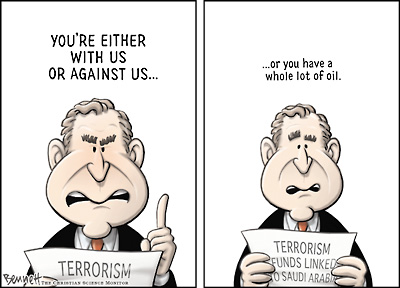
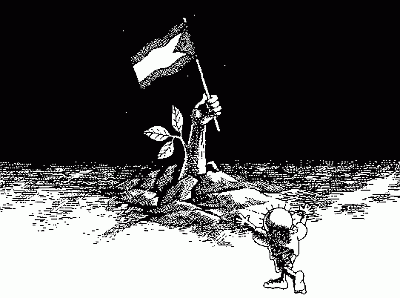
Cartoons I chose to share regarding Bush & Oil


Cartoons' references are located on the Pics

The Sad Story of Lebanon & Middle East

Three people died yesterday and their impacts are nothing on the grassroots level and political level. One of the deceased has been married for four months only, while the other had been married for 2 years, and had a baby child. The sad part of the story, the accusations remain flying between 14th of March and the Opposition on the grass root level.

A friend of mine Pro-Opposition & Resistance, on the eve of the explosion, tells me that the US blew the car with same material they supplied Fatah Islam. In fact they knew exactly how much to use explosives (Security Forces have declared 20 Kilograms of TNT were used in the detonated car) in order not to kill the Embassy’s two employees (who turned out to be Feltman’s scout cars. I argued left and right with him on the issue, and how he was certain of that fact (or the other fact that the government funded Fatah Islam which brings us back to Seymour Hersh’s original scenario), and he goes “they are desperate, they need to get more sympathy from the International Community.” This totally blew my mind off, what more solidarity the government needs? The government has so much international sympathy to the extent the Opposition failed drastically to oust them out. Hassan Nasrallah himself admitted that fact. He argues: “Because Bush is in the region”. Well, again, I told him without evidence, you can’t prove anything, and in fact, there are all possible scenarios. Sadly, I was talking to a wall.

The second person to join us on the table was a pro-Future & Government, and his argument was “Iran are teaching the Americans a lesson on Lebanese soil, henceforth, the Opposition are putting their foot in the face of the government.” I argue back, but how are you so sure that is the case? His reply: “Man, you are smart, Bush, Middle East, Escalations on Iran? Do the Math!” I reply back: what about Shaker el Absi? He answers: “Well, then it is Syria’s fault in that case, because they brought him to Lebanon! If only Bush visited the region!” I go : “Are you insane? Allowing the man who gave Israel to bomb the hell out of Lebanon? If Tony Blair when visited all chaos broke loose, the same with Kofi Annan, you want Bush?! Sure, if you want a full blooded confrontations to explode… the government is still being criticized for having lunch with Condi during the July War!” He goes: “Yes, it was the Prime Minister’s way of blocking the bloodshed!”

After a while debating with these two, then hearing debating, it was one of those fiascos that never end.

I have reached a conclusion that Lebanon is similar to theology, it is a never ending form of debate. The sad part of the story, three families are burying their beloved in coffins. One family had to come from Aleppo to confirm their son’s corpse. Two wives became widows. And the grassroots level, the party affiliated members still perceive this situation as scoring points. Then they all will say: “yes, it is sad what happened to the families!” But for sure, they will forget about these families and look again against each other to score points. Meanwhile, three bystanders were killed for nothing. They will be called by both sides as martyrs; however, do their families care? Just today one family was blaming the entire politicians of Lebanon. Which brings me to ask the question: why no schools/institutions closed today to mourn the deceased? Because they were common people?!

This is a classic case of what was mentioned in Marx’s 101 writings. The elite mobilize the masses against each other, while the masses themselves pay the price. Of course, you need an enemy, both camps have that: Syria/Iran versus USA/Israel/Gulf. What is most striking that so many have died, it is becoming common news!

I wonder how our fellow Palestinians survive in this bloodshed on daily basis! Just yesterday 17 people got killed, children die everyday, and the Palestinians live in a canned box. Worse, they have two parties butchering each other instead of defending their rights The civilians there suffer, whether from their leaders or from the Israeli artillery (which is often the case)! I didn’t even start with Iraq, where almost everyday 40 to 100 people die on daily basis.

Yes, this is the New Middle East.: he Middle East of Bloodshed, tyranny, and hypocrisy. When a bomb takes place in Beirut, they just say: thank heavens it wasn’t near us. People simply gave up hope to capture those invisible hands!” Palestinian Mothers burying their children or vice versa, children burying their mothers! Iraq under heavy bombardment from all forms of quasi-ethnic fuelling, vengeance, terrorism, and US Occupation! And we haven’t even talked about the poverty status supported by the US: the Al-Saud regime & the Mubarak regime.

I may have went a bit ashtray from the original topic, but I see it all combined. The Proletariat are suffering from their leaders’ affiliation. Zionism is increasing the gap between the Jews and the Arabs, and Egyptian statistics convey a terrible number of above 90% wearing the veil due to welfare nods because the US insist on supporting Mubarak (2nd most financed after Israel. I have no problem women wore the veil, as long as it is out of conviction, not out of financial needs!

As for Lebanon, it is a failed nation (to use Chomsky’s terminologies). The Arabs refuse to work with Israel (or at least used to refuse) and henceforth go pay lip-service to the US president who has been demanding that Israel is a pure ethnic Jewish nation that needs to be defended. If that is the case, what is the difference between Milosevic’s Serbia and Zionist Israel?

So many disgusting topics to mention, such a long road to emancipate the Proletariat into a single striking force against their oppressors, starting by dumping all 14th of March/Opposition cadres in the Sea! The government/Opposition followers fail to mention how everything (up to daily commodities such as Cheese) is on the rise. In fact, both factions blame each other and argue that once a Lebanese President is elected things will be better (if they ever do, and if that is the core problem of Lebanon, a tiny presidential chair whose president barely has any authority)! Enough of scapegoating "The Other"!

No War but Class War

MFL

Wednesday, January 16, 2008

Three killed by bomb meant for US Embassy vehicle

Details roundup from yesterday taken from the Daily Star here


(pic taken from daily star)


At last 21 wounded in attack that leaves intended victims virtually unscathed
By Hani M. Bathish


BEIRUT: An explosion targeting a US Embassy vehicle ripped through the Karantina industrial zone near Beirut on Tuesday, leaving three people dead and at least 21 wounded.

Two embassy security employees, both Lebanese citizens, were in the vehicle at the time of the attack, according to an embassy statement. One suffered minor wounds, while the other emerged unscathed.

Two people in a Fiat were killed when their car, traveling just meters behind the embassy vehicle, bore the brunt of the explosion. The vehicles were traveling along the sea route, a road parallel to the main Dora/Karantina highway, which experienced heavy congestion in the hours following the blast.

The Fiat was registered to one Joseph Khalil Khoury, a Sin al-Fil resident, according to a security source. The identities of the two victims inside the car could not be readily established as they were badly burned. A third man killed in the blast was identified as Ghassan Ali al-Hussein, a Syrian national who was riding a motorcycle.

The US State Department said Tuesday one "private US citizen" was also slightly wounded. The man was identified as a bystander who happened to be in the area at the time and was not affiliated with the US government or the embassy vehicle, said State Department spokesperson Sean MacCormak.

The armored embassy vehicle bore no diplomatic plates, only one set of Lebanese license plates in the back. The vehicle was returning from Beirut's Rafik Hariri International Airport after dropping off an embassy staffer, according to media reports. The embassy vehicle was damaged on its right side and pushed off the road by the power of the blast.

A senior security source told The Daily Star that the US Embassy vehicle was in the area on a scouting mission to ensure the road was safe. "The road was under surveillance all day. It was to be used by US Ambassador Jeffery Feltman, who was planning to attend a farewell party at the Phoenicia InterContinental Hotel held in his honor Friday evening," the source said. The party was cancelled as a result.

Many of the wounded were working in nearby buildings and factories at the time of the blast. They were taken to both Mar Youssef Hospital in Karantina and Jeittawy Hospital in Achrafieh. Army forces imposed a security cordon around the area and blocked access to the blast site, causing heavy traffic. Heavily armed US Embassy security staff were als on hand.

The security source said the bomb had been placed behind two metal dumpsters, attached to the wall of a two-story building on the side of the road and to the left of the embassy vehicle as it passed. The device went off after the embassy car had passed the dumpsters, thus the vehicle immediately behind the embassy car sustained the full blast.

State Prosecutor Saeed Mirza, who visited the blast site, took personal charge of the investigation since the bombing targets a diplomatic mission in the country. Also visiting the blast site Tuesday were the government commissioner at the Military Tribunal, Judge Jean Fahd, and Military Investigatiing Magistrate Rasheed Mezher. Two men were taken into custody by Lebanese Army soldiers at the blast site. It was not immediately clear if the two were suspects in the case or just being taken for questioning.

'Innocent martyrs fell today' - Aridi

BEIRUT: The Lebanese government strongly condemned the bombing that targeted a US Embassy vehicle on Tuesday, one day before Arab League Secretary General Amr Moussa's expected return to Lebanon to continue his mediation in the country's domestic political crisis

Information Minister Ghazi Aridi, addressing reporters following a scheduled ministerial meeting Tuesday evening, said all indications were that Moussa's visit Wednesday was still on.

Aridi offered the government's deepest condolences to the families of the victims of the attack, wished the wounded a swift recovery and expressed commitment to protect all diplomatic missions in the country. The ministerial meeting, chaired by Prime Minister Fouad Siniora, was held to discuss the Arab initiative and Moussa's return to Beirut.


"This bombing targets Lebanon at a politically critical and delicate juncture," Aridi said, adding that the government embraced the Arab initiative to fill the vacancy in the presidency and end the series of bombings that have plagued the country since 2005.

"The attack, whether it targeted the US Embassy or any other, was on Lebanese soil and as a result it targets the security of the Lebanese," he said. "Innocent martyrs fell today who have nothing to do with all that is happening politically. They were not embassy staff, whose vehicle was targeted. Therefore these attacks target the security and stability of Lebanon."

Hizbullah leader Sayyed Hassan Nasrallah, whose group is labeled a "terrorist" organization by the US, also spoke out against the blast.

"We condemn and denounce any explosion that takes place on Lebanese territory," he said, "regardless of who is targeted, and especially if innocent people are killed."

Parliamentary majority leader MP Saad Hariri said the bomb targeted stability in Lebanon. He said the perpetrators do not wish to see the country return to normality.

Hariri said he regretted that innocent Lebanese had paid a heavy price for continuous attacks targeting their country. He said he had called US Ambassador Jeffrey Feltman to confirm that he was unharmed and expressed regret on the injury of two embassy staffers.

In the immediate aftermath of the bombing in Karantina, the embassy released a single-sentence statement indicating that a farewell reception planned for the outgoing Feltman had been cancelled. This was followed by a more detailed statement that condemned the incident "in the strongest term."

"The embassy is outraged that there are still those who work to undermine Lebanon's stability through murder and intimidation," the mission said. "The Lebanese people deserve to live in peace and security in an independent and united Lebanon."

It added that "crimes" like Tuesday's bombing "will not weaken the international partnership working to support and strengthen Lebanon's independence and democracy."

US Secretary of State Condoleezza Rice also weihged in.

"I want to state the outrage of the United States against the terrorist attack that took place in Lebanon today," Rice said during a joint press conference in Riyadh with Saudi Foreign Minister Saud al-Faisal.

Rice said the United States would not be deterred by "intimidation" in its efforts to help democratic forces in Lebanon and the Lebanese people to "resist foreign interference in their affairs"

State Department spokesman Sean McCormack said US Embassy security people were working with the Lebanese government and were going to look into the circumstances of the blast.

France's UN ambassador, Jean-Maurice Ripert, deplored what he described as the "cowardly" bomb attack, which killed three bystanders.

"We really once again condemn this cowardly attack," Ripert told reporters after attending a Security Council meeting on the situation in Ivory Coast.

"We have to express our deep concern once again [over] the fact that some people are trying very hard to add some more confusion to the situation in Lebanon whereas we are needing peace, dialogue serenity," Ripert said. He recalled comments by French Foreign Minister Bernard Kouchner Monday that Lebanon's political crisis would have to be taken to the United Nations if the Arab League effort to end the impasse failed.

German Foreign Minister Frank-Walter Steinmeier also condemned the blast. "The attack showed once more that the domestic crisis in Lebanon needs to be resolved as quickly as possible in order to put an end to the violence," he said in a statement.

The foreign minister urged political forces in Lebanon and the region to work together to elect a new president and form a new government. Reports from Damascus said that Syrian Foreign Minister Walid al-Moallem would travel to Germany on Thursday to discuss the Lebanese crisis and other issues with Steinmeier. - With agencies


(Photo: taken from Annahar and written under it: Smoke coming out due to explosion in Karantina)


(Pic taken from Assafir


(Photo taken from the BBC and says: The attack comes at a time of high political crisis in Lebanon)


(Taken From CNN: written : Lebanese soldiers and Red Cross workers stand near charred cars at the site of the explosion in Beirut)


(taken from CNN: Written: Firefighters try to extinguish a burning car at the site of the explosion in Beirut.)


(taken from CNN: Written: -Reporter Dr. Joseph Yozgatian took this photo of a column of smoke rising shortly after the explosion.)

Tuesday, January 15, 2008

Bomb Explosion targets US Embassy Diplomatic Car

Updated minute by minute

4:25: Diplomatic car was targeted in the industrial and trade area between Karantina and Dowra region. Diplomatic car proceeded

4:50 According to LBC, The car targeted is for the US Embassy. Three killed and over 10 wounded so far. A lot of foreign faces are present there.

5:00 Three killed are not located in the targeted car, rather they are civilians killed while driving next to it

5:04 Two corpses have been covered. 20 cars damaged, in fact some cars flew 25 meters

5:06 Over 15 people wounded, security forces arrested two people

5:09 Mattew Placin is one among the wounded, among four others were taken to Hospital J'atawi

5:10 The targeted car has not been opened, nothing but photos from outside been taking

5:11: Hagop Bakradonian arrives (from Tashnag Party/Coalition for Reform and Change

5:11: Fire Fighters took out potential fires to eliminate fire spreading around to factories with explosive material.

5:12 Wounded are taken to Jatawi Hospital, Saint Joseph Hospital, and Lebanese Hospital. The killed are two in a car, and one on the road. The wounded are 20, some of them are inside their offices/homes.

5:15 Associate Press transmits Embassadorial Statement: No US diplomats/citizens have been killed in the process

5:18 Red Cross, Army, Security Forces are checking neighboring building for further martyrs

5:18 LBC: Second Explosion this year after the first in Shouf

5;20 ; Corpse on the road is taken to hospital

5:21 Eye witness : suddenly sky became black, and rushed quickly inside the factory to check on their workers. They didnt see anything suspicious activity. Offices and employees are requested not to touch anything outside for evidence collection

5:25 Corpses are still not identified

5:30 Military Judges Fahed and Mezher been over 30 minutes inspecting

5:31 Eye Witness: Gigantic explosive, took a kid to the hospital. There was a Honda parked for two days, it wasnt from the neighborhood. As the for the fortified diplomatic car, it was empty.

5:34 Explosion occurred when the diplomatic car passed next to a car loaded with explosives, detonated from distance. The three passengers are not military, rather guards and civilian employees at the embassy. Two died in the car behind it and one walking on the street.

5:36 K-9 dogs are brought in large numbers

5:39 LBC reporter: Problem with capturing suspects is that this area has plenty of factories, and henceforth has a lot of different foreign employees

5:40 LBC Speaker: Associated Press says that four killed, but not confirmed yet

5:40 LBC Speaker: Bomb might be targeted the US diplomatic car in parallel to George Bush's visit to the region for the past four days

5:45: Electricity is not available in the area of Karantina

5:55: Ahmad Fatfat argues that this is targeted at LEbanon,trying to blow up the Arab Initiative because this explosion like others prior to AMro MOussa's visit (UNIFIL, others), launching 2 missiles on Israel, plus Shaker el Absi's statement of seeking revenge. He also adds that the diplomatic car seemed to return from the airport. (MFL: seems he is trying to bury that explosion to 14th of March). He also adds that there are security holes such as the Palestinian Camps, Security Squares, Border areas which allows others make use of it. Army and Security Forces already captured tens of suspects under interrogation since summer.

6:01: One of the Four Killed, according to the US Foreign sector, is a Lebanese driver who works for the Embassy

6:02: One of the diplomats from the US Embassy arrives to the scene escorted with foreign US security guards in civilian troops

6:03: The US Embassy already cancelled its party to honor US Embassador Jeffery Feltman since he is leaving to be replaced with a new one.

6:06: LBC: there are information that says there are three martyrs, others say it is four

6:09: Updates: The Diplomatic Car had two Lebanese passengers, including one driver. The two were taken to the hospital after being wounded (but not seriously). The passenger was not hurt (The Car is Armored). One of the two left the hospital and gave his testimony to the people in charge in investigation. The US offered to to join in the investigation, the Lebanese answered they needed legal permission from the Lebanese Court.

6:22: Lebanese Government is meeting urgently. News as issued out by US officials that one killed is employee is wrong. He is slightly wounded. The two killed in the car behind the armoured car, they were trying to by-pass the diplomatic car when the car exploded. The government is about to meet.

Monday, January 14, 2008

The New Philosophy of Martyrdom

Ok, one thing for sure, it is dying as routine has struck a year and half stagnation. A lot are losing hopes of everything, and mass mobilizations are shrinking in size (well unless Hezbollah command their supporters to hit the barricades). Nevertheless, the overall political mobilizations have been shrinking in size, and even members from the Democratic Left Movement and Lebanese Communist Party (the two current cartoonish comical parties) have been expressing disappointments and de-activating themselves. In fact, when I stood against the hilarious Democratic Left, they mocked me and some went as far as to accuse me as a Syrian agent. Now, a majority of the ones I know are apologizing to me (after 4 years) and some even thanked me for keeping the line of return active. This does not mean that these members became progressive, oh no, they are stuck in the whirlpool of being trapped in 14th of March coalition and in their endless “epical” heroic battles against Syria and Iran.

Having said all that, what is the New Philosophy of Martyrdom? It is of course from my concept not related to Jihad nor anything else that is religious. It is process whereby one reactionary leader gets his/her agenda through by claiming to defend an influential figure’s ideas. This probably first appeared when Lenin died, Stalin self-proclaimed himself as defender of what he invented as “Leninism”, whereby he iconized Lenin (despite the fact that Lenin wrote extensively against iconization) and argued that whoever opposes him, opposes the glorious Lenin. Now Lenin died a natural death, but the process in Lebanese politics became active. We probably first witnessed that in Lebanon when Antoun Saadi was executed, different party members self-proclaimed themselves as the defenders of his radical ideas. After only 9 years of Antoun Saadi’s death, the Syrian Social Nationalist Party suffered from its first split.

A more clearer activity appeared when Imam Moussa el Sadre disappeared. AMAL movement was suffering from disorganization, lack of members, and lack of alternatives to rebuild. When Moussa el Sadre disappeared, AMAL movement members started to preach how they are defending el Sadre’s ideas, and of course, that was accompanied with over inflating el Sadre’s character/role in real life. AMAL movement after 1978 increased to incredible dimension even el Sadre himself didn’t expect to gather so much members.

A third one would be the assassination of Kamal Junblatt. With Kamal Junblatt, Walid Junblatt gambled a lot on his father’s name to also pursue his own goals. The fact that till 2005 he revived the concept of Syria killing his father makes it hilarious. Currently, a lot of PSP members call Kamal Junblatt as “the Teacher”, and some of them praise Walid Junblatt as the true heir, because Kamal Junblatt now is downsized to simply anti-Syrian and disregarded his socialist beliefs, his war against Zionism, and his solidarity with the Palestinians. (Even some try to erase the fact that the Progressive Socialist Party and the Syrian Social Nationalist Party were allies and their military men functioned sometimes as a single unit during the two year war).

A fourth one would be the assassination of Bashir Gemayel. Rewriting history on how he struck a deal with Sharon to get the Israeli Defense Forces to Beirut and install him as a Lebanese President, he was perceived as a hero by his followers. He was shortly assassinated with an explosion. The logo “Bashir Hayy Finna” (translation Bashir is still alive in us) is widely used by Phalange and Lebanese Forces supporters. Even Karim Bakradoni, with his short-lived flirtations as head of the Phalange Party with the Syrians, tried to link Bashir Gemayel to loving the Syrians. Jaajaa, Amin Gemayel, and other figures remain till this day at any chance to mention Bashir Gemayel to enforce their ideas on their supporters.

In any case, how does this apply in our community now? Ever since Rafiq el Harriri died, and along with him the economist Basil Fliehan, the philosophy of Martyrdom reached a new level. Directly after Harriri’s death, Samir Qassir and George Hawwi were assassinated, and eventually Joubran Tuieni followed them. The idea was to link all people assassinated under different circumstances and place them under one umbrella: anti-Syria. Hence, Kamal Junblatt, Bashir Gemayel, Mufti Khaled, and Rene Moua’awad were all associated with Rafiq Harriri, Samir Qassir, Bassil Fleihan, George Hawwi, and Jubran Tuieni. The difference between the former and the latter that the former is the fact all died at separate political circumstances at separate times during the civil war. Syria at a one point flirted Kamal Junblatt, Gemayel’s father, and of course Rafiq el Harriri and others. This means that 14th of March sought legitimacy in fighting Syria’s influence ever since Kamal Jumblatt was assassinated, despite the fact that Walid Junblatt allied after 4 years with them in the face of the Phalange/Lebanese Forces/Ahhrar/Israel. From Kamal Junblatt to Antoine Ghanem (the last target is still disputed regarding the assassinated General), the names has been placed into a single umbrella to face the opposing camps. Hence Aoun is fighting Pierre Gemayel Jr. and Samir Qassir. In fact, Samir Qassir never dreamt in real life that his name would be that inflated and used, but media inflated his martyrdom to fully retaliate on Pro-Syrian parties. The same applies about Pierre Gemayel Jr., he was hailed as the heir of Bashir and Pierre (Sr.) Gemayel.

While Hezbollah claims the 1300 civilians to be their own martyrs, 14th of March balanced out through their claim over all the names since Kamal Junblatt’s death. The on-going assassinations of the politicians within 14th of March camp reinforces their philosophy on the grassroots level. However, it should be noticed that due to the stalemate between the government and the opposition, each martyr dies gets less and less media attention compared to Samir Qassir, George Hawwi, Joubran Tueini, and Rafiq el Harriri. Walid Eido and Antoine Ghanem’s death got least media attention while the pro-14th of March media played and replayed the life stories of the early assassinated politicians.

A brief example of the new philosophy would be me going head to head with a stupid Democratic Left member:

Me: I seriously cant think a leftist should be part of 14th of March because it is too nationalist, and too liberal economically.

DLMer: Why? Because you disrespect Samir Qassir? Join us and don’t let his name be stained.
Me: What does that has to do with this?
DLMer: Because if you are not with us, you hate freedom, and you are not Leftist, Samir Qassir died for Lebanon and DLM. For Qassir join us!
Me: More like join you, and worship Elias Atallah and play ping-pong between Elias Khoury & Ziad Majed versus Elias Attallah And in the end, none of them is leftist, whatever happened to ‘long live the workers’!

Hence, the debate goes on and on. Bottomline is, DLMers tried to apply this philosophy; they are only successful in recruiting partly through the Samir Qassir foundation. Yet, their number shrank from what was supposed to be 5000 members to barely 340 participating in internal elections last year. I used the DLM excuse because it always amuses me. All the other parties are doing the same. Some PSP members almost think Kamal Jumblatt died 3 years ago (technically they are living it “we are seeking to avenge the First Teacher”).

Harriri is a more logical example. Before he died, everyone was complaining from taxes and unemployment. When he died, suddenly he became the angelic saint blindly, while the majority of the Sunnis became mobilized towards 14th of March. This media transformation can’t seize to amaze me how the transformation occurred. His movement’s station Future TV, daily replays historic moments from his life. His death became the political torpedo not only to oust the Syrians out of Lebanon, but also a missile spearhead to attempt and shoot the Syrian Baathi regime in Damascus. His “tomb” became a pilgrimage and history again was re-written disregarding the bad side of what happened in relations to Rafiq el Harriri. Now we see every liberalization of a sector, Seniora (Previously hated and dubbed MR. TVA in reference to value added taxes and all taxes as a matter of fact) blesses it “for the memory of my good friend Rafiq el Harriri. Soon we will enter the World Trade Organization to bless Rafiq Harriri’s memory!!!

Yet, this philosophy allowed the Government to gain recharged support from the International Community every time one of their politicians die to the extent Nasrallah himself complaint that the International Community gave the government too much support to be ‘simply ousted’.

Again, for respecting the dead people, cherish their ideas and not inflate them for private uses.

MFL

Israel, Bush, Hezbollah, and Lebanon

While watching Nasrallah’s A’shoura speech being replayed on Mannar, I decided to think loudly on some issues. Yes, I do agree with Hassan Nasrallah’s logic of how Bush was worried over 3 soldiers and their families while overlooking Israel’s butchery and terrorist acts over civilians with over 11,000 detainees.

What Bush doesn’t understand is that the majority of the Lebanese if given the choice between Israel and Hezbollah, they would choose Hezbollah. When I say majority, I surely don’t mean 50% plus 1%, rather like two years ago, almost the whole Lebanese population was with Hezbollah in the middle of the July War.

Bush doesn’t seem to understand that Israel’s past cost Lebanon a lot. Ever since Israel did the Litani operation back in the 1970s, a lot of the South despised Israel. Actually, then they also despised the Palestinians, but more the Israelis for killing their relatives. Almost everyone in the South has a relative who was kidnapped by Israel, killed, wounded, mutilated, shocked in traumas, and had material destruction. When Israel decided to invade Lebanon back in 1982, everyone in West Beirut had known someone who got killed by Israeli shelling. When Israel suddenly pulled out, the majority of the Christians in East Beirut and Mt. Lebanon felt they were abandoned and left to rot in the face of the other camp. When Israel occupied Southern Lebanon till 2000, a lot of families were brutally treated by the SLA, several tortured and even worse. When Israel broke out lashing Lebanon with missiles in 1993 and 1996, the Lebanese sat in anger as they watched helplessly Israeli plans killing fellow citizens. When July 2006 broke out, one quarter of the Lebanese (a whole million) were refugees, 1300 were killed (and still get killed from cluster bombs), 5000 wounded, a lot in trauma shocks, and land/agriculture/different industries were burnt to the ground. Even Samir Jaajaa (Israel’s ex-ally) stated out bluntly that the Lebanese Force sustained three martyrs during the July War. Hence, every Israel remains in the collective memory of the Lebanese as the spoiled prostitute of the United States. The fact Israel remains unpunished, special thanks to the US Veto power at the UN, will never allow peace to reign over between Lebanon and Israel (and even much worse between Palestine and Israel because Israel was constructed at the blood and houses of Palestinians). I also didn’t mention how many times day to day Israel’s warplanes and artillery randomly bombed people’s houses during their occupation.

In a nutshell, peace with Israel will never take place. The Lebanese cannot tolerate such peace with Israel. If given the choice between Israel and Hezbollah, the Lebanese would choose Hezbollah (Christians included) due to the previous butcheries and treacheries of Israel to Lebanon. Meanwhile, what Mr. Cowboy from hell Bush doesn’t understand, his blunders and Israel’s unpunished butchery make Hezbollah stronger and stronger only when it comes between the choice of Israel and Hezbollah. The Israeli humiliated retreat of 2000 transformed Hezbollah from a religious party to a Lebanese National Liberation Party. Nasrallah was smart when he dedicated his victory in the name of all Lebanese when Israel was kicked out from Southern borders. The victory even got anti-Hezbollah parties to respect their military victory. This transformation appeared clearly in the July War. While Israel and the US hoped for a civil war in Lebanon to cripple Hezbollah (probably hoped to give anti-Hezbollah supporters Israeli Air Force support), the Lebanese stood as a single line. Actually, at the ground, that was one rare moment whereby the Lebanese stood as a single line. This doesn’t mean we forget what happened to racist practices towards Palestinians living in Beirut (those who didn’t have a Lebanese identity were locked out of schools).

The other dimension is Bush’s failure to promote Hezbollah as a terrorist organ in the International Arena. So far, only the US administration and Israel recognize Hezbollah as a terrorist organ while all the rest of the world regard Hezbollah as a legitimate body with full rights to be existent in Lebanon. Even European Community members meet with Hezbollah, and the US administration itself meets indirectly with Hezbollah through mediators. Henceforth, the question goes, what did the US do? Get the Christians to support Hezbollah? Well done Mr. Bush. If any proper war against Hezbollah to be waged, get Israel punished severely for its entire war crimes so that the survivors in Lebanon (and I do say survivors, because the whole country since 1982 have been survivors of Israeli aggression, and 1977 the whole South civilians have been survivors). Hezbollah isn’t born out of scratch because certain people are born wicked, may be he should do a research why Hezbollah got all that popularity, and at least why all coalitions would support Hezbollah amidst a war with Israel who pathetically is still trying to promote that their war was not with Lebanon, rather with Hezbollah. All 14th of March, opposition, and independents directed their energy on relieving the refugees by helping them out 2 years ago, and if they didn’t do that, only then the Shiites would have hated Nasrallah and the Israeli plan would have worked to cripple Hezbollah. So again, to all stupid Zionists (and when I say stupid Zionists, I seriously mean that anyone pro-Zionism is stupid), go research history, and not what Israel says…

MFL

Sunday, December 30, 2007

Fawwaz Traboulsi: Breaking with the 'National Consensus: Towards Lebanese-Palestinian Reconciliation

[MFL: As always Fawwaz Traboulsi shocks me with his vision and how accurate he always is]

Published on ZMag on October 15, 2007

[Translator's Introduction: The article below by Fawwaz Traboulsi first appeared in Arabic in the Beirut daily as-Safir of September 13, 2007.

For several decades, there was an official dogma regarding Palestinian refugees in Arab countries. According to this dogma, proclaimed by both Palestinian and non-Palestinian leaders, all that the Palestinian refugees wanted was to return to their homeland. True, that yearning was real enough, but understated or willfully ignored was the elementary fact that, before returning to Palestine or to whatever part of it that would be restored, Palestinians wanted their human and civil rights to be acknowledged and respected. Invoking this dogma thus became a way to prevent the implantation of Palestinian refugees and to justify various forms of discrimination they endured in their host countries. Officially, Palestinians were welcomed as fellow Arabs and their rights recognized by the governments of Arab countries where they sought refuge; notwithstanding official recognition, however, Palestinian rights were routinely trampled in practice. In the name of solidarity with the Palestinian cause, invoking this dogma was thus used to serve the interests of local elites totally unrelated to Palestinian welfare.

This official dogma regarding Palestinian refugees continues to this day, though with diminished force, overshadowed by the many conflicts other than the Israeli-Palestinian conflict that have engulfed the Middle East in recent years. But the discrimination against Palestinians remains, now justified and enforced by other class and state interests.

In the case of Lebanon in particular, this official dogma has been combined with an elaborate fiction since the 1975-1990 civil war, and sometimes the fiction has become more important than the dogma and eclipsed it altogether. This Lebanese fiction has been to make the Palestinians into an alien presence that is supposedly threatening the very well-being of Lebanon and its citizens -- a fiction cooked up for fraudulent reasons, as Traboulsi carefully explains. What's more, in so doing, Traboulsi places himself squarely at odds with both of the two main camps in the current Lebanese standoff. Both government and opposition politicians routinely talk about the Palestinian presence as a burden Lebanon cannot shoulder or shoulder alone. If there is something on which the two camps agree, it is a refusal to a permanent settling of Palestinian refugees in Lebanon. Thus, in an otherwise inane speech to the UN General Assembly on September 28 and without fear of antagonizing either of the two camps back in Beirut, President Lahoud of Lebanon could declare with total confidence that a permanent settling of Palestinian refugees "will dangerously alter the delicate balance of Lebanon's existence as a nation based on diversity and coexistence among a large number of its sects" -- a statement thoroughly debunked by Traboulsi's article.

In years past, Palestinian refugees were ostracized in the name of that dogma that said all they want is to return to Palestine; today, they are further victimized under the pretense that they endanger "Lebanon's existence as a nation."

In the article below, Traboulsi is addressing Lebanese and Arab audiences familiar with events of recent decades, often evoked in passing without further elaboration. A few points to identify these events and place them in their historical context:

(1) Traboulsi refers to the Lebanese civil war of 1975-1990 not as a single war, but as a period of "many wars," which in fact it was. It involved Lebanese parties, armed organizations of the PLO, the Syrian army, and the Israeli army, with frequent infusions of weapons and money from parties further afield. Erstwhile allies often turned on each other during that period, and with increased frequency after the Israeli invasion of 1982.

(2) Traboulsi mentions several individuals and groups that were involved in the 1975-1990 wars; these or their successors all continue to play prominent roles in one of the two contending camps of the current Lebanese standoff. The Lebanese Front is a precursor of the Lebanese Forces, a right-wing organization now headed by Samir Geagea; Geagea is one of the three main leaders of the current pro-government coalition, along with Saad Hariri and Walid Jumblatt. Traboulsi mentions another chieftain of the Lebanese Forces, Elias Hobeika, who led the Lebanese militias involved in the 1982 massacre of Sabra-Shatila, before dissociating himself from the Israeli army and then throwing his lot with the Syrian regime; Hobeika was assassinated in 2002, a few days before testifying in a Brussels court against his former ally Ariel Sharon in a lawsuit brought against the latter by survivors of the massacre. Traboulsi also mentions the "war of the mountain," the "war of liberation," and the "war to unite all guns," commonly referring to different episodes of the 1975-1990 period.

(3) The Taif Accord was an agreement between Lebanese factions of the 1975-1990 wars, convened in the city of Taif, Saudi Arabia, under the auspices of the League of Arab States. The agreement was negotiated in October-November 1989, based on which a cease-fire was enforced by Syrian troops and gradually took effect in the course of 1990. Once the cease-fire was in place, Syrian troops were to withdraw after a cooling-off period, but they did not do so, in violation of the agreement. That Syria was given a free hand in Lebanon throughout most of the 1990's, despite Israel's objections, was in exchange for Syrian participation in Desert Storm, the 1991 US-led campaign to oust Iraqi troops from Kuwait.

(4) The "battle of Nahr al-Barid" is the devastating three-month battle of this past summer, which pitted the Lebanese army against the jihadi group Fateh al-Islam which had ensconced itself in the Palestinian refugee camp of Nahr al-Barid in northern Lebanon. It resulted in the total destruction of the camp and the forced displacement of its 30,000 to 40,000 refugee inhabitants.

-- Assaf Kfoury]


After the battle of Nahr al-Barid, much has been said and repeated about a Lebanese "national consensus" regarding the Palestinians in Lebanon, a presumed rejection by all Lebanese of a final settling of Palestinians on Lebanese soil. Many commentators continue to voice their alarm about the "conspiracy" to permanently settle the Palestinians.

The writer of this article, a Lebanese citizen, wishes to openly declare that he will have no part of such a consensus -- and more, that it is time to expose it for the fraud that it is.

This presumed danger of a final settling of Palestinians is another tale in the politics of lies and self-deception that has prevailed since the Taif Accord. In a complex and diverse country such as Lebanon, this accord sought to develop a consensus based on a deception. It sought to achieve national unity by inventing a presumed enemy of all Lebanese, short of finding a real common enemy, or by fabricating a phony scare that would frighten everyone.

There is a history to this tale and the purpose it has served. At the time of the Taif conference, a party had to be found to bear the blame for the disastrous consequences of the many wars fought during the 1975-1990 period. These wars came to an end of sorts, but without an honest reckoning and accounting of the responsibilities that had led to them. And worse, they came to an end by elevating to the seats of power the very warlords that had fought each other mercilessly. The only party left out of this equation were the Palestinians. The other parties at the Taif conference had thus found the perfect scapegoat that would unite them all -- the Palestinian side -- which they thus turned into all of the following: the cause and object of that murky "conspiracy" that had to be feared, the reason that there had been internal wars, and the constant danger to fend off against, then and in the future.

The parties of the Lebanese Front have used the specter of a final settling of Palestinians to justify their blood-soaked history during the 1975-1990 period. They have never tired of declaring that they were fighting "against foreigners". In their account of that period, their history was one of resistance against the "conspiracy" of permanently settling Palestinians on Lebanese soil, conveniently ignoring who instigated the internal wars and who profited from them. Thus, not only have these parties concealed their responsibility for putting the country to the torch, they have also managed to confound the beginnings and ends of the 1975-1990 wars and everything that happened in between.

Twenty-five years ago, in September 1982, was the massacre of Sabra-Shatila. On this occasion, let us not forget that the massacre was planned with the intent to eliminate the "superfluous people" for which there is no room in a settlement of the Middle East crisis. That slaughter of Palestinian civilians took place in a drive to frighten them to leave Lebanon, after the eviction of the PLO and its armed factions in the summer months of 1982. The refusal of a final settling of Palestinians was a euphemism, pure and simple, for their forced migration out of Lebanon under the threat of death.

On the pretense that the many mini-wars in the years 1975-1990 were against the "conspiracy" aiming at a final settling of Palestinians, the conspiracy mongers have wanted us to forget that most of these wars, even after the withdrawal of the PLO and its organizations in 1982, were between Lebanese parties. What was the relationship between this "conspiracy" and what was then called the "war of the mountain" in 1983, which resulted in driving out most of the Christian inhabitants in the Shuf region? Further back, what was the relationship between the refusal of a final settling and the forcible migration of the Muslims out of the Nabaa district in 1976? And what was the connection between this "conspiracy" and General Aoun's decision to ignite the so-called "war of liberation" and the "war to unite all guns"? And what was its connection with the internecine war between the Geagea and Hobeika factions of the Lebanese Forces, or between the Amal movement and Hizbullah?

During the years of Syrian hegemony, from the early 1990's and until 2005, the bogey of a permanent implantation of Palestinians played an important role in rallying a number of politicians, particularly Christians among them, to the side of the Syrian regime. The declared reason was that only the latter would be able to keep the Palestinians in check and disarm their organizations. Thus, incitement against the implantation of Palestinians became another means to justify the presence of Syrian troops on Lebanese territory, although it was in clear violation of the Taif Accord.

What's more, all this talk about the refusal of a permanent settling of Palestinians is a perfect example of the kind of vile repudiation which Palestinians have had to endure, in this case the crass refusal to acknowledge their many and varied contributions to Lebanese life -- from the construction worker to the successful banker, and the many others in all professions from teaching to contracting. If this is what the refusal of a permanent settling means, it is a dark stain on Lebanon's much-trumpeted hospitality, which allows rich Saudi citizens to buy plots of land of one million square meters at the heart of the Lebanese mountains while denying a Palestinian refugee the right to own a dwelling not exceeding a few dozens of square meters!

Let's not overlook that the refusal of a permanent settling also presumes that Palestinians have to be taught lessons in patriotism and how to remain loyal to the idea of an eventual return to Palestine, which in turn presumes that Lebanese can be more concerned than Palestinians in defending the latter's right to return. On this phony presumption, it has been necessary for example to prevent construction material from entering Palestinian refugee camps, so as not to let camp dwellers be seduced by the idea of a permanent stay and aspire to remain in Lebanon! Everyone knows that foreign visitors, who have countries to return to, all aspire and are allowed to remain in Lebanon, so why shouldn't we allow those without a country to aspire to the same? Under repeated policies of encirclement and neglect over the years, the Palestinian camps have become infested with shadowy armed groups, which Lebanese and Syrian security agencies have, by turns, promoted and used to do their dirty work, and then incited to fight each other. And here is Lebanon belatedly awakening to the reality that these groups have the military means to take hostage an entire camp (Nahr al Barid) on the very watch of the proponents of the refusal of a final settling.

Last but not least, the tale of the refusal of a final settling of Palestinians comes in the wake of another issue that is rarely discussed honestly. The proponents of this tale maintain that Lebanon, because of its confessional makeup, cannot sustain the integration of Palestinian refugees who are Muslim in their majority. Because of Lebanon's confessional makeup, they claim, this will create an imbalance between Christians and Muslims in Lebanon. The first flaw in this kind of logic is to equate the right of legal residency in Lebanon with the granting of Lebanese citizenship. Palestinians can be legal residents, with the same rights and duties of all non-citizen residents in Lebanon, without precluding their right to return to whatever part of their homeland that will come under the control of a Palestinian authority according to UN resolutions. But let's pursue this idea to the end: In a country where the confessional power-sharing formula is not based on percentages of the different religious sects in the first place, even if we were to equate the permanent settling of the refugees with the granting of Lebanese citizenship -- which is certainly not maintained by anyone -- what will be the effect of adding another 250,000 Palestinians to the number of Muslims in a country of 4 million where Christians represent no more than one-third of its inhabitants?

Treated with fraudulent remedies, the wounds in Lebanese-Palestinian relations have never ceased to fester and bleed. And here is another new wound caused by the events of Nahr al-Barid, once again treated with fraudulent remedies, as government officials have rushed to promise the rebuilding of the destroyed camp without drawing the necessary lessons for rebuilding relations between the two peoples.

Towards rebuilding harmony between the two peoples, we need to understand that Lebanon can no longer be a base for Palestinian armed organizations. Armed resistance from Lebanon is no longer an option for Palestinians, nor can the country provide the means to sustain such a resistance and serve its purpose. We also need to realize that the issue of Palestinian weapons in Lebanon is the result of fear -- fear caused by a history of massacres, further compounded by the growing racism peddled by politicians -- not to discount the fact that parties and governments have also used it, and continue to use this issue to serve external agendas unrelated to Palestinian interests.

If we want to avoid a repeat of the Nahr al Barid episode, with another terrorist organization abducting an entire Palestinian camp, we need an agreement that will stipulate the removal of all military weapons from Palestinian camps in exchange for the recognition and safeguarding of the Palestinians' civil and political rights. No need to spell out the details of such an agreement here, but the time has come to undertake the necessary steps towards its realization. And the first step on the long road to Lebanese-Palestinian reconciliation is to free ourselves of the fraud called the "conspiracy" to permanently settle the Palestinian refugees!

Fawwaz Traboulsi has taught at the Lebanese American University, Beirut-Lebanon. He has written on history, Arab politics, social movements and popular culture and translated works by Karl Marx, John Reed, Antonio Gramsci, Isaac Deutscher, John Berger, Etel Adnan, Sa`di Yusuf and Edward Said. His most recent book in English is A History of Modern Lebanon (Pluto Press, 2007). The translator, Assaf Kfoury, is Professor of Computer Science at Boston University.

Friday, December 28, 2007

What A Great Future President We Will Have!!

I have been thinking about this stupid presidential chair which is really wasting valuable time of mine, yours, and everyone else’s. The issue of course doesn’t stop at the Presidential chair, rather the situation has been escalating since debating whether the government is legitimate or not. In fact, the government and opposition reached a no return when the pro-opposition ministers resigned (although some of them remained attending their posts and representing Lebanon despite the fact they resigned). The presidential chair is nothing but a tip of an iceberg. If the President is elected as a reconciliatory move, would this mean that the opposition will close their tents at Down Town and return home? If that happens, what about the government, would the government mean it has been legitimate in the opposition’s eyes, and if that is the case, why did the opposition waste one year of our lives?

The Presidential chair in essence is agreed on, which is Michel Suleiman, head of the Lebanese Army. Now, the government and the opposition are just yelling at each other for technicality reasons.

The president historically was mighty powerful. He was stronger than the parliamentary cabinet that elected him. He had the power to suspend it. He was the sole supreme leader of the army. He was everything. The president, in pre-Ta’ef accord, was powerful as a result of agreement between the Sunni leaders and the Christian ones. In 1943, the Sunnis agreed to give the Christians such authority (not to forget on Parliamentary level 60-40) in return the Christians would demand that the French mandate is terminated.

In 1958, when Fouad Shehab was elected as a reconciliatory president (dubbed as The Third Force), he had constitutional authority to do what he wanted. This pushed both camps (Junblatt Sr./Salam & Jemayel/Shamoun) to push for eliminating the Shehabi regime in order to push further their own platforms.

The emulation of 1958 circumstances in 2007 is a hopeless case. The army has to remain on Nasrallah’s good side in order for it to grow stronger, not to forget the corrupted side of it (clientalism, outdated mechanisms,…etc). The current presidential position lacks any authority to do anything. The president in post-Taef is allowed simply to propose ideas. The government decides whether to implement the idea or not. The Parliamentary cabinet is the most powerful institution within the legality mechanism. It gives legitimacy to the President and the government.

The issue is not there still. What can a president do between two coalitions that have crippled the nation for more than a year. Aoun and Harriri Jr. seem more powerful than the future elected president. The president might develop schizo syndromes to keep both sides satisfied. In fact, such a president, amidst two giants, is nothing. He is just a pebble, and the battle between both coalitions remains active. So, again, what is the fuss over the president? We have been without a president for weeks and weeks. Who needs a president again? (other than the greedy politicians!!!!) We all know that the presidential chair is not the way out from this deadlock because all the current political parties are greedy for power at the Proletariat’s expense.

MFL

Lebanon's new president needs a reform agenda

(MFL: might be interesting to ponder about these reform points)

Reform plans written by Fady Abboud , taken from here

President Elias Hrawi's term in office lasted nine years. Likewise, President Emile Lahoud's rule stretched over nine years. Electing a replacement for the latter president has so far required nine attempts (and one more since this article was written). In Britain, however, 999 is the number for Emergency services. It seems that Lebanon now needs to dial 999. An emergency situation has developed over the past months, but there is nowhere for our officials to turn for help.

Although many Lebanese demonstrated for freedom, sovereignty, independence and national unity, the political class is letting them down because of the lack of seriousness with which national issues, such as the presidential election, are treated. Consequently, this brings to question the political class' commitment to reform, economic growth and even democracy.

If the 11th or 12th election attempts are lucky, we need to start thinking and acting seriously about launching the long-awaited reform process. For this, the Lebanese deserve officials who possess practical and analytical skills and who are able to inspire confidence. Reform is not a theoretical exercise. It requires a set of skills based on real-life experiences.

The new president (fingers crossed) deserves a team that is able to promote and execute a reform agenda based, among others, on the following:

1. To pass Freedom of Information Act legislation, granting all citizens the right to obtain any public information relating to government institutions, including the publication of all such information on the Internet for easy access and as a step toward e-government.

2. To pass legislation concerning public tenders to assure fairness and transparency, especially concerning standards and the opening of bids, and disallowing any form of cronyism concerning the award of contracts.

3. Revoking bank secrecy on all public employees and all those who benefit from public funds, including their family members and associated companies.

4. To create a National Competitiveness Council (NCC), which is empowered to re-write all bureaucratic procedures and Executive Decrees. The NCC will act as a "Bureaucratic Inertia Buster," forcing change to streamline procedures and modernize the bureaucracy, and cooperating with relevant experts from business, academia and civil society.

5. Exposing electricity production and distribution to competitive market forces during three months, and allow the free import of natural gas and fuel products and forbid monopolistic behavior.

6. Provide universal health care to all Lebanese citizens through the private sector and consolidate all the budgets of the National Social Security Fund (NSSF), Health Ministry, cooperatives and others under one regulatory authority, to provide health-care services to citizens who need it through buying insurance coverage from the private sector.

7. Increase the minimum wage to LL500,000, discontinue family allowances from the NSSF, liberalize end-of-service indemnities under the Central Bank's supervision, and transform the NSSF into a regulatory body.

8. Privatize public schools through a transparent bidding process in which only reputable private educational institutions, which have a long track record of academic excellence could participate.

9. Transform the national economy into a truly competitive and open economy, encompassing all sectors, to prohibit monopolies, respect consumer rights, and maintain the competitiveness of productive sectors, through:

a. Creating an Anti-Monopolies Commission

b. Creating specialized courts to deal efficiently and speedily with consumer-rights issues and prohibit monopolies

10. Introduce legislation to offer incentives to those who create jobs in Lebanon, which would encourage investment as well as balanced regional and sectoral development, and create "intelligent" Industrial Parks with services all over Lebanon.

11. Giving back to Parliament the exclusive right to impose taxation, and not allowing the introduction of fees under the guise of taxes, thereby assuring that fees are paid against services not to generate revenue for the government.

12. Creating special police forces (Traffic Task Force), trained in the West, to control traffic and introduce electronic surveillance on all Lebanese roads; and create a similar police force (Environmental Task Force) to monitor and control environmental violations.

No economy could survive and be sustainable without certain underpinnings, such as values, ethics, quality education, productivity, quality-of-life issues, etc. Societies do not move forward without a vision, as well as functioning institutions (legislative, legal, bureaucratic, educational, economic, etc.) to implement that vision.

An "enlightened" president, in cooperation with Parliament and government, should play an activist role in the reform process. This is where the Lebanese have to put their hopes. The three vital constitutional institutions have to lead us forward as a society, away from sectarianism, racism, nepotism and corruption, and toward modernity, civic responsibility, tolerance and liberal democracy.


Fady Abboud is president of the Lebanese Industrialists Association.

The Whole World Loves Lebanon

So far, we had every corner of the world speaking about Lebanon and what they “hope” and “wish”. Even the Pope of Rome himself intervened in the Presidential Elections, and nothing so far.

Hezbollah’s secretary general Hassan Nasrallah said this year that the Seniora government would have collapsed if it weren’t for the international community supporting the government. Hezbollah’s main channel, al-Manar, still refers to the government as illegitimate. Hezbollah’s strength comes from Iran’s funding and their humiliating victory over the Israelis (specially in expelling the Israeli from the South in 2000 and the severe damage over the Israeli Ground Forces in Southern Lebanon during the July War). The fact Hezbollah emerged more powerful than ever after the July war made them unstoppable. Iran’s gigantic funding of Hezbollah’s welfare nods and services over the Shiites (largest Sect in Lebanon) assured the Opposition that Hezbollah are in Lebanon to stay. Iran remains funding Hezbollah, and Nasrallah’s moderate views regarding co-existence has echoed vast throughout Lebanon (unlike Tfayli’s reign of terror). Bottom line is, Iran plays a drastic role in financing Hezbollah and allows them to provide services to the people of the South, education, hospitals, schools, corporations (Jihad el Maamari and al-Manar), and others.

Syria is one of the accused in assassinating Rafiq el Harriri in Lebanon. They remain meddling when they can, and they issue contradictory statements such as Bashar el Assad’s several speeches last year: “We will not intervene in Lebanon, but the government shall crumble down.” In fact, the mere historical event of Assad celebrating the end of July War and the humiliation of the Israeli Army in Southern Lebanon as his own victory showed how much he considers his role in Lebanon to be active. Syria of course remains the liasson also between Hezbollah and Iran. As a matter of fact, Syria preaches its war with Israel via Lebanon (while secretly undergoing meetings in Washington and attempting to look a nation of peace) as its own. Assad was receiving congratulations in the House of Parliament in Damascus as the man who defeated Olmert, even though not one bullet came from Syria towards Israel, rather whenever during the July War a missile struck Syrian borders, Assad directly jumped saying: “it was on Lebanese ground and I dare them to hit Syria”.

Well, in less than a month of the July War breaking out, Israeli planes hovered above the Syria’s presidential palace (literally above Assad’s head). This year, the region was charged with adrenaline rush when Syria accused Israel of raiding targets on its sovereign land, and Israeli planes breaching Syria towards Syria’s Northern Borders (which also pushed Turkey to complain as well). I find it amusing that none of that fuss occurs when that happened two days ago when 10 Israeli planes flew from Southern Lebanese borders till Hermel (Northern Lebanon). Syria still has plenty of cards to play, and it uses Lebanon to embarrass Egypt and Jordan that they too should be fighting Israel (but not sure if through Lebanese grounds or not). Moreover, as escalations occur in the region, the Syrian people are repressed more whereby opposition is accused of being Zionist agents (something we witnessed in Lebanon). Syria of courses claims they want a stable Lebanon but a government of their own taste, and currently they are annoyed by the current anti-Syrian government (to the extreme) an with the fact that the government are trying to shoot down el Baathi regime through the International Tribunal and International Community.

Then we have our brethren neighbors: Jordan, Saudi Arabia, and Egypt. Each claim they support democracy in Lebanon and condemn any action to shoot down the Seniora government. None of them acknowledge democracy in their own countries. Saudi Arabia’s corrupt regime oppressed the people (and emphasis on the women’s side) and corruption brought recruits to freakish terrorist organizations such as al-Qa’eda and its cancerous networks. Moubarak and King Abdullah II are more corrupt as ever, with Egypt and Jordan ranking respectively as second and third in the US administration’s financing and funding, while sustaining Moubarak as President has pushed the Muslim Brotherhood and Islamist activists to become the majority in Egypt. Now, our “democratic” Moubarak is preparing his son to take over. Moubarak speaks of democracy while he imprisoned his presidential rival. He has the vulgarity to speak about democracy. Of course, he didn’t take any drastic measures to stop Israel from bombing Lebanon last year, in fact, he oppressed any solidarity campaign in Egypt that was launched in solidarity to Lebanon. He didn’t condemn how Rice was celebrating the “New Middle East”, and of course he didn’t attack his financers how they were sending more arms to Israel. He even refused to expel the Israeli ambassador. His logic was: “we will send them donations and ambulances.” What a help…

Probably the most interesting of course is the United States, where you would have George Bush telling the Government to proceed with the 50% plus one logic, whereby exploding the entire nation into fire. The government have been so far meticulous regarding that issue and preferred to avoid the riots. Of course, Bush supports dictatorship leaders such as Moubarak and Abdullah II. Of course, to hell with the people, as long as his foreign policy is working perfectly. More to the point, Bush claims he wants Lebanon to be free from Syrian hegemony while he gave Israel the green light to take its time in Lebanon during the July war, and sending laser guided missiles to the IDF to “accurately” hit Hezbollah… instead they killed 1300 civilian and mutilated 5000 others. Bush was perfectly silent about the cluster bombs and Israel’s use of banned weaponry. Moreover, the US still hope to push the government to agree in selling a diplomatic / economical package of canceling Lebanon’s debt in return of giving the Palestinians the Lebanese nationality.

If all of these countries love us so much, as far as the Vatican agreeing on Michel Suleiman, why don’t they really help the country by doing the simplest issue: cancelling all the debts located on our country and get Israel to repay for damages done over here (and not only July War, but all the previous wars on Lebanese civilians).

MFL

The assassination of Benazir Bhutto

Pakistan: The assassination of Benazir Bhutto
By Alan Woods
Thursday, 27 December 2007
Benazir Bhutto has been killed in a suicide bomb attack.

(MFL notes: I totally agree with the Defense of Marxism, the capitalists will never stop the revolutionary storm in Pakistan)

Link

The leader of the Pakistan People's Party (PPP) had just addressed a rally of PPP supporters in the town of Rawalpindi when the attack took place. First reports talked of at least 100 killed in the attack, but more recent news put the figure at 15.

This murderous onslaught on the PPP came in the middle of an election campaign where, after years of military dictatorship, the masses were striving for a change. There was a wave of support for the PPP, which was sure to win National and provincial assembly elections that were due to be held on 8 January 2008.

The campaign was gathering strength, and the PPP Marxist wing was getting enthusiastic support for its revolutionary socialist message in places as far apart as Karachi and the tribal areas of Waziristan in the far north. These elections would have reflected a big shift to the left in Pakistan. This prospect was causing alarm in the ruling clique. That is what was behind today's atrocity.

This was a crime against the workers and peasants of Pakistan, a bloody provocation intended to cancel the elections that the PPP was sure to win and to provide the excuse for a new clampdown and the possible reintroduction of martial law and dictatorship. It is a counterrevolutionary act that must be condemned without reservation.

Who was responsible? The identity of the murderers is not yet known. But when I asked the comrades in Karachi, the reply was immediate: "it was the mullahs". The dark forces of counterrevolution in countries like Pakistan habitually dress up in the garb of Islamic fundamentalism. There are even rumours in circulation that Benazir was shot from a mosque, although the western media insist that the murder was the result of a suicide bomber.

Whatever the technical details of the assassination, and whoever was the direct agent of this criminal act, the threads of the conspiracy undoubtedly reach high up. The so-called Islamic fundamentalists and jihadis are only the puppets and hired assassins of reactionary forces that ere entrenched in the Pakistani ruling class and the state apparatus, lavishly funded by the Pakistan Intelligence Services (ISI), drug barons with connections with the Taliban, and the Saudi regime, always anxious to support and finance any counterrevolutionary activity in the world.

The war in Afghanistan is having a ruinous effect on Pakistan. The Pakistan ruling class had ambitions of dominating the country after the expulsion of the Russians. The Pakistan army and ISI have been meddling there for decades. They are still mixed up with the Taliban and the drug barons (which is the same thing). Huge fortunes are made from the drugs trade that is poisoning Pakistan and destabilizing its economy, society and politics.

The assassination of Benazir Bhutto is just another expression of the sheer rottenness, degeneration and corruption that is gnawing at the vitals of Pakistan. The misery of the masses, the poverty, the injustices, cry out for a solution. The landlords and capitalists have no solution to this. The workers and peasants looked to the PPP for a way out.

Some so-called "lefts" will say: But Benazir's programme could not have provided the way out. The Marxists in the PPP are fighting for the programme of socialism - for the original programme of the PPP. But the masses can only learn which programme and policies are correct through their own experience.

The January elections would have give the masses an opportunity to advance at least one step in the right direction, by inflicting a decisive defeat on the forces of reaction and dictatorship. Then they would have had the possibility of learning about programmes and policies, not in theory but in practice.

Now it seems most likely that they will be denied this opportunity. The purpose of this criminal provocation is quite clear: to cancel the elections. I have not yet seen the response of the Pakistan authorities, but it would be unthinkable that the elections could now take place on 8 January. They will be at least postponed for some time.

What effect will this have upon the masses? I have just spoken on the phone to the comrades of The Struggle in Karachi, where they have been battling the reactionary thugs of the MQM in a fierce election campaign. They tell me that there is a general feeling of shock among the masses. "People are weeping and women are wailing in their houses: I can hear them now," the comrade said.

But the shock is already turning into anger: "There is rioting in the streets of Karachi and other cities. People are blocking the roads and burning tires." That is a warning to the ruling class that the patience of the masses is now exhausted. The movement of the masses cannot be halted by the assassination of one leaser - or by a thousand.

The masses always adhere to their traditional mass organizations. The PPP developed in the heat of the revolutionary movement of 1968-9, when the workers and peasants came close to taking power.

The dictator Zia murdered Benazir's father. That did not prevent the resurrection of the PPP in the 1980s. The forces of state terrorism murdered Benazir's brother, Murtazar. Then they exiled Benazir and installed a new dictatorship. That did not prevent the PPP from experiencing a new resurrection when 2-3 million people came onto the streets to welcome her back.

The masses will recover from the momentary shock and grief. These emotions will be replaced in time by anger and the desire for revenge. But what is needed is not individual revenge, but collective revenge. What is needed is to prepare the masses for a new revolutionary offensive that will tackle the problems of Pakistan by the roots.

The ruling clique may delay the date of the elections, but sooner or later they will have to be called. The reactionaries calculate that the removal of Benazir will weaken the PPP. That is a serious miscalculation! The PPP cannot be reduced to a single individual. If that were true. It would have disappeared after the judicial murder of Zulfiqar Ali Bhutto.

The PPP is not one individual, It is the organized expression of the will of the masses to change society. It is the three million who came on the streets to greet Benazir's return. It is the tens of millions more who were preparing to vote for a change in the January elections. These millions are now mourning. But they will not mourn forever. They will find effective ways of struggle to make their voice heard.

The masses must protest the murder of the PPP leader through a national protest movement: mass rallies, strikes, protest demonstrations, culminating in a general strike. They must raise the banner of democracy. Against dictatorship! No more martial law! Call new elections immediately!

The PPP leadership must not capitulate to any pressure to delay the elections. Call the national and provisional elections! Let the people's voice be heard! Above all, the PPP must return its original programme and principles.

In the PPP's founding programme is inscribed the aim of the socialist transformation of society. It includes the nationalization of the land, banks and industries under workers control, the replacement of the standing army by a workers and peasants militia. These ideas are as correct and relevant today as when they were first written!

There is nothing easier than to take the life of a man or a woman. We humans are frail creatures and easily killed. But you cannot murder an idea whose time has come!