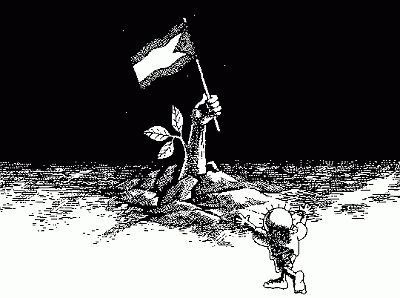
taken from here
[Translator's Introduction: The article below by Fawwaz Traboulsi first appeared in Arabic in the Beirut weekly Mulhaq al-Nahar al-Thaqafi (the Literary Supplement of the daily al-Nahar) of November 6, 2005. The article has not previously been translated into English, and it is offered here for its continuing relevance to Iraqi political developments.
The article was originally written as, part of a series of pieces by different commentators on "the consequences of Iraqi federalism on the Arab world," just a few weeks after the October 15 referendum approving a new Iraqi constitution -- or, more precisely, an incomplete version of it.
The struggle for Iraq's constitution is still very much ongoing, as I explain in a separate article , and Traboulsi's article is no less germane today than it was at the time of the October 2005 referendum. If anything, positions of the different Iraqi parties have become more polarized and entrenched over the last two years. Two of the most contentious issues yet to be decided in the constitutional document are the nature of Iraq's federalism and the disposition of the country's natural resources. Traboulsi addresses both issues.
One of Traboulsi's warning calls to Iraqis is about the sectarian character of the draft constitution. Traboulsi's criticism draws additional force as he writes from the vantage point of a historian of the modern Middle East, who has also been a direct witness to the ravages repeatedly brought about by a sectarian-based system of government (so-called confessionalism) for nearly a century in nearby Lebanon.
-- Assaf Kfoury]
Before we discuss the potential effects of establishing an Iraqi federation on the rest of the Arab world, we ought to give an examination of federalism in Iraq, in and of itself, its due. We ought to do this even though a detailed assessment of the proposed draft for an Iraqi constitution cannot be guaranteed as final yet, especially since the draft remains a working document that has been repeatedly adjusted and modified. If we are to examine the idea of federalism in Iraq and potential problems in putting it into practice, a good place to start from is the draft itself where a specific form of an Iraqi federation is proposed to the Iraqi people.
Any discussion of federalism in Iraq must take note of two important characteristics of the current situation. The first characteristic is that the American occupation accomplished more than just regime change. Not only did the occupation put an end to the Baath regime led by Saddam Hussein, it completely demolished the Iraqi state, eliminating the former state infrastructure and somehow aiming to rebuild it entirely from scratch: the legislative and judicial institutions, the army, the ministries, the civil service and all public administrations. And not only did it demolish the former state and its institutions which it directly targeted, it inevitably had a profound dislocating effect on the whole of Iraqi society. What concerns us here most are the changes and reversals which Iraq's three main communities have experienced in their mutual relations as a result. At the moment, Iraqis are facing a crucial turning point in their collective history: On the one hand, a majority of Iraqis reject a return to a centralized authoritarian government, whose remnants are no longer in a position to unite Iraqi society in any case, coercively or not. On the other hand, we are now witnessing an intense movement among the constituent parts of Iraqi society, whose outcome is yet to be determined -- in the form of new elements of domination or control or balance or leadership. The most salient features of this ongoing movement are:
· The two communities that suffered most from discrimination and deprivation under the Baath regime, namely the Shiites and the Kurds, are now exercising a new assertiveness, but in different ways that are often at cross-purposes. As most often reflected in pronouncements by Shiite leaders, the Shiite community is striving to impose the principle of majority rule on a political system still-in-the-making. By contrast, as indicated by its leaders' stated positions, the Kurdish community is trying to maximize the benefits of its self-autonomy and simultaneously preserve its position in the central government, against the background of a Kurdish public opinion strongly favoring secession -- an issue I shall return to shortly.
· The Sunni community is struggling to find a new place in the emerging order. It is doing so after long years during which Saddam Hussein monopolized power in its name and at the expense of its own majority. This search for a new place manifests itself in different ways. Some Sunni groups that espouse various nationalist ideologies are engaged in an armed insurgency with the declared aim of re-establishing a centralized Iraqi state, of one form or another, in which they will regain their privileges. Other Sunni groups, which have shunned the violence of the armed insurgency but also used it as a bargaining chip, are vying for a better position within the emerging political system. And lest we forget -- and how can we forget!! -- this armed insurgency has intermittently tolerated or abetted the kind of violence embraced by al-Qaeda in Mesopotamia that indiscriminately targets civilians and openly proclaims that Shiites are apostates deserving death.
· Last but not least, the various social movements and forces, including the labor movement and the women's movement, are all struggling to find a position and a role to play in the political system still-in-the-making. They are doing so in the face of a political system that is increasingly giving precedence to communal rights over individual rights, and increasingly sacrificing socio-economic interests to appease religious-regional demands.
In making the preceding points, we cannot stress enough the importance of the current juncture in Iraq's history -- this is a time when Iraq's state institutions are being rebuilt, its entire society remodeled, and the very basis of its existence as a single entity reconsidered.
So, how is it that we hope for Iraq to change from a centralized state to a federation? There is no point in saying that states in their historical development tend to go from loose federations or confederations to centralized states. In the case of Iraq, it may well be that the reverse will take place, and that this reverse may turn out to be the best way to re-unite its society by rebuilding its state and public institutions differently. Re-uniting Iraqi society is not the same thing as re-establishing a unitary centralized state; rather, if Iraqi society is to re-unite voluntarily, it will likely be the product of a form of government that devolves authority, permits all components of society to exercise their rights for self-rule, and distributes equitably national resources and public services.
The second important characteristic of the current situation in Iraq, insofar as the issue of federalism is concerned, is the growing current among Kurds for an outright secession, something I already alluded to before. An overwhelming majority of the Kurds once more expressed this sentiment in a poll conducted on the margin of the most recent parliamentary elections. Did the secessionist sentiment among Kurds predate the American invasion? And were the Kurds able to express this sentiment openly only after this invasion? Or was this secessionist sentiment the product of specific events and history? A number of factors have in fact contributed to this Kurdish shift, over many years, from a demand for self-rule in Kurdistan within a democratic Iraq to a call for outright secession.
Most of the available evidence indicates that the Kurdish population's shift towards secession started during the latter period of the Baath regime, and most significantly, since the so-called Anfal campaign of 1988-89. During that campaign, the Kurdish regions were subjected to wholesale massacres, ethnic cleansing, destruction of hundreds of villages, forced Arabization, and forced migration of thousands if not hundreds of thousands of their inhabitants. In other words, the movement favoring Kurdish secession grew in reaction to the extreme national-chauvinist and tyrannical policies pursued by the central government in dealing with the Kurdish question.
It is worth adding that the Kurdish movement towards secession was further nurtured during the years of self-rule in the 1990's and later, when the Kurdish regions in northern Iraq were outside Baghdad's control and largely isolated from the southern Arab-majority regions that remained under Baath rule.
Of course, the existence of a dominant separatist current among Kurds today does not mean, a priori, that it may not recede as a result of future circumstances, nor does it mean that Kurdish secession is bound to happen regardless of circumstances. Several internal and external factors militate against an outright secession. In particular, most of the Kurdish leaders and parties continue to search for a solution within the boundaries of a single Iraqi entity, while outright secession under current conditions would undermine the Kurdish regions' economic interests and external relations.
As I am talking about secession, I should point out that I fully support the Kurdish people's right to national self-determination, including its right to secede completely and form a separate state. But my support of this right is not neutral, and I find no contradiction in being partial to another alternative: As an Arab citizen, I am also in favor of Iraq's Kurds ultimately choosing to remain within the Arab world, as an affirmation that this Arab world can be open to ethnic, regional and religious communities -- in all their diversities and multiplicities -- in a context of coexistence and cooperation that are enriching to all.
Based on the preceding, I understand the proposal for a federal Iraq to be for a system of government that will grant the Kurdish minority all its legitimate rights: to exercise self-rule, use its own language, preserve and develop its cultural heritage, and receive its fair share of the national wealth and budget -- in the context of a united Iraq, as an alternative to the option of an outright secession.
That said, this vision of an Arab-Kurdish federation in Iraq is problematic and fraught with difficulties. While it provides an answer to part of the problem, it raises other problems. Any federal system, whether in Iraq or anywhere else, is erected on the presumed existence of two or more autonomous or semi-autonomous regions. In Iraq's present situation, there exists only one autonomous region in the Kurdish north, consisting of three provinces, where self-rule is already exercised through the creation of a regional government, a regional parliament, a regional administration and regional armed forces. In the face of this one autonomous region are: (1) a central government reflecting a twisted power-sharing formula* between a (Kurdish) ethnic community and (Arab) religious communities, and (2) a collection of 15 provinces in the rest of the country with an overwhelming Arab majority.
The question is: This proposed Iraqi federation is to be realized between whom and whom? An answer of sorts is in the draft constitution, which stipulates that any province (or group of provinces) can move to become a separate federal region, i.e. one of the units of the projected federation, provided the move to separate is approved by a majority of that region's eligible voters in a plebiscite. In the envisioned federal system according to the draft constitution, power and representation will be divided between four different levels: (1) the capital Baghdad and surrounding metropolitan area, with its own special executive and administrative organization; (2) the regions, each consisting of one or more provinces that elect to form a self-ruling federal unit; (3) the provinces, jointly administered by the federal and provincial authorities; and (4) what the draft calls "the local administrations," responsible for the affairs of religious minorities (Christians, Yazedis, Mandi Sabeans) and small ethnic minorities (Turkmen, Armenians). It does not take much imagination to foresee a situation of confusion and conflict when this projected system will be put to the test of practice, notably because the population of Baghdad and the surrounding area, representing more than one-fifth of Iraq's total, is a mix of all ethnic and religious communities.
The only plausible explanation for the adoption of this problematic system is that the commission responsible for the draft constitution refused to consider a single defining criterion for a federation, namely, an ethnic division between Arabs and Kurds. This is unfortunate, because the only meaningful and effective federation, one capable of embracing all the religious and sectarian diversities of Iraqi society, is an Arab-Kurdish federation consisting of two autonomous regions: one including all the provinces with a Kurdish majority, and one including all the provinces with an Arab majority. In this way, power and representation would be divided between two rather than four levels -- with the first of these two levels already mentioned in the draft constitution: (1) a national assembly of all the delegates elected by the entire Iraqi population, with one delegate for every 100,000 voters, and this assembly in turn elects a head of state and a council of ministers; (2) the regional institutions in each of the two autonomous regions. (To my knowledge, during the discussions on the draft constitution, there was a similar proposal that was not followed up, of a federation between two regions, one called Kurdistan and one called Mesopotamia.)
Such a federal solution leads us directly to the question of Iraq's identity. Is it an Arab country? Is it part of the Arab world?
There is no question that the American view of Iraq has been to divide Iraqi society into one ethnic community (the Kurds) and two Islamic sects (Sunnis and Shiites). The effect has been to diminish the role of Iraq's Arab population as its single ethnic majority. This has been the view underlying US policy since the 1990-91 Gulf War: the determination of the no-fly zones after 1991, the parceling out and distribution of food supplies during the UN food-for-oil program, the representation of the Iraqi regime as a Sunni regime, etc. This has been the view from our opponent's side -- the side of the imperial power and the interests it serves.
But from our side -- the side of those who support Iraq's liberation -- the crucial question is: What do we want? Do we adopt our opponent's view or do we confront it with an alternative view? An alternative view that expresses the Iraqi people's free will?
My sense is that much of the debate about Iraq's Arab identity is taking place in a context of symbols and images that ignore the facts. Some have criticized one of the clauses in the draft constitution that states that Iraq's "Arab citizens are a part of the Arab nation;" without any mention that Iraq is an Arab country or part of the Arab world, they read the draft as stripping Iraq the country of its Arab identity. There is some validity in this criticism, but there is a far more important omission in the draft constitution: It does not deal with Iraq's Arab inhabitants as one ethnicity and only identifies them according to their sectarian identities. Indeed, what is the gain in trying to amend the draft constitution to include some sort of clause proclaiming that Iraq is part of the Arab world -- just to please the Secretary General of the Arab League -- if the draft does not also recognize Iraq's Arabs as a single ethnic community and strips them of any constitutional role as such in the Iraqi political system?
One final remark is in order regarding the distribution of revenues from the oil and gas sector. This is a particularly sensitive issue in an Iraqi federal system, which must be considered against the current and past record inasmuch as it has all too often been an element of discord and division. First, we should give the draft constitution its due for explicitly stating that oil and gas resources are a common property of the entire Iraqi people, and that their revenues will be distributed proportionally to population size in every region. The draft constitution also allocates a special share to parts of the country that were deprived of the revenues under the former Baath regime. So far, this is in relation to ownership and distribution of revenues only. As for the administration of oil and gas production, the draft calls for it to be joint between federal and regional authorities, but limited to currently exploited fields. The draft leaves unspecified the administration of fields that are discovered in the future, allowing the possibility that these will be placed under sole control of the regional authorities. This is an unfortunate ambiguity, a portent of potentially divisive conflicts, especially since Iraq's oil reserves are estimated to far exceed its current production level.
An example of these potentially divisive problems is the current struggle over the city of Kirkuk in northern Iraq. The Kurdish claim to Kirkuk, the conflict regarding its ethnic makeup, and the debate on whether or not it should be part of the Kurdish autonomous region, become all the more critical precisely because of the city's importance in the oil industry. Unilateral insistence by any side on controlling Kirkuk undermines Iraqi federalism and, moreover, will embolden those who want to establish a separate region in southern Iraq to demand similar ownership rights on the southern oil fields. Regardless of the final status and geographical location of Kirkuk, inside or outside the autonomous Kurdish region, it is important that its oil wealth remains under federal control and administration, representing its joint ownership by the entire Iraqi people.
Note
* Translator's note: The power-sharing formula is "skewed" in that it is not a partnership between only ethnic communities, or between only religious communities, but between one ethnic community and two religious communities, with the latter two limited to Arabs. Kurds are religiously diverse, just like the Arabs. There are significant numbers of both Sunnis and Shiites (and other religious denominations) not only among Arabs, but also among Kurds and other smaller ethnic communities of Iraq (notably, Turkmen).
Fawwaz Traboulsi has taught at the Lebanese American University, Beirut-Lebanon. He has written on history, Arab politics, social movements and popular culture and translated works by Karl Marx, John Reed, Antonio Gramsci, Isaac Deutscher, John Berger, Etel Adnan, Sa`di Yusuf and Edward Said. His most recent book in English is A History of Modern Lebanon (Pluto Press, 2007). The translator, Assaf Kfoury, is Professor of Computer Science at Boston University.
Tuesday, December 25, 2007


The Gunmen of Kabul

taken from Corpwatch
In September, on a tree-lined street in the most expensive neighborhood in Kabul, dozens of men rolled out of armored vehicles in front of a little-known U.S. security company. Backed up by Blackwater guards, Afghan authorities and Americans from the FBI and the U.S. State Department quickly headed for the offices of United States Protection and Investigations (USPI). Once inside, they arrested four of the Texas-based company’s management team and confiscated 15 computers. The two Americans arrested were later released, while the Afghan managers remain in custody.
The September raid was one of the first attempts by President Karzai’s government to crack down on private security contractors in Afghanistan. Afghan police say they plan to shut down about 14 contractors, and so far, have closed 10 Afghan and foreign firms.
What made the USPI raid unusual was the U.S. government’s role. The State Department and FBI spearheaded the operation and accused the company of defrauding the United States, according to USPI guards in Kabul and Afghan officials who did not want to be named because the investigation is classified.
Ironically, the United States used private security guards from Blackwater -- the same company under scrutiny for the September death of 17 Iraqi civilians -- to carry out the USPI raid. It was Blackwater’s actions and virtual impunity that had spurred the Afghan and Iraqi governments to rein in Western security contractors in the first place.
That impunity is of particular concern to Ali Shah Paktiawal, head of criminal investigations with the Kabul police. A crusader against private security companies, he charges that many contractors are corrupt and are operating without an Afghan government license. Some, he said, are using their guns and power to commit murder and other crimes including drug dealing and bank robbery, and to extort money on a daily basis, he said.
“We’re going to make sure these companies clean up because they’re doing more harm than good in our country right now,” Paktiawal said from his busy Kabul office.
One foreign private security contractor, who would only speak off the record, counters that the police crackdown is really a witch-hunt to extort money from Western companies. An Afghan journalist who is researching the issue and cannot publicly comment, points to the fact that many of the companies, such as Afghan-owned Khawar, are back in business. If the right people in the government are bribed, he said, the contractors have no problems re-opening.
According to a high-level contractor who worked for the U.S. embassy in Kabul, the crackdown may be targeting legitimate companies along with rogue and unlicensed operations. Some businesses may have been shut down after high-powered government officials issued false charges arising out of vendettas.
Barnett Rubin, an Afghanistan expert and head of New York University’s Center for International Cooperation, said experienced international officials working in Kabul told him that the latest crackdown on security companies is an effort by one criminal group to eliminate its competitors. Apparently, he said, foreign contracts are being offered to “favored Afghan families.”
The foreign contractors say they want to be regulated without being gouged. Doug Brooks, founder and president of the U.S.-based International Peace Operations Association (IPOA), a trade group that represents private security contractors, confirms that stance. These companies are happy to register their weapons and obtain licenses from the Afghan government, he says, because it raises their standards and builds efficiency.
“They can handle high [license] fees as long as there’s fairness and transparency. But they can’t pay bribes because it’s against U.S. laws,” Brooks said.
Who are the security companies?
In the last six years, public security in Afghanistan has been on a downward spiral. According to the Afghan government and NATO figures, suicide bombings and other violence have killed hundreds of civilians in 2007, with many more injured or driven into internal exile. Western diplomats, NGOs and investors argue that the Afghan military is not ready to protect those involved in the reconstruction effort in Afghanistan. Without private security contractors, the insurgency -- including the Taliban, al Qaeda and other opposition groups -- would win the war for control of the country.
The private forces filling this security gap are funded by some of the nearly $20 billion in U.S. aid money that was allocated for Afghan “reconstruction.” To date, there is little security or reconstruction to show for the money spent. An undisclosed amount of the funds for projects assigned to the U.S. Agency for International Development (USAID) and other donor nations appears to have simply gone to security contractors, according to aid project contracts that detail security costs. For almost every project, security is the highest expense.
There has also been little progress in efforts to control the expense of or to monitor the private security industry. Two years ago, the Afghan government hired a Canadian consulting company to help formulate legislation to regulate the companies, but the effort has not generated effective laws. This December the U.S. Congress passed a bi-partisan bill requiring contractors to provide more information on how they are spending aid money. The legislation creates the post of a special inspector general for Afghanistan reconstruction (SIGAR) to monitor American assistance to Afghanistan. President Bush has yet to sign it.
Legislation or no, dependence on private security is a basic fact of life in Afghanistan. There are about 10,000 private security guards -- Afghan and foreign -- in Kabul alone right now, according to figures provided by the Afghan Ministry of Interior. Afghan officials say only 59 companies are registered and licensed, but perhaps 25 more operate illegally. These numbers are estimates, since part of the problem is that no system is in place that accurately counts the companies or publicly verifies their legal status.
Many of the private security companies, including USPI, have hired Afghan guards who fought in previous wars and were supposed to be disarmed. According to the joint United Nations and Afghan disarmament group, there are still 2,000 private militias in the country employing some 120,000 men, many of whom work for private security contractors. The largest companies are either U.S. or British, and include DynCorp, USPI, Armour Group, Saladin and Global Risk Strategy.
USPI in Afghanistan
USPI has risen quickly into the top ranks of Afghanistan’s private security contractors. It was founded in 1987 by a husband and wife team: Barbara Spier was a restaurant inspector and her husband Del was a private investigator specializing in insurance fraud in Dallas, Texas. They started with small contracts around the world, but when the Taliban were ousted and the new Western-backed government seized power in 2002, USPI planted itself in Afghanistan and collaborated with former Mujahideen commander Din Mohammed Jorat.
Jorat, a notorious warlord accused of killing the aviation minister in 2002, was head of security in the Ministry of Interior and headed a militia that became part of the Afghan police. His officers were paid a low salary, $70 a month, but offered the opportunity to boost it by working as guards for USPI. They remained Afghan government employees and received a $3 to $5 per diem for USPI’s on-the-job training. By claiming to train, rather than actually employing the moonlighting police, the U.S. contractor was able to provide the cheapest security option for its clients in Afghanistan. The scheme effectively turned a large sector of the Afghan police into a private quasi-militia.
In a matter of months, USPI became USAID’s second biggest security contractor in Afghanistan (after Virginia-based Dyncorp). USAID awarded the company $36 million for four and a half years to protect infrastructure projects, such as a road-building project awarded to Louis Berger, a New Jersey engineering company. USPI also made money from contracts with other foreign companies and NGOs to protect their offices and staff in Kabul and the provinces. At its peak, the company employed some 4,000 Afghans.
By September 2007, according to one USPI Afghan guard in Kabul, the company’s guards no longer worked for the government, and had become direct employees of USPI, which pays their salaries. Jorat, who is no longer head of security at the interior ministry, had opened his own security company, Khawar, and no longer collaborates with USPI, according to the guard.
Meanwhile opposition to the government is growing and the insurgency is targeting foreigners inside the country as well as Afghans who work for the government or foreign military and aid projects.
As both the opposition and USPI operations grew, the company began to assume a lower public profile. Until two years ago, when security in Afghanistan plummeted, USPI signs were omnipresent at booths staffed by their Afghan employees who guarded big Kabul houses filled with expatriate staff. Now the signs are gone but the guards remain.
By mid-December the security situation in Afghanistan had deteriorated so drastically that the Taliban were able to kill 15 USPI Afghan guards on the highway in western Afghanistan where they were protecting Louis Berger engineers.
The rising number of attacks has raised questions about the training, dedication and competence of private security operatives. A high-level security contractor who worked for the U.S. embassy in Kabul said that members of the small team of foreign advisers are paid up to $200,000 a year to work with the Afghan employees, but that most of the local officers received little training and were infamous for collaborating with local warlords and participating in the extortion and harassment of Afghans.
“[They] made deals with the devil and their guys could do anything they want: shakedowns, drug dealing. [They were] thugs who liked mafia-type operation,” said the U.S. embassy security contractor. He said USAID was not happy with USPI, but it had spent too much money mobilizing the company to let it go.
“People got killed because of the incompetence of their guys,” he added. “Taliban would attack road crews and USPI guys would run and throw away their weapons, and it happened on numerous occasions.” The consequence was that civilian construction workers ended up dead and kidnapped, and engineering contractors stopped construction simply because USPI could not protect them.
September Raid
By the time of the September raid on USPI offices, the company’s operations were raising red flags. USPI has a notorious history in Afghanistan of operating with a cowboy mentality and collaborating with shady local strongmen. In 2005, a U.S. supervisor for USPI allegedly shot dead his Afghan interpreter and was flown out of the country the next day, according to Afghan officials.
Despite these issues, USPI continued to get contracts because it underbid its competitors for projects and remained the cheapest option, the American contractor said.
Paktiawal, the policeman in charge of criminal investigations in Kabul, was present during the USPI raid and told CorpWatch that the FBI and USAID are both investigating the company. Until the investigation is complete, he said he could not release more details about the charges.
USPI could not be reached for comment, but in October, the Associated Press reported:
“USPI faces accusations of overcharging USAID by billing for employees and vehicles that did not exist, said a U.S. security official with close ties to the company who wasn’t authorized to release the information. The overbilling could run into the millions of dollars … Blackwater held U.S. and Canadian citizens at gunpoint during the raid, said the U.S. official. Blackwater ... helps provide security for the U.S. Embassy.”
After the raid, one of USPI’s uniformed guards, armed with a knife and an AK-47, patrolled in front of foreign offices in a quiet neighborhood in Kabul. He did not want to be named, but confirmed that there were issues of fraud involved at USPI and that none of the lower-ranking guards were aware of management’s dealings.
“We were discouraged from asking anything and so we keep our mouths shut and heads down,” he said.
The guard said he supports a big family with the $150 a month that he receives, and was afraid that if the firm were shut down, he would lose his job.
More Crackdowns
Paktiawal says that the Afghan police are only after the corrupt companies and that the recent law enforcement efforts will impose accountability and control over contractors. He cited USPI as an example of one corrupt foreign company that the crackdown is restraining.
But USPI is hardly alone. A senior security contractor working in Kabul told CorpWatch that the Pentagon is investigating criminal misconduct in regard to $6 billion worth of equipment and service contracts to many companies in Afghanistan and Iraq. He said that 72 FBI investigators are probing mostly Pentagon and State Department security contracts in Afghanistan, but the details are highly classified.
Other companies the government has raided include: the British firm Olympic Security Group for operating without a license; the joint Afghan-British contractor, Witan Risk Management; and Afghan companies Watan and Caps, Khawar and Mellat International Security. It is not clear whether these companies remain closed or have re-opened for business.
Meanwhile, the Afghan people face a variety of men with guns on their streets and blame most of the violence on the private security contractors.
Susanne Schmeidl, co-author of a recent report on private security companies in Angola and Afghanistan for Swisspeace, writes that the expatriate guards are often confused with foreign troops by the local populations. “While there is a positive argument to be made that private security company employment keeps former strongmen and their militia off the streets,” she told a news conference in Kabul, “the dilemma as to what will happen to these militia when the contract ends needs to be addressed.”
Monday, December 24, 2007
Hell No to Holland to host the International Tribunal
The Dutch should be the last to allowed to host the International Tribunal as they proved unqualified during their stay during the Yugoslav wars as part of UNPROFOR.
The Dutch's mediocre performance to protect a safe haven called Srebrenica in Bosnia led for a Bosnian Serb general (also supported by Belgrade) General Mladic to enter the enclave and butcher civilians with such brutality to the extent it was last witnessed in Europe during World War II. 7000 civilians were killed, women were raped, and Holland was not held accountable. The Bosniac faction raised lawsuits on Holland for not protecting the civilians (link). Mr. Ban should no better than to allow the Netherlands to host the Harriri International Tribunal which might trigger a new civil war in Lebanon.
How can the Lebanese government approve of this hilarious scenario?
MFL
Now the Iraqis have Turkey also
With all the semi-ethnic wars, terrorist explosions and al-Qa'eda, US brutality occupation, a pethatic muppet government, now the Iraqis have Turkey to worry about:
(article taken from the Daily Star Dec. 24, 2007)
Turkey stages third round of attacks on PKK positions in Iraqi Kurdish villages (AFP)
ANKARA: Turkey's military said it attacked Kurdish separatists in northern Iraq Saturday for the third time in less than a week, bombing and shelling positions and warning that more attacks will follow. "Turkish aircraft attacked between 1:35 p.m. and 2:00 p.m. major positions of the terrorist organization [Kurdistan Workers Party or PKK]," after which the Turkish artillery shelled the area for 15 minutes, the military said in a statement on its Web site.
It added that it would carry out more operations despite harsh winter conditions in the mountainous region.
Turkish television channel NTV said the raids were in the Al-Amadiyya area of northern Iraq.
"It will become well understood how effective the operations against the terrorist operations are," the military's statement said, adding that the PKK "no longer has a chance of success" against the Turkish Army.
Actions over recent weeks had left "hundreds of terrorists" dead, it said.
In northern Iraq, Jabbar Yawar, spokesman for the Iraqi Kurdish Peshmerga security force, said Turkish warplanes had hit isolated Kurdish villages.
"In the afternoon Turkish warplanes entered northern Iraqi airspace in Al-Amadiyya. Later at around 4:00 p.m. they bombed Iraqi Kurdish villages. We do not know the extent of the damage. But these areas are largely deserted and are along the border with Turkey," Yawar told AFP.
The PKK, listed as a terrorist group by Turkey and many other countries, has waged a bloody campaign for Kurdish self-rule in southeast Turkey since 1984. The conflict has claimed more than 37,000 lives.
Turkey has been stepping up pressure since its Parliament approved in October cross-border raids on PKK bases, with Ankara saying the Iraqi government and its US backers were not doing enough to halt PKK attacks.
Asked for a reaction, US State Department spokeswoman Nicole Thompson said in Washington: "The US does view the PKK as a terrorist group and is against any acts of violence against Turkey or Iraq. It will continue to work with the governments of Turkey and Iraq on how they can work together to deal with the PKK."
The new raids followed attacks on December 16 on the Qandil mountains near the border with Iran where Ankara says 3,500 PKK rebels are holed up, using the area as a springboard for attacks in Turkey.
On Tuesday, Turkish troops penetrated into northern Iraq from the southeast Turkish province of Hakkari, the army said. Iraqi officials said about 500 Turkish troops took part in the ground operation.
Ankara has accused Iraqi Kurds, who run an autonomous administration in the north of the country, of tolerating and even supporting the PKK.
Turkey, which has the second-largest army in the NATO military alliance after the US with 515,000 troops, has moved around 100,000 soldiers up to its 380-kilometer border with Iraq.
The United States fears that Turkey could launch a major cross-border operation and destabilize the relatively peaceful northern part of Iraq.
After a flurry of diplomatic activity, Iraq has promised to rein in the PKK and, in November, US President George W. Bush said Washington would provide Ankara with information on rebel movements from its satellites.
The US administration said Wednesday that it had been informed about the December 16 raids in advance.
Turkish Chief of Staff General Yasar Buyukanit said earlier that the United States approved the December 16 air raids by providing "intelligence" and opening Iraqi airspace.
Massoud Barzani, president of Iraq's Kurdish region, refused to meet visiting US Secretary of State Condoleezza Rice in Baghdad Tuesday in protest of US support for Turkey's strikes, a top Kurdish official said.
Ankara has denied that civilians were hit on December 16, blaming reports of villages being bombed and hospitals and schools destroyed on PKK sympathizers among Iraqi officials seeking to mislead the international community.
The UN refugee agency has said some 1,800 people fled their homes in Suleimaniyya and Irbil provinces in northern Iraq following the attacks. - AFP
Thank You Lebanese Politicians
Not that it would have mattered if they did elect a president, but at least one less obstacle to worry about, and less "fairy tales" to hear on TV.

This is taken from Annahar's cartoon section:
Written in Arabic: Present to the Lebanese (upper right)
Vote Ballot (Written on the box)

This is taken from Annahar's cartoon section:
Written in Arabic: Present to the Lebanese (upper right)
Vote Ballot (Written on the box)
Sunday, December 23, 2007
Israel's July War aggression is still active
"Cluster bomb kills father of three" By Agence France Presse (AFP) (link)
"
TYRE: A Lebanese father of three was killed by a cluster bomb dropped by Israeli forces during last year's war in Lebanon, police said on Thursday. Mohammad Hamzeh, 33, was killed in the village of Zebqine near the Southern port city of Tyre when a cluster bomb exploded as he was gathering wood to heat his home, police said. The munitions dropped by Israel during its devastating war against Lebanon last year included at least a million cluster bomblets, according to the United Nations. Unexploded ordnance has killed at least 36 people and wounded 227 since the conflict ended in August 2006, according to UN figures. - AFP"
Another Israeli crime to be added to the record of bloodshed of the Zionists and their allies. Of course, they will complain that they are the victims as always and we are anti-semites... bla bla bla
MFL
Saturday, December 22, 2007
Beirut – Overcrowded with Immigrants
No matter where you go to Beirut, you will see everywhere crowded since morning. Practically a gigantic portion of the immigrants returned to visit for two reasons. The first reason is the coincidence of Christmas and al-Adhha holidays (Christian the first, Muslim and Durzi the second) whereby a lot of Lebanese students/immigrants returned. The second reason, a lot of people’s vacations were canceled in the past, practically for a whole year. The assassination of Jubran Tuieni in 2005 scared people to visit Lebanon; the same impact occurred on the summer of 2006 (July War with Israel), the assassination of Minister Pierre Gemayel + the Opposition launching their open demonstration which started with over 1.5 million participant (people were terrified we were at the dawn of a new civil war on Christmas/Adhha of 2006), the war with Fatah Islam (Summer of 2007) which was accompanied with random terrorist bombings and assassination of Walid Eido and later Antoine Ghanem, and now people came to visit despite the assassination of General Francois Hajj and the political void.
The working/student class in exile needed to return and see their families and friends. In fact, a lot of collage friends agreed to meet up for the holidays whether from the US, Canada, Europe, or the Arabian Gulf. I, myself, saw people in 2 hours at a single night 51 people whom graduated with me and never saw for the past 5 years. Jemayzi, Hamra, and Monot are packed with cars whereby you can get stuck in traffic jam for one hour in the tiny street of Jemayzi. The Taxi Cabs have tripled (in most cases) their fees (1$ usually) for riders, and the immigrants came to spend their money in the richest nightlife through out the Middle East: Beirut.
A 14th of Marcher would stand up and yell: “this is what we are talking about, security and stability to bring money.” And again as always, the free market advocates are wrong, because partly why everyone left because the Lebanese Market doesn’t offer work jobs. The only thing that would benefit the Lebanese economy if non-Lebanese tourists came and invested in Lebanon, or at least purchased commodities from tiny stores. The only establishments that made good money were of course the Air Travel agencies, nightclubs and pubs, and super chain stores that would require families buying food to welcome their visitors.
I would like to pin-point that that those who traveled to outside Lebanon are not just immigrants, they are the working class in exile, away from their homes. It was the political situation imposed by the local Lebanese sect leaders (currently distributed between 14th of March and the Opposition), Syria, Iran, Israel, and other key players. I can also blame the free market system followed by the late Rafiq Harriri which made the poor poorer and the rich richer which drove people to seek economical exodus towards the gulf. Of course, the Israeli racial aggression on Lebanon last year also accelerated this exodus, and finally, the fear that a civil war may break out anytime soon motivated more people to travel. As people say: “This is a beautiful country, but it is a doomed nation.” As Iran is more threatened to be hit by the US and Israel, more people worry that this might bring war and devastation to Lebanon as well.
Instead of celebrating the minor inflow of the working class who traveled abroad, the pro-government supporters should ask why these immigrants traveled in the first place, and how many more are on their way to leave permanently Lebanon. The majority of the immigrants prefer to remain in Lebanon, but now they have no choice as this abandoned country has nothing to offer them.
If anything, the gigantic influx of immigrants has effected the ones at home. Night life is becoming more and more difficult to enjoy (specially for those who are still trapped here), commodities are a bit more expensive, and transportation expenses are on the rise. The money multiplier is not enough supported by the immigrants money to boast Lebanon’s economy, and in any case, it is short since the immigrants mostly are visiting for a week or two, rather a month or three. I would really consider any political faction to consider this gigantic turn-out of immigrants as a political victory for their coalition, because these same coalitions are responsible for the existence of immigrants, despite their will, to live away from their families.
MFL
Thursday, December 20, 2007
Lebanon's Cycle Continues...
The obsession between the government and opposition to appear victors in this race has led this country into a stagnant stalemate without any chance of progress. There wasn’t any local, regional, or international initiative to allow both bourgeoisie camp leaders to reach a mutual face save deal, and hence the country is trapped in a time frame while the Proletariat suffer.
Last year, when Pierre Gemayel was assassinated, the emotions of the duality reactionary camps were exploding to the extent riots broke up with Christians belonging to the Pro-Opposition and Pro-Government almost beating each other. One week later, on December 1st, the opposition launched the largest protest in the history of Lebanon, and the government remained standing. By late January of 2007, tension was high, the country almost entered a civil war. Two separate events broke out in January that almost dragged the country to immense bloodshed. The first was when the opposition decided to perform civil disobedience and swore to remain active till the government resigns, and the second would be the Arab University incident whereby one unknown sniper shot students whereby riots broke out (which caused Hassan Nasrallah to issue a direct fatwa telling the Shiites to remain home while Saad Harriri begged his audience the same).
We can consider January 2007 the verge of a civil war which the sect leaders clearly didn’t want to enter, nor their sponsors. The media played a massive role in igniting the masses into sect mobilization against each other (Shiite – Christian versus Durzi – Christian – Sunni coalitions). Yet, the leaders didn’t want a civil war, which I would definitely consider a good thing. However, this deadlock between the government and the opposition didn’t change anything, instead it made things worse for the people.
While the media remained charging the different groups against each other, the leaders remained failing to achieve what they promised their sect herds. A large faction of the people, just as anticipated, has lost hope with the future of their country. This means more and more people see their future outside Lebanon. The government and the opposition has disgusted people more and more just as collisions remain standing. Actually everything that happens, the government and the opposition try to take credit for. When the war with terror broke out at Nahr el Bared, the opposition and government remained accusing each other to the extent each called the other bluntly: “of funding Fatah Islam”.
The cycle became so monotonous that even the political assassinations seized to do any impacts because again people are simply fed up. The crowd for Pierre Gemayel, George Hawwi, and Samir Qassir for example were much larger than Antoine Ghanem, Walid Eido, and General Francois Hajj. The mobilizations in the earlier assassinations were more powerful than this year. This year though, towards the middle of it, witnessed media blackout in different location. Whenever riots broke out between the two camps, media didn’t emphasize on them as they used to in December/January. Now of course, we always have the exceptional comical figures like We’am Wahhab threatening the government with annihilation whenever he wants.
Hence, we reach the political void we all anticipated, the deadlock without a way out. The opposition insisted on having head of the army Imad Suleiman as head of the nation state, only to be rejected by the government since they insisted that anyone is welcomed to be a president as long as he/she are part of the 14th of March coalition. When the Syrian installed president Lahoud declined, and Michel Suleiman refused to comply with the president’s orders of imposing Martial Law in a case of emergency, the next day suddenly the government wanted him as a president. Actually, the opposition switched logic that “since you want a military figure, why don’t you choose Aoun (!)”. Hence, the cycle never stops. When the opposition and the government agreed in general on Michel Suleiman, suddenly Aoun adds more rules, such as he has to decide on key positions on the government. In fact, Aoun still holds the optimism of attaining the presidential chair. Last week, everyone thought that Aoun was abandoned by his allies, when they started to put a mechanism of “flexing” the constitution to elect General Suleiman with the Aounieh not attending (despite the fact that Aoun’s close ally Michel el Murr was there), suddenly people started praying that let it any president be a president, just end this fiasco. Suddenly, Aoun bombs the political arena that the Opposition appointed Aoun to spearhead the negotiations with the government. This makes the talks between Saad Harriri and Nabih Berri as a waste of time, and the people have to wait more for positive results without having a choice in the matter.
The Nahr el Bared Fiasco for example witnessed the Future Movement rushing to the streets with their flags in order to cheer for the army because they dominated Nahr el Bared (despite Hassan Nasrallah saying: Nahr el Bared Khat Ahhmar). When Francois Hajj was assassinated, 14th of March and the Opposition competed whose martyr it is. When the Matn elections occurred, both camps attempted to emerge victorious while in fact both lost drastically: 14th of March’s most powerful candidate lost, but he lost in the face of a coalition that swept Matn two years earlier. And now the presidential void…
The only people who would probably envy Lebanon’s position are our fellow Egyptian comrades who wrote to me: “You mean to tell me, comrade, that in Lebanon, there is no President? Wow, I wish we can switch situations if that is the case!” The face save deals are not appearing because none of the camps want to appear declining to the other what they promised to their followers as “all the way victory.” Hence, 14th of March cant step down because they convinced their people that they will block permanently Iran and Syria from touching Lebanon’s sovereignty, while the opposition convinced its followers that they will stand victorious against Condi’s puppet government. Hence if someone approaches to be a victor in their negotiations, the other will blow out everything. Even though Michel Suleiman did appear as the reconciliation president, he once even visited Hassan Nasrallah, then Samir Jaajaa in the same day: two leaders of two opposing sect parties.
As for General Michel Suleiman, several people I know started speculating that he will be the president following President Shehab’s logic of “the third force” (or non-alignment policy). His name started to appear in the July War when the army sent down 15,000 reservists to the South in the middle of the war with Israel and for the first time since Israel’s Litani operation in the 1970s, took perfect “control” symbolically of the South. Eventually, he remained neutral from all political fiascos. When the Down Town demonstration series broke out, he kept the army neutral. When the Civil Disobediance fiasco broke out, again he emerged as the neutral one. With Nahr el Bared exploding to new dimensions, he became the primary candidate. From one side, he simply obeyed what Elias el Murr (a 14th of Marcher) commanded him through the Ministry of Defense (mainly sending the army to Nahr el Bared to save Prime Minister Seniora’s face, plus disregarding ex-President Lahoud’s final orders). While on the other, he always advocated a resistance policy to Israel and made sure it was part of the Lebanese Army policy, which puts him on a positive side with Hezbullah.
In anyways, the economical situation has gotten worse. The prices of Gas, cheese, and basically a lot of day to day consumption commodities are higher. Taxes on the phone and electricity aren’t helping the middle and lower class either. With every assassination or political instability hitting Lebanon, the economic situation would shrink in size more and more. The only foreign investors interested in Lebanon these days are those foreign politicians and international institutions who want to see this camp or that one gaining an upper hand (or sustain their local allies in the face of the others). The gulf, the US, Iran, the World Bank, France, and others have different financial interests to see Lebanon exploding into raging fire. In any case, this leaves the Proletariat dangling in the open air. The rise of gas for example would decrease the purchasing power of the middle and lower class, which again would cause the overall market system to shrink in size. With the assassination of Francois Hajj prior to the seasons’ greetings, another blow came to the sector of tourism. In any case, the ones who remain visiting Lebanon are the already immigrants who don’t care about the situation and want to catch up with relatives/friends, foreign students, and business men (whenever that requires a visit). The bogus parliamentary meetings to decide when we will have a president also shuts down businesses and hurts those who are still struggling to continue with businesses. The on-going demonstrations in Down Town do not help also as clearly their job to oust a president, but of course they proceed to do a statement to wound the people instead the government.
One thing for sure, once a president is agreed on, several people expect re-alignment between the major political parties. Politicians get greedy, and the poor get poorer.
MFL
Wednesday, December 19, 2007
Back Again
Due to different personal and work pressures, I couldnt blog till now. I will blog again as I used to, starting with the pending issues.
Thank you all who supported me, you can consider Meiroun as the one who revived me into blogging again.
MFL
Thank you all who supported me, you can consider Meiroun as the one who revived me into blogging again.
MFL
Tuesday, November 13, 2007
Lenin, Trotsky, and the October Revolution (90th Memory) - Part I
“No matter what one thinks of Bolshevism, it is undeniable that the Russian Revolution is one of the great events of human history, and the rise of the Bolsheviki a phenomenon of world-wide importance. Just as historians search the records for the minutest details of the story of the Paris Commune, so they will want to know what happened in Petrograd in November, 1917, the spirit which animated the people, and how the leaders looked, talked and acted.” (John Reed: Preface to Ten Days that Shook the World)
The Status Quo of the Left
A person can never learn anything about the October Revolution (November in the Old Calendar) without understanding the status quo of the Left, the Lenin and Trotsky collisions, the imperial wars, and the basic concepts of Marxism.
The left has entered massive debates in the 19th century after the failure of the Paris Commune rebellion of 1871 and earlier the Spanish Commune of 1866. The later was trashed effectively by Engels, the former generated the grounds for expanding Marx’s revolutionary ideas on the ground. The Second ‘Socialist’ International was built after the First International collapsed (with the break-up of the Communists and the Anarchists). The figures who would lead the 2nd International would be Eleanor Marx, Eduard Avalin, Engels himself, Plekhanov (father of Russian Marxism), Karl Kautsky (Spearhead of German Socialism), and others. While the Second International flourished, the great divide expanded despite the foundation of several powerful labor and social democratic parties (then labor and social democratic parties were purely socialist in nature).
Debates among the socialist spheres rotated around the different phases of capitalism. For example, most quasi-feudal societies were supposed to enter the capitalist era before advocating a Proletariat Revolution, this probably would be led by Kautsky, Julius Martov (first spearhead of the Mensheviks), and others. The other line advocated that the feudal lords integrated themselves in the Capitalist system, henceforth all countries already submit to Capitalism. The Proletariat are ready to erupt the revolution when they can as well when the circumstances are available. They focused on the core values of Marx, and argued that Europe already emerged out of the feudal era by 1840. This will be advocated by Rosa Luxemburg, Lenin, Trotsky, Lunacharsky, and several others.
Toward the late 19th Century, Anarchist, and Marxist circles were established on the grassroots level. Lenin, Martov, Vera Zasulich, Plekhanov, Axelrod, and Potresov established the radical journal: Iskra (which means in English: the Spark). Iskra will become the founding basis for activists through out Europe (and elsewhere). Others, such as the likes Trotsky will join. Iskra itself became the building block to build the Russian Social Democratic Party. The Iskra also displayed the heavy collisions between the old guards and the new ones. Lenin, Martov, and Potresov (younger generation) will entered a collision against the Plekhanov, Axelrod, and Zasulich. Here, Trotsky and Lenin will meet the first time in London, October 1902. Lenin and his wife Krupskaya were using alias names of MR. and Ms. Richter.
The Iskra witnessed heavy collisions between Lenin and Plekhanov, who attempted to place an iron-grip over Iskra. Lenin proposed the ousting of Axelrod, Zasulich, and Potresov from the Iskra editorial because they haven’t been productive, while Plekhanov and others fought him heavily. Excluding for the this proposal at the assemply failing, Lenin won every single proposal at a two vote difference, henceforth Lenin’s faction would be called the Bolsheviks (meaning Majority in English), while Martov’s faction would become the Mensheviks (meaning Minority in English). Eventually, the Russian Social Democratic Party will collapse into two separate parties. This signaled the division lines between the Socialists: Emancipation from below through a pure Marxist approach, or step down and reconcile with the right-wings.
In 1905, Leon Trotsky escaped back to Russia after a massacre of proletariat called “Black Friday”, and transformed a workers’ demonstration into a proletariat revolution whereby he succeeded where all his predecessors failed: establishing a Soviet. Trotsky clearly supported a workers’ revolution; however, he advocated the reunification of the Bolsheviks and Mensheviks into the Russian Social Democratic Party. Even though dubbed a Menshevik for disagreeing with Lenin, Trotsky wasn’t any of the two. In fact, when the Petrograd Soviet collapsed, Trotsky was greeted in contempt, while back in exile again, by Lenin and Martov, We will return to 1905 for different reasons at a different section.
The 1905 revolution stormed the Left through out Europe by surprise. Theories were revised, the softies who claimed socialism were placed in a corner. At the dawn of the break of imperial wars among empires, the left remained divided between pure emancipation from below or allying with right.
When World War I came into existence, the Second International collapsed. Kautsky’s stubbornness of remaining its prime figure destroyed whatever is left. The Socialists were divided. One Socialist became the Minister of War to support France’s imperial causes, and he was severely attacked by Trotsky. Trotsky’s mentor, Parvus, became a German Nationalist supporting Czarist Germany in the face of the allies, and to this Trotsky issued an obituary mourning the death of his friend (even though he remained alive). The Mensheviks were also divided into supporting Russia’s war or not. Lenin severely attacked all forms of Nationalism in the war and called it: “Bourgeoisie’s war”. He heavily criticized any socialist who supported the concept of “Fatherland”. For Lenin, these are imaginary boundaries that divided the Proletariat to unite against their oppressors. Two powerful figures also followed this path bluntly, and they paid the price ultimately: Rosa Luxemburg and Karl Liebnekht. Karl was locked up in prison during all the time of the World War.
Yet, people like Rosa Luxemburg, Lenin, and Trotsky expected a global change throughout the world. Marx’s basic rules over here will come handy. Lenin and Trotsky foresaw the insurrection of the Proletariat in the face of their oppressors. Trotsky and Lenin in specific anticipated a revolution that will trigger a global revolution and knew that it was their chance to attempt to overthrow the capitalist system.
End of Part I
Trotsky, Lenin, and the October Revolution (90th Anniversary) - Introduction
The year 2007 marks the 90th anniversary of probably the greatest event which almost shook the foundations of Capitalism and taught us a lesson that anything is possible to attain the goals of Marxism. The two primary engineers are definitely Vladimir Lenin and Leon Trotsky. This doesn’t mean we exclude the role of the Bolshevik key figures such as Kamenev,Bukharin, Zinoviev, Radek, Rakovsky, Reed, Riazanov, Kollontai, Sverdlov (another details on Sverdlov by Trotsky, and a whole list of never ending figures. Another dimension of course is the great sacrifices the proletariat paid for to achieve equality in 1917. This of course would make couple of Stalinists angry (Lebanon and abroad), but I will like to announce the introduction of October Revolution (90th Anniversary) series to explain for the Lebanese left what has happened in the past and how we can on Lebanese and International scale build to the next level of activism and establishing a Proletariat movement. After all, the only real war that exists in the 21st century is the class war. There are no Nationalistic wars, such wars are conducted for business reasons.
The preferred references to understand in a simplified form the October revolution are:
The Prophet Armed (Isaac Deutcher), Lenin and Trotsky: For What they Stood For (Alan Woods and Ted Grant), Bolshevism: The Road to the Revolution (Alan Woods), 10 Days that Shocked the World (John Reed), The History of the Russian Revolution (Leon Trotsky), , and almost never ending wonderful references on the subject. I would like to comment on two people who shamefully tried to distort history as it happened: Stalin and Kautsky. Stalin advocated his Russian Nationalism which he linked to Lenin and crowned himself as “Defender of Leninism”, while Kautsky justified himself by deviating from the path of “emancipation from below” and tried to eliminate the importance and lessons of the October Revolution (Check Lenin's Book). I consider the latter more dangerous than the former. Stalinism died with Stalin, and what we still have are minor residues slowly moving to capitalism. The Latter is more dangerous because he opened a path for right-wingers to become active under the banner of the left. The Left of course, such as the current bankrupt Social Democrats globally, would be tempted to follow the easy way to solve the problems of the working class by allying with the right-wing. We see this with the Democratic Left Movement, while the Lebanese Communist Party justifies how a Stalinist party would behave in the absence of Moscow. All of these lessons will pop up in the October revolution, along the importance of Internationalism, Class Struggle, Historical Materialism, Dialectical Materialism, Marxist Economics, Science of Revolutions and its ethics, and Marxist Sociology.
I hope you will enjoy those series, and sadly I wish I can just write down everything I know on the topic, but that would require a whole set of remarkable books that will never end.
MFL
Sunday, November 11, 2007
90th Anniversary of the Russian Revolution: Esteban Volkov and Alan Woods speak in Copenhagen
Article taken from here
Over 200 people packed the Workers' Museum in Copenhagen last night, leaving standing room only, in order to hear Esteban Volkov and Alan Woods speak on the 90th anniversary of the Russian Revolution. Esteban Volkov, the grandson of Leon Trotsky, and also last living witness to his assassination, spoke in the city where Trotsky made his final public speech in 1932.
This month celebrates 90 years since the October revolution, which swept away the old oppressive Tsarist dictatorship, brought Russia out of the First World War and capped off 9 months of struggle by the working class with the coming to power of the Bolsheviks, led by Lenin and Trotsky.
In 1932, 8 years after the death of Lenin, Trotsky found himself in exile in Prinkipo, in Turkey, isolated from the entire world and deprived of any means of direct contact with the international labour movement. Therefore, when the youth of the Danish Social Democracy invited Trotsky to speak 15 years after the events of 1917, he accepted the invitation enthusiastically. This was the last time that Trotsky ever spoke at a public meeting. To read the transcript of this read In Defence of October.
The meeting on Wednesday night was the culmination of a year's planning by the comrades of Socialistisk Standpunkt, the Marxist voice of the Danish Labour movement. The event attracted the attention of the mainstream media, who were curious to find out what this peculiar spectacle was all about. The celebration of the October revolution and the ideas of Marxism attracted the Nyhedsavisen, a Danish paper with a circulation of 500,000, who conducted an interview with Volkov, of which you can read about here.
At 6 o'clock sharp a large number of young people, trade unionists and labour movement activists filed into the magnificent hall of the Workers' Museum, which has a long history in the Danish workers' movement dating back to the days of the Paris commune. The magnificent wood panels that surrounded the hall were adorned with wood cuttings depicting the different professions of the working class; carpenters, painters, engravers etc. The platform was decorated with a large banner with pictures of Lenin and Trotsky.
The meeting was opened by Marie Friederiksen, the editor of Socialistik Standpunkt, followed by the young worker Lasse Bertelsen, who introduced the main speakers, Esteban Volkov and Alan Woods.
In a moving speech, Esteban Volkov relayed the main events of his life and contacts with Leon Trotsky until the assassination of his grandfather in August 1940; "He (Trotsky) and a small group of followers faced the harshest dictatorship in history, and Stalin usurped the power of the workers for himself."
"I joined my grandfather in Prinpiko in the early 1930s. Even as a child I was taught to hate the oppressors and love the oppressed. But I gradually learnt to understand that there was also another: the Stalinist bureaucracy which was trampling the rights of the workers underfoot."
Volkov described how he learnt of the assassination of one after another of Trotsky's collaborators: Ignace Reiss, Erwin Wolff, Andreas Nin, and also Trotsky's sons Leon and Sergei Sedov.
He described how, after the assassination of Leon Sedov, his grandfather brought him to Mexico. He described in great detail the first attack on Trotsky in May 1940, when he was wounded in the foot by gunfire. Finally, he described the events leading to the assignation of Trotsky by the Stalinist agent Mercader, in August 1940.
"In my brief 80 years... I never in my life met someone as brave and intelligent as Leon Trotsky. Trotsky's confidence in the future of the working class and socialism was absolute, but it did not drop from the sky. He always defended the ideas of Marx, Lenin and the October revolution. In his last testament he says ‘life is beautiful, let us cleanse it of all injustice and oppression and live it to the full'".
Esteban Volkov's emotional speech was received by the audience with a standing ovation which lasted for several minutes.
The second speaker was Alan Woods, editor of Marxist.com, who spoke on the October revolution; "The October revolution was the greatest event in human history, because here for the first time, if we exclude the glorious episode of the Paris commune, the masses, that is the millions of ordinary working class men and women overthrew the old oppressive state and at least began the task of the socialist transformation of society."
Alan referred to the assertion which is frequently made that young people are not interested in politics. "Young people are not interested in politics! Yes, we are not interested in YOUR politics (applause)".
Alan explained that the ruling class and its ideologues have a spiteful attitude toward all revolutions, not just the Russian revolution but the French revolution of the 18th century and the English revolution of the 17th century. This spitefulness comes from fear. The ruling class does not fear revolutions of the past, but revolutions of the future. It is determined to poison the minds of the youth against revolution in general.
Alan questioned the idea that the Soviet Union never achieved anything. The nationalised planned economy transformed Russia, which was more backward than Pakistan today, into a modern developed economy. A formerly illiterate nation had more scientists than the USA, Germany, Britain and Japan together. Such a transformation has never been seen in the history of the world. The Soviet Union proved that it was possible to operate the economy of a vast subcontinent without landlords, private bankers and economists." What failed in the Soviet Union was not socialism, but a bureaucratic and totalitarian caricature of socialism.
Alan's speech was received with an enthusiastic ovation and the singing of the Internationale. Among those present was a television crew from the most important Russian television service, NTV, who were visibly moved by the meeting, which will be shown on Russian television, in prime viewing time on the popular news programme Sevogdnya at 7 pm next Sunday.
Wednesday, November 07, 2007
Mariategui: Anti-Imperialism Perspective (1929)
More relevant than ever, submitted in 1929 and nothing changed since then... taken from here
(Presented to the First Latin American Communist Conference, June 1929.)
To what degree is the situation of the Latin American republics similar to that of the semi-colonial countries? The economic condition of these republics is undoubtedly semi-colonial, and this characteristic of their economies tends to be accentuated as capitalism, and therefore imperialist penetration, develops. But the national bourgeoisies, who see cooperation with imperialism as their best source of profits, feel themselves secure enough as mistresses of power not to be too greatly preoccupied with national sovereignty. The South American bourgeoisies, not yet facing Yankee military occupation (with the exception of Panama), are not disposed to admit the necessity of struggling for their second independence, as Aprista propaganda naively supposes. The state, or better yet the ruling class, does not seem to feel the need for a greater or more secure degree of national autonomy. The revolution for independence is relatively too near, its myths and symbols too alive in the consciousness of the bourgeoisie and petty bourgeoisie. The illusion of national sovereignty still lives on. It would be a serious mistake to claim that this social layer still has a sense of revolutionary nationalism, as in those places where it does represent a factor for anti-imperialist struggle in semi-colonial countries enslaved by imperialism, for example, in Asia in recent decades.
Over a year ago, in our discussion with Aprista leaders in which we rejected their desire to propose the creation of a Latin American Kuomintang, we put forward the following thesis as a way to avoid Eurocentric plagiarism and to accommodate our revolutionary activity to a precise appreciation of our own reality:
Collaboration with the bourgeoisie and even many feudal elements in the anti-imperialist struggle in China are explicable in terms of race and national culture that are not relevant for us. A Chinese nobleman or bourgeois feels himself Chinese to the core. He matches the white man's contempt for his stratified and decrepit culture with his own contempt and pride in his millennia-long tradition. Anti-imperialism can therefore find support in such sentiments and in a sense of Chinese nationalism Circumstances are not the same in Indo America. The native aristocracy and bourgeoisie feel no solidarity with the people in possessing a common history and culture. In Peru, the white aristocrat and bourgeois scorn the popular and the national. They consider themselves white above all else. The petty bourgeois mestizo imitates their example. The Lima bourgeoisie fraternizes with the Yankee capitalists, even with their mere employees at the Country Club, the Tennis Club, and in the streets. The Yankee can marry the native senorita without the inconvenience of differences in race or religion, and she feels no national or cultural misgivings in preferring marriage with a member of the invading race. The middle class girl has no qualms in this regard, either. The girl who can trap a Yankee employed by the Grace Company or the Foundation does it with the satisfaction of thereby raising her social position. The nationalist factor for these inescapable objective reasons is neither decisive nor basic to the anti imperialist struggle in our environment. Only in countries such as Argentina, where there is a large and rich bourgeoisie proud of their country's wealth and power and where the national character for this reason has clearer contours than in more backward countries could anti imperialism (perhaps) penetrate more easily among bourgeois elements. But this is for reasons related to capitalist expansion and development, rather than for reasons of social justice and socialist theory as in our case.
The betrayal by the Chinese bourgeoisie and the failure of the Kuomintang have not yet been understood in their full magnitude. Their capitalist style of nationalism (one not related to social justice or theory) demonstrates how little we can trust the revolutionary nationalist sentiments of the bourgeoisie, even in countries like China.
As long as the imperialists are able to "manage" the sentiments and formalities of these states' national sovereignty and are not forced to resort to armed intervention or military occupation, they can definitively count on the collaboration of their bourgeoisies. While they may depend upon the imperialist economy, these countries, or rather their bourgeoisies, consider themselves as much the masters of their own fate as Romania, Bulgaria, Poland, and the other "dependent states" of Europe.
This factor of political psychology should not be discounted in the precise estimation of the possibilities of anti-imperialist action in Latin America. Neglect of this matter has been one of the characteristics of Aprista theory.
The fundamental difference between us in Peru who originally accepted the APRA (as a project for a united front, never as a party or even as an effective organizer of struggle), and those outside Peru who later defined it as a Latin American Kuomintang, is that the former remain faithful to the revolutionary, socioeconomic conception of anti-imperialism; the latter, meanwhile, explain their position by saying: "We are leftists (or socialists) because we are anti-imperialists." Anti-imperialism thereby is raised to the level of a program, a political attitude, a movement that is valid in and of itself and that leads spontaneously to socialism, to the social revolution (how, we have no idea). This idea inordinately overestimates the anti-imperialist movement, exaggerates the myth of the struggle for a "second independence," and romanticizes that we are already living in the era of a new emancipation. This leads to the idea of replacing the anti-imperialist leagues with political parties. From an APRA initially conceived as a united front, a popular alliance, a bloc of oppressed classes, we pass to an APRA defined as the Latin American Kuomintang.
For us, anti-imperialism does not and cannot constitute, by itself a political program for a mass movement capable of conquering state power. Anti-imperialism, even if it could mobilize the nationalist bourgeoisie and petty bourgeoisie on the side of the worker and peasant masses (and we have already definitively denied this possibility), does not annul class antagonisms nor suppress different class interests.
Neither the bourgeoisie nor the petty bourgeoisie in power can carry out anti-imperialist politics. To demonstrate this we have the experience of Mexico, where the petty bourgeoisie has just allied with Yankee imperialism. In its relations with the United States, a "nationalist" government might use different language than the Leguia government of Peru. This government is clearly, unabashedly Pan-Americanist and Monroeist. But any other bourgeois government would carry out the same practical policies on loans and concessions. Foreign capital investment in Peru grows in direct and close relation to the country's economic development, the exploitation of its natural riches, its population, and the improvement of its routes of communication. How can the most demagogic petty bourgeois oppose this capitalist penetration? With nothing but words; with nothing but a quick, nationalist fix. The taking of power by anti-imperialism, if it were possible, would not represent the taking of power by the proletarian masses, by socialism. The socialist revolution will find its most bloody and dangerous enemy (dangerous because of their confusionism and demagogy) in those petty bourgeois placed in power by the voices of order.
Without ruling out the use of any type of anti-imperialist agitation or any action to mobilize those social sectors that might eventually join the struggle, our mission is to explain to and show the masses that only the socialist revolution can stand as a definitive and real barrier to the advance of imperialism.
* * *
These factors differentiate the situation of the South American countries from that of the Central American nations. There, Yankee imperialism, by resorting to armed intervention without the slightest hesitation, does provoke a patriotic reaction that could easily win a part of the bourgeoisie and petty bourgeoisie to an anti-imperialist perspective. Aprista propaganda, conducted personally by Haya de la Torre, has obtained better results here than in any other part of America. His confusionist and messianic perorations, which claim to be related to the economic struggle, actually appeal to racial and emotional factors, thereby meeting the necessary conditions for impressing the petty bourgeois intellectual. Class parties and powerful, clearly class-conscious union organizations are not destined for the same quick growth here as in South America. In our countries, the class factor is more decisive and more developed. There is no reason to resort to vague populist formulas behind which reactionary tendencies can only prosper. At the moment, Aprismo, as propaganda, is limited to Central America; in South America, it is being totally liquidated, a consequence of the populist, "bossist," and petty bourgeois deviation that sees it as a Latin American Kuomintang. The next Anti-Imperialist Congress in Paris, which will have to unify the anti-imperialist organizations and distinguish between anti-imperialist programs and agitation and the tasks of class parties and trade unions, will put an absolute end to this question.
Do the interests of imperialist capitalism necessarily and inevitably coincide with the feudal and semi-feudal interests of our countries' landowning classes? Is the struggle against feudalism unavoidably and completely identical with the anti-imperialist struggle? Certainly, imperialist capitalism uses the power of the feudal class to the degree that it considers it the politically dominant class. But their economic interests are not the same. The petty-bourgeoisie, even the most demagogic, can end up in the same intimate alliance with imperialist capitalism if it, in practice, dilutes its most conspicuous nationalist impulses. Finance capital would feel more secure if power were in the hands of a larger social class that is in a better position than the old, hated feudal class to defend the interests of capitalism and serve as its guard and water boy by satisfying certain overdue demands and distorting the masses' class orientation. The creation of a class of smallholders, the expropriation of the latifundia, and the liquidation of feudal privileges are not in opposition to the interests of imperialism in an immediate sense. On the contrary, to the degree that feudal vestiges still remain despite the growth of the capitalist economy, the movement for the liquidation of feudal privileges coincides with the interests of capitalist development as promoted by imperialist experts and investments. The disappearance of the large latifundia, the creation of an agrarian economy through what bourgeois demagoguery calls the democratization" of the land, the displacement of the old aristocracies by a more powerful bourgeoisie and petty bourgeoisie better able to guarantee social peace: none of this is contrary to imperialist interests. The Leguia regime in Peru, as timid as it has been in regard to the interests of the latifundistas and gamonales (who support it to a great degree), has no problem resorting to demagogy, declaiming against feudalism and feudal privilege, thundering against the old oligarchies, and promoting a program of land distribution to make every field worker a small landowner. Leguiismo draws its greatest strength from precisely this type of demagogy. Legitismo does not dare lay a hand on the large landowners. But the natural direction of capitalist development-irrigation works, the exploitation of new mines, etc.-is in contradiction to the interests and privileges of feudalism. To the degree that the amount of cultivated land increases and new centers of employment appear, the latifundistas lose their principal power: the absolute and unconditional control of labor. In Lambayeque, where a water diversion project has been started by the American engineer Sutton, the technical commission has already run up against the interests of the large feudal landowners. These landowners grow mainly sugar. The threat that they will lose their monopoly of land and water, and thereby their means of controlling the work force, infuriates these people and pushes them toward attitudes that the government considers subversive, no matter how closely it is connected to these elements. Sutton has all the characteristics of the North American capitalist businessman. His outlook and his work clash with the feudal spirit of the latfundistas. For example, Sutton has established a system of water distribution that is based on the principle that these resources belong to the state; the latifundistas believe that water rights are part of their right to the land. By this theory, the water was theirs; it was and is the absolute property of their estates.
And is the petty bourgeoisie, whose role in the struggle against imperialism is so often overestimated, necessarily opposed to imperialist penetration because of economic exploitation? The petty bourgeoisie is undoubtedly the social class most sensitive to the fascination of nationalist mythology. But the economic factor which predominates is the following: in countries afflicted with Spanish-style poverty, where the petty bourgeoisie, locked in decades-old prejudice, resists proletarianization; where, because of their miserable wages, they do not have the economic power to partially transform themselves into a working class; where the desperate search for office employment, a petty government job, and the hunt for a "decent" salary and a "decent" job dominate, the creation of large enterprises that represent better-paid jobs, even if they enormously exploit their local employees, is favorably received by the middle classes. A Yankee business represents a better salary, possibilities for advancement, and liberation from dependence on the state, which can only offer a future to speculators. This reality weighs decisively on the consciousness of the petty bourgeois looking for or in possession of a position. In these countries with Spanish-style poverty, we repeat, the situation of the middle classes is not the same as in those countries where these classes have gone through a period of free competition and of capitalist development favorable to individual initiative and success and to oppression by the giant monopolies.
In conclusion, we are anti-imperialists because we are Marxists, because we are revolutionaries, because we oppose capitalism with socialism, an antagonistic system called upon to transcend it, and because in our struggle against foreign imperialism we are fulfilling our duty of solidarity with the revolutionary masses of Europe.
Tuesday, November 06, 2007
Same Headlines - Same News but different dates
By December 1st 2007, it will be the first year anniversary of the Opposition launching their Open Demonstration in the Business Trade Center known as Down Town. The tents have been open ever since, although most of the time they are empty and they lost their esteem.
The Opposition failed to oust the US and French backed Government, and eventually gained nothing so far from the entire operation except participating in worsening the situation (along with the government) at the economic, social and political level. The Political level’s critical level (call it Two Minutes to Midnight) may have soothed down, unlike last year’s December and late January; however, people still worry about Hooligans belonging to different parties might erupt anytime. The good news though, none of the politicians want that so far. So, what we have is the same routine of bourgeoisie corrupted politicians and sect leaders disparaging each other on daily basis in a ping-pong manner. Thousands of jobs have been canceled, and now the Presidential issue remains the sole driver for news to fill their empty 7:30 and 8:00 news.
Saad Harriri and Aoun met in Paris (which is strange though because they could have easily met in Lebanon, or chatted via the phone). Aoun is dubbed as 8th of March by the 14th of March (government) while Aoun insists he is a separate entity, but not to be divided from Hezbollah. Personally I think Saad Harriri should have given Aoun a nice check of money because he pushed a huge chunk of the Christians back to isolated traditional “Marounstan” logic. Aoun, as expected has been cornered, and it seems his own allies are abandoning him on the Presidential Campaign. Rather, they are using him to attain bargaining cards from the Government. This of course includes the two primary actors (other than Aoun) Hezbollah and AMAL movements.
Meanwhile, we heard from Akhbar newspaper that Hezbollah did the largest Military maneuver in its history below the Litani river (where UNIFIL are supported to be allocated). Neither the UNIFIL nor the Lebanese intelligence detected anything. Hezbollah’s statement to the Akhbar Newspaper was that they are just practicing and to send a message that they are prepared to face Israel. Can someone explain to me how the hell a resistance movement does a full scale military maneuvers and training without the invader? Statements are awaited to get full knowledge on the manner.
The 14th of March seem that they are still clutching to both Boutros Harb and Nassib Lahoud as their primary candidates to the Presidential elections. So far, the deadlock remains. Harriri acts as if he is the mitigating agent among the factions while Junblatt goes frenzy on TV. The foreign nations’ ministers, specially the US and France, argue that no country should intervene in Lebanon’s internal affairs, then they go visit every primary key actor politician in Lebanon. Syria isn’t that better, and worse is Israel. Every time they breach Syrian sovereign land, they reinforce the division that exists in Lebanon by promoting the Opposition’s logo: “Pro Resistance or Against”. Personally I do not see any resistance to US imperialism as the Opposition claims, all I see is a lunatic General seeking the presidential chair by willing to ally even with the devil, capitalists running the government, and capitalists from the opposition want to regain previous gains to distribute gains.
The funniest part is when watching NBN TV, they still refer to the government as “non-legitimate”, but if that is true, then how come it’s supreme president (Nabih Berri himself) is always in contact with the Prime Minister and his boss Saad Harriri.
On the other side, the government has covered better grounds than they wanted. For starters, the Future Block (ultra capitalists) has prepared the full package to bury Lebanon in the World Trade Organization. They already initiated the procedures of privatizations on the telecommunication level, and the people are going to worry about the WTO to starve them to death, and not only the 14th of March and Opposition coalitions’ corrupted leaders.
Most of the people are fed up from watching the same news (unless Israel does a blunder or one politician is assassinated). The headlines have been almost the same on daily basis, and people are more alienated than ever. Work already alienated the proletariat, sectarianism (along with fearing the other) remains dividing the Lebanese into two gigantic camps (then each camp to mini sects/parties), and now the chance to even hope/dream for a better situation is down the drain and discouraging.
These days, me and the comrades sit and guess the headlines of tomorrow’s newspaper. The sad part of the story, most of the time we guess correct. What is there to guess for? Jaajaa retaliated on Aoun? Aoun declared he is a reconciliatory president? Seniora trying to compete with Hezbollah about who is resisting more? Even We’am Wahhab’stupid speeches are no longer shocking or Elias Attallah (when sober) are also predictable. Junblatt’s disparage on Syria? Or Rice’s boring speeches about leaving Lebanon alone? OR who visited who? Or who wants a better a Lebanon? Or who stated what at Archbishop’s Sfair?
All of this fiasco and most of the Lebanese seem to forget a humanitarian crisis occurring at Nahr el Bared. Most of the Lebanese forgot about Nahr el Bared after Lebanon’s “War on Terror” was over with Fatah Islam. They totally forgot about the looting taking over up there. They forgot about the need to pressure the government to reconstruct Nahr el Bared after it was flattened. They forgot to stress about the need to provide alternate living standards for the Palestinians in exile (for a second time since 1948). They never wondered what happened to the relatives of the deceased; did they get any form of compensation?
Speaking of Fatah Islam, the army said they are linked to Al-Qaeda; however how come we never heard Zawahari mentioning Fatah Islam while mentioning every detail in Northern Arab Africa. Al-Qaeda usually issue statements about their assassinated Cadres? How come nothing is mentioned about Fatah Islam even though a whole organization was supposed to be dismantled to kingdom come at Qa’eda’s sources? Again this brings suspicion to two traditional suspects: Seymour Hersh’s logic that the US (along potentially with government) is building tiny terrorist cells to counter the expanding Shiite expenditure (even though over here the Lebanese Army suffered most in a military sense) and the Syrians who wanted to destabilize the country’s sanity infrastructure even more.
The primary question is: when the “seculars” will wake up and join forces upon a progressive platform to bind the country’s divided proletariat into one.
MFL
Friday, November 02, 2007
One World - One Human Race
It has been a while since I last wrote because I was extremely busy, hopefully now I can manage more on a daily basis.
You may be surprised to see the article’s title “One Human Race”, but this article will tackle one of the core issues of Marx’s basic ideas: Internationalism.
From here we shall begin with a statement that I always love to write: “All the members of the Proletariat are equal despite race, gender, nationality, color, sect, and tendency.” Tendency refers to the “non-straights” or “homosexuals”. Tony Cliff actually wrote about integrating Tendency in 1976 as part of the class struggle, but for now let us dwell on this beautiful concept of internationalism. This concept is fundamental in every corner of the world, including Lebanon.
Marx and Engel’s theme, Internationalism (and on a later stage Rosa Luxemburg, John Reed, Lenin, Trotsky, Karl Radek, Guevara, and a lot others) remains the heart of Marxism within the Proletariat’s battle to emancipate themselves from the bourgeoisie. The first notion someone might disagree with me is: “But MFL, there are no longer Proletariat and Bourgeoisie.” I would yell out loudly: “Wrong!”
The summarized definition of the proletariat is those who lack the means of production; henceforth they are left with nothing but their muscles to work, and hope that the bourgeoisie would give them a better treatment. Another trait of the Proletariat is the fact they are always alienated due to the fast pace of their work. Due to excessive work, the Proletariat are always isolated from their surrounding, and hence they blocked to attain collective consciousness (whether via a Proletariat Vanguard Party, or build their own). The Proletariat are enslaved in banks, factories (yes assembly lines and sweatshops are still existent through out the world), services section, while the “owners of the means of Production” harvest the fruits, and accumulate cash.
The last two words are very important, ‘accumulate cash’. The supporters of neo-liberalism always celebrate the circulation of money, or pray that money spills from the top to bottom (which rarely happens). The Bourgeoisie spend a mere fraction to allow the right-wing economists to celebrate “the money multiplier” syndrome. Rather they stockpile while the purchasing power of the Proletariat shrinks. Marx said: “Automation is gradually replacing the proletariat while the workers are left to compete for cheaper wages.” This is true, if one proletariat is not satisfied with his/her work, they are easily replaced by others, and in a lot of 3rd world countries: import cheaper labor elsewhere and destabilize the labor market of the country (hence triggering bad case of recession). In 2001, statistics (from the Balance of Payments, and others) showed of the top 100 entities, 51 one of them are corporations while 49 are nation states. I think that is a scary number if you ask me. That means that somewhere in the top 100 entities, a corporation can move 1% of its budget (which would equate to a lot of Asian nations and most of Africa combined) to else where. Actually according to the ILO, again in 2001, the number of global workers within the transnational corporations is only 10%, while the transnational corporations are gradually eradicating minor and middle run corporations (or tiny ones) to integrate them within their own empire. When 3.2 trillion dollars rotate the globe in one day (according to the Balance of Payments), this shows three important details:
- The shift from the manufacturing industry to the services is enormous (hence more unemployment is taking place, which includes also 1st world nations because they are closing their factories and moving east.
- The greediness of the bourgeoisie whereby 3.2 trillion dollars rotate the globe in the form of direct investment, which means the markets of the world (specially 3rd world) are left at the mercy of the transnational corporations.
- The Transnational Corporations, and their servants (the elected officials of the first world) refused to protect the fragile markets because they prefer the free volatile market rather implement the Tobin Tax. The concept of the Tobin Tax was to charge a mini-tax on every direct investment, and the revenues would go to cover the debts of a third world country (which actually is in debt due to previous colonialism). I highly recommend you rent the documentary: “The Corporation” for a nice idea.
This leads us to the concept of internationalism, the majority of the world is starving or suffering from bad economic recessions because bunch of CEOs prefer to maximize their profits rather than believe in a just way of financial distribution.
The previous boundary which divides the world into nationalism is collapsing, as Marx predicted in “The German Ideology”. The world will shrink in size to the extent there will be no difference between what color as long as the corporations are functioning at the expense of the Proletariat. Of course, if one manager miscalculates, it is tens of thousands of unemployed proletariat forced to work cheaper. Religion no longer has any value in dividing the Proletariat, rather, it binds when the religious institution is needed as an oppressive tool. I think the Vatican and Saudi Arabia are nice examples of that fact.
Capitalism has its own functionary internationalism of its own. It also trespasses boundaries to cover the proletariat also despite race, gender, ethnicity, color, religion, and nationality. Lenin was clear on that issue, there cant be a revolution on a national scale, for what is the use to establish a socialist country amidst capitalist greed. The only occasion socialism will temporary work (on a minor welfare degree) is when the nation has sufficient resources /services capabilities to manage to manage throughout the capitalist system. As long as money has a social and purchasing value, capitalism will remain standing still and the poor will get poorer (unless feeling lucky to purchase a lottery ticket).
It is capitalism that produced all this form of decaying 19th century nationalism. It is capitalism that preserves the religious institution as an obedient tool with the promise of “suffer now, and enjoy heaven”. This is class struggle. It is Capitalism that is distorting history. If the US is the land of freedom, why don’t they admit that they established their nation by literally committing ethnic cleansing the original inhabitants of that land.
Here, Marx and his merry warriors step in. Marx attempted to establish the first international movement to bind the proletariat all over, and ever since, the struggle has been going on. The primary goal is the abolishment of this ruthless system, there can be no other way to end the crisis of capitalism, and the “neo-imperialist tools” (whether preemptive wars like Israel and USA, the World Trade Organization, the International Monetary Fund, and the World Bank…etc). There is no other way! (you hear that ignorant Democratic Leftists and Lebanese Communist Party?). Any other form of solution will lead us to vicious circles or tyranny.
The borders of the elite are fading away, and remain fading. Previous imperial conquests are replaced with market domination and shoving the workers aside. We are one race, as one motto in Genoa said: “We are six billion, you are 6!” There is no difference where you are, as long as you are fighting for your rights and the rights of your fellow colleague.
Time will come for our return!
Hasta La Victoria Siempre
Subscribe to:
Posts (Atom)